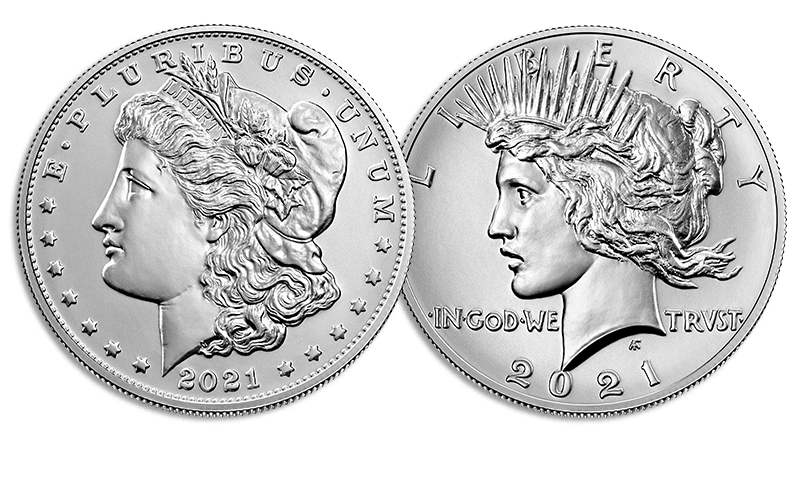
After I posted the news that the U.S. Mint will continue the Morgan and Peace dollar programs, I watched the reaction.
If I only read the reaction from social media, you would think that the U.S. Mint was proposing to devalue every collection and that they were about to do the worst thing since striking the Susan B. Anthony dollars.
According to my Inbox, 39 people were excited. Three were not in favor but less negative than those on social media. Six people said that they were indifferent to the program.
What do you think?
Should the U.S. Mint Continue to Strike Morgan and Peace Dollars
Yes, I love them. (69%, 86 Votes)
NO! (insert your reason here) (14%, 18 Votes)
Ok, but I probably won't buy them (9%, 11 Votes)
I don't know... maybe. I mean if people really want to buy them... (8%, 10 Votes)
The U.S. Mint and the Negro League Baseball Museum held an unveiling event for the 2022 NLBM Commemorative Coin Program. The ceremony was held at the museum in Kansas City, Missouri. NLBM Director Bob Kendrick hosted the event. Also attending was Sen. Roy Blunt (R-MO), President of the Kansas City Federal Reserve Esther George, and Kansas City Mayor Quentin Lucas (D).
Rep. Emmanuel Cleaver (D-MO) recorded a message for the event because he was traveling overseas. Cleaver was a council member and was an early supporter of the museum. Cleaver continued to support the museum as mayor of Kansas City and was one of the Members of Congress who ushered the bill to authorize the commemorative program to passage.
As part of the ceremony, Sen. Blunt presented a copy of the signed law to the museum. Blount and Cleaver autographed the copy.
Acting Director of the U.S. Mint Ventris Gibson recorded the design unveiling ceremony they played at the museum. Before announcing the designs, Gibson revealed that her father played for a Negro League team in Virginia from 1949 through 1960.
Later in the day, the U.S. Mint published a press release with the design information.
The U.S. Mint is currently holding a numismatic press availability via conference call. During the call, the U.S. Mint announced that they plan to continue the Morgan and Peace dollar programs in 2022 and beyond.
Although the products have not been finalized, it is possible that there may be different finishes, such as reverse proof, and additional products options including the production of the coins at other mint facilities.
Stay tuned for more from the U.S. Mint’s press availability.
I have been following politics for many years. I trace my awakening to the news and politics to the assassination of Dr. Martin Luther King, Jr. It was something in the news that we discussed in school, and I did not know or understand what my classmates were talking about. After school, I read the stories about MLK in the Daily News and Newsday that were delivered daily. When my father came home, he brought a copy of the New York Times.
I was so interested in public policy that I did a master’s in public policy late in life. Having the degree helped my career as a government contractor working with government executives and appointees. Unlike others who go into public policy, I was fascinated with policy compliance and implementation. It became helpful in trying to implement information security policies for the government.
After 40 years in computing and 25 years with the federal government, I burned out. Since then, I have followed numismatic-related policy because the U.S. Mint does not strike any legal tender coin without a law permitting them.
Since retiring in 2017, partisan politics has gone from bad to worse. Politicians and their constituents are no longer talking with each other but shouting at each other. It is no longer looking to accomplish something for the common good but who can score points.
Unfortunately, there is no such thing as the radical middle. Those of us in the center are willing to work together but are being shut out by the shouting coming from the extremes.
Numismatic-related bills are not immune to the policy divide. The bills get dumped into committees and are subject to the partisan scorecard review. These bills languish in committee until an end-of-session floor review.
Although following numismatic legislation is necessary to know what the U.S Mint strikes next, it is no longer fun. Therefore, this will be the last monthly report. In the future, I will post updates after the Government Printing Office reports them. The GPO is the official publisher of the U.S. government and they are responsible for publishing everything from congress.
For the last monthly report, Rep. Claudia Tenney (R-NY) introduced H.R. 5601, the Erie Canal Bicentennial Commemorative Coin Act. If passed, the bill will create a commemorative program to celebrate the 200th anniversary of the building of the Erie Canal.
In 2025, the bill would require the U.S. Mint to strike clad half-dollars, silver dollars, and gold $5 coins with the dual date 2017-2025. These dates would mark the 200th anniversary of the construction of the canal (1817-1825). The funds raised from the sale of these coins would be paid to the “Erie Canalway Heritage Fund, Inc., to support the historic preservation, conservation, recreation, interpretation, tourism, and community development of the Erie Canalway National Heritage Corridor and for educational and commemorative programs of the Erie Canal’s history and impact on our Nation’s history.”
Summary: This bill directs the Department of the Treasury to mint and issue 50,000 $5 gold coins, 400,000 $1 silver coins, and 750,000 half-dollar clad coins in recognition of the bicentennial of the Erie Canal. The designs of the coins shall be emblematic of the Erie Canal and its impact on the development of the United States and New York. Treasury may issue coins minted under this bill only during the one-year period beginning on January 1, 2025. All sales of coins issued under this bill shall include a surcharge, which shall be paid to the Erie Canalway Heritage Fund, Inc., to support the historic preservation, conservation, recreation, interpretation, tourism, and community development of the Erie Canalway National Heritage Corridor in New York and for educational and commemorative programs of the Erie Canal’s history and impact on our nation’s history.
Introduced in House — Oct 15, 2021
Referred to the House Committee on Financial Services. — Oct 15, 2021
It would not be the first time the Erie Canal appears on a coin. The Erie Canal was the innovation celebrated on the 2021 New York American Innovation $1 Coin.
A news item popped up that announced a dealer is selling Non-Fungible Tokens (NFT) for 13 rare ancient coins. Following the news, collectors ask if NFTs should be part of numismatics.
To answer the question, we must define the NFT. An NFT is a piece of data created using the complex math of cryptography to make it unique to tie it directly to the owner and the item. It is non-fungible because it represents a one-to-one relationship between the owner and the asset. An asset is fungible because it is interchangeable. A coin can be a fungible asset.
A token is an object that represents something else. In numismatics, a token represents money. The NFT is a piece of data that represents the owner and its tie to the asset.
Are you confused? So is most of the market that has run face-first into this new allegedly fantastical concept of owning a piece of something.
But is it an NFT or cryptocurrency numismatics?
According to Merriam-Webster, numismatics is “the study or collection of coins, tokens, and paper money and sometimes related objects (such as medals).”
First, NFTs are not numismatics. NFTs are a deed of ownership. Deeds are not numismatics.
Cryptocurrency may be considered a related object by definition, but does it represent money or currency in any form?
Cryptocurrency is an asset. The asset is assigned a value based on market forces. Are those assets numismatics? No! Cryptocurrency is an asset that does not represent anything. It is a set of bits and bytes created using complicated math.
The creators of cryptocurrency use names similar to physical assets to influence a market. For example, crypto-mining is a series of calculations to find large prime numbers. Searching for large prime numbers is something researchers have been calculating since the discovery of computers. In college, I worked on a project that calculated the largest prime number held at the time.
Today, someone decided to sell the idea of this complex math to calculate a series of prime numbers within constraints. Cryptocurrency is buying the number stored in something called a digital wallet. Owners of these numbers can trade them the same way you can trade stock or your car to a dealer.
Cryptocurrency is not legal tender. A governing authority does not authorize it. It is also not representative of anything except mathematics.
There is nothing in the definition of the trade of numbers to make it part of numismatics.
Today marks the 16th Anniversary of the Coin Collectors Blog. When I started this blog, I did not know if I had enough to write about. But numismatics has had many twists and turns over the years to keep the hobby interesting. As long as there is something to write about and you are willing to read it, I will keep going. Here’s to the last 16 years and more fun in the future. Thank you for being a loyal reader!
Collectors are reporting that they received their orders of 2021 Morgan and Peace Dollars. Deliveries have come in waves where some have received multiple packages over two weeks.
A few collectors have noticed differences in the finish between different coins. A local collector showed me the difference between a Morgan Dollar with the CC privy mark and a 2021-S coin. The coin struck in San Francisco had a cloudier look. The Philadelphia Mint struck the Morgan Dollars with the privy marks.
A Canadian friend reported receiving colored Bluenose 10-cent coins in change. There is a general consensus that Canadians love the coins. One story included a cashier who was excited to open a roll of the new coins and took joy in giving them out.
Someone I know who is a member of the U.S. military had his post changed to the Pacific. As part of his tour, he went to Australia, where he discovered the alphabet coins. The Royal Australian Mint created 26 new designs with reverses featuring something Australian for each letter of the alphabet. The program, dubbed The Great Australian Coin Hunt 2, follows the 2019 program.
He was so impressed with the coins that He mailed a set of the 2019 and 2021 coins home for his children. When I told him that the Royal Mint released a similar set in the U.K., he said he might try for a tour in the North Atlantic to pick up a set.
There are a lot of interesting world coins to explore. Collectors may want to branch outside the U.S. and start a new collection.
A family in Michigan found an old ammunition round in there house that was filled with coins and bills decades ago. MSP First District A Michigan family made a bombshell discovery this weekend when they discovered a non-live WWI-era ammunition round was filled with treasure. → Read more at nypost.com
0:00 0:03:24 A rare piece of metal money made in the 1600s in the New England area of the U.S. could be sold for $300,000. → Read more at learningenglish.voanews.com
Prisoners at historic Port Arthur were not allowed to carry money. So how did a pile of silver shillings worth about a week's salary for one of the penal colony's overseers end up buried beneath the convicts' workshop? → Read more at abc.net.au
More than 6,000 silver coins from the late Middle Ages were discovered during a renovation project on a farm in the village of Rainbach, Upper Austria. The silver coins, which were handed over to the OÖ Lande-Kultur GmbH museum in Upper Austria, also known as Linz Schlossmuseum, “were wrapped in fabric and kept in a clay lidded pot,” the museum said. → Read more at klewtv.com
The U.S. Mint took to social media to let everyone know that they struck 24 million coins since January 2020.
After COVID-19 shut down the world, the supply chain was interrupted and not moving as expected. As businesses began to open, regulators ordered the U.S. Mint to increase circulating coin production so the Federal Reserve could push coins through the economy.
In 2020, the U.S. Mint struck 14.774 billion coins, 23.7-percent more than they struck in 2019. The announcement means that in the first ten months of 2021, the U.S. Mint struck 10 billion additional coins. It appears that the U.S. Mint will match the production rate of 2020.
Although collectors have a lot to say about how they have been treated, the U.S. Mint exceeds its primary mission as the nation’s coin manufacturer.
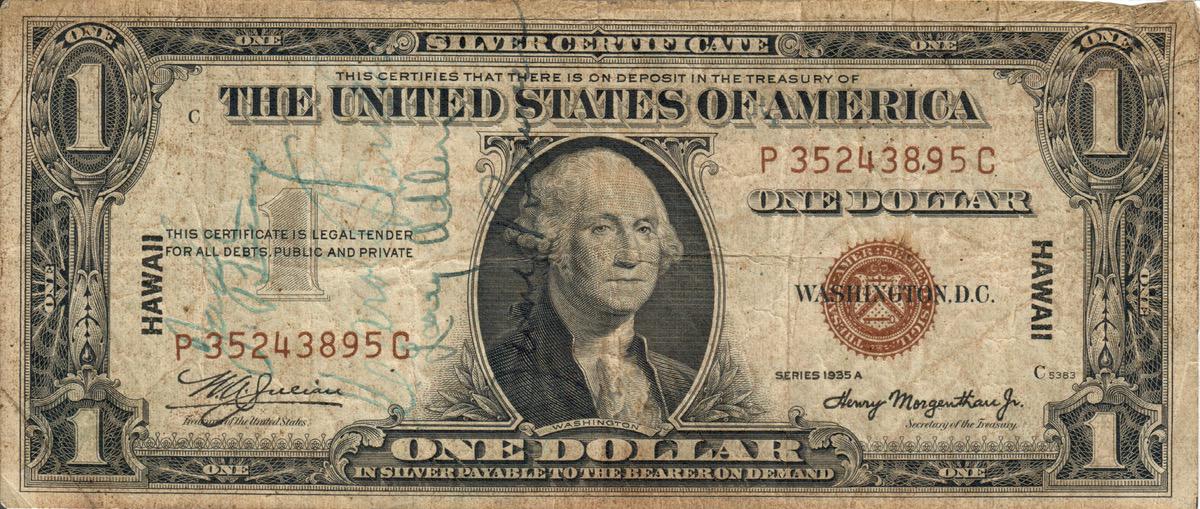
Reverse of the $1 Silver Certificate Short Snorter
Have you ever been searching for a collectible that you stumbled over something so neat that you had to buy it? In September, I was searching the Lyn Knight Currency Auction for a scarce National Bank Note issued by a bank that was once in the hamlet where I grew up when I found a short snorter on a $1 Hawaii overprint note.
A short snorter is a banknote signed by people meeting or traveling together. Although the practice is said to have started in 1925 by Alaskan bush pilots, it became popular during World War II. Soldiers would have a banknote, usually a $1 bill, and have people they meet sign the note. Some soldiers used local currencies to remember where they met the people who signed the notes.
Short snorters are interesting. There is a story behind every note. Even if you do not know who the signatures belong to, it is interesting to think about their stories. If that is not enough, to have a short snorter on a Hawaii overprint note makes it very interesting.
Following the attack on Pearl Harbor, the Treasury and the Federal Reserve issued notes with HAWAII on the front and overprinted on the back. The notes were issued so that if Japan invaded Hawaii, the government could remove their legal tender status, making them worthless.
Treasury issued the $1 silver certificate in June 1942. Later, the Federal Reserve issued $5, $10, and $20 Federal Reserve Notes. By August 1942, there were enough notes that the military ordered residents to exchange old currency for the new Hawaii overprint notes.
The U.S. government recalled Hawaii overprint notes in April 1946. Locals continued to use them for a few years since they retained their legal tender status. Some notes survived as souvenirs.
$1 Silver Certificate with the Hawaii overprint used as a short snorter.
The note I purchased from LKCA has four signatures that have faded with time. The handwriting is not legible, making it challenging to make out the names. Who were these guys?
Since the notes were first issued in 1942, withdrawn in 1946, and VJ Day is August 15, 1945, it gives us the period and location for this meeting. Unless someone can read the handwriting, that is all we know.
Was this the souvenir of a last drink by four soldiers before being discharged after the war? Maybe it was their last meeting before a battle or after surviving whatever the Japanese tried to throw at them. Or was it an acknowledgment of friendship?
The note was likely found by a relative of a deceased World War II veteran who put it back in collector circulation. Its story passed along with that veteran. On its current stop in the collecting continuum, I am honored to hold a piece of their heroic history.
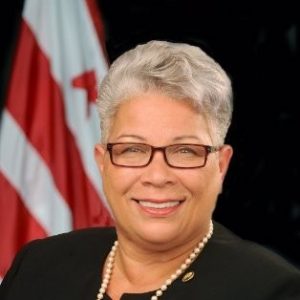
Ventris Gibson, Acting Director of the U.S. Mint (LinkedIn photograph)
Treasury announced the appointment of Ventris Gibson as Deputy Director of the U.S. Mint. Gibson will also serve as Acting Director.
Gibson, a Navy veteran, previously served as the Director of Human Resources for Washington, DC’s Department of Human Resources. Previously, Gibson was Deputy Chief Human Capital Officer at the Department of Health and Human Services (HHS) and held similar positions at the National Labor Relations Board (NLRB).
Gibson is a member of the federal government’s Senior Executive Service (SES). She is a federal employee, and the Acting Director does not require congressional approval. The law allows a person in an acting role to serve for a maximum of 180 days.
Treasury was quick to note that Gibson is the first African American person to lead the bureau. Deputy Secretary Wally Adeyemo said, “Her historic appointment reflects our ongoing commitment to building a qualified, diverse workforce at Treasury and its bureaus that will serve the American people well.”
Is Gibson really qualified for this position? The U.S. Mint is the world’s largest manufacturer of coins. The U.S. Mint reports that they have manufactured over 11.2 BILLION coins in 2021. Although Gibson has extensive government experience, she does not have any experience manufacturing or producing a product.
Gibson has extensive experience with human resources, but the U.S. Mint not only has a diverse workforce but a constituency that watches everything the bureau does. HHS and NLRB do not have a constituency like the U.S. Mint. The collecting community is very critical as to how this bureau does its job. While the law governs what the U.S. Mint can do, the areas where they have latitude, the decisions are more diverse than human resources.
Does having a human resources background make Gibson qualified in collector relations? An HR professional may be able to talk with collectors, but does she understand the market? The last two directors had numismatic experience before their appointments.
Does having a human resources background make Gibson qualified to manage an e-commerce service? The numismatic media has documented the failures of the U.S. Mint’s e-commerce system. Fixing the system requires leadership and the ability to understand what the technical people are saying. As a former government contractor, I watched as SES and appointees did not properly question rosy contractor reports only to watch as the contractors could not deliver results. The U.S. Mint’s contractor has not delivered. What assurances do we have that Gibson can understand when the contractor is lying?
There is nothing wrong with human resource professionals but are they qualified to run a government manufacturer with an opinionated customer base? I guess we shall see.
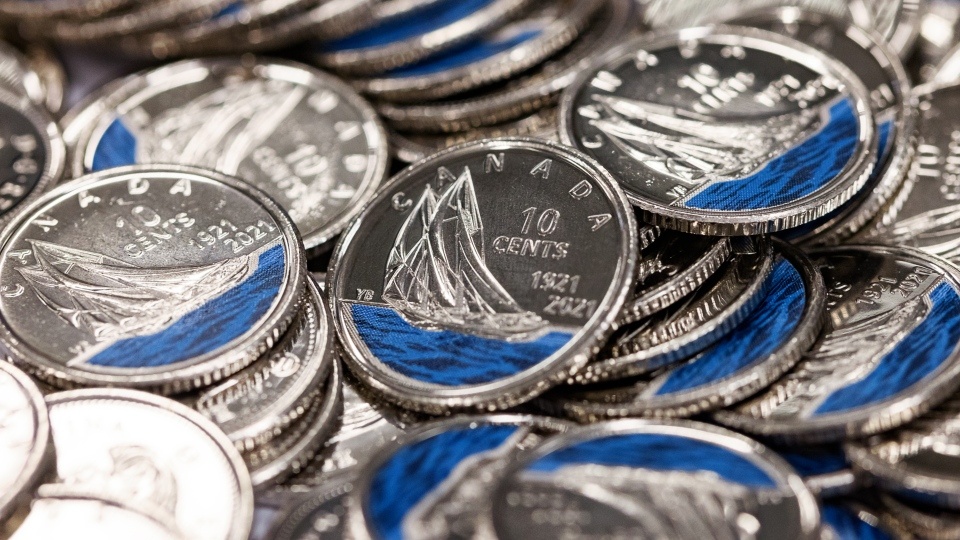
2021 Canada circulating 10-cent coin featuring a splash of color honoring the 100th Anniversary of the Bluenose (Royal Canadian Mint image)
A few weeks ago, the Royal Mint published a survey that said British collectors love the new 50 pence series featuring childhood characters. The series has been attracting new collectors of the various 50p coins. They report increased sales in the colorized coins.
This week, the Royal Canadian Mint announced that they would issue a colored 10 cent coin to celebrate the 100th anniversary of the Bluenose. The Bluenose was a famous fishing schooner launched from Nova Scotia in 1921. Canadians nicknamed the vessel The Queen of the North Atlantic. An image of the Bluenose began its depiction on the Canadian 10-cent coin in 1937.
The dual-dated coin will include a splash of blue on the design that represents the water. The Royal Mint and Bank of Canada have begun circulating the coin this week.
The new 10-cent coin is not the first circulating colorized coin. In 2004, the Royal Canadian Mint produced a 25-cent coin with a red poppy to honor Canadian veterans. In 2006, they produced a 25-cent coin with a pink ribbon in support of Breast Cancer research.
Canadians do not have the same hangups about what constitutes a coin as their U.S. neighbors. Regular contacts report that Canadians welcome the new coins excitement. Many suspect people will pick the coins out of circulation as soon as they enter, similar to the red poppy and breast cancer awareness 25-cent coins.
Imagine the reaction if the U.S. Mint produced a colorized circulating coin?
Archaeologists from the Israel Antiques Authority (IAA) have excavated a hoard of silver coins from the Hasmonaean period in Modiin-Maccabim-Reut, Israel. → Read more at heritagedaily.com
WASHINGTON – The U.S. Department of the Treasury has approved an image of former Principal Chief Wilma Mankiller with “a resolute gaze to the future” for the reverse side of a 2022 quarter as part of the U.S. → Read more at cherokeephoenix.org
A man was “completely amazed” to find one of the US’s first struck coins in a forgotten sweet tin. The Hon Wentworth Beaumont said he found the mid-17th century New England shilling in an old Barker and Dobson sweet tin at his father’s home among a collection of old coins. → Read more at standard.co.uk
The People’s Bank of China has launched a set of Panda precious metal coins, in celebration of the iconic Panda series’ fortieth anniversary on October 20. The range includes the first platinum Pandas to be released since 2005. → Read more at miningweekly.com
Conservation workers have discovered a 127-year-old farthing which had been placed under the mast of Nelson’s flagship, HMS Victory, for good luck. → Read more at uk.news.yahoo.com
By Anil Dhir Bhubaneswar: Netaji Subhas Chandra Bose had declared the formation of the “Provisional Government of Free India” at Singapore on the 21st Oct 1943. → Read more at orissadiary.com
Image Credit : Dr Marek Florek Archaeologists from the Maria Curie-Skłodowska University (UMCS) have excavated another medieval treasure hoard in Zawichost-Trójcy, Poland. → Read more at heritagedaily.com
Households were not only hoarding canned goods and toilet paper during the coronavirus pandemic, they were also stockpiling rolls of coins. Demand was so high for 20¢, 10¢ and even 5¢ pieces when COVID-19 sent the nation into lockdown that the Royal Australian Mint was forced to double shifts to produce enough change to keep up over the past financial year. → Read more at smh.com.au
OTTAWA — You could soon have a little splash of blue in your pocket, with a new dime from the Royal Canadian Mint commemorating a national icon. The Mint is launching Canada’s first-ever coloured dimes to commemorate the 100th anniversary of Bluenose, the famous fishing schooner that graces the coins. → Read more at ottawa.ctvnews.ca

 After I posted the news that the U.S. Mint will continue the Morgan and Peace dollar programs, I watched the reaction.
  Loading ...
 I have been following politics for many years. I trace my awakening to the news and politics to the assassination of Dr. Martin Luther King, Jr. It was something in the news that we discussed in school, and I did not know or understand what my classmates were talking about. After school, I read the stories about MLK in the Daily News and Newsday that were delivered daily. When my father came home, he brought a copy of the New York Times.
 A news item popped up that announced a dealer is selling Non-Fungible Tokens (NFT) for 13 rare ancient coins. Following the news, collectors ask if NFTs should be part of numismatics.
 November 4, 2021
 → Read more at
  Today marks the 16th Anniversary of the Coin Collectors Blog. When I started this blog, I did not know if I had enough to write about. But numismatics has had many twists and turns over the years to keep the hobby interesting. As long as there is something to write about and you are willing to read it, I will keep going. Here’s to the last 16 years and more fun in the future. Thank you for being a loyal reader!