Oct 20, 2021 | coins, Eagles, silver, US Mint
With everything that is going on, coin collecting is still a fun hobby, and there are a lot of coins to collect. I am proudest of my almost complete collection of proof American Silver Eagle coins.
From 1986 to 2019, my father bought two proof American Silver Eagle coins. One was for his collection, and the other was mine. When the U.S. Mint issued special sets, I would purchase one for myself and attempt to purchase one for my father. I was able to purchase the 25th Anniversary Set for myself but could never buy one for my father. On the secondary market, too many sets were broken up and graded, ruining the grandeur of the five-coin set.
I am missing the 1995-W American Silver Eagle.
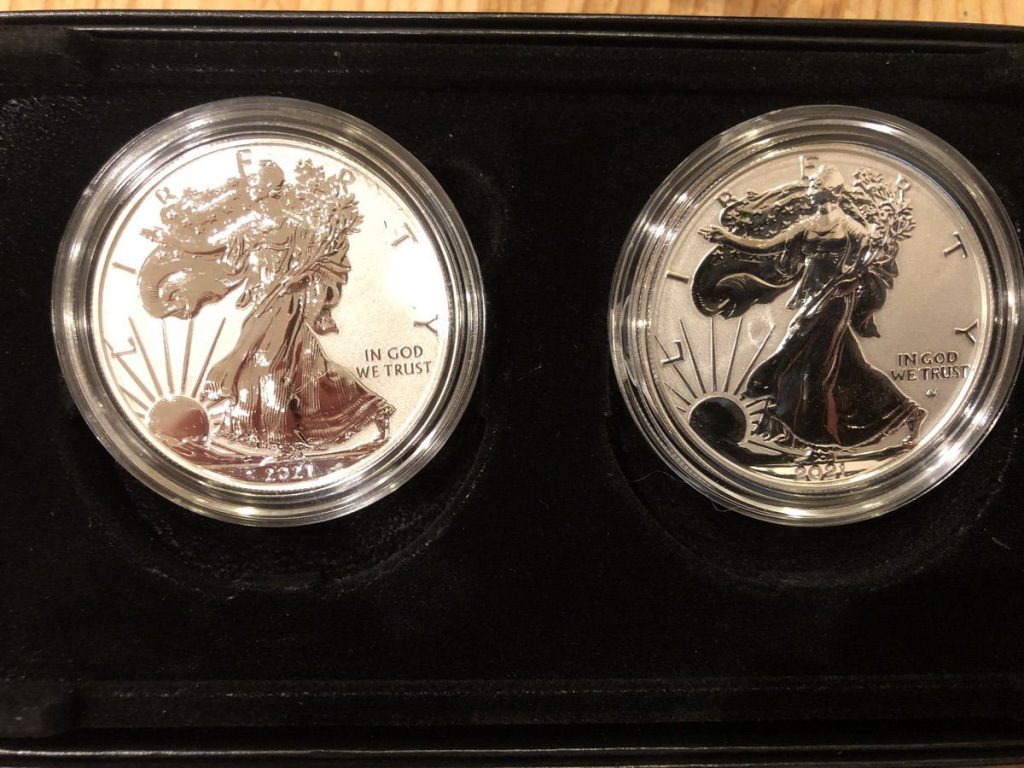
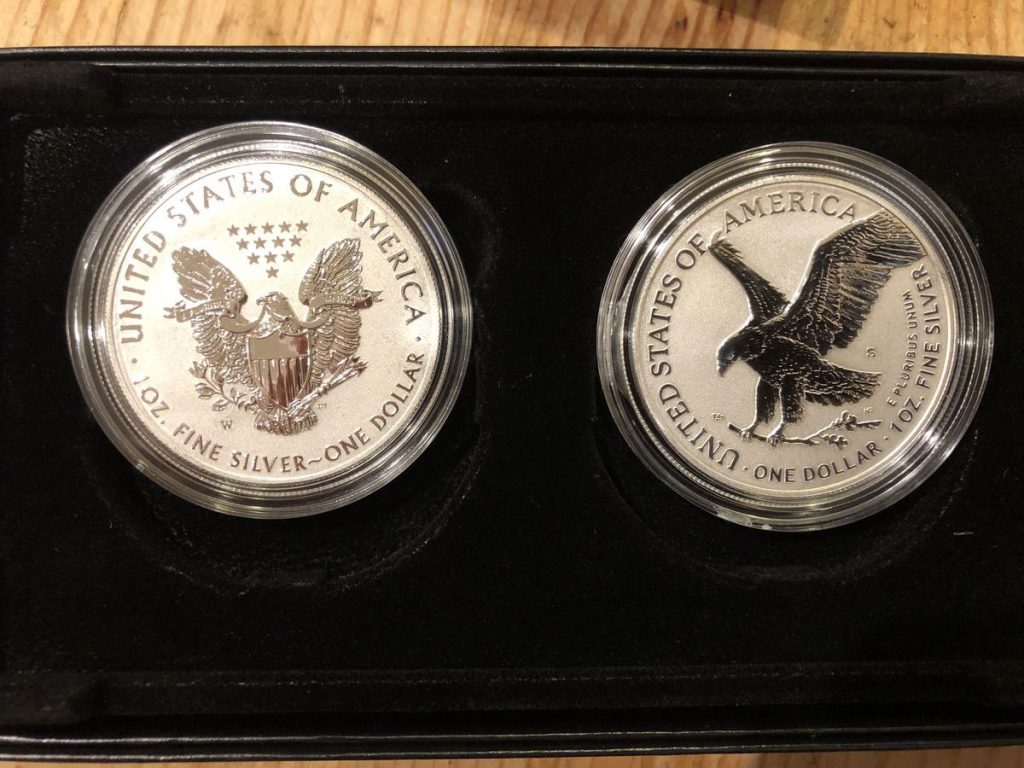
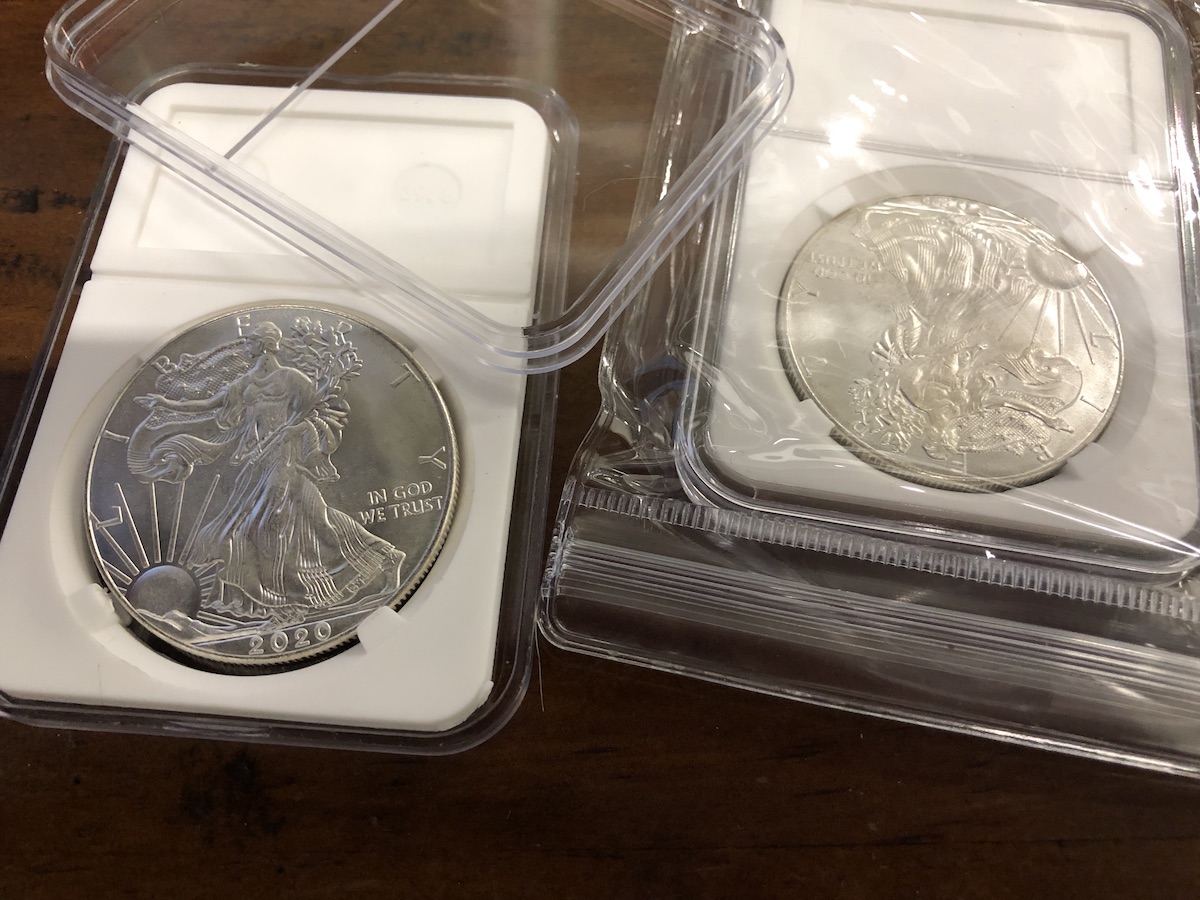
Although there have been problems with the U.S. Mint’s e-commerce site, I have been able to keep up with my American Silver Eagle collection. Recently, the U.S. Mint shipped the American Silver Eagle Reverse Proof Two-Coin Set. My set arrived before I left town for the weekend.
Like many collectors, I love the look of reverse-proof coins. The shiny devices make the design stand out. When I show the coins to non-collectors, the coins make an impression.
What does not make an impression is the package.
For a set that costs $175, the package feels cheap. The insert is cheap plastic that holds onto the coin so tight that the coin is difficult to remove. The box is thinner cardboard, and it is not in a clamshell box, like other sets. The package appears as if the U.S. Mint modified it from a copper-nickel clad proof coin.
The U.S. Mint might think that the package does not matter. There will be collectors that will take the coins out of the package and send them to a third-party grading service. This attitude does not consider those who prefer to keep the coins in the original government package (OGP).
My entire collection of American Silver Eagle proof coins is in its OGP. The 2021 set looks like an afterthought next to the 2013 West Point and 2012 San Francisco two-coin sets.
At least the coins are gorgeous!
Oct 19, 2021 | coins, news, security
 One of the reasons for the delay with the Weekly World Numismatic News is that I have been looking into a report of worldwide e-commerce issues under the radar.
After ordering a box of flips and other storage products from a small company, a representative called to say that the transaction did not go through. According to the representative, overseas attackers are trying to hack shopping cart sites to steal merchandise and credit card information. Rather than attacking the entire site, the hackers are targeting individual shops. They are looking for sites that are not configured correctly.
During the telephone call, the representative said they turned off credit card verification and the system “throws the credit card away.” I know this vendor, but I am still not comfortable.
E-commerce is supposed to make purchasing goods and services more accessible. But when hackers are driving vendors to verify credit cards by telephone, it is not making e-commerce easy. Thankfully, I received an announcement for local shows. Maybe it’s time to spend money there.
By the way, a source told me that the Baltimore Convention Centre would be open when the Whitman Expo is scheduled in November.
And now the news…

October 8, 2021
Subscribe now! EUREKA — Walker Hilbert sat on the ground one recent Saturday, next to a small mound of dirt. He waved a wand above the soil, and the device chirped encouragingly.

→ Read more at
stltoday.com
October 14, 2021
King County sheriff warns of counterfeit bills FALL CITY, Wash. — A Fall City grocery store fell victim to a man using a counterfeit $100 bill Tuesday, according to the King County Sheriff’s Office.
→ Read more at
kiro7.com
Oct 13, 2021 | coins, news, US Mint
 The weekly numismatic news report is late for the same reason the U.S. Mint cannot run an ordering system. It seems that the dangers to online systems are growing.
Every week, I am receiving reports from collectors being scammed by Chinese counterfeiters. People are providing pointers to websites and other sellers that are pushing counterfeit coins. The most common coin is the American Silver Eagle.
Last week, the parent company of HiBid, one of the largest online auction platform after eBay, was struck with a ransomeware attack. HiBid was taken down Thursday, September 30 through Monday, October 4. To add insult to injury, HiBid crashed again on Sunday, October 10 because bidders overloaded their systems.
As I am looking for new business opportunities, several eBay sellers are also looking for alternate selling venues. They are complaining about how eBay has handled the conversion to charging sales tax collection. New programs do not include the small sellers. Although eBay has always preferred high-volume sellers, now they are adding programs to benefit those that sell high-value items. And some sellers are reporting driven crazy by eBay’s new payment system.
With all this happening, then how does one buy online? I have been buying from eBay. It has been a convenient way to find interesting out-of-print numismatic books and tokens from New York. My other buying venues have been the U.S. Mint, the Royal Mint, and Apmex.
Maybe it’s time to look for other purchase venues.
October 5, 2021
Two men have denied charges relating to a Viking hoard of historically important coins and silver worth almost £1m. Roger Pilling, 73, and Craig Best, 44, appeared before Durham Crown Court to plead not guilty to all charges.
→ Read more at
news.sky.com
October 5, 2021
Over 600 coins unearthed in a field in western Zealand will initially go on display at Sorø Museum before moving to the capital It has emerged that a significant silver coin treasure from the late Viking Age has been discovered in Denmark.
→ Read more at
cphpost.dk
October 6, 2021
A pensioner's secret stash of rare coins has sold for a staggering £185,000 at auction – well over double the estimate. John Cross, 72, from Canterbury, died with few knowing of his extraordinary collection, which has been described by experts as among the most important of its kind outside any UK museum.
→ Read more at
kentonline.co.uk
Oct 6, 2021 | coins, Federal Reserve, policy, US Mint
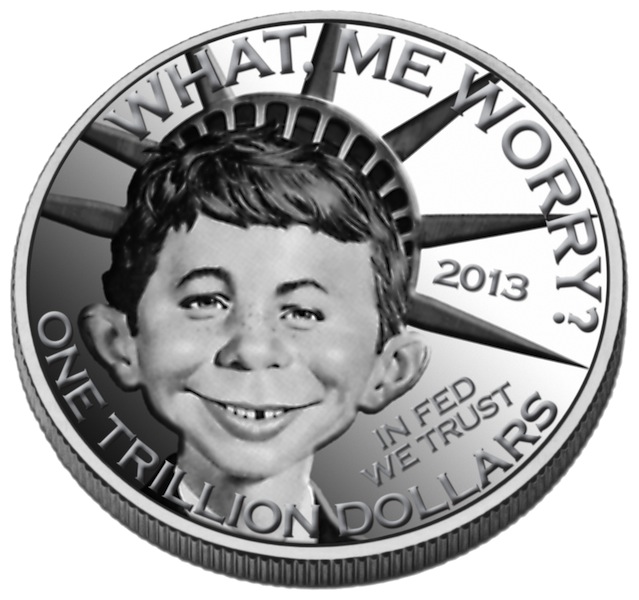
The $1 trillion coin concept turns up like a bad penny.
Also turning up are all pundits, politicos, reporters, and sycophants explaining why the U.S. Mint should or should not strike the coin. The problem is that EVERYONE IS WRONG!
Let’s look at the FACTS.
FACT: Before a coin leaves the U.S. Mint, the purchaser must pay for the coin.
The Federal Reserve purchases business strike coins at face value. The money is deposited in the U.S. Mint’s Public Enterprise Fund.
Collectors pay for collector coins through the U.S. Mint’s retail and e-commerce operations. When the money is collected, they deposit the funds in the U.S. Mint’s Public Enterprise Fund.
FACT: The United States Mint has successfully argued in court that a coin is not legal tender until it is paid for.
After the U.S. Mint discovered the existence of several 1933 Double Eagle coins that were supposedly melted, the Secret Service investigated and seized several coins. Through the 1950s, government lawyers argued that the coins were government property since the coin was never monetized.
During the case of the Farouk-Fenton double eagle coin, the government used the same argument. Even though there was an export license for the coin issued to King Farouk of Egypt, the government maintained that the lack of monetization made the coin illegal.
As part of the $7,590,020 paid for the 1933 Double Eagle in 2002, $20 of the purchase price was paid to the U.S. Government to monetize the coin. When Sotheby’s sold the coin in June for $18,872,250, the coin came with a certificate from the U.S. Mint declaring its Legal Tender status.
If the U.S. Mint does not monetize a coin until someone or entity buys it, then how will striking a $1 trillion coin help anything?
Even as crazy as government generally accepted accounting principles (GAAP) may appear to the commercial market, Government GAAP still requires double-entry bookkeeping. In double-entry bookkeeping, if an asset is added to one part of the ledger, there must be a debit on another.
Forget the political arguments about the debt. When the government needs money, it sells bonds to finance its obligation. The bond is the created asset, as the coin. The asset is purchased, adding cash to the general treasury. In bookkeeping terms, an asset entry and an associated debit entry.
Who is going to buy the coin?
The Federal Reserve is not going to buy the coin. Bonds, warrants, and other investments have tangible returns. The investments have value and can be traded on the equity markets keeping the books balanced. What happens if $1 trillion is tied up in a non-investing asset?
If the Federal Reserve buys the coin, the general treasury may see a $1 trillion windfall, but the Federal Reserve will have $1 trillion less economic power. It is $1 trillion less in short-term loans to large financial institutions and quantitative easing that is keeping the economy in control.
If the Federal Reserve buys the $1 trillion coin, it will create a $1 trillion hole in the economy.
The U.S. Gross Domestic Product (GDP), the monetary value of all goods and services, is estimated at $22.675 trillion. Taking $1 trillion out of the economy will reduce the economy by 4.4-percent.
As the Great Recession of 2008 raged, the GDP lost 1-percent of its value by 2009. If a one percent drop caused the most significant economic calamity since the Great Depression, what will happen if the GDP contracts by more than 4-percent?
Of course, Congress can pass a law that changes how the U.S. Mint determines the legal tender status of coinage they manufacture. But the likelihood of that happening is about the same as the U.S. Mint striking a $1 trillion coin.
Oct 4, 2021 | coins, commemorative, legislative
 It has been a few months since I reported on the numismatic-related bills in Congress. For the last few months, there has been little to report. Members of Congress have introduced several vanity bills, but watching their actions has been frustrating.
Regardless of the side of the aisle you follow, Congress is a very frustrating body. Members live in their own world, interested in what they can do to make them look better. When a citizen is interested in something that is not prominent in the daily news cycle, the response is cold or non-existent.
In the last few months, I tried to inquire about the scheduling of hearings in the Congressional committees regarding coin legislation. There were no answers.
For the last ten years, every Congress has promised to return to regular order. It seems that what we have now is regular order, meaning that coin-related legislation will not be heard until a holiday period or during the lame-duck session in 2022.
Welcome to the new regular order.
H.R. 4429: Semiquincentennial Commemorative Coin Act
Summary: This bill directs the Department of the Treasury to mint and issue $25.00 gold coins, $2.50 silver coins, 25 cent clad coins, and proof silver $2.50 coins in commemoration of the 250th anniversary of the establishment of the United States. The designs of the coins shall be emblematic of the semiquincentennial anniversary of the establishment of the United States of America and celebrate 250 years of our nation. On each coin there shall be
- a designation of the value of the coin;
- an inscription of the years 1776-2026; and
- inscriptions of the words Liberty, In God We Trust, United States of America, and E Pluribus Unum.
Treasury may issue coins under this bill only during the period beginning on January 1, 2026, and ending on December 31, 2026. All sales of coins issued shall include a surcharge as prescribed by this bill. All surcharges received by Treasury from the sale of such coins shall be paid to the America 250 Foundation to fund the restoration, rehabilitation, and interpretation of units of the U.S. National Park System and its related areas, as a legacy of the semiquincentennial commemoration.
Introduced in House — Jul 13, 2021
Referred to the House Committee on Financial Services. — Jul 13, 2021
S. 2384: Semiquincentennial Commemorative Coin Act
Introduced in Senate — Jul 20, 2021
Read twice and referred to the Committee on Banking, Housing, and Urban Affairs. — Jul 20, 2021
H.R. 4703: Sultana Steamboat Disaster Commemorative Coin Act of 2021
Summary: This bill directs the Department of the Treasury to mint and issue $5 gold coins, $1 silver coins, and half-dollar clad coins in recognition and remembrance of the Sultana Steamboat explosion of 1865. The designs of the coins shall be emblematic of the historical significance of the Sultana disaster, with special recognition and remembrance given to the lives lost, including the recently released Union soldiers returning home after having been prisoners of war during the American Civil War at Confederate prisons located at Andersonville and Cahaba. Treasury may issue coins minted under this bill to the public only during the one-year period beginning on January 1, 2023. All sales of such coins shall include a surcharge to be paid to the Sultana Historical Preservation Society, Inc. to establish and maintain a new Sultana disaster museum.
Introduced in House — Jul 27, 2021
Referred to the House Committee on Financial Services. — Jul 27, 2021
H.R. 5232: Working Dog Commemorative Coin Act
Introduced in House — Sep 10, 2021
Referred to the Committee on Financial Services, and in addition to the Committee on the Budget, for a period to be subsequently determined by the Speaker, in each case for consideration of such provisions as fall within the jurisdiction of the committee concerned. — Sep 10, 2021
H.R. 5472: To amend title 31, United States Code, to limit the face value of coins.
Introduced in House — Sep 30, 2021
Referred to the House Committee on Financial Services. — Sep 30, 2021
Oct 3, 2021 | coins, news
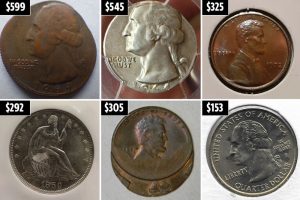
The Sun is searching eBay for interesting coins and hyping the prices as part of their U.S. Edition (Image courtesy of The U.S. Sun)
In the U.K. version of The Sun, someone watches eBay auctions and writes about whatever sells for more than face value. There are many stories about the extraordinary prices for the sale of 50 pence circulating commemoratives, error coins, and some demonetized the Royal Mint issues.
Now that The Sun is publishing for the United States market, an editor is watching eBay for the sale of U.S. coins. Although most of the stories have been about error coins, they have picked up on higher prices of classic coins. Almost all of their stories have been about what appears to be well-preserved ungraded coins. These are the type of coins that someone might find in a relative’s draw.
These columns have a lot of fans in the United Kingdom. It will be interesting to see if they catch on in the United States.
And now the news…
September 27, 2021
Freedivers in Spain notified the authorities after finding a handful of gold coins dating to the fall of the Western Roman Empire (Image credit: Xàbia City Council; University of Alicante )
→ Read more at
livescience.com
September 28, 2021
Research commissioned by the South African Reserve Bank (SARB) shows that there is an economic case for introducing a R10 coin in South Africa – however, there are concerns about uptake from the public, says Pradeep Maharaj, the central bank’s chief operating officer.
→ Read more at
businesstech.co.za
September 29, 2021
FacebookTwitterWhatsAppEmailPrintFriendly A commemorative $1 coin issued by the Royal Canadian Mint marks the 125th anniversary of the discovery of gold in the Klondike region of Yukon.
→ Read more at
rcinet.ca
October 2, 2021
The story of how a poor Irish migrant from Donegal became the face of American’s ten-dollar gold coin has been made into a documentary. Mary Cunningham, a native of Carrick, was working in a restaurant in New Hampshire when she caught the eye of the famous sculptor Augustus Saint-Gaudens.
→ Read more at
irishcentral.com
October 3, 2021
MANILA – The Bangko Sentral ng Pilipinas (BSP) on Sunday called for a law against hoarding of extremely large volume of coins after some P50 million worth of loose change were found in Quezon City last week.
→ Read more at
news.abs-cbn.com
Sep 26, 2021 | coins, news, US Mint

David J. Ryder, Director of the U.S. Mint.
Ryder served as the 34th and 39th Director after being appointed by two different administrations. Ryder came into this term touting his work with physical money security. During his confirmation hearing, Ryder said he worked for Secure Products, a company focused on developing anti-counterfeiting solutions for currency and branded products. Ryder also testified that he was involved in developing the Royal Mint’s new 12-sided one-pound coin.
The U.S. Mint claims security measures built into the new American Silver and Gold Eagle coins. However, there do not seem to be breakthroughs similar to those used by the Royal Mint and Canadian Royal Mint on their bullion products.
Ryder may want his legacy to be introducing new products, but the public will remember the colossal failure of the U.S. Mint’s e-commerce system. As Director, he was supposed to oversee the entire operation and not just one aspect. Those failures will weigh on his legacy.
Alison Doone is a career civil servant who entered the Senior Executive Service (SES) in 2004. After working at several other agencies, Doone served as the Mint’s Chief Administrative Officer since March 2021.
The Federal Vacancies Reform Act of 1998 requires the president to send a nomination to the Senate within 90 days to fill a vacant position. During that time, an acting director can serve in that role for only 180 days. As we saw in the 2,629 days (7 years, 2 months, and 13 days) between the resignation of Edmund Moy and the confirmation of David Ryder, the government has ways to get around the law to maintain operational consistency.
And now the news…
September 17, 2021
If artifacts could talk, we’d love to hear this one’s tale. This pierced German coin from the 17th century was recovered during a systematic excavation at the Jacob Jackson Home Site, part of Harriet Tubman Underground Railroad National Historical Park (HATU).
→ Read more at
nmscarcheologylab.wordpress.com
September 17, 2021
Readers of a certain age will remember the florin, or flóirín as it was in Irish. Those of an uncertain age will even recall when it was Ireland’s two-shilling coin, complete with the leaping salmon of Percy Metcalfe’s classic 1928 design.
→ Read more at
irishtimes.com
September 22, 2021
The coin, known as the Triple Unite, was minted in Oxford in 1643 during the English Civil War and had the value of 60 shillings, or three pounds.
→ Read more at
bbc.com
September 23, 2021
LAKE MARY, Fla. – A Florida teenager recently made a spectacular find while on an ocean dive: a rare gold coin believed to be from the 1715 Spanish Treasure Fleet.
→ Read more at
fox35orlando.com
September 24, 2021
(CNN) — Two amateur free divers have found one of the largest collections of Roman coins in Europe off the east coast of Spain. Luis Lens and César Gimeno were diving off the island of Portitxol in Xàbia on August 24 when they found eight coins, before further dives by archaeologists returned another 45 coins, according to a press release from the University of Alicante on Tuesday.
→ Read more at
edition.cnn.com
Sep 23, 2021 | ANA, commentary
When they persisted in questioning him, he stood up and said to them, “The one without sin among you should be the first to throw a stone at her.”
— John 8:7
During an open session of the ANA Board of Governor on January 19, 2021, a session not advertised in a prominent location, the Board voted to remove Farran Zerbe’s name from the top service award offered by the organization.
Let’s take a look at the reasons given for removing Zerbe’s name from the ANA award. According to the ANA’s press release:
A retrospective look at Zerbe’s professional dealings uncovered accusations that he made deceptively inflated claims about the future value of the Louisiana Purchase Exposition gold dollars he sold; complaints of hucksterism and fraud for his creation and sale of coin-like 1904 gold-plated exposition souvenirs;
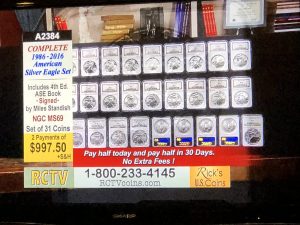
Modern hucksterism that the ANA Board does not seem to mind versus one that allegedly occurred 112 years-ago.
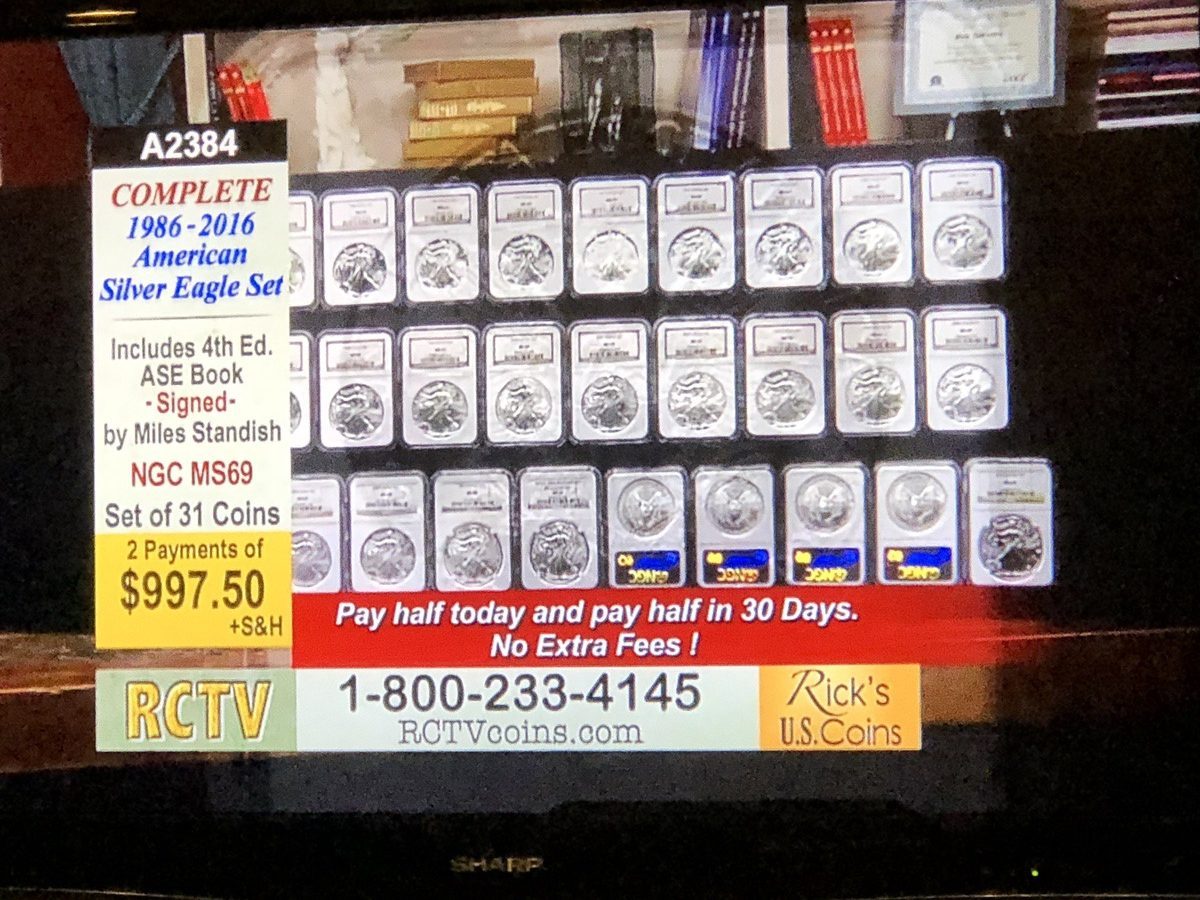
I have documented inflated prices and deceptively inflated claims by Rare Collectibles TV, DCN Coin Talk, and other scams that walked into my shop that purchased coins from these members of the ANA. the RCTV pitch included Miles Standish, and the DCN Coin Talk pitch included David Ganz. Ganz, like Zerbe, is a past ANA President.
These are not the only cases of inflated claims on coins that have appeared on television. Frequent viewers of “The Coin Collector” on HSN regularly send emails asking if they are legitimate. I purposely avoided the show because I already have heartburn issues, and it would put a severe test on my regimen of Pepcid.
What do we do with gold dealers who also make deceptively inflated claims about bull markets? Remember, some of these dealers are past Zerbe Award winners. After all, I have rarely read an analysis from them saying it was time to sell off your gold holdings.
Zerbe also served as head numismatist for the expositions in 1905 (Portland) and 1915 (San Francisco). Were there any accusations for those expos? Or was there cherry-picking of reasons to justify their actions?
What is the difference between the claim that Zerbe made inflated claims on coins versus the television hucksters? Zerbe is dead and cannot defend himself. The hucksters are living and have given money to the ANA.
[A]llegations that he unscrupulously obtained personal ownership of The Numismatist in 1908 from relatives of the ANA’s late founder, Dr. George F. Heath (then ANA Vice President W.W.C. Wilson subsequently purchased the periodical and donated it to the Association in 1910);
The first word of this is “allegations.” His actions were alleged. Can the allegations be substantiated? What evidence do they have?
Whatever evidence they have is circumstantial and hearsay. I understand that someone can make a strong case using circumstantial evidence, but when the case is being built against someone who cannot testify, there should be almost no questions.
An example of solid circumstantial evidence would be that if you go to bed, the ground is clear. When you wake up, there is snow on the ground. You did not see the snowfall, but you see the snow on the ground. The snow on the ground is circumstantial evidence that there was a snowfall overnight.
Finally:
… and claims of bribery involving the 1909 ANA election in which Zerbe’s friend John M. Henderson was named president.
CLAIMS? The ANA Board of Governors has chosen to besmirch the name of a past president, the driving force behind the creation of the Peace Dollar, and whose collection formed the basis of the Chase Money Museum on CLAIMS?
What are the claims? Who made the claims? What documentation do we have of the claims?

No ANA dealer face an ethics examination after the fiasco of the 2014 Kennedy Half Dollar 50th Anniversary Gold Coin release. (Image is a screen grab courtesy of ABC 7 News, Denver)
The problem I have with all of this is that there is NO documentation offered to the membership. The ONLY documentation provided is a 119-word paragraph, most of it reproduced here.
Another problem I have is that the ANA holds open Board sessions with little advertisement. Had I known about the session, I would have made myself available. Unfortunately, the Board is lax with their membership engagement making it seem they are a club amongst themselves.
The press release does not report the vote total for the motion. I am sure that the press release would report it was a unanimous vote if it was the case. But the tersely written press release suggests there was contention behind the decision. The ANA does not write terse press releases. Look it up!
The decision was made by a Board of Governors with a sitting member that was once asked to resign from a previous Board because “He realized he had made a mistake.” It was a mistake related to a lawsuit against the ANA by former ANA Executive Director Larry Shepherd.
What did Steve Ellsworth add to the discussion? As past president, Ellsworth is a non-voting member of the Board of Governors. However, given his previous actions that left the ANA flat-footed when the pandemic closed everything down, it would be interesting to hear his counsel on this matter.
Unless the ANA Board of Governors publishes the details of the allegations against Zerbe, including source material and where it was discovered, then the move adds the ANA to the “woke community” looking to cancel a historic member of the numismatic community.
Therefore, as a member of the ANA, I hereby move that the ANA Board of Governors reinstate the name of Farran Zerbe to the organization’s highest honor.
Sep 21, 2021 | coins, commentary, Eagles, scams, technology
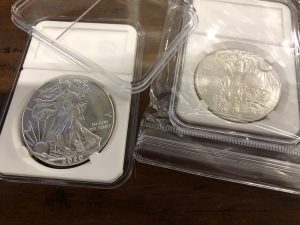
Two counterfeit American Silver Eagles purchased from LIACOO, a company based in China who advertised on Facebook.
Over the last few weeks, I have been counseling several people about requesting a chargeback for receiving counterfeit merchandise. Requesting chargebacks have their problems, too. Some credit card issuers will use the chargeback as an excuse not to renew your credit card.
During this time, another group has been trying to work with Facebook to stop the scammers from reaching consumers.
On Monday, three numismatic groups sent a letter to Facebook Founder Mark Zuckerberg asking why he did not respond to a similar letter a month ago. The letter was signed by Doug Davis, Director of the Anti-Counterfeiting Educational Foundation, Mark Salzberger, Chairman of Numismatic Guaranty Company, and Bob Brueggeman, Executive Director of the Professional Numismatists Guild. You can read the press release and letter here.
It is not surprising that Facebook and Zuckerberg have not answered previous letters. If you watch other media reports about Facebook, the company is notorious for trying to sweep issues under the proverbial rug until something brings it to the forefront. While Facebook claims they are responsive to the communities, they respond solely when someone yells and causes an uproar.
Although some find Facebook useful, it is a cesspool of scammers and trolls playing on the gullible looking to prove P.T. Barnum correct: There’s a sucker born every minute.
News organizations worldwide have reported how criminals use Facebook advertising for crimes, including selling counterfeit merchandise, false activism (e.g., Fake News), and human trafficking.
Facebook’s response has been the same. They promise to try harder and look to add code to help protect their users. The result is that they try to implement a technical solution that works to the point of being able to placated the current activists. The problem is that while Facebook depends on artificial intelligence to protect its platform, company leadership has not shown any real intelligence to understand that there may not be a technical solution to every problem.
It is easier for Facebook to scan for words that someone believes are hurtful than to look at an advertisement selling a one-ounce silver coin for less than its silver value. Besides, the alleged bully is not paying for to have their content distributed to a target audience that includes you.
Facebook really doesn’t care because they are getting paid. They were being paid as late as 2018 by a Russian troll bot for placing activist ads after being admonished for accepting campaign ads paid in Russian rubles in 2016.
Zuckerberg and company do not care. He is getting paid and so is their management. They lie just enough to get past alleged watchdogs in a way to keep confidence in their market price. After all, Facebook stock (NASDAQ: FB) is up 32.25% for the year as of Sep 20, 2021. Why should they care what you think about their advertisers? In the meantime, consumers are getting defrauded by scammers allowed to roam freely by a company that advertises on television as being a place to build a community.
Do not expect help from the government. In between their partisan fighting, members of Congress do not have the knowledge or competence to figure out how to fix the issue. Most members of Congress are lawyers with no technical background nor did any study the technical issues enough to make competent decisions.
Although Congress is to blame, the voters must accept their part of the responsibility. Instead of voting in competent people, they send these old folks with no technical background back to Washington. Many have held their seats for over 20 years without any incentive for advancement. So they grow old without learning new ways and blame everyone else for what they are not doing. Think of the problem like this: 26 of the 100 Senators are 70 years of age or older. None of these people had any experience with computers as students or early in their careers. Most can barely use a smartphone (Steve King actually asked Google CEO Sundar Pichai why his daughter’s iPhone behaved strangely). Even if they did, when was the last time you saw an elderly member of congress with a computer or even a smartphone?
Davis, Salzberg, and Brueggeman will have an uphill battle with Facebook. Everyone does. But the ACEF and PNG need to think beyond talking reason to Zuckerberg. They need to work with Congress to help them understand the technologies and what regulations will be effective without putting undue limits on the technology companies.
NOTE TO THE DAVIS, SALZBERG, AND BRUEGGEMAN:
I know of one person in the numismatic industry that has a background in technology and public policy. This person worked as a contractor to the federal government for 25 years as an information security analyst. This person worked for a PAC concerned with numismatic issues and has a Masters’ with a concentration in information security and technology public policy from Carnegie Mellon University. You can contact this person at
coinsblog.ws/contact.
Sep 20, 2021 | cash, cents, coins, news
Yes, I’m a day late. At least I’m not a dollar short!
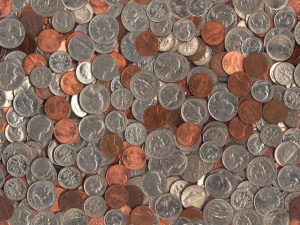 It is not a surprise to economic and market watchers that there is a perceived coin shortage. The problem is not just in the United States, but worldwide central banks are trying to fix their circulation issues.
Over the last three months, the Reserve Bank of India (RBI) has been trying different tactics to get money to circulate. In addition to striking more coins, they promote new designs and a program for citizens to redeem old coins for the newly issued coins. It has a moderating effect on the COVID crisis at high levels in the country.
India has also been dealing with rumors one type of circulating coin has been counterfeited or been withdrawn and not legal tender. However, the RBI has insisted that the coins are legal tender but continue to promote them with the redesign.
The Royal Mint has stepped up the production of 1 penny coin for circulation. Physical money is used more in the UK than electronic transactions, especially outside of the cities. Although some feel the penny has been overproduced and would rather see the 2 pence coin used, the increase in the number of transactions since the lifting of COVID restrictions created the demand.
The United States continues to see shortages. Most of the reports are coming from outside of the major metropolitan areas. Most are looking for one-cent coins. Experts are blaming accelerated consumer spending in areas where cash payments are more prevalent. More populated urban regions are seeing more electronic transactions than cash.
Let’s keep the economy moving. Spend those coins! (not the ones you collect)
And now the news…
September 14, 2021
Bankers thought the nationwide coin shortage was over, as the U.S. economy reopened and previously housebound consumers were able to unload more of their change. But a combination of factors — including government stimulus payments, accelerated consumer spending and the threat of the COVID-19 delta variant — has stymied progress and forced retailers to resort again to asking shoppers for exact change.
→ Read more at
americanbanker.com
September 14, 2021
Croatian National Bank (HNB) Governor Boris Vujčić said on Monday after meeting with European Commission Vice President Valdis Dombrovskis that a test production of euro coins with Croatian national motifs should begin by the end of this year, with possibly about two million coins being minted.
→ Read more at
croatiaweek.com
September 15, 2021
LAS CRUCES – The Las Cruces Police Department received two reports of movie prop money that was passed as legal tender over the weekend, a news release on Monday stated. In the news release police stated movie prop money can look like actual currency but, in most instances, does not have the same texture.
→ Read more at
lcsun-news.com
September 15, 2021
A very rare large gold coin from the reign of Charles I is expected to fetch £50,000 when it is sold at auction.
→ Read more at
newschainonline.com
September 15, 2021
A huge hoard of Iron Age gold artifacts has been uncovered by an amateur metal detectorist in Denmark. The "enormous" find consists of almost one kilogram (2.2 pounds) of gold buried 1,500 years ago, according to a press release from the Vejlemuseerne museum, which will exhibit the hoard.
→ Read more at
cnn.com
September 16, 2021
One penny coins were back in production last year after none were minted for general circulation in the previous two years, Royal Mint figures show.
→ Read more at
bbc.com



 Loading ...