Sep 19, 2006 | coins
I read other numismatic blogs to see if they find anything interesting. Sometimes, I will do additional research and write my own entry. But there was a posting on one blog that I could not write better. The writer of the Coin Collecting (and other Numismatic Interests) Through the Eyes of a Beginner blog wrote an interesting entry about the actual worth of the gold and silver in the tribute “coins” a private mint is advertising as struck using gold and silver recovered from the World Trade Center. In his blog entry How much is the gold or silver worth in that coin or medallion?, Arlington calculates the actual value of precious metals in those over-hyped medallions. The math is very easy to follow and concludes thatt the real value of precious metals in that medallion is 30-cents!
I have purchase silver rounds and commemoratives from other private mints. These purchases were from private mints that fairly represented their products and did not try to mislead me by using linguistic twists to make their products sound like something it is not.
Before you buy from a private mint, understand exactly what you are buying! As Arlington demonstrates in his blog entry, you should buy the steak, not the sizzle!
Sep 18, 2006 | coins, US Mint
Something that I missed last Friday was the announcement by the US Mint of their pending sale of uncirculated American Eagles as part of the Mint’2006 Holiday Catalog. These special uncirculated Eagles will be struck at the Mint facility in West Point and carry the “W” mint mark. The mint says that these coins will be struck on specially burnished planchets. Coins will be encapsulated and will include a Certificate of Authenticity.
The design of the gold and silver coins in this program will be the same as their proof and uncirculated counterparts. Platinum coins will use the same obverse as the proof and uncirculated coins with the reverse featuring the design honoring the Legislative Branch of the federal government that is used on the platinum proof coin.
The Mint is pricing their coins “at the relative mid-point between the American Eagle Proof Coins and the American Eagle Bullion Coins.” Prices will be as follows:
Platinum American Eagles
- 1 ounce $1,390
- ½ ounce $720
- ¼ ounce $390
- 1/10 ounce $180
- four coin set $2,585
Gold American Eagles
- 1 ounce $720
- ½ ounce $375
- ¼ ounce $190
- 1/10 ounce $85
- four coin set $1,350
Silver American Eagles
These coins will be on sale beginning September 28, 2006 from the Mint’s website and via their phone ordering service 1-800-USA-MINT (872-6468). As with other collectibles, the Mint will probably place order limits during the initial offering phase. The Mint has not disclosed what these limits will be.
Sep 15, 2006 | ANA, coins
In August, the American Numismatic Association (ANA) emailed their membership to obtain their opinion as whether or not to eliminate the Lincoln Cent. The ANA was prompted to take this poll came after it was reported that the mint said that it cost more to mint the coin than its face value. The following was sent to members in the monthly “ANA September Newsletter” via email.
ELIMINATE THE U.S. CENT?
1,040 E-mails!
When the ANA asked members their opinions about the possible elimination of the United States one-cent coin, that’s just how many responses were received. The emails ranged from one-word “Yes” or “No’s” to passionate, detailed responses.
Overall, the respondents were evenly split on the issue. Below are a few excerpts from member responses:
- I say keep the Penny. I think to get rid of it would precipitate creeping inflation in retail prices. – Wm Fulco
- There is simply no point in maintaining the illusion that the cent is a useful component in commerce. It is now just a historic relic of America’s past.– David Lange
- It is not possible to ever administer a sales tax without pennies…. There exists no paper or electronic substitute that will ever function in all areas especially rural except the penny. – John Parkyn
- Yes, the cent should be retired…. The United States is far behind the international trend in adjusting our currency issues to the needs of the population. – Tom Maringer
Thank you to all of those who offered responses. The ANA will continue to ask for member opinions concerning a wide array of numismatic topics.
Interestingly, the uproar is centered around the price of the metal even though the report said that the rise was because of the production costs. Although the cost of copper did rise, the cent is made of 99.2-percent zinc and coated with eight-tenths percent copper. Should the economy change, including the cost of energy, would the production costs be lower?
Sep 15, 2006 | coins, legal, US Mint
The US Mint issued a press release warning consumers that the Liberty Dollar medallions, marketed by the National Organization for the Repeal of the Federal Reserve Act and the Internal Revenue Code (NORFED) “are not genuine United States Mint bullion coins, and not legal tender.” Consumers are warned that the Justice Department has determined that the use of these “medallions as circulating money is a Federal crime.”
NORFED is marketing these medallions as “Real Money” and that the associated notes are “America’s Inflation Proof Currency™.” Their web site even has links to reproduced articles that says the government claims that it is legal. Aside from not being able to verify the source of the articles from on-line resources, both articles say that these items are NOT legal tender and are legal.
As the Mint points out, these are medallions that are made to look like genuine US coins and currency. Devices like “USA” instead of spelling out “United States of America” and “Trust In God” rather than the legally required “In God We Trust” can make this confusing to an ordinary citizen.
NORFED is yet another scheme to capitalize on the “our money is not real money” because it lacks precious metals and that the US Constitution defines money in those terms. The fallacy of the arguement is that when the constitution was written, the price of precious metals were fixed by governments and varied based on a number of other economic factors. Today, the prices fluctuate based on market conditions. Therefore, when silver jumped to $15 per ounce, the $10 silver medallion would have 33-percent less buying power than $15 United States dollars. This is the consequence of a market-based economy.
A point made on the site is that private transaction can be bartered using anything of value to both parties. While this is true, if a business wants to do any business within the United States, the Uniform Commercial Code requires all negotiable instruments (represtatives of money) to be backed by legal tender. In other words, it is not legal to write a check or other promisory note using Liberty Dollars as its backing.
NORFED is a commercial (for-profit) venture started by Bernard von NotHaus who was the superintendent of the Royal Hawaiian Mint, a private mint located in Honolulu (the mint has no connection with the Hawaiian government). NORFED makes no guarantee that their Liberty Dollars would be widely accepted or be converted into United States currency. To further the illusion of hypocracy, it is reported that von NotHaus submited the design of the Liberty Dollar to the US Mint as a design for the Golden Dollar coin. This reminds me of the Flat Earth Society an organization formed in the sixtheenth century that continues to try to convince us that the world is flat.
Sep 13, 2006 | coins, legal
Tom Noe, the indicted coin dealer who was charged with allegedly bilking the Ohio Bureau of Worker’s Compensation (BWC), was sentenced to 27 months in jail. This sentence was handed down in federal court for his guilty plea to three counts of federal campaign finance violations. Noe was charged with using friends and associates to funnel $45,400 to President Bush’s re-election campaign. Noe will have to pay $136,000 in fines in addition to his jail sentence.
Noe will remain free on bond until his trial for 46 felony counts from Ohio for allegedly stealing over $50 million from the Ohio BWC rare coin fund. His case is scheduled for trial next month.
Sep 9, 2006 | coins, grading
Lately, I have been reading and participating in the discussion forum at the NGC and Collectors’ Society website. One of the discussion talked about the “FIRST STRIKE” designation being added to the grade of slabbed bullion coins by the major grading services. Although they may have slightly different guidelines, both NGC and ANACS post their policies on the web that are very similar. Basically, to gain the FIRST STRIKE designation, the coins must be submitted in the original Mint packaging with all the official Mint documentation that shows the coins were struck in the first month of their run. This designation has nothing to do with the first coins that are struck from a die pair or coins that were struck from the first used die pairs. These are just coins struck during a particular month.
According to the Consumer and Business Awareness page from the US Mint, the Mint does not track the order which coins are minted. Coins that are produced are packaged as convenient, thus that coin that is marked as FIRST STRIKE could be the last coin struck by that die set. If the mint strikes 1,000 coins from a die pair, does that 1,000th coin deserve FIRST STRIKE designation? The Mint does not support this designation.
This situation borders on consumer fraud. Not only does the US Mint not keep records on the number of coins they strike on the first day, but the shipping records are not as detailed as to determine how many are actually shipped as FIRST STRIKE. Also, the term FIRST STRIKE is not properly defined. For example, the ANACS site says proof “coins must be submitted to ANACS within the first month of release by the Mint” and that bullion must be “sealed in the original Mint packaging and have full and proper Mint documentation inside the sealed Mint packaging proving that the coins were struck no later than January 31 of the year of issue.” The subtle difference shows an inconsistency that could be troubling to an unsuspecting market.
The capitalist in me has no problems with the grading services coming up with a new way to expand their market. However, without a consensus on what FIRST STRIKE means and without tying it to something real that proves that the coin is a FIRST STRIKE, the confusion will cause long-term damage to a hobby where some outsiders worry about being taken advantage of. This is not good for the hobby.
I am putting together a set of uncirculated American Silver Eagles that have a minimum grade of MS-69. All are NGC graded. I will not add a FIRST STRIKE coin unless the price is comparable to other coins, because the designation does not make sense when I can purchase an MS-69 that is just a beautiful but not minted in the first month.
P.S. You can also read a similar opinion on the Coin Collecting (and other Numismatic Interests) Through the Eyes of a Beginner blog. The blogger, Arlington, wrote an entry First Strikes: A Marketing Gold Mine that you may want to read.
Sep 6, 2006 | coins
On Saturday, September 5, 2006, the US Mint announced that Edmund C. Moy was sworn in as the 38th Director of the US Mint. Moy succeeds Henrietta Holsman Fore who became the Under Secretary of State for Management. David A. Lebrynk was acting director between Fore’s appointment at the State Department and the installation of Moy. Lebrynk returns to his Assistant Director role.
Moy served on the transition team for George W. Bush and has served in various offices in the Bush administration. Previously, Moy served in the Department of Health and Human Services for President George H.W. Bush.
Pursuant to the Coinage Act of 1873 (31 U.S.C. §304), the Director of the Mint is appointed for a term of five years. However, it is common in today’s political environment that many appointees resign at the end of the president’s term in office to allow the new president to appoint a new team. The last director to serve full terms under two presidents was Donna Pope, who was appointed by President Ronald Regan but served under President George H.W. Bush as well.
Good luck to Director Moy!
Sep 1, 2006 | coins
Having some time to myself over the last few days allowed me to finish reading Illegal Tender: Gold, Greed, and the Mystery of the Lost 1933 Double Eagle by David Tripp. Tripp is was a director of Sotheby’s in the department responsible for the 2002 sale of the only legal 1933 Saint Gaudens $20 Gold Double Eagle coin. His book is about the history and the over $7.5 million auction sale of this coin.
As with any thriller, the book opens with the background and history of the our protagonist, in this case, the Saint-Gaudens $20 Double Eagle. Tripp repeats the well known history of how President Theodore Roosevelt wanted to extend the gilded age and update the design of US coinage. Roosevelt thought the design of the Mint’s Chief Engraver Charles E. Barber’s were bland and not fitting of a great nation. Tripp reproduces reports of conversations and letters from Roosevelt to Barber and other US Mint officials demanding they follow the instructions of sculptor, Augustus Saint-Gaudens, as to how the coin would be minted. If you have not heard the details of this history, the first chapter is a must read.
From the history of the rise of the Saint-Gaudens $20 Double Eagle, Tripp then talks about its demise. With the country in the throes of the Great Depression and the country revolting against President Herbert Hoover at the polls, Tripp discusses the tension between Hoover and the transition team of Franklin D. Roosevelt. While the country was experience a near total economic collapse, Tripp writes how FDR did not want to do anything that would give Hoover credit for doing anything before the March, 1933 inauguration.
Hours after FDR’s inauguration, the Senate approved the appointment of William H. Woodin as the Secretary of the Treasury. Woodin worked tirelessly with the Hoover administration to try to stop the damage. Tripp paints a great word picture as to how Woodin and FDR created a policy that helped the country pull out of the depression.
One of the problem was the amount of gold leaving the United States and being used for overseas trade. More gold was leaving the Treasury than they were taking in. At Woodin’s urging, FDR signed an executive order recalling all privately held gold. As this executive order goes through many updates, Tripp brings us inside the Philadelphia Mint facilities as they continue to mint 1933 $20 Double Eagles. Tripp puts us right in the Mint and traces the path of these gold beauties.
With the order to melt these coins in 1934, the mystery begins. Tripp weaves the story in true mystery novel style following the trail of several of these coins as they leave the Mint. This includes the one coin with a legal export receipt that was shipped to King Farouk of Egypt. Tripp’ coverage of the “Palace Collections of Egypt” or King Farouk’s by the Egyptian government (website in English) is a classic twist of capitalism and greed meeting politics.
The book bogs down a bit starting in the late 1950s as the trail for all of the Double Eagles gets cold and the various law suits are settled. The story picks up again with the discovery of the Farouk coin. Tripp follows the trail from its consignment in England through the seizure in the Waldorf Astoria Hotel in New York City by the United States Secret Service. From there, the book reads like an episode of Law and Order leading up to the settlement and auction of this one-of-a-kind coin.
The only thing that makes this only a four-star (out of five) book is that Tripp’s prosaic tome makes this composition a somewhat arduous read. One may require a dictionary close at hand to fully understand the lexicon he uses. If nothing else, the book did help improve my vocabulary. Otherwise, Illegal Tender is a wonderful book to read and better than most mystery novels because it is true!
Illegal Tender won the 2005 Book of the Year award from the Numismatic Literary Guild.
Aug 31, 2006 | coins
After taking some time off for the end of the summer, I went over the US Mint’s website to see if anything interesting was released. On the front page, the Mint is advertising the American Eagle 20th Anniversary Sets. Starting at noon on August 30th, the Mint is selling three sets celebrating the 20th anniversary of the American Eagle Coin program.
The Mint is offering three sets of coins: silver, gold, and one with a single silver and gold Eagle using the same designs as previous coins. The combined set is a two coin set with a one-ounce uncirculated Silver American Eagle and a one-ounce uncirculated Gold American Eagle. Both coins are minted at the West Point facility and will include a “informative booklet outlining the history of gold and silver in coins throughout history.” The set is priced at $850.
Each of the three-coin silver set and gold set have one-ounce uncirculated and two proof coins. One of the proofs in these sets will feature a new reverse proof Eagle coin minted at the Philadelphia Mint. The uncirculated and regular proof coins are minted at West Point. The silver set is priced at $100 and the gold set is $2,610.
The reverse proof is intriguing. Although not a new concept as Australia, Canada, and Great Britain produce reverse proof bullion coins, I believe these Eagles will be the first reverse proof for the US Mint. These reverse proof coins will only be offered as part of the 20th anniversary set.
The Mint is limiting pre-sale orders to 10 sets each. I have already ordered mine!
Aug 16, 2006 | coins, US Mint
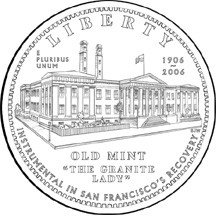
Today I received a notice from the US Mint announcing that the they are taking orders for the San Francisco Old Mint Commemorative Coins. According to the email, “The San Francisco Old Mint Commemorative Coin Program features a silver dollar, with a limited mintage of 500,000 coins, and a $5 gold coin, limited to 100,000 coins. Each coin is available with a proof or an uncirculated finish.” The Granite Lady is noted for surviving the Great Earthquake of 1906.

 The gold commemorative will be made from 90-percent gold and will be 21.6 mm in diameter and has a nominal value of $5. Its obverse design is based on the 1869 construction drawing by Alfred B. Mullett and the reverse design uses the reverse of the 1906 Liberty Half-Eagle eagle reverse, designed by Christian Gobrecht. The pre-issue price is set at $230 for the proof coin and $220 for the uncirculated version. Both prices will be increased by $25 October 17. Public Law 109-230 (GPO: text or pdf) requires that $35 per coin is donated to the San Francisco Museum and Historical Society to rehabilitate “the Historic Old Mint in San Francisco as a city museum and an American Coin and Gold Rush Museum.”

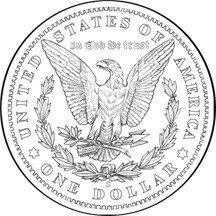
 The silver commemorative will be minted in a 90-percent silver and 10-percent copper alloy and will be 1.5 inches (38mm) in diameter. The obverse design is based on the San Francisco Mint Medal by Sherl J. Winter. The reverse will use the reverse design of the 1904 Morgan Dollar design by George T. Morgan (remember, the Morgan Dollar was not minted during the period 1905-1920). The pre-issue price is set at $35 for the proof coin and $33 for the uncirculated. After October 17, the proof coin will cost $39 and the uncirculated will cost $35. By law, $10 from the sale of each coin will be donated to the San Francisco Museum and Historical Society.
When visiting the Mint’s online catalog, there is an entry for the 2006 United States Mint American Legacy Collection. The set will contain proof version of the 2006 circulating coins and proof version of both the Benjamin Franklin Founding Father Silver Dollar and the San Francisco Old Mint Silver Dollar. This set will be presented in “unique prestigious packaging.” Price is advertised at $135 and will be available for shipping in December.
According to the Mint’s Product Schedule page, the next special set will be the American Eagle 20th Anniversary Coin Set. There is no further description as to what will be in that set. Maybe, there will be an announcement this week at the American Numismatic Association’s World’s Fair of Money® in Denver. Stay tuned!
Coin line art images from the US Mint Image Library




 Loading ...