Jan 13, 2006 | coins, US Mint
After a few days of doing real work, I want to get back in to some numismatics. While sitting in my office waiting for a Friday afternoon meeting to start, I surfed over to the US Mint’s online catalog to see what is now available. I noticed that since January 5, the Mint has been selling the 50 State Quarters clad proof set. For $15.95, collectors can purchase the packaged clad proof quarters for this year (Nevada, Nebraska, Colorado, North Dakota, and South Dakota). As a fan of the 50 State Quarters program, this is a nice set to have.
Yesterday, the Mint started pre-selling rolls and bags of uncirculated coins for the Return to Monticello design from the Westward Journey Nickel Series for shipping on January 28. This is the last coin of the series which features a full-face portrait of Thomas Jefferson, the 3rd President of the United States. It’s an interesting concept, but I still like the Joe Fitzgerald designed portrait uses on the 2005 nickels. That portrait really ads a sense of character to Jefferson.
Next Tuesday, January 17 is the 300th Anniversary of Benjamin Franklin‘s birth and when the Mint will release the Benjamin Franklin commemorative coins. Under the Benjamin Franklin Commemorative Coin Program, there will be two $1 commemorative in uncirculated and proofs. One will represent the younger Franklin scientist. The other, the elder statesman. This is a nice set for commemorative collectors.
Jan 7, 2006 | coins
One of the things I like to do while writng these entries is to link to provide the readers with links to other information. I know these links are valuable becausae they are right out of my bookmarks file and where I go when I want to read more about a topic. So rather than make everyone hunt down every posting for information, I combined the links into a single area for reference.
If you look on the left column of this screen, you will find a line that says Numismatic Links. If you click on that hyperlink, it will take you to a virtual notebook that I am keeping of the linked items. The notebook is converted to HTML for viewing in your browser. The notebook is divided into catagories, and each page represents a subject within that catagory. So if I mention information found on the US Mint’s website, you can look in the notebook under the “Numismatic Information” section on the page for “US Mint Resources.”
A unique feature of this notebook is that I annotate every entry with a link to the blog entry (or entries) where it was mentioned below the entry and right justified. So if you are interested where I discussed the 2006 Benjamin Franklin Commemorative Coin Program, the entry says that it was mentioned in the entry titled Happy 2006! Just click the direct link and read all about it.
It is important to note that it may take up to 24-hours to update the Links Notebook following a posting because it is a manual process.
Let me know what your think or if you find dead or otherwise invalid Links. Happy Collecting!
Jan 2, 2006 | coins
Coin Lobby is a blog advocating returning the image of Liberty to US coinage. The blogger, identified as Hayden Rose of Matthews, NC in Numismatic News (edition dated 1/3/06), provides a generic letter for the reader to send to their member of congress and provides links to help you find your representative.
With all due respect to Mr. Rose, I disagree. With regard to his proposal, I wrote the following on his blog:
Prior to President Theodore Roosevelt becoming fed up with the blandness of US Coinage, coin images were dominated with images of Liberty. Liberty was standing or sitting; we saw a full bust or with a “silly head;” she wore headdresses and laurel leaves. At one time, the same image of Liberty dominated silver coinage complements of a stubborn mint engraver.
But T.R. change this. Athough he inspired the striking images of August Saint-Gaudens, Roosevelt was instrumental in honoring Abraham Lincoln on US Coinage. And without T.R. would we have James Earle Fraser’s Indian Head or Buffalo Nickel? Roosevelt ushered in a change for US coinage that has been good for everyone, even numismatics.
But for some, this is not good. Even though the 50 State Quarters and the Westward Journey Nickels have inspired new artists and collectors, Some want to return to the past. I am not one of those people!
The 50 State Quarter program ends in 2008 (unless there is an extension for the District of Columbia and other territories) and the Westward Journey Series will end in 2006 with the issue of the long-term design for the nickel. Both have been popular programs, including the big sales of the 2005 Bison Nickel design. It is a great time to be a collector!
I am looking forward to see how the quarter will be redesigned in 2009 or 2010. I am also excited about the presidential dollars and the bicentenital of Lincoln’s birth circulating commemoratives in 2009. That will be interesting!
Over all, I am more positive about the future of numismatics with these new coins and, quite frankly, see the full-time return of using the image of Liberty on US coinage to be regressive and not progressive.
Jan 1, 2006 | coins
Happy New Year!
May you be healthy, happy, and find that elusive Key Date coin for your collection
As we start the new year, we can begin to look forward to what will be available to us from the US Mint. I was looking at the 2006 Scheduled Products Listing on the Mint’s website and noticed that they are releasing more items earlier. For example, the 50 State Quarters Proof Set is going to released on January 5 and the Return to Monticello nickel from the Westward Journey Nickel Series will be available in bags and rolls on January 12. Although this can change for a number of reasons, including production issues, this is earlier than in the past.
Dealers who sell the uncirculated American Silver Eagle coins are advertising that they will be able to ship first-strike coins by mid-January. Proof silver and gold American Eagles will be available from the Mint on February 2.
For those collecting commemoratives, the Benjamin Franklin Commemorative Coin and the Coin & Chronicals Set will come out on January 17, the tercentennial of Franklin’s birth. According to the Mint’s website, this is going to be the only commemorative for 2006. Commemorative collectors can use this draught to fill holes in their collections.
Otherwise, 2006 may not be that exciting of a year for the Mint. The only other listings are for the Nevada, Nebraska, Colorado, North Dakota, and South Dakota quarters. While the quarters a fun, the last two years with the Westward Journey Nickels were even better. Hopefully, the Mint will keep its website working and fix its shipping issues.
Dec 26, 2005 | coins
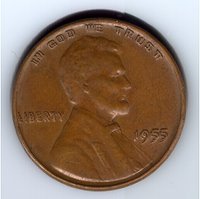 Since this is my blog, I get to take the chance to show off. Today, I am showing off the gift I received from my fiancée. After going through a box of paired dice showing all fives, dice-theme packing, dice envelopes with two chocolate Chanukah Gelt, and two dice candles with the fives showing on the top, I came on the final envelope at the bottom of the box. In the envelop was a Capital Plastics holder with a coin. That coin is known as the “King of Kings” of errors and the most famous die variety in the world: The 1955 Double-Die Obverse (1955-1DO-001).
My fiancée, a wonderful woman whose previous gifts were a 1909-S VDB and 1928 Peace Dollar, said that this was not an easy coin to find. She spoke with several local dealers for weeks and was able to find one in the past week. To her credit, she did some research to not only find area dealers but what to look for. She may not be a numismatist, but she does take an interest in what I find.
Click on the image to see a large image of the coin. The doubling is very distinctive and really neat to see. Thank you, dear, for another wonderful gift!
Dec 25, 2005 | coins, legislative
Happy Holidays!
Whatever holiday you celebrate, I wish you good cheer, good health, peace, and hope you find a key coin in your pocket change!
Over my last few entries, I have been covering the various components of the Presidential $1 Coin Act of 2005 that President George W. Bush signed last Thursday. Title I creates the Presidential $1 circulating commemorative coin that will honor each past, deceased president, four per year, until all have been honored. As part of Title I, there will be a corresponding First Spouse gold bullion coin and a bronze counterpart. Title II creates a $50 gold bullion coin using the original (Type 1) design of the Buffalo Nickel created by James Earle Fraser. Today’s entry will discuss Title III, Abraham Lincoln Bicentennial 1-Cent Coin Redesign.
In commemoration of the 200th Anniversary of the birth of Abraham Lincoln, the United State’s 16th President, congress authorizes the minting of 1-cent coins during the year 2009, where the obverse uses the likeness of Lincoln as designed by Victor David Brenner in 1909 and the reverse to have four different designs to represent different aspects of Lincoln’s life. With 2008 being the end of the 50-State Quarter Program (unless extended for the District of Columbia and territories), the 2009 Lincoln Cent can help perpetuate the interest in collecting creating a new, one-year collectibles.
During the last 20 years, the Mint has lowered the relief of the coins in an attempt to make the dies last longer and save money. As a result, there have been design decisions that many feel has detracted from the beauty of the coins. For example, the likeness of George Washington on our current quarters seems to have “spaghetti hair” in an attempt to make up for the lower relief. To answer the critics, this law requires “that the original Victor David Brenner design for the 1-cent coin was a dramatic departure from previous American coinage that should be reproduced, using the original form and relief of the likeness of Abraham Lincoln, on the 1-cent coins issued in 2009.” (emphasis added) A much needed change to preserve the beauty of Brenner’s original design.
An interesting provision of the law requires the Mint to issue the coins using the same metallic content as when the first Lincoln Cent was issued in 1909. The 1909 Lincoln Cents weighed 3.11 grams and was 95-percent copper and 5-percent zinc and tin. Since 1982, the coins were changed to a copper-plated zinc coin of 99.2-percent zinc and 0.8-percent copper plating. These coins weigh 2.5 grams. Using more copper and the higher relief may make the coins more expensive to manufacture than the 1-cent face value. The Mint will probably make up the loss in seigniorage with the collectibles it will generate during the year.
I am looking forward to the new collectibles and hope that they are as beautiful as the Westward Journey Nickels were in 2005!
Dec 23, 2005 | coins, legislative
The White House issued a press release announcing that President George W. Bush signed the Presidential $1 Coin Act of 2005. This act will create a new series of numismatic collectibles and hopefully revive the circulating dollar coin. In my previous entry, I wrote about the Presidential $1 circulating commemorative coin and the corresponding First Spouse gold bullion coin. Today, I will write about Title II that authorizes the minting of a $50 bullion coin of 99.99 percent pure gold bought from at fair market value from US sources using the original design of the Buffalo Nickel by James Earle Fraser.
Fraser’s design has been a favorite of many. It is the only design that represents unique aspects of American history or culture. Unlike other circulating coins where the image was of Liberty wearing a headdress, Fraser created his design using real Native Americans as models. The reverse image is that of “Black Diamond” who was a popular resident of the Bronx Zoo. Fraser’s original design, known to collectors at the 1913 Type 1 variety, has the buffalo standing on a grassy mound. The Type 2 variety changed the design to a straight line because of wearing problems.
This law mandates the use of the Type 1 design. The law requires that the nominal value and the weight of the coin incused on the reverse. By making this area incused, the Mint will avoid any wearing issues that caused the original changes to Fraser’s design. While that may not be a problem with a bullion issue, is may allow the coin to better fit a proof set capsule.
But temper your excitement. The law allows the Commission of Fine Arts and the Citizens Coinage Advisory Committee to change the design after the first year. Considering the popularity of the 2001 Buffalo Coin Commemorative, this design has the potential to make this a popular coin for those in the gold bullion market making it unlikely that the design will change. Unfortunately, given the rising price of gold and that the current $20 one-ounce bullion proof coin sells for over $700, a speculative price of this coin may make it too expensive for most collectors.
Dec 22, 2005 | coins, legislative
On December 13, 2005, the Senate passed S.1047, the Presidential $1 Coin Act of 2005, and on December 15th, sent it to the White House for President George W. Bush‘s signature. The main component of the bill is to create a $1 coin to commemorate the Nation’s past Presidents and an accompanying $10 gold coin to commemorate the President’s spouse (First Lady). Title II creates the minting of a $50 gold bullion coin using the original design of the Buffalo Nickel by James Earle Fraser. Finally, Title III is the Abraham Lincoln Bicentennial 1-Cent Coin Redesign that calls for four different design representing different aspects of Lincoln’s life honoring Lincoln’s 200th birthday. President Bush has not signed the bill as I write this entry.
Since each section is interesting in its own right, I will cover one at a time.
Starting in January 2007, the Mint will issue circulating $1 coins commemorating each past President. The obverse must include the President’s name and likeness, dates or years of the term, and the number order which the president served. The reverse will have “a likeness of the Statue of Liberty extending to the rim of the coin and large enough to provide a dramatic representation of Liberty while not being large enough to create the impression of a ‘2-headed’ coin” and include the denomination and “United States of America.”
Interestingly, the bill says that the word Liberty does not have to appear on the coin since the appearance of the Statue of Liberty satisfies established law. Also, to provide more room for artistic impression, the mottos “E Pluribus Unum” and “In God We Trust” will be incuse on the edge of the coin. The edge lettering requirements is an interesting twist on US coinage and should make for an interesting coin.
There will be only one coin design per president and one coin for all terms and one coin issued for each non-consecutive terms. So Franklin D. Roosevelt will have only one coin in the program and Grover Cleveland will have two coins, each with different inscriptions of his terms (1885-1889 and 1893-1987). No living current and former president can appear in this program and two years have to pass after a president dies to be eligible. Currently, all presidents since Gerald Ford are ineligible, although President Ronald Reagan will be eligible by the time it is his turn. And as we have seen with recent circulating commemoratives, only four coins will be issued each year until all presidents have been honored.
Along with the presidential coin, a First Spouse $10 Bullion Coin will be issued on the same schedule as the Presidential coin. The First Spouse coin will be the same diameter of the $1 coin and contain one-half ounce of 99.99 percent pure gold purchased at fair market value from US sources. The obverse will have the name and likeness of the President’s spouse and with the year and order of term, just like the President’s coin. On the reverse will be “images emblematic of the life and work of the first spouse” and the inscription United States of America.
In the case of no first spouse, the image will be emblematic of the concept of Liberty. The reverse will represent themes of the corresponding president. The exception will be for President Chester A. Arthur, the 21st President who was widowed when he took office in 1881. The first spouse coin will honor Alice Paul, suffragist, who was born during Arthur’s term. The reverse will represent the suffrage movement.
As someone who believes that a $1 coin should replace paper currency, having a circulating commemorative is wonderful. The only downside to this bill is that the Sacagawea Dollar will continue to be minted and must make up one-third of the circulating issues. This will dilute the population and impact of the circulating commemoratives and probably lessen its impact.
My next entry will look at the $50 Buffalo gold bullion coin.
Dec 15, 2005 | coins
As I attend coin shows I begin to notice how there seems to be a theme that appears across the many vendors. This is where a few coin types just seems more prevalent than others. This past Baltimore show was no different. As I walked through the aisles on Friday, I noticed the recent mainstay 50 State Quarters,™ the increase in competition amongst the grading services along the back wall, certified gold coins, and Morgan dollars.
It is difficult to argue against the display of the 50 State Quarters. The program is credited with raising the profile of numismatics and have made collectors out of many people. The program has sparked an interest in coins in many different areas including with the kids, who are the hobby’s future. It has also raised the profile of the numismatic industry for those who see this as a hobby and those who just invest. The investors are accused of driving up prices. Only time will tell if this is good for the hobby.
At my first Baltimore show, only PCGS and NGC were present. This past show also included ANACS, ICG, PCI, and PMG. There was so much competition that one of the services announced “show specials” while I was walking around the floor. I always believe competition is good and hope that these grading services keep up the good work as they compete for our business.
Nowadays, it is rare to walk up to a table and find a raw gold coin. The only raw gold coins I see are sealed in Mint packaging or uncirculated American Eagle bullion coins. What I saw at the show appears to be similar to what I read in the trade press. There is a demand for Saint-Gaudens double eagles and Indian head eagles, Indian double eagles, the Bela Lyon Pratt Indian Head half-eagle, and the “odd denomination” $3 gold coin and I saw a few $4 Stellas. I was impressed with the crowds looking and what I saw was buying these coins.
For other circulation coins, I saw a lot of Morgan Dollars. While Morgan Dollars have always been very popular, there seemed to be an overwhelming appearance of top and mid-grade Morgans. I was able to pick up a number of good pieces at good prices to add to my collection. A few friends also noticed the availability of quality Morgans at this show.
As I patrolled the floor, I was looking for some key coins without much success. While I cannot afford high grades, I would be happy to find some nice mid-grade key coins with some nice eye appeal. For example, I am looking for all three 1921 Walking Liberty Half Dollars but found either high grades that were beyond my budget or low grade coins that were affordable but did not appeal to me. I know there is a compromise that has to be made for low grade coins, but much of what I saw did not even make my compromise grade.
Is the market for key coins going to shut out those of us who have to stick to a budget? Although many dealers will work with you at their tables, from what I saw at the Baltimore show, it may start happening.
The Baltimore Show is fun. Aside from being Baltimore, the dealers I meet at the show are good folk and nice to meet. Although I have my favorites, I like to buy and trade with many different dealers just to meet them, talk with them about the market from their perspective, and just see the variety. I highly recommend anyone attending any one of the big shows to meet the people who go. I also recommend you come to Baltimore and enjoy your experience in Charm City.
Dec 14, 2005 | coins
I know I need to write a report on my trip to Baltimore, but something happened this evening that I want to share. I am a member of the Montgomery County Coin Club (MCCC). The club holds its monthly meetings on the second Tuesday of each month. For this meeting, Joe Fitzgerald was our speaker. Mr. Fitzgerald is the artist and a member of the US Mint‘s Artistic Infusion Program. He is the designer of the 2005 obverse portrait on the Westward Journey Nickel and the reverse of the 2005 “Ocean in view!” reverse.
Mr. Fitzgerald’s spoke about how he applied for the Artistic Infusion Program and the process that he experienced in creating the new designs. His talk included slides that showed the different designs he submitted and how the design evolved from concept to the final coin. He also explained his thoughts in the design. What I found interesting was that while designing the obverse of the nickel, Mr. Fitzgerald explained that the design was something that he wanted to try but did not think it would be accepted. He said that as part of the design, he wanted to position the word “Liberty” in a way where it looks like Jefferson was speaking. Mr. Fitzgerald also wanted to have Liberty in Jefferson’s handwriting in order to give it life in Jefferson’s character, giving it more meaning.
It has always been my opinion that this portrait of Jefferson has had the most character of any presidential portrait that has appeared on any coin. It was a bold move to suggest this design and it was executed with such care that it visually gives Jefferson character and strength to heighten its stature. I wish this design would have been made the permanent design. Unfortunately, the Mint has other ideas.
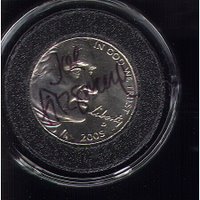 Following the meeting I was able to speak with Mr. Fitzgerald. He is a delightful person and all of the accolades he has received are well deserved. When we finished talking, He pulled an “Ocean in View!” nickel from his pocket and autographed it in front of me. I was so impressed I put it in my wallet between two credit cards to ensure that his autograph would not rub off. At home, I carefully removed the coin and placed it in an AirTite holder. I scanned and offer the image here for anyone to see. Sorry, this coin is not for sale. It will be in my collection until it is time for be to pass it on to my heirs!
Thank you, Mr. Fitzgerald for a delightful talk and a wonderful memento of this evening.



 Loading ...