Apr 8, 2006 | BEP, coins, currency
Money has always been a fascination because of their design and the history they reveal. It is interesting to look at a series of the same denomination and learn the history behind the designs. I had the chance to do that when my bank’s ATM gave me three generations of $20 Federal Reserve Notes (FRN). Although I am not a bank note collector, I find their images and devices interesting.
 First, I found is the Series 1990 note with the signature of Treasury Secretary Nicholas F. Brady and Catalina Vasquez Villalpando, the Treasurer of the United States. Both Brady and Villalpando were appointed by President George H. W. Bush and served until the end of his term. Brady also served for six months under President Ronald W. Reagan.
The second is a Series 2001 note with the signatures of Treasury Secretary Paul M. O’Neill and Treasurer Rosario Marin. They were appointed by President George W. Bush during his first term. The third note is from Series 2004 with Marin’s signature along with Treasury Secretary John W. Snow, who succeeded O’Neill.
 My first impression was the differences in design. The $20 FRN was first designed in the 1920s and was an evolution of earlier designs. It has ornate and fine engraving with a green hue. The fine engraving has been a staple of bank notes since their inception as a means to prevent counterfeiting. The “green back” was used to prevent copying using new photographic technologies which had a difficult time reproducing the green color. Today, the green color remains out of tradition considering modern imaging capabilities.
The newer notes do not have a lot of fine engraving. The same portrait of President Andrew Jackson is used but was enlarged on the newer notes with the border around the portrait removed on the Series 2004 notes. Another difference is the addition of color with a darker green hue and peach on the front adds a new dimension I am not sure I like.
Although an engraving of the White House remain on the reverse, the older note uses an image taking from the south lawn from the ellipse. The new notes show the White House from the north lawn that could be seen from Pennsylvania Avenue more centered rather than filling the entire reverse. As part of the Bureau Engraving and Printing’s (BEP) program to include better security features, they have left the sides blank so the watermark image and security thread can be easily seen.
I like the front of the latest note, but I don’t like the color. I also miss the indication of the Federal Reserve System Bank for which the notes were printed. It is like the mint mark for the FRN. I always found it interesting finding notes from different areas. I like the south lawn portrait better than the one from the north lawn. I am disappointed with the starkness of the reverse. I am not sure that BEP can change this given the nature of the security features.
Finally, the attempt to colorize the notes is not working. It looks cheesy. If BEP colorizes the note, it should be more than just a gradient on the background. Many countries use color in their bank notes as part of the devices, not just to splash some color around to say “look at the color.” I think BEP can do better.
Apr 7, 2006 | coins
After a few days of nice finds, real life set in leaving me very busy with my day job and trying to complete my taxes. Tax season is not one of my favorite times and I am sure it does not rank high on your list.
Since the postings of my finds, I withdrew money from my bank’s ATM and found the last three types of $20 Federal Reserve notes. I will write more about this over the weekend, but seeing the transition of the design is very interesting.
Other future entries will include a word or two about two new purchases: silver Chinese Pandas and the Breast Cancer 25-cent circulating commemorative from the Royal Canadian Mint. The Pandas are very interesting and worthy of a look. As for the Breast Cancer Commemorative, I am an advocate for any program that raises money and awareness for cancer research. Stay tuned!
Mar 29, 2006 | coins, foreign, pocket change
While searching through my change to feed the soft drink machine, I was picking through my quarters and found something that looked quite a bit different. The obverse had the image of Her Majesty Queen Elizabeth II. Thinking that it was a Canadian coin, I returned it to my pocket and selected a quarter to quench my thirst.
When I returned to my desk I decided to examine the coin further to find only the words “Ten Pence&rdquo” on the reverse. Since it did not have Canada or the name of any other Commonwealth Realm, it had to be British coinage. A quick search revealed that it is a 1992 10 Pence coin. The 1992 10p coin is a resized, smaller version of the decimalization coins.
Aside from being the second interesting find in as many days, someone still owes me 7½ cents since the coin is worth 17½ cents at the current exchange rates!
Mar 28, 2006 | coins
I was standing at the cash register at a local convienence store to purchase a diet soft drink sifting through change to pay my tab. As I picked quarters and nickels to give to the cashier, I saw a nickel that looked different. I pushed it aside to provide payment for my libation.
Outside of the establishment, I reached back into my pocket and removed the coins to find a 1927 Buffalo Nickel! The rim and high-points are flat, the buffalo’s horn cannot be seen, but the date is visible. Even though the 1927 coin is a common date and the find is in good (G-4) condition, it was nice to find. Regardless of the condition, the James Earle Frasier-designed coin remains one of my favorites.
Mar 26, 2006 | ANA, coins
The following is an open letter to the American Numismatic Association Board of Governors with copies being provided to Numismatic News and the Numismatist for publication to the ANA membership. The note refers to most recent articles that appeared in Numismatic News as wells as previous news reports regarding the actions of the Board. Permission is granted to all news publications to reproduce this note in whole or part as long as proper attribution is included.
There are so many good things to write about in numismatics. Aside from my own successes in finding interesting items, the interest in collecting has risen significantly. Regardless of whether the reasons can be tied to the 50 State Quarters program, the new currency, the fascination with the skyrocketing values of rare coins, or the rise in the precious metals markets, the interest in numismatics seem more sustainable than the overheated market of 1979-1980. Even with my late arrival for the Baltimore Coin Convention, I saw remnants of a very strong weekend. Then I opened the March 28, 2006 edition of Numismatic News to pages 34-36 and wondered if American Numismatic Association is in step with its members.
ANA President William H. Horton, Jr. asked Numismatic News to reproduced a guest editorial by ousted Governor Walter Ostromecki, Jr. that originally appeared in Coin World. The article appeared with a previously unpublished rebuttal written by Mr. Horton. If you are a member of the ANA, I urge you read these tomes. They should disturb you as much as they disturbed me.
The articles makes it appear that a person who is naive in the political innards of the ANA was caught up in the ANA Board of Governors’ attempt at propaganda. It has the appearance that the Board is covering up its action. For Mr. Ostromecki and the ANA Board, please remember that the operative words are “appear” and “appearance.” These new statements and previous articles on the matter leaves a lot of questions as to whether the current Board can regain and maintain the trust of the membership.
Was there a problem with Mr. Ostromecki’s credibility? It is possible one could assert this accusation from his own written explanation. One of his arguments was that copies of the policies and procedures were not provided in a timely manner. But as an ANA member, Mr. Ostromecki should know that the Association has a charter and bylaws that does explain how he should conduct himself. This is discussed in the Article “Board Member Code of Ethics.” By Mr. Ostromecki’s own admissions, it appears that he violated Section 8 of that Article regarding confidentiality of Board proceedings on more than one occasion.
Mr. Horton’s response said that the board was concerned that there may have been a violation of Section 11 which prevents board members from making “any promises or commitments on behalf of the Association unless authorized to do so….” This may be the one issue that would truly justify the board’s actions. But the attack laid by Mr. Horton that used 18 paragraphs and almost three full columns of print before addressing this issue leaves the impression that there was a vendetta against Mr. Ostromecki.
In the ANA Bylaws Article “Board Member Code of Ethics,” Section 13 says, “A Board member shall maintain the highest standard of personal conduct.” An open article in a numismatic publication that uses the word “lies” without full disclosure of the evidence is not only bad judgment but does not meet any high standard of personal conduct. As ANA President, Mr. Horton should be above name-calling and be the one to set the example in this matter. In short, Mr. Horton should examine his own judgment and motives before accusing Mr. Ostromecki of showing bad judgment.
As a professional in the area of information security and public policy, it appears that the ANA has a serious business risk in the way its board conducts the Association’s business. Aging bylaws have not been amended to reflect the changing needs of the organization. As a result, the board appears to be enforcing de facto operating procedures without appropriate policies in place. For example, there are provisions in the bylaws where the Association’s counsel and executive director are required for decisions, yet the same person holds these offices. If Chris Cipoletti is still acting as executive director and of counsel to the Association he should be asked to resign one of these positions. Not only does this suggest a conflict of interest that is dangerous to any organization but an outsider can question the ethics of an attorney that would legally advise an entity which he has a personal stake. This situation should be resolved immediately.
Another de facto standard without appropriate policy of the use of email to conduct Association business. Email is not covered in Section 10 of Article IV of the ANA bylaws. If the board is that interested in confidentiality, they should know that sending email is the electronic equivalent of mailing a postcard. Policies of known services like AOL and Google say that they reserve the right to scan your email for violations of their policies. Making this practice more incredible is that there have been accusations against AOL and Yahoo! for misuse by their employees. If there is a lawsuit against the ANA for items sent in email, the ANA will have a difficult time proving the chain of custody of their messages. The potential outcome of such litigation should worry every ANA member, especially that some of the Board members have accounts with these services. The Board is urged to consider proposals to improve on the bylaws so that it reflects the Association’s current operating environment by addressing the risks with mitigations that will improve operations, like supplying secure, archival email access on ANA controlled servers.
Many people will agree with Mr. Ostromecki’s comment that the actions of the board lack transparency. As a member driven organization, the Board should be accountable to the membership. By not disclosing policies, procedures, and the essentials of decisions made by the Board, ANA members left to question the motivations of the decisions made by the Board of Governors. The privilege of serving on the Board of Governors in a organization where membership is a privilege should include a responsibility to be accountable to those who have entrusted you with the organization’s present and future. The Board members must demonstrate that they are deserving of this privilege by making as much transparent to the membership as legally and practicably possible.
In the time since the election of the Board of Governors, there have been letters printed in numismatic publications that indicate that members and non-members are losing trust in the Association. If the current course continues, the potential is there to put the ANA charter in jeopardy. No ANA member wants to see the Association fall into this type of disarray. Therefore, the Board of Governors is urged to consider these suggestions to strengthen the ANA for today and the future.
For the record, I am and will remain an ANA member.
Mar 22, 2006 | coins
“The best-laid plans of mice and men often go awry” is the best way to describe my attempt to go to the Baltimore Coin Convention. Rather than go on Saturday and see the bustling three hall show, I arrived at two o’clock on Sunday afternoon to a mostly empty Baltimore Convention Center.
While I made a few purchases, I found more interesting numismatic items outside off the bourse floor. First, before traveling to Baltimore, I stopped at my bank’s ATM where I withdrew a few new, consecutively numbered $10 bills. It appears my bank filled the cash machine with the new bills for the weekend. I was a bit taken aback by the new color. Even when combined with the new $20 bills, the $10 bill looks more yellow than green. When I spent the bills on the bourse floor, nearly everyone referred to these notes as Monopoly® money. I have to agree with that assessment.
On my way out of the convention center, I purchased a soda for my trip back to the DC-area. When I examined my change later that night, I found a 1962 silver FDR dime and a 1970-D Washington Quarter that is rotated about 10-percent and broadstruck where the obverse is struck over the “bottom” of the rim.
The dealers I spoke with said that it was a good weekend. Judging by the number of tables, it must have been incredible to see. I hope to make it for the next show. In the mean time, I cannot make the National Money Show™ in Atlanta but I hope to make the World’s Fair of Money® in Denver this August.
Mar 17, 2006 | coins
The Baltimore Coin and Currency Convention began yesterday at the Baltimore Convention Center with the dealers’ bourse. Today, it was open to the public. This show is supposed to be Baltimore’s largest with 50-percent more table space being open to the show. Bowers and Merena will conduct three auction sessions.
The highlight of the show will be the exhibition of the 1787 Brasher Doubloon. Considered America’s first gold coin, it is noted for having that “EB” (for Ephraim Brasher who produced the coin) counterstamped on the eagle’s breast. It is a very interesting coin that is now owned by Rare Coin Wholesalers who bought the coin in January 2005. I look forward to seeing this wonderful coin.
I should be there on Saturday to roam the aisles. It should be fun!
Mar 12, 2006 | coins, currency, history, medals, silver
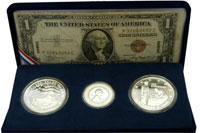 In this time of uncertainty, I feel that we Americans need to remember those who have given their lives in defense of this country. This is not a political statement on the current Middle East situation, but an appreciate of those with their boots on the ground who risk their lives daily. As part of that, my wife and I visited the U.S.S. Arizona (BB-39) Memorial at Pearl Harbor during our trip to Hawaii. Unfortunately, rain prevented us from visiting the U.S.S. Missouri (BB-63) Memorial.
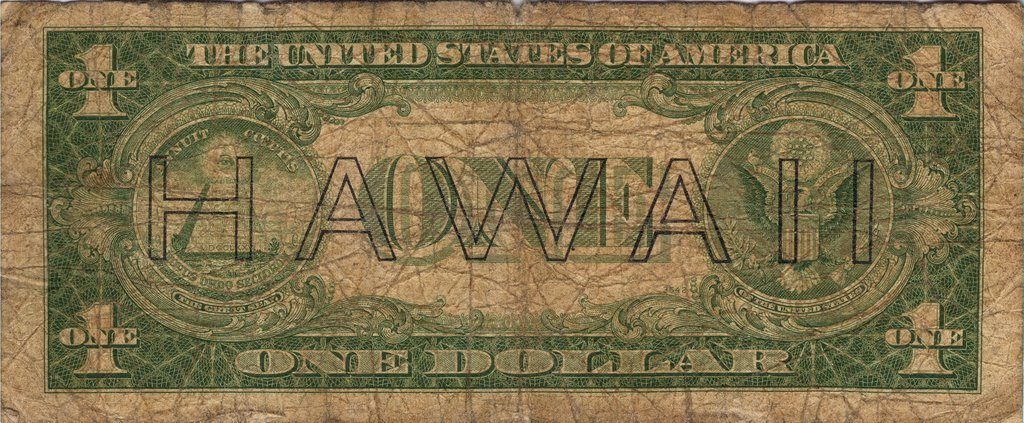
In front of the gift shop that is inside the Visitors Center was a table with gentleman selling Pearl Harbor commemorative medals and sets produced by the Honolulu Mint. I was very intrigued by the items and gravitated to the commemorative set that contains two .999 Silver, 1 Troy Ounce medals, an uncirculated 1943 Steel Lincoln Cent, and a Series 1935A Hawaii issue Silver Certificate. Even though I am not a commemorative collector, I do tend to buy numismatic items from my personal experiences. While standing in the Memorial, and with my wife’s urging, I could not pass up buying this set.
-
-
Series 1935A Silver Certificate with “HAWAII” Overprint Reverse
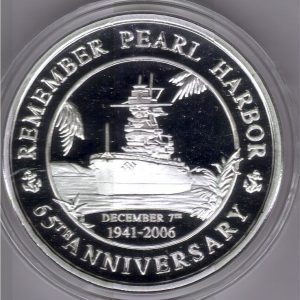
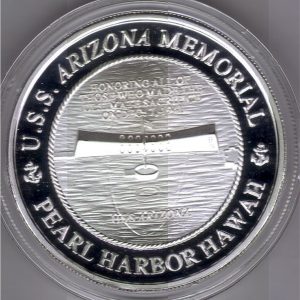
The set includes a medal commemorating the 65th Anniversary of the Japanese bombing of Pearl Harbor. The obverse shows the U.S.S. Arizona and the anniversary date. The reverse shows an arial view of the memorial with the outline of the sunken ship in the water. On the image are the words “Honoring all those who made the ultimate sacrifice on Dec. 7, 1941.”
-
-
Obverse of the Pearl Harbor 65th Anniversary silver medal
-
-
Reverse of the Pearl Harbor 65th Anniversary silver medal
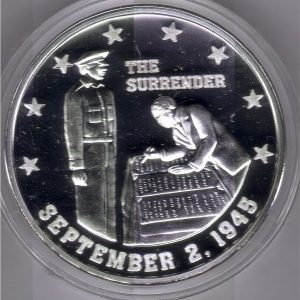
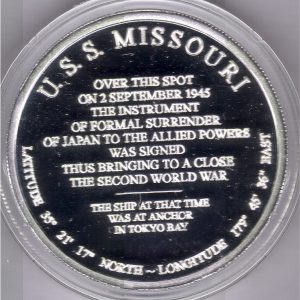
The other medal commemorates the Japanese surrender aboard the U.S.S. Missouri. It was prophetic that the articles of surrender were signed on her deck. The obverse of this medal recreates the signing of the document by General Yoshijiro Umezu, Chief of the Army General Staff, with Lieutenant General Richard K. Sutherland standing across the table. The reverse has the inscription on the deck of the Missouri where the articles were signed.
-
-
Obverse of the Japanese Surrender Silver Medal
-
-
Reverse of the Japanese Surrender Silver Medal
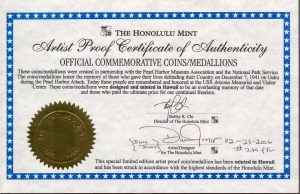
Personally autographed COA from the Honolulu Mint
Although everyone should visit the U.S.S. Arizona Memorial and the rest of Pearl Harbor, I know it is not a trip that every can take. So if you are interested in this collectible and other medals honoring those who served and gave the ultimate sacrifice, you can visit the Honolulu Mint’s website or the U.S.S. Arizona Memorial Bookstore. Portions of the proceeds benefit the Memorial.
Mar 7, 2006 | coins, grading
I picked up the March 7, 2006 of Numismatic News and read the front-page article about the new ANACS slab. The new slab is thinner than their previous holder and thinner than the holders from other grading services so that 25 will fit in a “standard” box. It was also reported that the new design and the clear plastic allows the encased coin’s edge, sometimes called “the third side,” to be seen.
Recent interest in being able to see the edge lettering has been revived with the passage of the Presidential $1 Coin Act. The Act says that in order to provide more room for artistic impression, the mottos “E Pluribus Unum” and “In God We Trust” will be incuse on the edge of the coin. There are also collectors who wanted to be able to see the edge of other coins, such as the Saint-Gaudens Double Eagles. In response NGC created a new holder and announced it with the encasing of a 1907 Proof Saint-Gaudens Double Eagle.
I have to admit that I have been a fan of the NGC holder. The holder has a solid feel and seems to show off the coin better. When I read about the new NGC holder in December, I thought that changing the insert of the holder to use “prongs” cut into the slab’s insert to hold the coin in place and maintain the current holder was a great idea. But as I look at the pictures of the new ANACS holder, I may be swayed.
First, the all clear holder will show the entire surface of the edge and not just some areas. Since it is a good idea to certify gold coins to ensure authenticity, it would be wonderful to be able to see around the entire edge of the beautiful Saint-Gaudens design. The thinner slabs are also a great idea. With the increase in the number of coins being graded, the ability to store 25 coins in the area where we used to store 20 will make it easier for those with larger collections.
One of the problems I have with many of my graded coins is that in order to look for a specific coin, I have to pull the slab out of the box in order to read the label. Someone at ANACS must have had the same experience because the new design places the grading information and barcode so that it is readable from the top of the slab. These slabs can then be stored in the new clear plastic box ANACS now offers.
On the surface, there is a lot to like about the new ANACS holder, but I would like to see it for myself. Since ANACS will be attending the Baltimore Coin and Currency Convention next week, I hope to stop at their booth and see the holder.
Mar 5, 2006 | coins, legal
One of the biggest stories in the numismatic industry is the alleged mismanagement of the Capital Coin Fund by former dealer Tom Noe. The Capital Coin Fund was created to be an investment vehicle for the Ohio Bureau of Workers’ Compensation (BWC). It has been reported that Noe has been charged with 53 felony counts including “a pattern of corrupt activity under the Racketeer Influence Corruption Organization (RICO) Act” which carries a possible prison sentence of up to 175 years.
On February 22, 2006, a press release issued by Ohio Attorney General Jim Petro announced that the BWC will sell 100 coins to recoup some of the original $50 million investment. The sales is expected to bring in $7.5 million, which is reported to be a $1 million profit. Spectrum Numismatics International, Inc. is guaranteeing the $7.5 million.
It is being reported that there will be 3,400 items sold in 100 lots via a mail bid sale. Most coins have been certified NGC and PGCS. In-person viewing is scheduled for Tuesday, March 21 in Columbus, Ohio. The auction closes at 5:00 PM on Wednesday, March 29. To get more information about this auction, visit www.frostbrowntodd.com/coins. Good luck to all bidders!

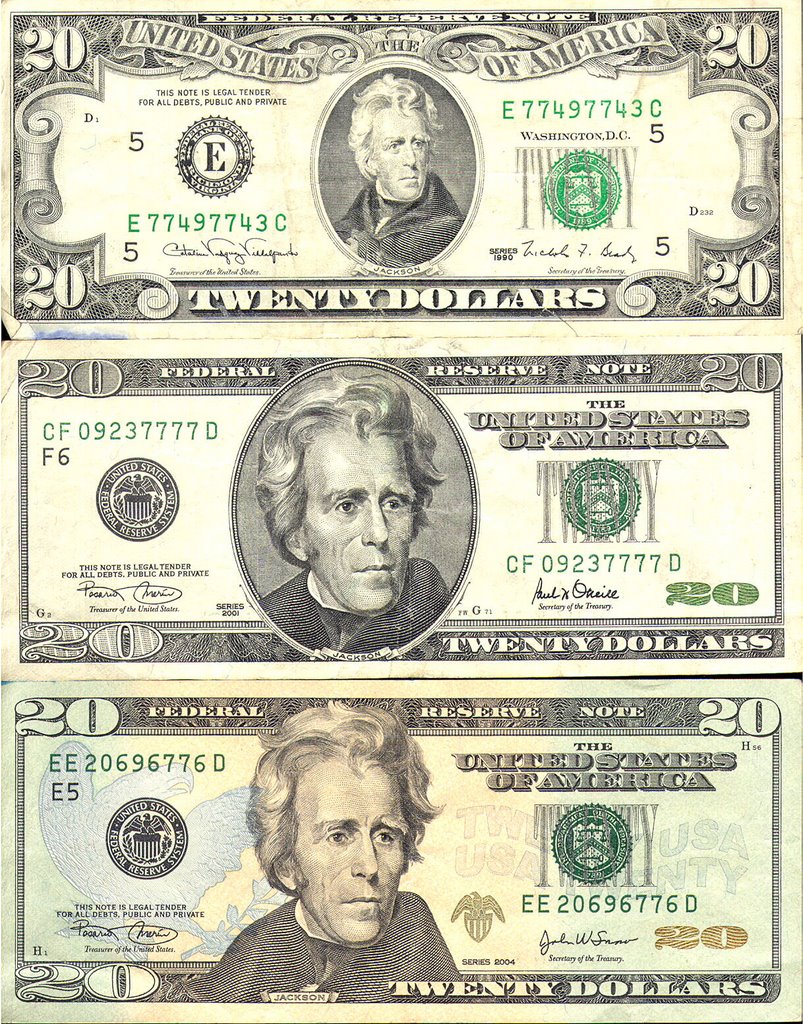 First, I found is the Series 1990 note with the signature of Treasury Secretary Nicholas F. Brady and Catalina Vasquez Villalpando, the Treasurer of the United States. Both Brady and Villalpando were appointed by President George H. W. Bush and served until the end of his term. Brady also served for six months under President Ronald W. Reagan.
 My first impression was the differences in design. The $20 FRN was first designed in the 1920s and was an evolution of earlier designs. It has ornate and fine engraving with a green hue. The fine engraving has been a staple of bank notes since their inception as a means to prevent counterfeiting. The “green back” was used to prevent copying using new photographic technologies which had a difficult time reproducing the green color. Today, the green color remains out of tradition considering modern imaging capabilities.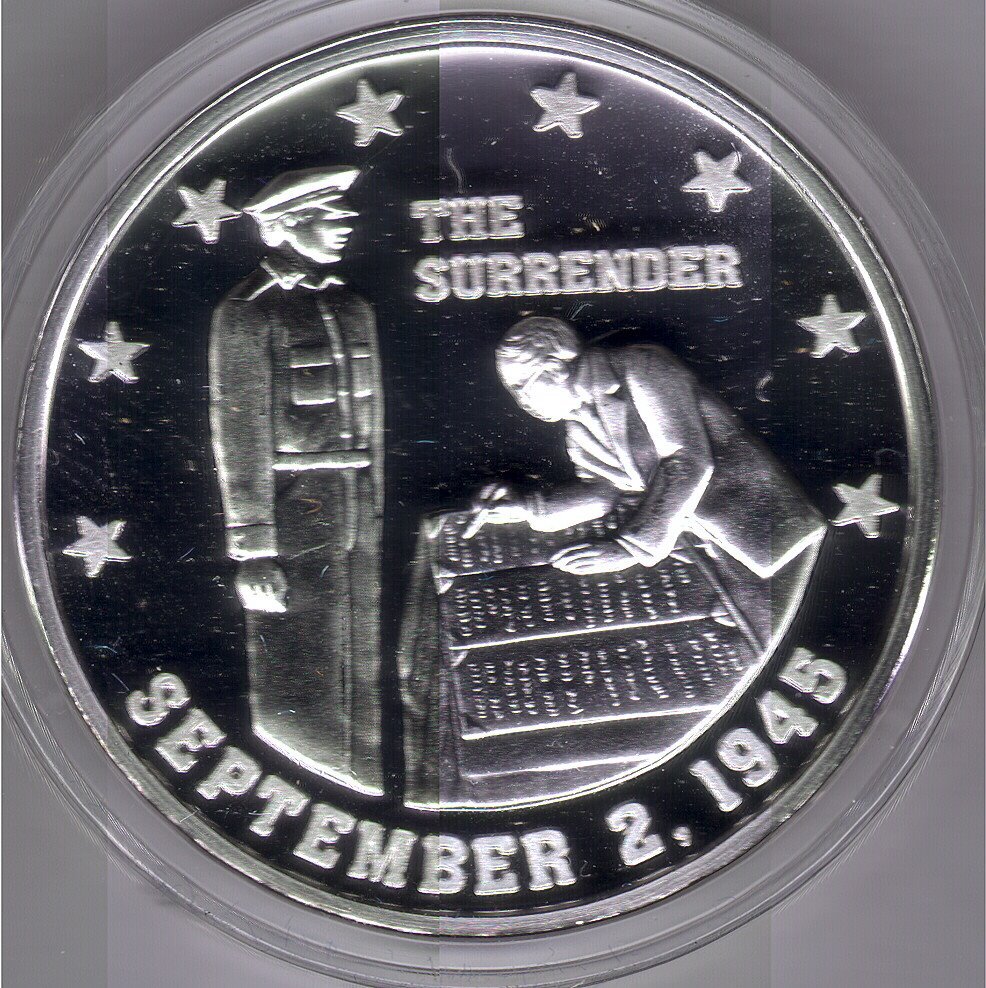


 Loading ...