Jun 6, 2006 | coins, legislative
Few programs from the US Mint have driven the interests of numismatics that the 50 State Quarters program. Reports from the Mint and industry resources have shown that the interest in new issues is more popular than ever. With the end nearing, will the interest continue after Hawaii’s quarter is issued? One solution is to extend the program one more year to honor the District of Columbia and the territories: the Commonwealth of Puerto Rico, Guam, American Samoa, the United States Virgin Islands, and the Commonwealth of the Northern Mariana Islands.
H.R.3885, District of Columbia and United States Territories Circulating Quarter Dollar Program Act, was introduced on September 9, 2005 proposes to extend the program one year to issue six quarters for DC and the territories. The bill was introduced by DC Representative Eleanor Holmes Norton and co-sponsored by Rep. Madeleine Z. Bordallo (Guam), Rep. Donna M. Christensen (Virgin Islands), Rep. Eni F. H. Faleomavaega (American Samoa), and Rep. Luis G. Fortuno (Puerto Rico). None of these representatives are allowed to cast a vote on the floor of the House of Representatives—but they do have voting privledges in committees.
As a resident of the metropolitan District of Columbia area, I know there are many who feel that DC’s status as a non-state but the home of the federal government hurts the District in many ways. Pro-statehood groups readily show how badly the District is treated by the carpet baggers called Congress, who oversees its affairs. DC even provides three electors to the Electoral College. So why not have a quarter honoring the home of the federal government and the 450,000 residents who are taxed without real representation in congress?
But why stop with DC? Each of the territories are very distinct in their culture and background that could lead to some very interesting designs for the quarters. Since the residents of these territories are Americans (the carry US passports) and each add their own part to the American culture, they should have a quarter to commemorate for when they became a territory. It could make the 2009 set one of the most beautiful one-year series of the entire program!
If H.R.3885 was to pass, 2009 will be a fantastic year for numismatics. Aside from the DC and territory quarters, the Presidential $1 Coin Act that commemorates the presidents begins along with the new Lincoln Head Anniversary Cents issues. The thought makes the collector in me excited. I think I will write to my representative and ask him to support of H.R.3885 and make 2009 an exciting numismatic year.
Jun 1, 2006 | coins, legislative
Part of my day job is to analyze the impact of laws and policies on the security of computing systems. Although I enjoy the research, there are times it gets tedious and I need a diversion. Today’s diversion was to log into THOMAS, the website of the Library of Congress where citizens can look up bills and resolutions from congress, where I entered “coin act” as a search string.
The search turned up 55 bills—many of which are different versions of the same bill. Many of the bills are for commemorative coins along with the Presidential $1 Coin Act (codified in Public Law 109-145). But what caught my eye is the Theodore Roosevelt Commemorative Coin Act (S.863) to honor the centennial of his winning the Nobel Peace Prize. Roosevelt was the first US citizen to win Alfred Nobel’s prize, the first sitting president to be so awarded (the only other sitting president to win the Nobel Peace Prize was Woodrow Wilson for his founding of the League of Nations, the forerunner to the United Nations).
Roosevelt was known as a reformer with a real vision as to how to modernize a nation still recovering from a bloody Civil War and draconian laws from the Victorian Age. Roosevelt was a man of strength and a man of peace. He won the Nobel Peace Prize for negotiating the 1905 peace treaty ending the Russo-Japanese War. A truly remarkable American.
For us numismatists, Roosevelt initiated the “Golden Age of American Coin Design.” Using his bully pulpit, he held the designs of the US Mint’s Chief Engraver Charles E. Barber in contempt and ordered coinage whose designs were more than 25 years old to be redesigned. Roosevelt was a fan of sculptor Augustus Saint-Gaudens and asked Saint-Gaudens to redesign the small cent. Rather than use the Liberty design in an Indian Headdress for the small cent, it was used on the 1907 $10 gold coin. Roosevelt also asked Saint-Gaudens to design the $20 gold double eagle coin to rival the beauty of all classic coins.
Unfortunately, Saint-Gaudens died of cancer before he could redesign the small cent. Roosevelt continued to look to revitalize US coinage and seized on Abraham Lincoln’s 100th birthday to redesign the small cent. He was steered to Victor David Brenner, whose bust of Lincoln was used as the model for the new Lincoln Cent first issued in 1909. Not only was Lincoln the first president to appear on a circulating coin, but Brenner’s obverse is still in use today.
The impact of Roosevelt’s redesign continues to be felt today. Saint-Gaudens’ image of Liberty from the $20 coin is being used today on the American Eagle Gold Bullion Coins. With his impact on American coinage, it is astounding that Roosevelt was not honored with a commemorative coin of his own.
The Theodore Roosevelt Commemorative Coin Act is the perfect way to honor this great American. The Act calls for three commemorative coins: one to represent his presidency using designs from James Earl Fraser and Augusts Saint-Gaudens; one with the obverse commemorating Roosevelt as a Rough Rider with a reverse from the Saint-Gaudens $20 coin; and an “Adventurer” coin with an image of Roosevelt on horseback that is based on the Fraser statue that stands at the American Museum of Natural History in New York City. Although I am not a collector of commemoratives, I would purchase these coins.
S.863 was passed by the Senate on December 16, 2005 and sent to the House of Representatives the next day. The next day, the bill was “Held at the Desk” since the calendar makes aspects of the bill impractical to enact. It was too late to complete the bill in order to honor Roosevelt in 2006. This bill was discharged from the Senate a few weeks later, which formally lays it to rest.
Although it is too late to honor Roosevelt for the 100th Anniversary for winning the Nobel Prize, it is never too late to bestow this honor to a reformer, veteran, peace maker, and great President. Hopefully, congress will give us numismatists and fans of Teddy Roosevelt a present and revive this act for the future.
May 31, 2006 | coins
It has been a very busy few weeks. Now that our Memorial Day weekend is over, I thought it was time to catch up on a few items.
Tom Noe, the indicted coin dealer charged with allegedly bilking the Ohio Bureau of Worker’s Compensation (BWC), pleaded guilty to three counts of federal campaign finance violations. Noe was charged with using friends and associates to funnel $45,400 to President Bush’s re-election campaign. It was reported that the plea deal came with a recommendation for a 2-year prison sentence. If Noe had gone to trial, a guilty verdict could have resulted in a 15-year sentence and over $900,000 in fines. Noe still faces charges in Ohio for the BWC case.
In Rock Me Amadeus, I wondered if the Austrian Mint would issue commemoratives honoring the 250th birthday of Wolfgang Amadeus Mozart. My posting said that the Austrian Mint scheduled the release of Mozart collectibles on May 10th. A visit to their site lead me to Euro Collections International, the official dealer for the Austrian Mint’s North American Market. My quick search found an 2006 Austrian 5 Euro siver commemorative in a special collectors card and a 50 Euro gold commemorative coin. I also found a 2006-D uncirculated and proof 10 Euro commemorative coins from the German Mint (the D mint mark indicates the was struck at the Munich Mint).
I also have been waxing poetic on the beauty of silver and its price. Silver closed at $12.42 today, below the $13 price I wrote about earlier. Like all investments, you have to decide what is best for your needs regardless of what Bill Gates and Warren Buffet do for their portfolios! I am still buying silver, but I am watching the price a little more closely.
Finally, my friends have been asking me about hoarding Lincoln cents since it costs more to make than face value. One thing everyone missed was that the cost to mint the coin also includes labor, materials, and other costs. The costs of the metal used to make the Lincoln Cent costs less than face value and not worth hoarding. Spend those little brown beauties. A future posting will look at the arguments for keeping or doing away with the cent.
May 29, 2006 | coins
On this Memorial Day, I want to take this opportunity to remember those who gave the ultimate sacrafice while defending freedom at home and abroad. Whether it was wars for this country’s freedom, helping allies overseas, world wars, or helping others settle armed conflict around the globe, it is important we take this day to honor their service that helped make this country what it is today.
Regardless of how you view the current world conflicts, the men and women who serve in our military deserve the honor and respect for their service. Pray for their ability to safely return home.
We will resume numismatic writings shortly.
May 18, 2006 | coins, US Mint
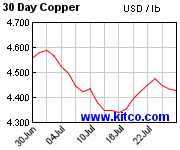 Last week, I was as intrigued with the political stories as many of you have been. Since I had purchased a copy of USA Today to read these revelations, I decided to read the rest of the paper. In the business section was the article “Coins cost more to make than face value” explaining that the US Mint estimates that it will cost 1.23 cents to strike the Lincoln Cent and 5.73 cents to strike the Return to Monticello nickel.
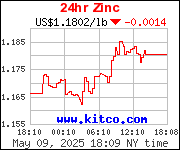
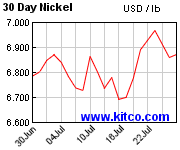 This article and a similar article from Numismatic News explains that along with the rising metal prices, fuel and processing costs will has caused the price of production to rise. The composition of the cent is 97.5% zinc plated with copper (2.5 grams) and the nickel is made with 75% copper and 25% zinc (5 grams). As I write this, the closing price per pound of zinc is $1.4952, nickel is $9.4092, and copper closed at $3.6266. Prior to the change in 1982, the composition of the Lincoln cent was 95% copper and the rest tin and zinc with a weight of 3.11 grams.
 Before anyone starts to hoard these coins, the Mint told USA Today that the actual metal content of the cent is less than face value and the nickel is only fractionally more. Even if one was to hoard Lincoln cents from before 1982, the cost to process those coins to remove other metals and impurities would cost more than the net refined copper. With the rising cost of base metals, the future hoarding of US coinage could present an interesting problem.
The Mint is one of the few profit-making agencies of the federal government. They reported a profit of $730 million last fiscal year. Mint officials estimate that profits will be down by approximately $45 million.
I wonder how that would change if the Bureau of Engraving and Printing stopped making $1 Federal Reserve Notes and the demand for $1 coins increased? But that is a discussion for another entry.
May 11, 2006 | coins
It has been a busy two weeks, but I wanted to write about an interesting transaction which I was involved. My professional life requires me to attend many meetings. One of these meetings involves someone who commutes every week from New York City to the Washington area. Before one of our meetings, he was talking about how he spent Saturday around Times Square and even visited a large toy store chain with his three children. As he was talking, he was jingling change in his pocket.
That is when the ever attentive numismatist in me sprung into action. I remembered the stories about author and former ANA Vice President Scott A. Travers placing 1909-S VDB and 1914-D Lincoln Cents into circulation—reportedly worth about $1,000 and $300 respectively. Travers also spent a 1908-S Indian Head Cent, the first cent minted in San Francisco and reportedly worth $200. I also do not remember anyone saying they found the coins. So I offered to buy all the change in my colleague’s pocket. With the change landing on the table, we counted over $7 in various denominations. I gave him $8 for all of the coins.
After completing the transaction, I began to look at the various cents in the pile. Following a comment of surprise after finding a 1982 Canadian Cent, I was asked why I was checking the cents. When I explained about the coins Travers placed in circulation and figuring that since he was in midtown Manhattan, I thought it was an interesting gamble. The pre-meeting congregants began to show interest in the coins.
Unfortunately, I did not find any of the coins Travers placed into circulation. But I did find a 1950 Washington Quarter along with the Canadian Cent. The quarter looks to be in Fine (F-12) condition and probably only worth its value in silver (approximately $2.67 with silver closing at $14.77 an ounce on May 11). This may be the makeup for my previous 7½ cent loss!
Apr 29, 2006 | coins
It was a beautiful Friday afternoon in the nation’s capital, but I was stuck in the office. I was trying to finish a document for the client and was waiting for someone to review my work. Since my mind was on the sunny, wooded scene outside my office window, I did not want to start something new. I called up my browser and started to surf the Internet. I wanted to read anything that did not involve technology or the government. My attention turned to numismatics.
During my search, I stumbled across an article in The Columbus Dispatch that reported the auction sale of a rare, uncirculated 1792 half disme for $1.15 million ($1,322,500 with 15-percent buyer’s premium) to an anonymous collector. The auction was held at the Central States Numismatic Society (CSNS) 67th Annual Convention in Columbus, Ohio by Heritage Auctions Galleries.
 Although I am not a fan of the press these high-priced sales generate, I was intrigued by the date of this coin. If I remembered the history of the US Mint correctly, I thought the first half dismes were minted in 1794 following the first mintage of half cents and large cents in 1793. With a little time on my hands I started searching for more information. After trying unsuccessfully to find more information at my usual starting point, CoinFacts.com, I found the auction listing on the Heritage online catalog. [I found other sites that will be included in the Numismatic Links pages]
According to Heritage, the coin was graded SP67 (Specimen 67) by PCGS and “[d]espite opinions to the contrary, this issue is the first circulating American coin struck under authority of the Mint Act of April 1792.” I learned that 1,500-2,000 of these coins were minted for the new government by John Harper using the equivalent of $100 worth of silver reported to have been provided by George Washington. While there has been some controversy whether these were real or authorized coinage, the information in the Heritage listing provides strong evidence that these coins were accepted by Secretary of State Thomas Jefferson as legal tender.
In addition to the summary of the coin’s history, the listing also provides a list of 28 distinctive examples (plus some potential duplicates) of this coin from previous auctions or sales. This is why I love numismatics. The combination of history and the interesting designs makes the story of this coin a fascinating read. I hope the new collector enjoys this new prize!
Apr 23, 2006 | coins
![[Most Recent Quotes from www.kitco.com]](http://www.kitconet.com/charts/metals/silver/t24_ag_en_usoz_2.gif) With the spot price of silver hovering around $13 per ounce, it is getting more difficult to find silver bullion coins at lower prices. Up until the last month, I have been able to buy most silver bullion coins at the spot price or even a dollar lower on Ebay. This rise in silver prices has proven profitable for billionaire investors like Warren Buffet (The Wizard of Omaha) and Microsoft Chairman Bill Gates. Both invested in silver while at lower prices.
With the spot price of silver hovering around $13 per ounce, it is getting more difficult to find silver bullion coins at lower prices. Up until the last month, I have been able to buy most silver bullion coins at the spot price or even a dollar lower on Ebay. This rise in silver prices has proven profitable for billionaire investors like Warren Buffet (The Wizard of Omaha) and Microsoft Chairman Bill Gates. Both invested in silver while at lower prices.
Numismatically, I wrote that I liked silver bullion coins for being able to show off the coin’s design better than the “affordable” gold bullion coins. While looking at sets to purchase, I am drawn to the wonderful Adolph A. Weinman Walking Liberty design on the American Silver Eagle, the different design on the Great Britain Britannia Bullion Coin, the Chinese Silver Panda, and the simple yet elegant Canadian Maple Leaf. Over the last month I was able to procure at least one issue of all four of these coins at reasonable prices.
Bargains (and reasonable prices) in silver are becoming hard to find. Sources where I was able to buy at “fair” prices (± 10-percent of spot price) are now selling silver at premium prices (greater than 10-percent of spot price). Those bullion coins with greater numismatic value (e.g., uncirculated 1986 first year issue of the American Silver Eagle) are commanding prices beyond many price guides. I was a bit surprised to see the PCGS online price guide lists the 1993-P Proof American Silver Eagle for $190 at PR-65. My complete set of proof American Silver Eagles has been purchased from the US Mint at their issue. While they were bought as a collectible, the current market value of that collection is something to watch as the spot prices change!
One area where bargains cannot be found are with the silver Chinese Pandas. If you check the bargain basement capital of the world, Ebay, silver Pandas sell for an average of $8 more than American Silver Eagles. Are the Silver Pandas that popular? I had the chance to ask that question to Julian Leidman, noted dealer, who was speaking at the recent meeting of the Montgomery County Coin Club. Mr. Leidman said that the Silver Pandas are sold at a premium by the Chinese government. He said that the Pandas have become a very popular collectible worldwide and that the Chinese government was capitalizing on that popularity.
The silver market is getting very interesting. It may not reach the highs seen in 1980 (over $300 per ounce), but the demands and the investors using silver as part of their portfolio make it very interesting to watch.
Apr 16, 2006 | coins, foreign
Over the last few years, the trade press has run articles about the uninspired designs of US coinage. The 50 State Quarters Program has seen reviews from fantastic (the Charter Oak of Connecticut) to scary (the hanging astronaut of Ohio). Recent portraits of Thomas Jefferson on the Return to Monticello nickel and Benjamin Franklin on the commemorative celebrating his 300th birthday are so bad that they are barely a representation of the person being honored.
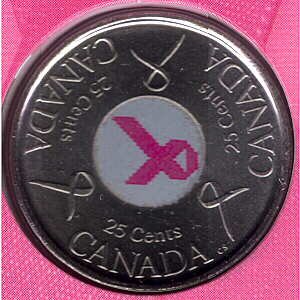
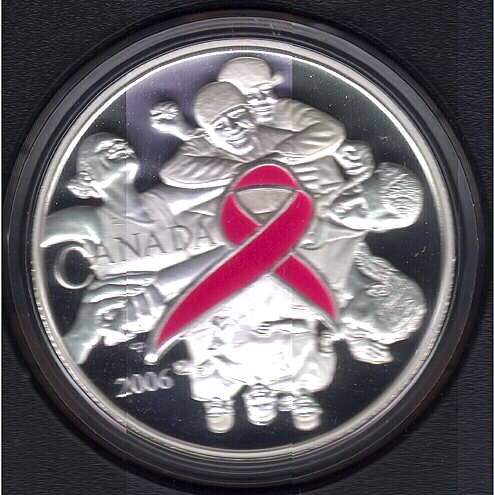
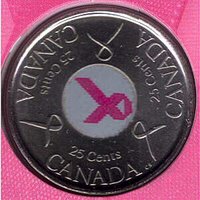 One country that does a great job with its coinage is Canada. Since I started collecting Canadian coins two years ago, I have been studying their significance and admiring their designs. Recently, the Royal Canadian Mint (RCM) issued the 2006 25-Cent Circulation Coin Creating a Future Without Breast Cancer. The coin’s reverse features an enameled pink ribbon in the center surrounded by the engraving. The obverse is the common design featuring HM Queen Elizabeth II. It is a simple and elegant design that is well executed by RCM. This campaign puts 30 million coins into circulation to support the work of the Canadian Breast Cancer Foundation.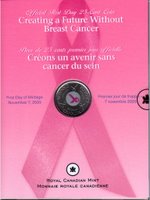
RCM sells this coin in several collectible forms. My purchase included the first day of mintage card. This card is tri-folded with the coin encapsulated in the center. Inside, it explains the campaign, the hope for a future without breast cancer, and that part of the proceeds will go to the Canadian Breast Cancer Foundation to support their programs. It is a beautiful collectible in support a worthy cause.
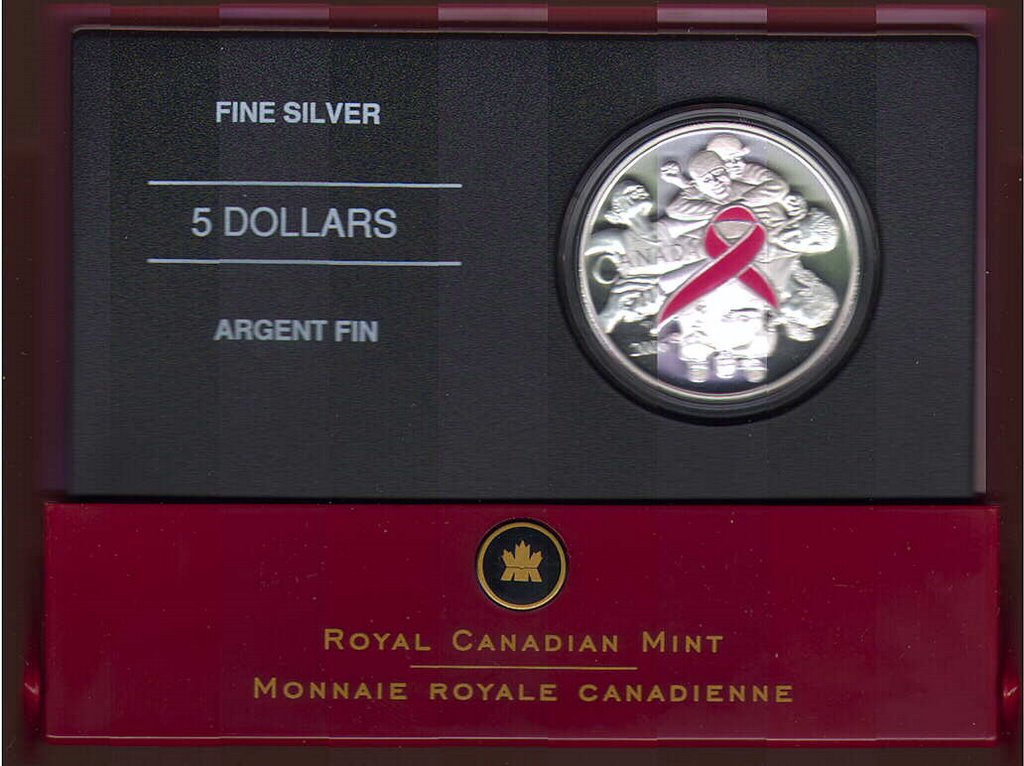
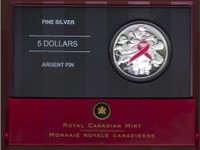 I also purchased the 2006 CAN$5 Special Edition Proof with the pink enameled ribbon on the reverse. According to the RCM website, “Its inspiring design reveals the many fronts working to create a future without breast cancer. A special “enamel-effect” combined with pure silver creates a powerful statement of hope that will enrich any collection.” When I received the coin, my reaction was “oh wow!” It is beautiful, well executed, and a true inspiration to the cause.
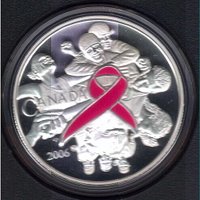 In my last two years of starting a Canadian coin collection, I have seen the RCM issue beautiful coins on a variety of topics. Although I do not yet know the process the RCM has to undergo for permission to produce these coins, it is obviously not the politically charged process that the US Mint has been tied to for over 200 years. I will investigate the Canadian process and compare it with what we have to go through in the US to see why Canada seems to issue more inspiring coins.
Apr 11, 2006 | coins, foreign
With the precious metals market on the rise, many collectors and investors have been purchasing bullion and rare coins. One segment that is appealing to many investors and collectors are silver bullion coins.
If you are a reader of Numismatic News, you would have been reading a flurry or articles about the use of base metals over precious metals for our coinage. While both sides have their points, the fact remains that the base metal coins are legal tender and used in our daily transaction. But the appeal of precious metals was not lost on the US Mint when they create the American Eagle Bullion Coins. Since then, the awareness of collecting bullion coins has grown.
As a collector, I like different types of coins. I was first drawn to the Silver American Eagles when my father started buying the proof coins for me. He has done this every year since 1986. I find the silver coins appealing for their look and feel. Not only are they a great collectibles, but their silver price has increased over the years. That is one of the reasons why I have been buying and hoarding uncirculated Eagles when I can find them at a good price.
Since then, I have started to collecting Canadian Silver Maple Leaf bullion coins. For a simple coin, they have a beauty that I find intriguing. Canada has been producing the Silver Maple Leaf since 1988 and I am working on putting together a complete set.
While hunting for nice examples of American Silver Eagle and Silver Maple Leaf coins, I found the Chinese Silver Panda. As I started to look into the Panda, I found that except for 1991 and 1992, all the reverse designs are different and the same design is used on both the silver and gold coins.
I have found some nice, inexpensive gold Pandas through Internet auctions, but when I saw the silver Pandas I was excited. Not because they are more affordable than even the gold 1/20 oz. 20 Yuan Panda, but 10 Yuan 1 ounce silver Panda allows them to show the design on a 40mm diameter planchet of silver as compared to the 14mm diameter of gold. It is amazing what an extra 26mm of surface can do for a design.
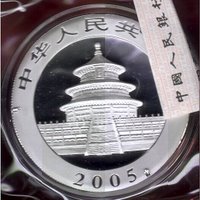 I recently bought my first two Silver Pandas in mint packaging from an Internet auction site. The common obverse has Chinese letters which is the title of the People’s Republic of China, the year of issue, and a wonderful proof-like engraving of Hall of Prayer for Good Harvests of the Temple of Heaven in Beijing. (click photo to enlarge)
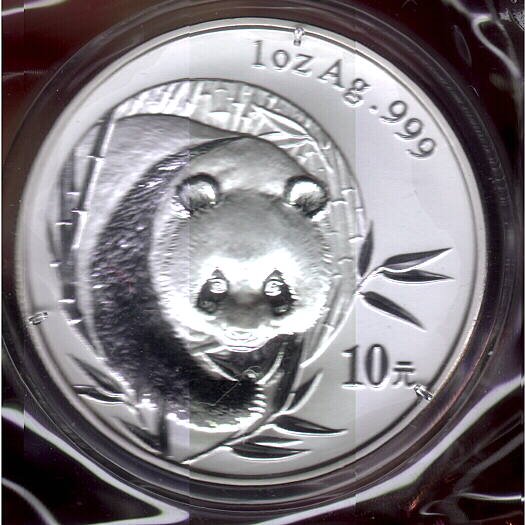
 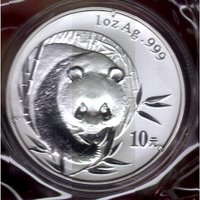 The reverse of the 2003 coin shows a single panda walking on all four legs through a bamboo forest. Although the China Gold Coin provides images of the coin, the real coin is more beautiful.
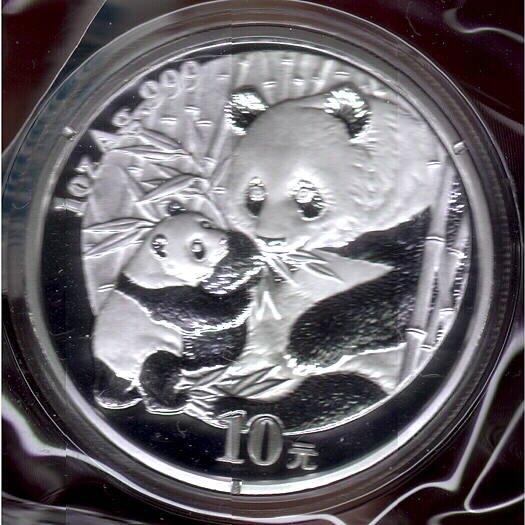
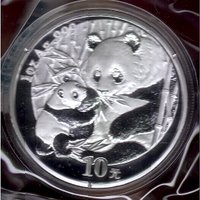 The 2005 Panda design features a mother panda feeding her cub in a bamboo forest. Although I do have a 1/20 oz gold coin of this design, the 40mm silver Panda is well executed and beautiful. The extra room for the design works very well with this design allowing the coin to pass the eye appeal test.
I will be adding more Pandas to my collection. They deserve their place next to my collection of American Silver Eagle, Canadian Maple Leaf, and British Britannia coins. It will be a beautiful collection once it is completed.




 Loading ...