Jun 28, 2008 | coins, commemorative, legislative
Yesterday, I was notified by one of my political junkie sites, govtrack.us, that H.R. 6404, a bill to “require the Secretary of the Treasury to mint coins in commemoration of the centennial of the establishment of the Girl Scouts of the United States of America.”
As I write this, the information is so new that it has not been posted on Thomas, the Library of Congress site that shares legislative information with the public. So there is no further information. When the bill is posted, it will be available via this link.
If we look at other commemorative legislation, I speculate that the bill with be a $1 silver commemorative coin that will be available in proof and business strike issues. Since the Girl Scouts were founded in 1912, the coin will celebrate their centennial in 2012. Other than design specifics, the bill will call for the minting of 300,000 to 500,000 coins with a $10 surcharge that will be donated to the Girl Scouts.
We will check back to see how well I played swami!
Jun 27, 2008 | ANA, coins, gold, US Mint
Another reason to attend the World’s Fair of Money® at the end of July in Baltimore is to be there for the unveiling of the 2009 Ultra High Relief Double Eagle Gold Coin.
The US Mint announced that US Mint Director Ed Moy will participate in the show’s opening ceremony and then officially open the Mint exhibit that will feature the one ounce gold coin that will go on sale in 2009.
The coin&rsqou;s design will be a high-relief $20 gold piece on a double-thick, 24-karat gold planchet (sometimes called a piefort) 27 millimeters in diameter. The design will feature Augustus Saint-Gaudens original 1907 design where the date will be in roman numerals (MMIX). The inspiration for this coin came from 1907 when the Mint tried to strike an experimental double eagle using two stacked $10 eagle planchets. When it was realized that congress would have to approve the striking of the coin for circulation, the project was abandoned and the test pieces were melted.
Aside from the date, the only difference between the 1907 test pieces and the 2009 bullion issue is that the the motto “In God We Trust” will be added over the rising sun as it appeared in 1908.
Jun 25, 2008 | coins, history
One of my favorite television shows is History Detectives, the PBS show featuring four investigators with interests in antiques, history, and sociology research the background and history of artifacts in the possession of ordinary Americans. It is one of the most popular series on PBS.
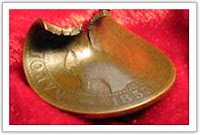 The show enters its sixth season starting on June 30. The first episode will feature Elyse Luray investigating a coin with a bent, split edge that may have been shot by Annie Oakley during a Buffalo Bill Wild West Show and given to the contributor’s great-grand uncle.
There are two issues for this investigation: was the great-grand uncle in a place to be able to receive the coin and was the coin something that would have been used by Oakley in the show? The coin is an 1853 two Centimes coin from France. Would that coin have been available in America during the mid-ninteenth century?
You can find out when the show will be aired in your area from the PBS website. If you do not mind a little spoiler before watching the show, you can write up by Susan Headly, the moderator at coins.about.com.
Image courtesy of PBS.org
Jun 22, 2008 | coins, commemorative, legislative
This passed week, the Senate passed S. 2159, NASA 50th Anniversary Commemorative Coin Act, by unanimous consent. The bill was held at the desk, meaning that it was not sent to the House of Representatives for consideration.
The bill is similar to H.R. 2750, which was passed by the House in July, 2007. The significant different between the bills is that the House bill specifies where the coins can be minted and the Senate bill does not. Because the 50th anniversary of NASA is this year, the Senate bill specifies that the coins will be dated 2008, allows the coins to be issued through 2009, and specifies that it does not count against the maximum of two commemorative programs for 2009.
Both bills call for a high relief $50 gold coin and $1 silver coins. For the $50 coin, the obverse will bear an image of the sun and the reverse will “bear a design emblematic of the sacrifice of the United States astronauts who lost their lives in the line of duty over the course of the space program.” There will be a mintage limit of 50,000 gold coins and 300,000 silver coins. The US Mint would be allowed to make bronze medals based on the design of the gold coin.
For the $1 silver coins, the bill calls for nine different obverse designs representing the nine planets of the solar system, including Earth. It appears that congress is not paying attention to Pluto being voted out of the solar system. The reverses of these coins will be “be emblematic of the contributions of the research and space centers.” The bill requires the following:
- On the Earth coin, the reverse will “bear images emblematic of, and honoring, the discoveries and missions of the National Aeronautics and Space Administration, the Mercury, Gemini, and Space Shuttle missions and other manned Earth-orbiting missions, and the Apollo missions to the Moon.”
- On the Jupiter coin, the reverse will “include a scientifically accurate depiction of the Galilean moon Europa and depict both a past and future mission to Europa.”
- For the Saturn coin, the reverse will “bear an image of the planet Saturn on the obverse shall include a scientifically accurate depiction of the moon Titan and depict both a past and a future mission to Titan.”
- For the Pluto and Other Dwarf Plant coins, the reverse will “include a design that is emblematic of telescopic exploration of deep space by the National Aeronautics and Space Administration and the ongoing search for Earth-like planets orbiting other stars.”
The bill also calls for images that would be selected for realism and scientific accuracy.
There will be a surcharge of $50 for the gold coin, $10 for the silver coin, and $1 for the bronze medals. The first $4 million collected will be paid to “NASA Family Assistance Fund, for the purpose of providing need-based financial assistance to the families of NASA personnel who lose their lives as a result of injuries suffered in the performance of their official duties.” The next $1 million of the money collected will be split between the Dr. Ronald E. McNair Educational (D.R.E.M.E.) Science Literacy Foundation and Challenger Center for Space Science Education. Any balance will be given to the Smithsonian National Air and Space Museum for their exhibits.
If done right, this program could create very interesting collectibles. I can see a set with the gold coin in the middle surrounded by the nine planet coins in a display case. Given the current cost of the metals, this set may be more expensive than most collectors can afford. In the mean time, the House and Senate have to work out the differences between the two versions.
Jun 21, 2008 | coins, commemorative, legislative
After being amended by the Senate, the House of Representatives agreed to the changes to H.R. 634, American Veterans Disabled for Life Commemorative Coin Act, on June 18. The bill is now enrolled and is cleared for the White House for the President’s signature.
The bill calls for the striking of 350,000 silver dollars whose design will be “emblematic of the service of our disabled veterans who, having survived the ordeal of war, made enormous personal sacrifices defending the principles of our democracy.” Coins will be issued in 2010. For this commemorative, the $10 surcharge will “be paid to the Disabled Veterans’ Life Memorial Foundation for the purpose of establishing an endowment to support the construction of American Veterans’ Disabled for Life Memorial in Washington, DC.”
Jun 19, 2008 | CCAC, CFA, coin design, coins, dollar, US Mint
Simcha Kuritzky, Treasurer of the Montgomery County Coin Club and past president of the Maryland State Numismatic Association, attended the June 18, 2008 meeting of the Citizen Coinage Advisory Committee. The agenda was to review the possible reverses for the Native American $1 Coins.
Simcha reported that for the 2009 reverse, the CCAC chose the design representing the three sisters: maize, beans, and squash, which are grown together. As required by law (Public Law 110-82 [PDF]), the date will be removed from the obverse and placed on the edge so that all circulating dollar coins will have edge lettering.
There were three reverses that had substantial support: a woman planting seeds with three corn plants in the background; three woman’s faces with the respective plants intertwined in their hair; and three sets of plants with a shining sun. The first and last designs had the most support from Native American groups. The main arguments at the meeting were over the novelty of design: the three faces design was a fresh approach and some members wanted greater artistic vision, while others were concerned that most people wouldn’t understand the design. The woman planting design had support because it showed agriculture (as opposed to nature) and women’s roles in the native economy, but the plants were small and may not show up well on the actual coin.
The designs and CCAC recommendation will be submitted to the U.S. Commission of Fine Arts for their opinion. The Director of the US Mint as proxy for the Secretary of the Treasury will make the final decision.
Jun 17, 2008 | ANS, coins
How do you move one the largest and most valuable coin collections in the world? Hire a moving company with ordinary trucks to schlep 425 plastic packing crates across Manhattan.
Although there was a police escort, the American Numismatic Society moved over 800,000 coins, bank notes, medals, pins, tokens, campaign buttons, and many other artifacts to the society’s new headquarters at One Hudson Square.
The ANS was founded in 1858 and the collection represents an accumulation of some of the finest and most unique collectables accumulated during that time.
The ANS collection will begin to exhibit the collection starting in October. In September, the ANS library of over 100,000 books, manuscripts, catalogs, and other items will be open to the public.
Jun 14, 2008 | coins, US Mint
After nearly six months of searching, I found a 2008-P Jefferson Nickel in pocket change. I noticed the shinier-than-usual nickel in the pile that was removed from my pocket on Thursday, June 12. Not including State Quarters, this is the latest I have seen circulating coins for any year.
The slow economy is also slowing coin production. Numismatic News is reporting that even the production of Presidential Dollars are slower than the equivalent time period after the introduction of the Sacagawea Dollar. Although the US Mint does not provide monthly production figures, the total mintage figures for 2008 through May is less than one-third of the 2007 totals.
Hopefully, I will find a penny and dime soon.
Jun 13, 2008 | coins, legislative, quarter, US Mint
In a grand announcement, Rep. Mike Castle (R-DE) announced that he introduced H.R. 6184, America’s Beautiful National Parks Quarter Dollar Coin Act of 2008 that would change the reverse of the quarter dollar coins to be “emblematic of a national park or other historic site in each State, the District of Columbia, and each territory of the United States.”
Castle, who authored the 50 State Commemorative Coin Act, noted that the program will make more than $6.2 billion in revenue, which will be $3.7 billion more than non-state quarters.
Note to Rep. Castle: ENOUGH!
We know that the 50 State Quarter program was a success. Aside from the income, it helped introduce more people to collecting. The process brought good designs and bad designs. It introduced the coin making process to the public while allowing the states to create designs to allow them show off. After the states are completed, the District of Columbia and territories are get their turns next year.
During that time, we celebrated the Westward Journey by redesigning the nickel and started honoring our past presidents with a one dollar coin. Next year, we honor Abraham Lincoln with four different Lincoln Cents reverses and a special 2009-S VDB collectible. Even the reverse of the Sacagawea Dollar will undergo a change to honor Native American heritage.
Note to Rep. Castle: ENOUGH!
These programs have been nice. But maybe it is time for a break.
The Presidential Dollar program has waned, mainly because the coins are not circulating. Coins are not circulating because there is a perception that the paper Federal Reserve Note is easier to deal with. But it is known that congress will not change the law to end the one dollar note until the Bureau of Engraving and Printing can make up for the lost production. One way to do that is to print currency for other countries.
Note to Rep. Castle: what about helping BEP find foreign customers so that they are not relying on the printing of $1 FRN? Why not provide the environment so that BEP can bring in new business? Can you help the BEP do what it takes to print the polymer notes that many foreign countries are demanding?
Are you doing what is right or are you looking for a few dollars? Is there a call for this series or are you looking for a few dollars? Are you afraid that there may be some fatigue in this idea, or are you looking for a few dollars?
There seems to be a “collectors’ fatigue” with the number of offerings from the US Mint. It is time to give the collecting community a small break and allow congress to fix some of the other issues that fact the Mint.
Jun 11, 2008 | coins, commemorative, legislative
What does Mother’s Day, the Infantry, and Disabled Veterans have in common? They all had bills passed on Tuesday for the issuing of commemorative coins in their honor.
Following the death of her mother in 1905, Anna Marie Jarvis devoted her life to establishing Mother’s Day as a national, then international holiday. Although there were some celebrations, there were no holidays to celebrate mom. With the financial help of famed clothing merchant John Wanamaker, West Virginia became the first state to recognize Mother’s Day as a holiday in 1910. On May 14, 1914, President Woodrow Wilson signed a presidential proclamation designating the second Sunday in May as Mother’s Day.
To commemorate the 100th anniversary of Mother’s Day, Rep. Shelley Capito (R-WV) introduced, H.R. 2268, Mother’s Day Centennial Commemorative Coin Act. The bill calls for thee striking of 400,000 silver dollars in 2014 where the “design of the coins minted under this Act shall be emblematic of the 100th anniversary of President Wilson’s proclamation designating the second Sunday in May as Mother’s Day.” A surcharge of $10 will be split between Susan G. Komen for the Cure Foundation and the National Osteoporosis Foundation.
H.R. 2268 was passed by a voice vote in the House of Representatives. It must be passed by the Senate before it can be sent to the president for his signature.
Another bill passed by the House and sent to the Senate is H.R. 3229, National Infantry Museum and Soldier Center Commemorative Coin Act. This bill calls for uncirculated and silver dollar commemorative coins, struck at the West Point Mint that would be “emblematic of the courage, pride, sacrifice, sense of duty, and history of the United States Infantry.” Coins will be issued in 2012 and the $10 surcharge will “be paid to the National Infantry Foundation for the purpose of establishing an endowment to support the maintenance of the National Infantry Museum and Soldier Center following its completion.”
On the other side of the Capital, H.R. 634, American Veterans Disabled for Life Commemorative Coin Act , passed the Senate by unanimous consent. Introduced by Rep. Dennis Moore (D-KS) and passed the House on May 15, 2007 by a 416-0 vote, the bill calls for the striking of 350,000 silver dollars whose design will be “emblematic of the service of our disabled veterans who, having survived the ordeal of war, made enormous personal sacrifices defending the principles of our democracy.” Coins will be issued in 2010. For this commemorative, the $10 surcharge will “be paid to the Disabled Veterans’ LIFE Memorial Foundation for the purpose of establishing an endowment to support the construction of American Veterans’ Disabled for Life Memorial in Washington, DC.” The bill passed with a minor technical change that must be approved by the House before it is sent to the President for his signature.
Interesting set of commemoratives for collectors.



 Loading ...