Aug 24, 2008 | coins, history, personal
In 1938, President Franklin Delano Roosevelt founded the March of Dimes. That year Howard Hughes set a record by flying an airplane for 91 hours around he world. It was the same year as Douglas “Wrong Way” Corrigan landed in Ireland after allegedly trying to fly to California claiming navigation problems.
Roosevelt launched a $5 billion spending program (roughly $78 billion in 2008 money) to try to stimulate the economy after the Recession of 1937. The US also established minimum wage laws. The radio adaptation of H.G. Wells’s The War of the Worlds broadcast by Orson Welles causes panic, especially in the northeast.
The New York Yankees beat the Chicago Cubs 4-0 in the 1938 World Series and the New York Giants defeated the Green Bay Packers in the 1938 NFL championship game. Seabiscuit beat War Admiral in the “Match of the Century” at Pimlico in Baltimore.
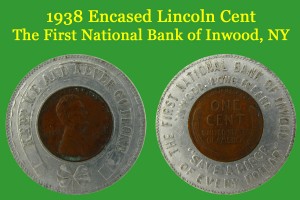
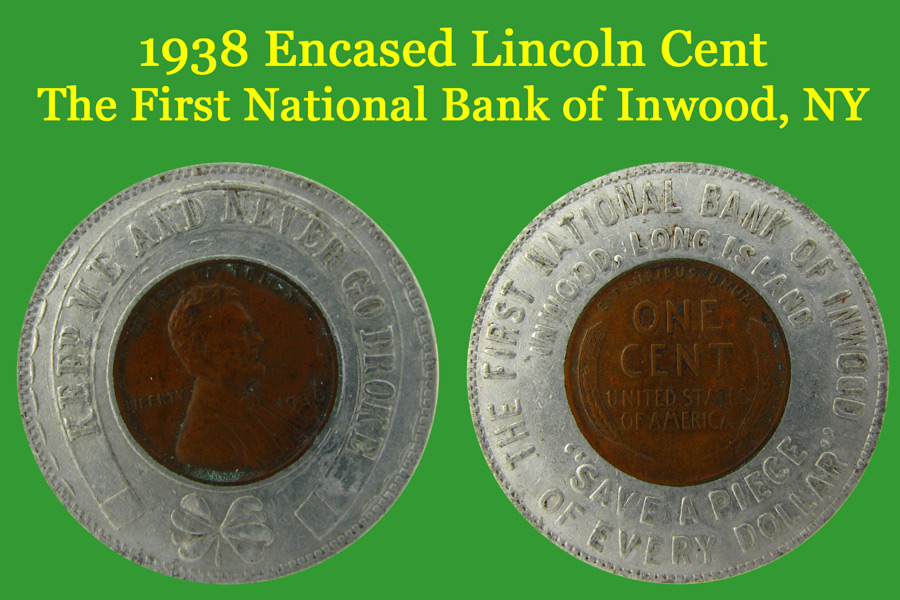
1938 Encased Cent from the First National Bank of Inwood (NY)
The First National Bank of Inwood (FNBI) was founded in 1923, the same year Yankee Stadium opened with a Babe Ruth home run. It was founded by former members of Bank of Manhattan to take advantage of the migration to the suburbs as new immigrants started to move into the areas of New York City. FNBI was able to survive the Great Depression through good management and extending good will to the community. FNBI was the first bank on Long Island to offer drive-through teller windows in 1950.
FNBI eventually merged with Franklin National Bank (formerly Franklin Square National Bank) in 1954. During the 1960s, a Belgium bank consortium working with a German bank consortium bought Franklin National Bank in 1968 to form European-American National Bank—rename European-American Bank (EAB) in 1972. EAB was a fixture on Long Island until Citigroup purchased the bank in 2001.
Inwood is one of the Five Towns along with Lawrence, Cedahurst, Woodmere, and Hewlett. The Five Towns are located in the southwest corner of Nassau County, near the Far Rockaway, Queens border. My parents move their young family to Inwood in 1965 so that their oldest son (me) would not go to the failing New York City Public Schools.
As I reflect on my youth in Inwood through the long lens of time, I have fond memories of the good times. So when I find a numismatic souvenir of Inwood, regardless of when it is from, it has to become part of my collection.
Aug 21, 2008 | coins, dollar, US Mint
It is not new that the various dollar coins have not been circulating as the US Mint and congress would like. It is also not new that congress refuses to eliminate the one-dollar note even though there are more incentives to eliminate the paper note. What is new is the new attempt at marketing ploy to try to convince people to use the one dollar coins.
According to Golin Harris, Campbell-Ewald, and Momentum Worldwide, the partnership that will market the dollar coin for the Mint, the campaign will highlight the “green” aspect of the dollar coin. No, not green the color, but green as in recyclable and environmental friendly.
According to Ellen Ryan Mardiks, GolinHarris chief client officer:
With the $1 Presidential Coin, every man, woman and child will make a personal statement about the money they spend. The coin is 100 percent recyclable and lasts for decades, offering consumers—and Mother Earth—tangible benefits that are especially relevant today. In addition, the U.S. Government Accountability Office (GAO) estimates that increased usage of the coin can save our country as much as $5 billion over the next ten years. The time is right for consumers to embrace the $1 coin, and we intend to show them these benefits through a creative and dynamic integrated marketing campaign.
For some reason when I read this, I thought about the movie Thank You for Smoking. What do you think?
Aug 11, 2008 | coins, fun
 Reuters is reporting that a sweetshop owner in Avilés, Spain was counting change and found a one euro coin with the likeness of Homer Simpson engraved where the likeness of King Juan Carlos should be.
“The coin must have been done by a professional, the work is impressive,” José Martínez, the finder of the coin, told Reuters.
The one-sided design is reminiscent of Hobo Nickels that gained popularity in the United States during the period 1913-1940. Artists, mainly hobos of the time, would carve designs into nickels that would be sold for their sustenance. It is a unique concept not widely seen outside of the United States.
Reuters reports that Martínez was offered €20 ($30.01) for the coin.
Image from Reuters. Click to enlarge.
Jul 22, 2008 | BEP, coins, currency, dollar, policy, US Mint
Since the introduction of the Presidential $1 Coin, many numismatic venues have discussed how to make the program more successful. Reports are being made that Gallup has been calling people asking questions that lead to the impression they are researching the circulation of dollar coins.
When asked about how to increase the circulation of the dollar coin, the dominant suggestion has been to remove the one dollar federal reserve note from circulation. It is thought that the move would force people to use the coin when the paper currency is no longer available.
There are many emotional arguments on both sides of the issue. Whether one is for or against the printing of the one-dollar note, the US may be the only nation to print its unit currency in paper. Looking beyond the emotional arguments, each side has dominant arguments to support their positions.
Those who want to eliminate the one-dollar note use at the cost of is production as the dominant reason. The Bureau of Engraving and Printing reports that 95-percent of all notes printed are used to replace notes that are taken out of circulation. Using BEP’s 2007 production numbers, 4,147,200,000 one-dollar notes were printed. With 95-percent being replacement notes, 3,939,840,000 notes were printed just to maintain circulation levels. With it costing 4½ cents to produce one note of any denomination, the cost to just replace notes removed from circulation was $177,292,800 in 2007.
Rather than printing paper dollars, if the US Mint strikes coins the cost to replace those 3.9 billion notes would cost 15.9-cents (according to the Mint’s 2007 Annual Report [PDF]) per coin. The total production cost would be $626,434,560.
But do not let the 353-percent increase fool you. The BEP predicts the life of a one-dollar paper note is three years while the US Mint predicts the life of any coin is 30 years. To help with the calculation, let’s assume the price of printing notes will stay constant. In order to keep the $3.9 billion of one dollar notes in circulation for 30 years, it will cost the BEP $1.77 billion dollars. Since the Mint will be striking new coins for circulation and (theoretically) not replacement coins, the US government would save about $1.15 billion over 30 years. The following table illustrates these costs:
| Denomination |
Production Total |
Number of Replacement Notes |
Cost of Production for Replacements |
Cost of Replacements over 30 years |
| Paper Dollar |
4,147,200,000 |
3,939,840,000 |
$177,292,800 |
$1,772,928,000 |
| Coin Dollar |
N/A |
3,939,840,000 |
$626,434,560 |
$626,434,560 |
While this might be a compelling argument to stop printing one dollar notes, such a move has political ramifications for some powerful members of congress. With over 1500 people working in the Eastern Currency Facility in downtown Washington, DC, they are represented by several leaders of both parties. Amongst the protectors of the employees in the facility include House Majority Leader Stenny Hoyer (D-MD), House Campaign Finance Leader Christopher VanHollen (D-MD), Former Chairman of the Government Reform Subcommittee Tom Davis (R-VA), Del. Eleanore Holmes Norton (D-DC), and the well respected Senator John Warner (R-VA). These powerful members of congress will not allow anything that will reduce the production capacity of the Bureau of Engraving and Printing and where constituents could lose jobs.
This does not take into consideration that the President of the United States is from Texas, location of the Western Currency Facility.
Before congress changes the law to stop the printing of the one-dollar note (31 U.S.C. §5115(a)(2)), the BEP will have to supplement production in order to protect jobs. The way this could be done would be to print foreign currency. However, it seems that the BEP is having problems selling their services to foreign governments.
While there are no official statements from the US or foreign governments, the dominant request is for the printing of polymer notes. According to unconfirmed reports, BEP is experimenting with different types of polymer substrate without notable success. If the BEP can adjust their equipment to print on polymer paper, they can solicit business from other countries to produce their currency. Once the BEP builds its portfolio, they are prepared to go to congress to recommend discontinuing production of the one-dollar note. Until then, the BEP will continue to produce one-dollar notes in order to keep workers employed in key congressional districts.
If BEP starts to use polymer notes, it would raise the eyre of Senator Edward M. (Ted) Kennedy, the powerful senior Democrat from Massachusetts. Amongst Sen. Kennedy’s constituents are the employees of Crane & Company from Dalton, Massachusetts. Crane & Comapny has been the exclusive supplier of currency paper to BEP since 1879. Although BEP tried to open the competition for purchasing currency paper used in printing currency (see GAO Report GAO-05-368 [PDF]), the cost of entry into the market has prevented other manufacturers from competing for the business. If BEP would stop printing over 4 million one dollar notes without replacing it with similar paper production, the Massachusetts-based company could lose significant business.
Regardless of the measures taken by the US Mint to increase the circulation of the one-dollar coin, public perception is that the one-dollar paper note is easier to use than the coin. Unless key congressional leaders agree that ending the printing of the one-dollar note is in the best interests of everyone, including their political careers, the political reality is that printing of the one-dollar note is here to stay until a significant event causes a change in policy.
Jul 16, 2008 | coins, dollar, legislative, US Mint
I am back, feeling better, and ready to look what has happened in the world of numismatics. Two items of interest are the National Parks Quarter Bill and the availability of the Presidential Dollar Uncirculated Set.
Last week, the House of Representatives, passed H. R. 6184, America’s Beautiful National Parks Quarter Dollar Coin Act of 2008, with a 419-0 vote. If the bill passes the Senate and is signed by the President, it will give us 11 more years of changing quarters. There are some interesting tidbits in the report from the Congressional Budget Office. I will write about this report in a few days.
The US Mint announced that the Presidential $1 Coin Uncirculated Set will be available on July 24, 2008. The set will cost $15.95 and contain coins from both Philadelphia and Denver with coins honoring James Monroe, John Quincy Adams, Andrew Jackson, and Martin Van Buren. Coins will be encased in a blister-type package so that the edge lettering can be seen with biographical sketches about each president. I think I’ll pass on this one for the entire uncirculated set.
Thank you to those who have remained subscribed to the RSS or email feed. More good stuff is to follow!
Jul 5, 2008 | coins, errors, US Mint
Now that we have seen the fireworks and enjoyed our barbecues, it is time to add a numismatic touch to the celebration. This one is a new purchase of a 1976 Type 2 Eisenhower Dollar with an error at the US Mint.
Struck in 1975 and 1976, the dollar, Kennedy Half-Dollar, and Washington Quarter were minted with the dual date 1776-1976 and commemorative reverses designed by Dennis Williams to honor the nation’s bicentennial. In 1975, the lettering on the Eisenhower Dollars had a bolder reverse that did not strike well. For 1976, the dies were changed and the letters were thinned giving us the Type 2 variety.
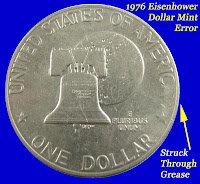 Thirty-two years later, I purchased a 1976 Type 2 dollar with an error from the US Mint. The dollar in the image on the right, you can see the lettering in “AMERICA” disappearing. The star after the word is also missing. This error is called strike through grease filled dies.
Strike through grease errors are relatively common and only add a small premium to the value of the coin. They occur during the Minting process when Mint employees apply a thin layer of grease on the dies to prevent the newly struck coins from sticking to the die after being hit with more than 40 tons of pressure. When the grease is not applied evenly, it creates a buildup. Those areas where the grease is applied too thickly prevents raised elements from striking properly.
This is not a commentary on the US Mint or the Independence Day celebration. Just something neat I found to add to the patriotic definition of the day. Enjoy your weekend and I hope you find something neat in coins, too.
Jul 1, 2008 | coins, gold, US Mint
While checking the US Mint’s Public Release RSS Feed, there was an announcement for the coming sale of the American Buffalo fractional coins. However, the press release pointed to by the feed does not exist. There is no listing for these coins in the online catalog and the product release schedule does not announce a date for their release.
The information in the RSS feed was as follows:
Washington – The United States Mint announced today that it will begin accepting orders for fractional denominations of the American Buffalo Coin, now available in proof and uncirculated versions, on July 15, at 12 noon Eastern Time. Both versions of the coin will be offered in four sizes – one ounce, one-half ounce, one-quarter ounce and one-tenth ounce, as well as a four-coin set which contains one coin in each size.
I am looking forward to see how the Mint treats the fractional Buffalo coins. Let’s see what happens over the next few days regarding this pseudo announcement.
Jul 1, 2008 | coins, quarter
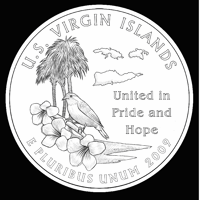 Governor John P. deJongh, Jr. of the U.S. Virgin Islands announce the results of the people’s vote to choose the design of their quarter that will be released in 2009. The design chosen was Virgin Islands Beauty, Yellow Breast, Yellow Cedar Tyre Palm. The governor’s website describes the coin as:
A geographical rendition of the Virgin Islands, which includes the 3 major islands, and the official bird of the Virgin Islands (the Yellow Breast or Banana Quit (Coreba Flaveola) and the official flower of the Virgin Islands (Yellow Cedar or Yellow Elder (Tacoma Stans)) representing the natural wonder and beauty of our islands. These are placed on the background of a beach with the Tyre Palm (coccothrinax alta) native to the Virgin Islands, and the inscription “United in Pride and Hope” the Official Motto of the Territory found on the Virgin Islands Territorial Seal.
“I am proud to forward a recommendation to The United States Mint for the Virgin Islands Commemorative Quarter design. After a three week-long voting period, Virgin Islanders have collectively selected an overall favorite design, and I thank the community for its participation in this truly historic process,” deJongh said.
Three more territories to go!
Jun 30, 2008 | coins, fun
 On the Collectors’ Society Message Boards, a user name Stefanie (handle: coinsarefun) created this image on her computer. It is a compilation of various portraits and other main elements from US coins. I thought it was so cool I wanted to share it with my readers.
To see it as a full size version, click on the image. Right-click (Mac users can CTRL-click) to save it or even set it as your wall paper. Enjoy!
Jun 29, 2008 | coins, errors, medals
Error collecting is an interesting part of the hobby. Combined with variety collectors, those interested in finding coins that are not what the U.S. Mint intended is a specialty that requires a bit of education and persistence. Some of the errors and varieties collectors look for are doubled dies, repunched mint marks, clipped planchets, off-centered coins, off-metal coins, strike-throughs, and even differences in one set of dies from another.
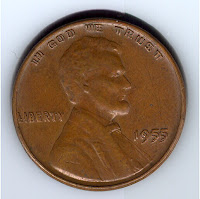 Error collecting is a relatively new specialty. The specialty can be traced to the discovery of the famous 1955 Lincoln Cent Double Obverse, now called the king of errors. Its discovery lead to people beginning to search for errors, varieties, and anything out of the ordinary.
As a result, two organizations were formed to serve various collectors. After two decades of competition, they joined forces to create the Combined Organizations of Numismatic Error Collectors of America (CONECA). CONECA now provides education services, publications, and attribution services. Its membership are responsible for some of the definitive guides to errors, including the Cherrypicker’s Guide to Rare Die Varieties by J.T. Stanton and Bill Fivaz.
 This year marks the 25th Anniversary of CONECA. To commemorate this milestone, CONECA has created a medal that will be produced in silver, silver clad, and bronze. What makes these medals special is that CONECA will be offering various “error” versions of the medals. The five variety of errors will include an off-center and various form of double strikes. You can also buy a medal that does not simulate an error.
For ordering information, see the CONECA website. When you get there, search for “25th Anniversary Medals Program” to see the medals and ordering information.
Whomever thought of creating errors from the commemorative medal deserves a pat on the back. It is a wonderful idea!
Medal images courtesy of CONECA.



 Loading ...