The U.S. Mint attempts to fix their online ordering system, but to what effect?
This past week, the U.S. Mint held a press availability for the numismatic media. I highlighted the meeting after the discussion, which includes corrections. While the U.S. Mint appears to be working to rectify its e-commerce issues, there continue to be unaddressed problems.
A few weeks ago, I wrote that it was my impression “that the lawyers had more say over policy than the appointed director or the career executives.” It is not clear that the U.S. Mint has separated its policy decision from the advice of counsel.
Missing from the discussion is how the lawyers forced the U.S. Mint to violate the law. Even though they identified the Internet Robots (BOTs), the lawyers not allowing the U.S. Mint to resolve the problem puts the e-commerce system in violation of the Federal Information Security Management Act (FISMA). FISMA was passed in 2002 to require the government to protect computing resources.
Although it sounds like a technical issue, FISMA’s purpose is to allow bureaus like the U.S. Mint to protect public access to government resources. It also allows the government to do what is necessary to serve the public.
While the dealer community is part of the public, they are not the majority of the interested public. The U.S. Mint reported that only 18 authorized purchasers could access 10% of production at a 5% premium as part of its early access program.
The U.S. Mint deserves commendation for its ability to exceed production during the pandemic. Questions remain on the decisions on collector coin programs.
OTTAWA, ON, Aug. 20, 2021 /CNW/ – The Royal Canadian Mint (the "Mint") is pleased to announce its financial results for the second quarter of 2021 that provide insight into our activities, the markets influencing our businesses and our expectations for the next 12 months. → Read more at newswire.ca
Hundreds of ancient coins looted from archaeological sites were found in a house in Bnei Brak, the Antiquities Authority (IAA) announced Monday. The artifacts were uncovered during an operation by the IAA’s Robbery Prevention Unit. → Read more at jpost.com
INDIAN RIVER COUNTY — It was a slow day Aug. 1 when Nick Amelio was treasure salvaging near Corrigan's shipwreck, just south of Turtle Trail Beach. → Read more at tcpalm.com
There are few things more alluring than buried treasure — preferably ancient and preferably gold. Historically, people tended to bury their coinage in times of trouble, intending to come back for it. → Read more at independent.ie
The U.S. Mint held a press availability for members of the numismatic media this morning. There will be more to say about the information presented, but the following are some highlights that will interest the numismatic community.
Mint management noted that the U.S. Mint is the only sovereign mint with continuing bullion production during the pandemic. In addition to the bullion coin production, the U.S. Mint has produced more circulating coins than any other time.
The U.S. Mint continues operating at the highest level while maintaining safety and controls to protect the employees during the COVID-19 pandemic.
Although it is easy to criticize the U.S. Mint, it is commendable that the bureau continued production but manufacturing more products than ever in the last 18 months.
U.S. MINT DIRECTOR DAVID RYDER noted that sales at the U.S. Mint had been declining prior to his arrival. Part of the reason is that there was not a permanent director in almost nine years. Ryder saw his job as trying to expand the product line to increase interest in the numismatic process.
U.S. MINT ASSOCIATE DIRECTOR OF SALES AND MARKETING MATTHEW HOLBEN said that the U.S. Mint had faced unprecedented demand for its products during the “black swan event.” According to Holben, the U.S. Mint sold more proof American Silver Eagle Proof coins in under a half-hour than they sold in 2019.
The U.S. Mint has 18 dealers that are registered authorized purchasers of numismatic products. These 18 dealers can purchase up to 10-percent of the numismatic products before the public sale. They credit the reduction in attempts to use automated methods to order (BOTs) now that the dealers can determine their inventory.
U.S. MINT DEPUTY CHIEF MARKETING OFFICER KIRK GILLIS said that since the first 2021 Morgan Dollar release, the catalog website could process 217 peak orders per second, up from 96 peak orders per second.
Gillis reported that “up to 60% of the activity on the sites were BOTs” based on the drop in traffic demand since the May 24 launch of the 2021 Morgan Dollar products. He said that the U.S. Mint had implemented technology to reduce the impact of scripts and BOTs used to order products.
The U.S. Mint will explore pre-ordering and waiting room software similar to the processes used by the ticket purchasing systems. They are also looking into other rate-limiting technology.
Beyond the highlights, there are other issues to explore. Stay tuned!
CORRECTIONS
The website can process “217 peak orders per second, up from 96 peak orders per second.” It was originally reported as “270 orders per second, up from 90.”
Clarified the 60% reduction in BOT activity as being since the May 24 launch of the initial Morgan Dollar products.
The ancient bundle of coins found on Habonim beach in Israel. (photo credit: OFIR HAYAT via The Jerusalem Post)
I regularly peruse online news sources looking for numismatic-related stories in non-numismatic media. The stories are not limited to geography or the news media. I find stories about numismatics on sites that cover news for different disciplines and industries.
Although I post a link to every story I read on Twitter, the stories I find the most interesting make it to the weekly post. Regular readers will notice that I find many stories about people finding ancient coins make the weekly post.
I do not collect ancient coins, but I am interested in their stories. Even though the concept of a minor was not offered when I went to college, I filled many of my electives with history and political science classes. So when I see stories about these discoveries, I read each article thoroughly. Most are very well written and include a context around the era that the coins are from.
Recently, a professor who teaches ancient history using coins to highlight his lectures said that much of what we know about rulers was learned from studying coins. He is excited about new finds because the coins could add to their knowledge of history.
While discussing the coin hoard unearthed in Israel, we discussed collecting ancient coins. He said that once the collector decides what to collect, they can compile a nice collection for the same amount of money as assembling a nice Mercury Dime collection.
An important suggestion was to buy ancient coins from a reputable dealer. It will prevent you from a claim that you have stolen cultural property by a foreign government. This is because the U.S. State Department Cultural Property Advisory Committee (CPAC) accepts any claim from any country without understanding how they hurt legitimate collectors. I have written many posts on this subject. Just search for ACCG (Ancient Coin Collectors Guild) to read those posts.
Even if you do not collect ancient coins, read the articles about the finds from around the world. The articles are fascinating and provide a look at the world’s collective history.
Israeli archaeologists working for the Israel Antiquities Authority (IAA) have discovered a Byzantine-era gold coin depicting Jesus’ Crucifixion. According to CBN News, the coin was one of several artifacts found during an excavation by Ramat Ha-Sharon, a city near Tel Aviv. → Read more at christianheadlines.com
This summer, tour guide Yotam Dahan was camping with his family on a beach near the town of Atlit, Israel, when he stumbled onto a greenish metal mass made up of 13 pounds of ancient coins. → Read more at smithsonianmag.com
August marks the 50th anniversary of Richard Nixon’s infamous decision to “close the gold window,” reneging on the U.S. government’s pledge to redeem dollars for gold. Although Nixon’s action spelled the end of the postwar Bretton Woods framework, the system in place circa 1970 was a pale shadow of the original gold standard. → Read more at thehill.com
The King of American Coins just fetched a princely, world-record sum. The single finest example of the 1804 US silver dollar sold for an astonishing $7.68 million at a Stack’s Bowers Galleries auction on Tuesday to become the most expensive coin of its kind. → Read more at robbreport.com
Madurai: Keeladi, with its rich storehouse of antiquities, has hogged the limelight, especially with the recent finding of a punch-marked silver coin dating back to the ancient Maurya dynasty. The silver coin was a hidden treasure with symbols of sun, flower and Nandi. → Read more at dtnext.in
The Chinese scammers are back after a brief hiatus. They are flooding social media with advertising for fake coins. I found three ads from these scammers offering American Silver Eagles for $9.95 on Facebook in the last two days.
NOBODY IS SELLING LEGITIMATE AMERICAN SILVER EAGLE COINS FOR LESS THAN THEIR SILVER VALUE!
As I type this, silver is $23.73 per troy ounce. It means that that the American Silver Eagle contains $23.73 worth of silver. Even with a modest numismatic premium of 5-percent (below the current market value), a silver bullion coin should cost around $25.00. A quick market survey shows that legitimate dealers are selling ungraded American Silver Eagles for $33-36 each. Coins with the Type 2 reverse are selling for $1-3 more.
Proof American Silver Eagles are more expensive because they cost more to purchase. If the U.S. Mint sells American Silver Eagle proof coins for $73.00 and dealers on the authorized purchase program receive a 5-percent discount, the wholesale price is $69.35 per coin.
Who would sell a proof coin less than the wholesale cost? If it is a genuine coin, then it is likely stolen merchandise. Otherwise, scammers are selling fakes.
Before you purchase these alleged “good deals,” please remember my five rules:
NO LEGITIMATE DEALER IS SELLING BULLION COINS FOR BELOW THE SPOT PRICE!
IF THE DEAL IS TOO GOOD TO BE TRUE, IT LIKELY IS NOT A GOOD DEAL!
IF THE DEALER DOES NOT IDENTIFY THEMSELVES ON THEIR WEBSITE, THEY ARE LIKELY HIDING SOMETHING.
Check the “About” or “Contact” page. If there is no contact information, then they are hiding. If the address is in China or the Middle East, they will sell you counterfeit merchandise.
IF THE SITE IS “POWERED BY SHOPLAZZA,” IT IS LIKELY A SCAMMER SITE.
According to contacts in the information security industry, the service is run by Chinese companies known to sell counterfeit merchandise.
IF THERE ARE ANY QUESTIONS, THEN DON’T PURCHASE THE COINS!
Please! Please! Please! Do not give these scammers your credit card information. You will be ripped off, and they will likely steal your credit card information, leading to other problems.
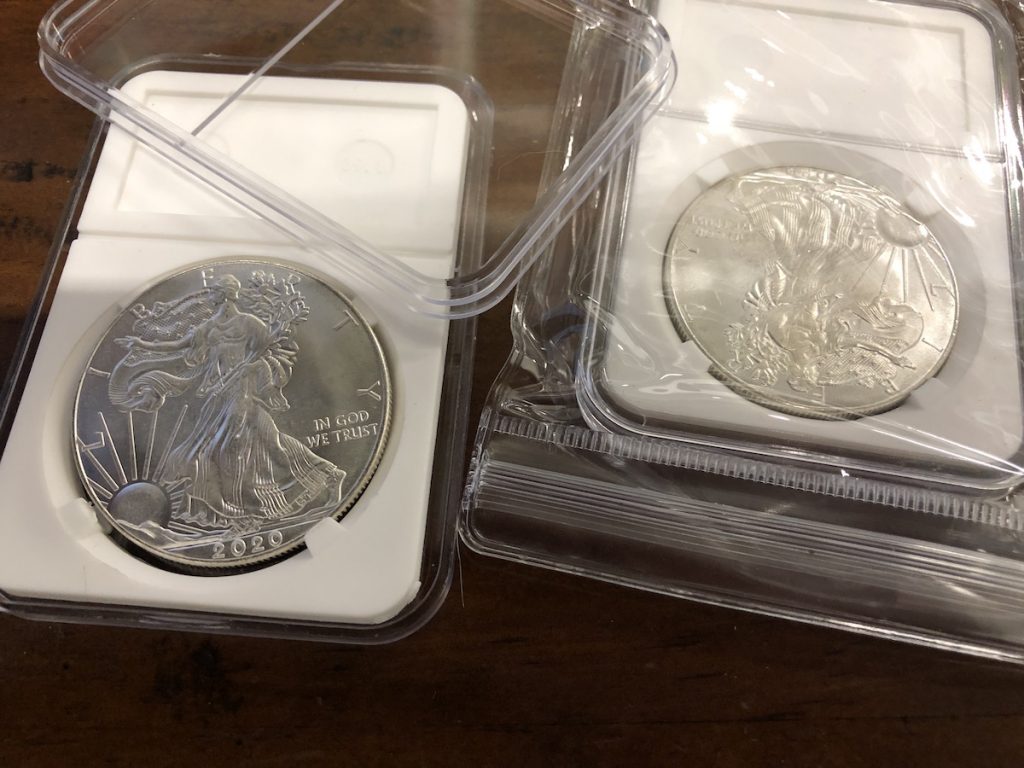
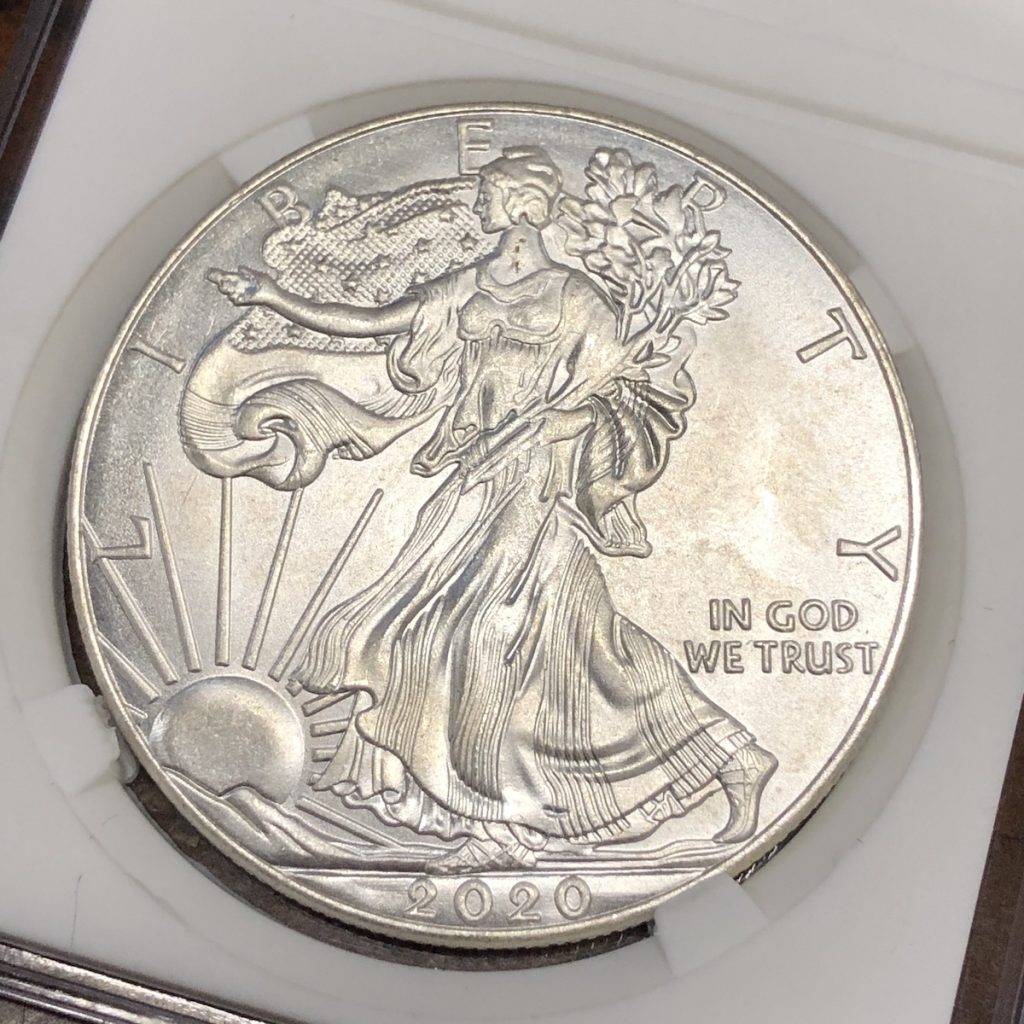
Last year, I purchased two coins knowing they are counterfeit for educational purposes only. I used gift cards to purchase the coins to prevent exposing my credit card information. Both coins are made of nickel-plated steel and contain no silver.
Two counterfeit American Silver Eagles purchased from LIACOO, a company based in China who advertised on Facebook.
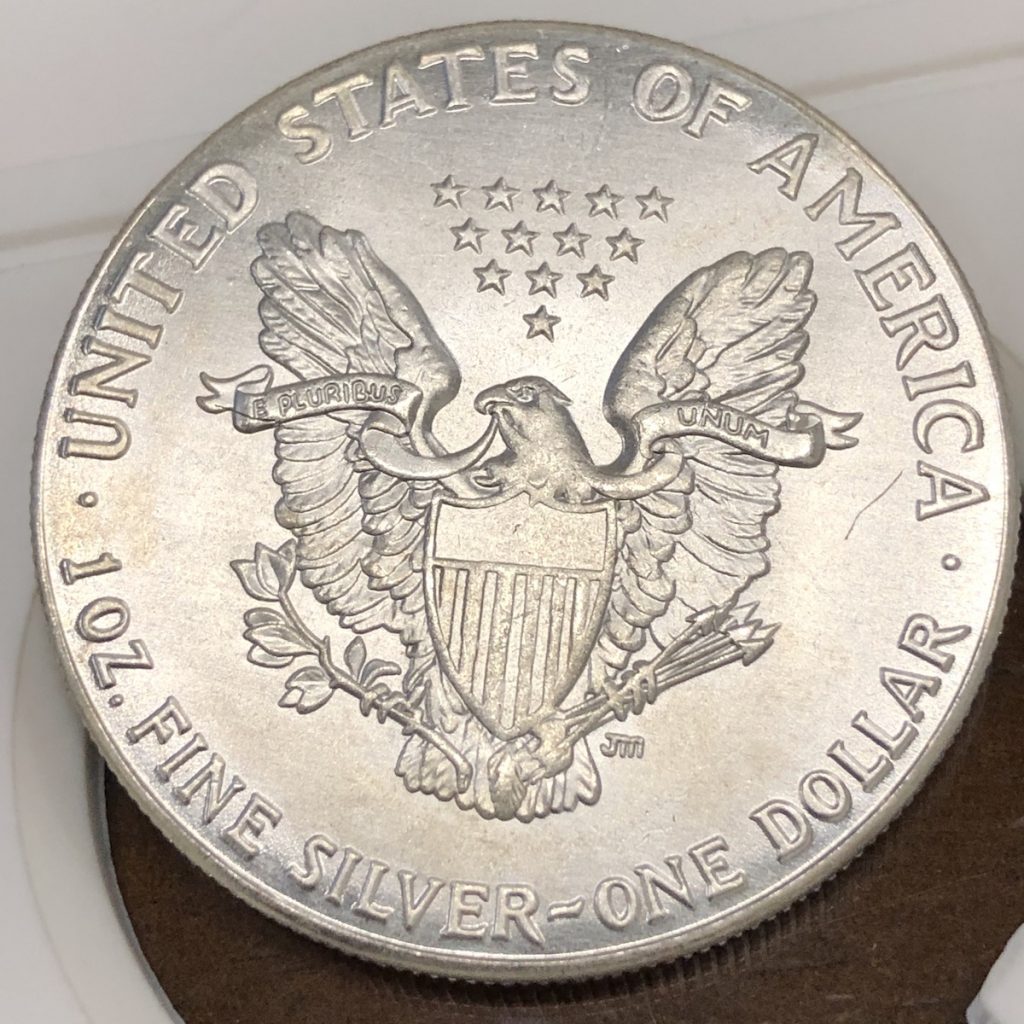
The font for LIBERTY is too thin. Also, the stars in her flag draped over the shoulder are too small.
Aside from the rims being to thin, look at the U in United and the dash between SILVER and ONE. These are not correct for the 2020 ASE.
The following excerpt was part of an email sent by the ANA this afternoon:
Unfortunately, several dealers have notified the ANA that they have tested positive for COVID-19 since returning from the show. Although protective measures were in place, the potential for exposure is always a possibility when one leaves home. The ANA is unaware of when, where or how the dealers contracted the virus. (Due to privacy issues, we are unable to provide the names of the infected dealers.)
If you feel ill or are displaying any COVID symptoms, consider quarantining for 10 days and/or getting a COVID test.
I have made my feelings known about the COVID-19 pandemic. It is the primary reason why I did not attend the World’s Fair of Money.
Every time I write about COVID-19, I receive at least a dozen emails filled with vitriol. The fact is that over 99-percent of those hospitalized with COVID-19 are not vaccinated, and 100-percent of those deaths are not vaccinated. Today, Alabama announced they have run out of ICU beds.
In the meantime, I hope that the ANA did the responsible thing and notified the appropriate people in Cook County, Illinois. They should make sure that the convention center workers are safe.
I will not attend a coin show regardless of the size until the pandemic subsides, including the Whitman Expo scheduled for November. I will deal with the short-term inconvenience for my long-term health.
Please stay healthy and safe. Please get vaccinated!
In my day job working within the collecting world, there are two hobbies whose collectors have arguments about which way is best. Comics collectors argue whose universe is better. Most of these arguments are Marvel versus DC comics, but there are interested collectors in the smaller and independent (indy) publishers. But you can go to a Comicon and find that the differences are all in fun.
U.S. numismatics collectors are different. On one side, there are the collectors of old coins. If the coin was not circulated and made of precious metals, then it is not worth collecting. They look at modern coins as “trinkets” or not worth their time. The rest of us will happily collect modern (post-1964) coins and the new issues by the U.S. Mint.
As an aside, my company sells sets of 50 State Quarters for higher prices than in 2019. Although there is an active market for this material, they sell for less than collectors paid in the 2000s.
Enough people are collecting modern material that the Treasury Inspector General has noticed the problems collectors have experienced with ordering from the U.S. Mint. Modern products are selling out as fast as they are offered, and premiums are rising 100-percent and higher on the secondary market.
For this poll, I am asking if you are collecting the coins produced by the U.S. Mint in 2021, then what are you collecting?
As always, your comments are welcome!
Are you collecting the new releases from the U.S. Mint?
I am collecting the 2021 Peace Dollar (20%, 34 Votes)
I am collecting the new Morgan Dollars (19%, 32 Votes)
I am an American Eagle Collector (19%, 31 Votes)
I always check my pockets for what comes in my pocket change (15%, 25 Votes)
I cannot wait for the proof or mint sets to get here (10%, 16 Votes)
Yes, I am collecting everything! (6%, 10 Votes)
Those commemoratives are a great addition to my collection (5%, 8 Votes)
Those new silver medals look cool as part of my collection (3%, 5 Votes)
No, modern stuff doesn't interest me! (3%, 5 Votes)
Total Voters: 65
Loading ...
If you like what you read, share and show your support
According to Coin World, the Treasury Office of Inspector General (OIG) “may” investigate how the U.S. Mint has handled the sales of limited-edition numismatic collectibles. Coin World may have confirmed information provided to me on background.
Although the web-based ordering has sort-of worked, I reported on the systemic issues facing the U.S. Mint in moving forward. In summary, my investigation found:
The alleged silver shortage was not a shortage of silver but a failure of the U.S. Mint to manage its supply chain properly.
The U.S Mint’s insistence that Internet robots (BOTs) were the cause of their web-based issues was the symptom of a more significant problem that they have not learned from their past mistakes.
The U.S. Mint’s management managing like they were afraid of repercussions because the lawyers said so. The way it sounded, the U.S. Mint management was not managing but taking instructions. If they cannot manage, should they be replaced by lawyers?
An investigation by the Treasury OIG is an excellent first step. But experience has shown that an OIG report does not guarantee that U.S. Mint will fix the problems. I have seen government managers and appointees say all of the right things and do little to nothing.
It might require an act of Congress to fix the U.S. Mint. If it requires an act of Congress, don’t hold your breath waiting for changes.
What does it take to create, publish, and maintain a price guide for coins?
Readers who downloaded my first edition of the Coin Collectors Handbook: American Eagle Coins have asked about the lack of a price guide. I hesitated to add a price guide for American Eagle coins because, with very few exceptions, the spot price of metals affects the prices. Market watchers know that spot prices are volatile. Are there differences in prices that might make working on a price guide a good time investment?
To better understand pricing and price guides, I asked several dealers what they use for pricing guidance. Most of them said the Greysheet and what the coins were selling on eBay. A few larger dealers will start their eBay auctions at $1 and sell the coins regardless of the final bid. High-volume dealers say they are rarely disappointed with the results.
Smaller dealers will subscribe to a service that will automatically adjust the prices based on the spot price and the results of the eBay inventory. Depending on the service level these dealers have with the service, the price for coins can change every day.
The pricing service can query eBay for list prices, and the prices realized to come up with their formula.
In the past, I tried to ask the people who write the Greysheet how they come up with prices. The harsh rejection at that time prevented me from asking again. It was time to look at other guides to determine how they create their prices.
Information from PCGS’s website is clear that their price guides are for coins only in their holders. In the past, PCGS noted their price guides use the prices on the Certified Coin Exchange market, which Collector’s Universe, PCGS’s parent company, owns.
Similarly, NGC notes on its website that they base their prices on the market of NGC-graded coins only. Neither service considered the market perception of CAC-certified coins. Although the Greysheet has a publication that publishes guidance for CAC-certified coins, that information is available only to subscribers.
One of the price guides not affiliated with a grading service is Numismedia. They are similar to Greysheet in that they offer a range of publications that span the market. Although their website does not disclose how they determine prices, their Fair Market Value guide has been more comprehensive and closer to retail market values than I have experienced with the Greysheet’s retail guides.
Other price guides found around the web have different concerns. A few are crowd-sourced, meaning that collectors provide input based on what they paid. Although crowd-sourced prices report real-world transactions, the information is limited to what users report and not a market survey.
Then there is the Red Book, A Guild Book of United States Coins. For 75 years, it has been the bible of coin values for many collectors. Unfortunately, the Red Book has several problems. First, it is published once a year and released in April. It means that production for the Red Book must begin before then.
A few years ago, I volunteered to work as a pricing contributor for the Red Book. I felt prices for modern coins were too low for the market, and I tried to bring them up to reality. It was challenging to make the edits using the poorly design web form. Even with my effort, much of my input did not make the book. The following year’s pricing entry was a spreadsheet, but my attempts at aligning the prices with the market did not affect the published prices.
Another problem with the Red Book is that the contributors are not given sufficient time to provide input. The process should be ongoing rather than giving the pricing editors a few weeks to edit the prices, so there is no rush before closing the edition.
Although I was not involved with the Blue Book (Handbook of United States Coins) pricing, I suspect it has similar issues.
It appears that every method used to create a price guide is flawed. Publicly accessible price guides are too generic to be taken seriously. Unless the public is willing to pay high prices for the wholesale guides, there is an opaqueness in how the industry prices coins.
Creating price guides is a difficult task. Over the next few weeks, I will continue my market survey while compiling the price guide for the American Eagles Handbook. I will share what I find here on the blog. Stay tuned!
Although this past week was the World’s Fair of Money, there was not much news surrounding the event. According to individual reports, people said that it was a good show even with the COVID precautions. It was similar to reports from The National, which was held in the Stephens Convention Center the week before.
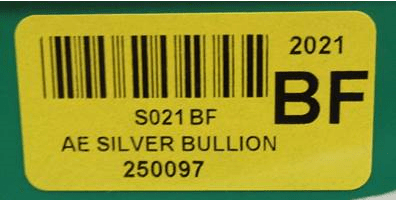
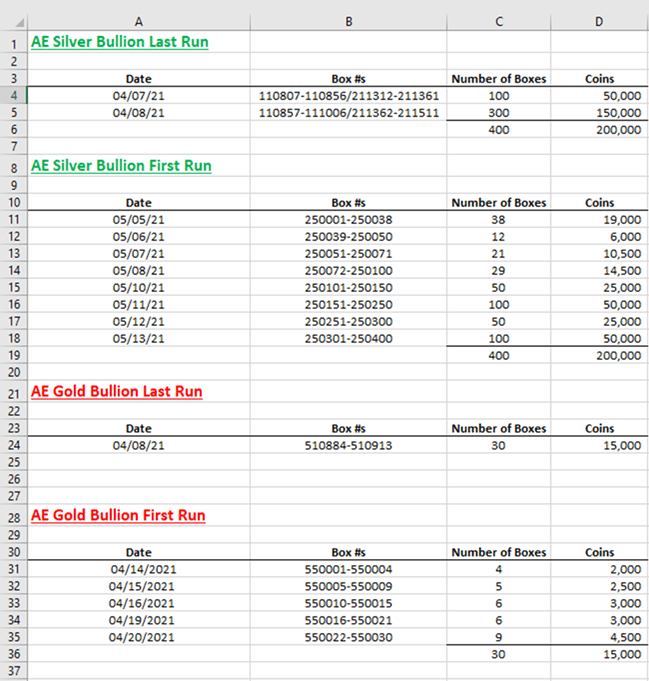
The week’s biggest news was the U.S. Mint publishing the lot numbers used to label the boxes with the American Eagle bullion coins.
Until last year, the U.S. Mint has not identified where they strike the American Eagle bullion coins. Spokespeople emphasize that since their production is for the investment market, the mint location is not relevant. Of course, collectors view the market differently. Dealers and third-party grading services have tried to determine where the coins were struck based on shipping labels and other factors. Although they are reasonably sure, there are mistakes in their assumptions.
In 2020, the COVID-19 pandemic caused the West Point Mint to close temporarily. To keep up with production, the U.S. Mint struck 240,000 bullion coins in Philadelphia. The third-party grading services asked the U.S. Mint about the production of these coins. Rather than leave the industry guessing, the U.S. Mint identified which boxes contained American Silver Eagle bullion coins struck in Philadelphia. As a result, the third-party grading services accurately noted the origin of the bullion coin on the label of their slab.
The U.S. Mint reports that some of the boxes marked with “BF” should not have the “F” since they were not part of the first production run.
Without the industry asking, the U.S. Mint released the lot information about the American Eagle bullion coins this year. Making this remarkable is the U.S. Mint broke published the lot numbers for the Type 1 and Type 2 reverses for both the silver and gold bullion coins. In fact, they noted that a few boxes had labeling errors incorrectly marking some of the coins as part of the first production.
Although the U.S. Mint has claimed it was always considerate to the collector community, it is the first time they voluntarily provided this information without prompting. Could the U.S. Mint finally be learning from past mistakes? Time will only tell.
'Remarkable' collection of 52 Tudor, Stuart and Commonwealth coins is set to sell for £500,000 at auction — including a Henry VIII coin struck in tribute to his first wife Catherine of Aragon → Read more at dailymail.co.uk
A scavenger hunt at a Talmud-era village in northern Israel took a surprising turn on Tuesday when an Israeli girl found a 1,500-year-old bronze coin. → Read more at israelhayom.com
While out camping with family on the beach, Yotam Dahan discovers 13-pound lump of coins from about 1,700 years ago which archeologists speculate belonged to a merchant ship that wrecked ashore → Read more at ynetnews.com
TEHRAN – Iranian authorities have seized some ancient coins from an illegal digger in the western province of Ilam, the provincial tourism chief announced on Wednesday. → Read more at tehrantimes.com
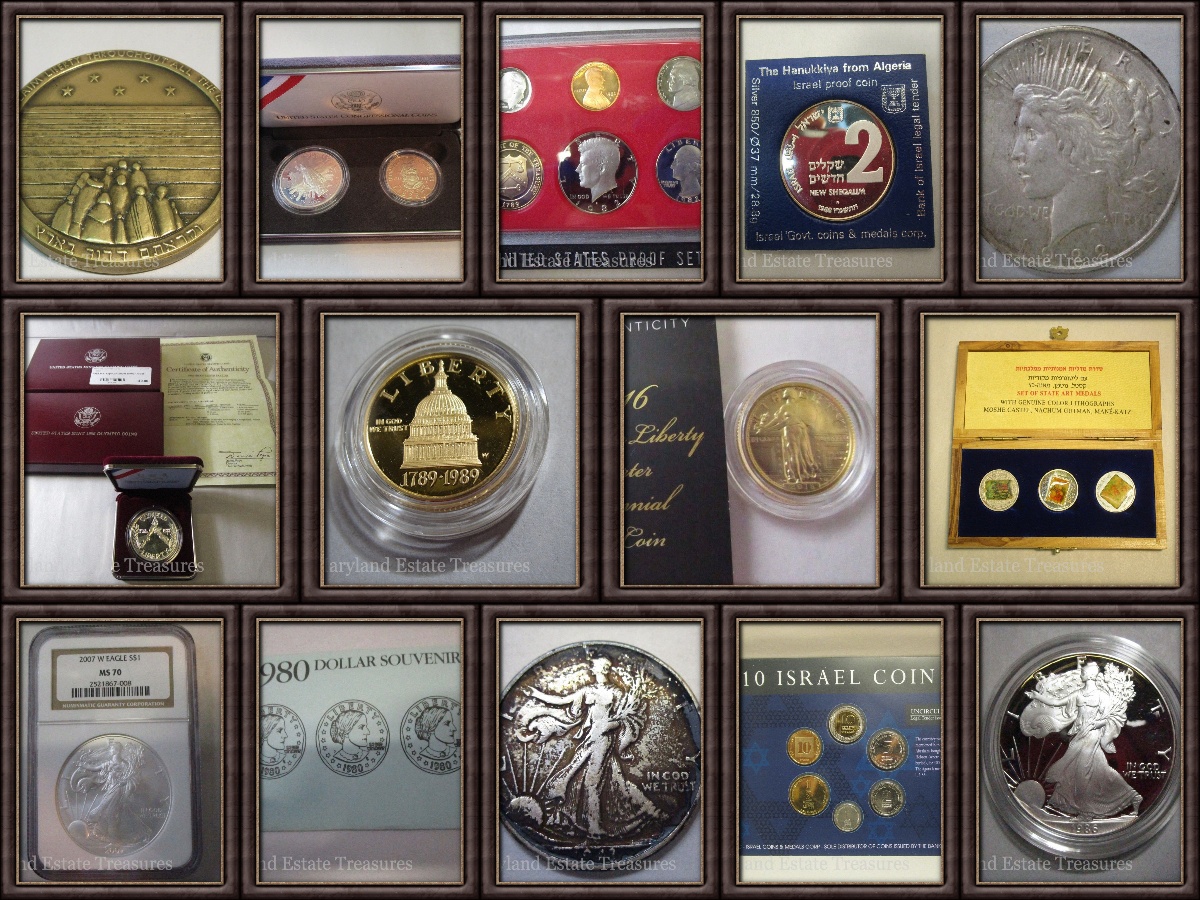
After cleaning out his house and gathering the coins hidden in many places, the entire collection was cataloged, imaged, and is now online for anyone to bid. The collection includes both United States and Israeli collectibles.
My father liked modern commemorative coins and collected almost everything produced by the U.S. Mint, including Mint Sets, Proof Sets, Prestige Proof Sets, commemorative coins, and American Silver Eagles. The collection has many Olympic commemorative coins. It was his way of supporting the Olympics and getting a coin in the process.
When you look at the coins from Israel, you can see that he collected nearly everything. In the piles of coins were appreciation medals from the Israel Government Coins and Medals Corporation for being a top customer. The collection includes many different sets that I learned about by going through this collection.
There are 557 lots of coins in this auction that will close on Sunday, August 29, beginning at 6:00 PM Eastern Time. To prevent sniping, it is a “soft close” auction. Bids received in the last 30 seconds before the auction closes will extend the bidding for another 30 seconds. Bidding will continue until at least 30 seconds passes after the final bid.


 August 24, 2021
 → Read more at newswire.ca
 The U.S. Mint held a press availability for members of the numismatic media this morning. There will be more to say about the information presented, but the following are some highlights that will interest the numismatic community.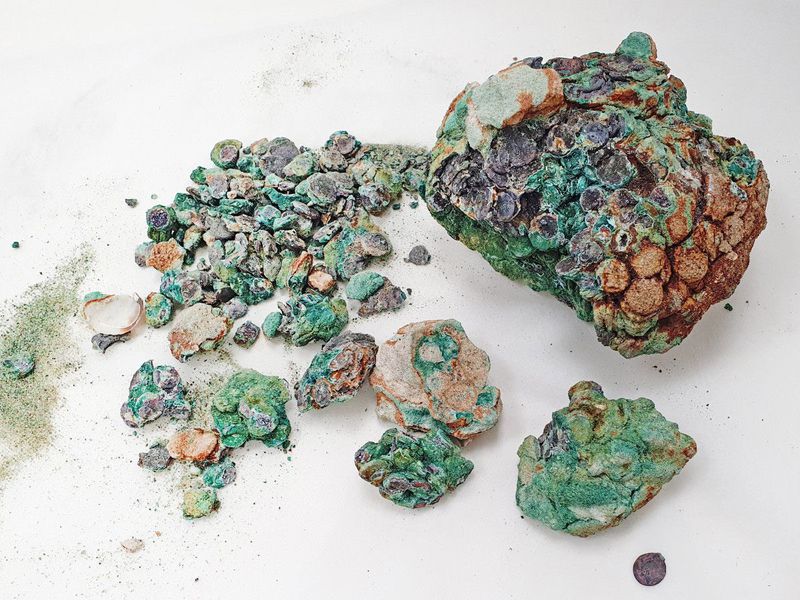

 Loading ...