
Weekly World Numismatic News for December 1, 2019 (Day Late)
Sorry for being late. It’s the holiday season and those of us in retail are busy!
‘Tis the season… for scams!
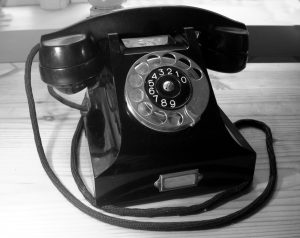
Ericsson DBH 1001 (ca. 1931), the first combined telephone made with a Bakelite housing and handset.
According to the AARP Fraud Watch Network, the people perpetrating the scams are skilled in the psychological warfare necessary to get the intended victim to believe them. Most target the elderly because they are the ones with psychological issues that come from aging, such as reduced functionalities, loss of loved ones, and a changing culture that they do not understand.
Although gold and silver scams are not new, scammers are using the confusing language of new laws that allows these criminals to hide behind the mumbo-jumbo of words.
Unfortunately, these slick-talking salespeople are good at what they do. The result is separating their mark from their money, leaving the victim broke.
The best suggestion to deal with this type of fraud is not to buy anything over the telephone from someone you do not know. It does not matter how professional they sound or good they make you feel. These people are not looking out for your best interest.
Also, do not fall for the “we will hold your gold or silver in our vaults and give you a receipt” scam. While there are legitimate companies that will offer this service, for a fee, others are not licensed or insured to keep your assets secure. If you fall for this scam, they will run away with your money while you hold onto a worthless piece of paper.
Unless you initiate the call to a verified telephone number, do not give out any personal information to the person on the other end of the line. Even if the person claims to be from a charity, you will not be able to verify whether their story is true or not. Just hang up and go on with your life. You will be happier that you did!
RECOMMENDATION: If you want to learn more about how scams occur and how to protect yourself and your loved ones from them, you will want to listen to The Perfect Scam, a podcast from AARP. Although I have heard about many of these scams, the podcast puts them into a broader context by discussing how widespread it is. If there is a vulnerable person in your life, you should listen to this podcast to learn about the signals that they may be in trouble from a scammer. You can listen to it on your favorite podcast app or visit the podcast’s homepage.
And now the news…
 November 26, 2019
 → Read more at express.co.uk
November 28, 2019 → Read more at hellomonaco.com
November 28, 2019 → Read more at independent.co.uk
November 28, 2019 → Read more at israelnationalnews.com
November 28, 2019 → Read more at twocents.lifehacker.com
→ Read more at express.co.uk
November 28, 2019 → Read more at hellomonaco.com
November 28, 2019 → Read more at independent.co.uk
November 28, 2019 → Read more at israelnationalnews.com
November 28, 2019 → Read more at twocents.lifehacker.com
Pothole Cause Armored Truck To Spill Quarters
The rear door to an armored truck failed after hitting a bump causing three $500 bags of quarters to spill on the road south of downtown Dallas.
The police were called to close the street too keep the nearby homeless population away so that the guards and city workers could pick up the quarters. Workers were seen using shovels and vacuum cleaners to pick up the coins.
The video of the scene is amusing and something that I hope will help brighten your Friday.
Video from NBC Dallas-Fort Worth local website.
Left Out of Left Coast
I am not attending the American Numismatic Association’s World’s Fair of Money® this week. I would like to attend, but the show is in Los Angeles, which is about 2,690 miles from the Washington, DC metropolitan area. Although this is closer than the 2,800 miles I would have had to travel to Portland, Oregon for this year’s National Money Show,™ both were too far to travel—especially in this economic climate.
I know the ANA had to make it up to Portland for moving the 2007 National Money Show to Charlotte. However, by doing this, the ANA has prevented a few people from attending at least one show this year.
Although I would not mind both shows being East Coast affairs, I can understand the need for a national organization to hold its conventions to make it accessible to both coasts, but to hold both on the West Coast reduces accessibility for those of us in the east.
Next year, the National Money Show will be in Fort Worth, Texas and the World’s Fair of Money will be held in Boston. Fort Worth, home of a branch of the Bureau of Engraving and Printing, will be more accessible from the West Coast than Boston. Although not perfect, it is better than if both shows would be on the East Coast.
I hope that in the future the ANA will make every attempt to diversify the location of their shows so that everyone can be included.
Endearing Art Duplicated Over 450 Billion Times
On Monday, August 2, 1909, people lined up at banks and other distribution points in America’s major cities. It was an event like the country has never seen before. For the first time in the United State’s history, a coin minted for circulation was to carry the portrait of a real person. Sure, the US Mint produced a coin with other portraits, but they were commemoratives and not intended for circulation, even though some did circulate.
 But this was different. This was the portrait of one of our greatest presidents. Abraham Lincoln, our 16th president, was being honored on the cent the year the country celebrated the 100th anniversary of his birth.
The new Lincoln Head Cent featured a portrait by Lithuanian immigrant, Victor David Brenner. Brenner, who came to the United States in 1890, learned engraving in New York City and spent the rest of his life honoring his adopted home with beautiful portraits of Lincoln, Theodore Roosevelt, and other leaders.
Even with the excitement the release was not without controversy. Almost instantly, the public did not like the prominence of the artist’s initials “V.D.B.” on the reverse of the coin. On August 5, 1909, Treasury Secretary Franklin MacVeagh ordered production halted in order to remove the initials from the coin’s reverse.
When production was halted, over 27 million were struck in Philadelphia but only 484,000 were struck in San Francisco. With the rumors that the US Mint would recall the VDB cents, speculators saved as many coins as possible. But with only 484,000 minted, the 1909-S VDB became an instant key date in the new Lincoln Cent series.
Chief Engraver Charles Barber removed the initials from the master die but did not add them anywhere else claiming it would too difficult and would take too much time. When George Morgan was named Chief Engraver following Barber’s death immediately and effortlessly added Brenner’s initials to the trunk of the bust.
Brenner’s design lasted 50 years even with a one-year composition change in 1943. In order to preserve copper for the war effort, over 1 billion coins were struck in 1943 on zinc-coated steel planchets—which were not popular when they were circulated.
For the 150th anniversary of Lincoln’s birthday, the US Mint’s Tenth Chief Engraver Frank Gasparro redesigned the reverse of the coin to show the Lincoln Memorial. The obverse would continue to use the Brenner portrait of Lincoln.
As we celebrate the Bicentennial of Lincoln’s birth, the reverse of the coins were redesigned for the celebration. But as it has been since it was introduced in 1909, the cents feature the portrait of Lincoln designed by Victor David Brenner.
Since August 2, 1909, the US Mint says that they have struck over 450 billion Lincoln Cents. This probably makes the Brenner portrait of Lincoln the most duplicated of any portrait in history. Talk about history in your hands!
Well… It Was Shiny
Continue to search through my change looking for 2009 coins. Since leaving Charlotte, I have not been able to find another 2009 coin.
When I go to a store, I become a little excited as the cashier hands me shiny coins. If I cannot take a quick glance, which is becoming more difficult as my eyes are showing their age, I put the coins in my pocket and check when I get home.
Earlier this week I went to a local grocery store and paid with cash. I noticed the shiny copper coin that was dropped into my hand. I looked at the coin with excitement and thought I saw a Log Cabin Lincoln Cent. But there was a line and I was in a hurry to go home.
Later that evening I emptied my pocket and found the coin. Rather than seeing a log cabin it was coat of arms. A closer look was that it said “Commonwealth of the Bahamas” with the year of 2004. The reverse of the coin has star fish and the denomination of “1 Cent.”
According to The National Bank of the Bahamas, the coin is 19.05 mm in diameter and 1.58 mm thick. The Lincoln Cent is also 19.05 mm in diameter but only 1.55 mm thick. Both coins are made from copper-plated zinc.
The Central Bank of the Bahamas ties its currency to the US Dollar making it an even exchange between the currencies. In this case, a cent is worth one cent and I broke even.
Even though it was nice to find a Bahamian coin in pocket change, I am still waiting to find my first 2009 quarter, nickel, and dime.
It May Take More Than a Beer
We are living in interesting times. The economy has problems and the experts cannot decide whether we are seeing a recovery or experiencing the proverbial dead cat bounce. Politics has gone berserk as the 24-hour news cycle cannot make heads or tails of the events in Washington as they watch the sausage making process of how to deal with 17-percent of the gross domestic product.
Collectors may have thought that we could withdraw into our world of numismatics and ride out this storm. The economy may be bad, but a creative collector can find other ways of enjoying the hobby. But this might now be the case.
From online forums to printed publication, there have been stories of collectors not being treated well by dealers. Stories have ranged from ignoring people at shows to dealers being rude in their own shops.
When I returned to collecting after my first wife died I felt a bit intimidated. I was interested in the hobby but I had forgotten what I had learned many years earlier. After 20 years away I found that the entire hobby changed with the growth of third-party grading. I was overwhelmed! But I found a dealer who was willing to talk with me, answer my questions, and point me in the right direction. I was so grateful that I purchased a starter collection of Peace Dollars from that dealer at a fair price.
Then I moved onto shows. I went to the Baltimore show for the first time and was awe struck by the size. But I was able to walk around the floor and talk to almost anyone about collecting. They were not put off by my questions and I was satisfied with their answers. This continued when I attended by first American Numismatic Association show when a large auction house allowed me to look at a $4 Stella even after I told the dealer that I could not afford the coin.
Over the last year I have noticed a change in the attitude of dealers. I have been ignored at some tables and practically chased away the table of a very well known dealer. I thought these were isolated incidents until I read the stories of people being accused of being tire kickers and wasting dealer’s time.
What is happening to the hobby?
Is the economy affecting dealers so much that in their haste to just make money they are chasing away future customers? Don’t they realize that a tire kicker may eventually be a buyer?
I know there are a lot of good dealers because I make sure I talk with many of them at the Baltimore show. But what about the other dealers? Are these rude dealers giving the hobby a bad name?
I am not against dealers making a living. In fact, I cheer for their success so that I can sit at their tables or visit their shops to ask questions and learn more about the hobby. I want them to be successful so that they can be there to help me find that special coin.
I know that times are difficult and that some online auction sites may be cutting into your business. But if you can hang in there, the economy will improve and business will return. In the mean time, please be nice to that young numismatist who walks up to your table with her father in tow to ask what their folder of circulated State Quarters are worth. It would not hurt to use this as an educational moment and build good will with a future customer.
Support the Coin Collectors Blog
 Buy me a coffee
Thank you for your support!
Let Me Know What You Think
Are you going to the World's Fair of Money
Total Voters: 17
 Loading ...