
VIDEO: World’s Largest Coin Pyramid (Almost)
This one is just for fun.
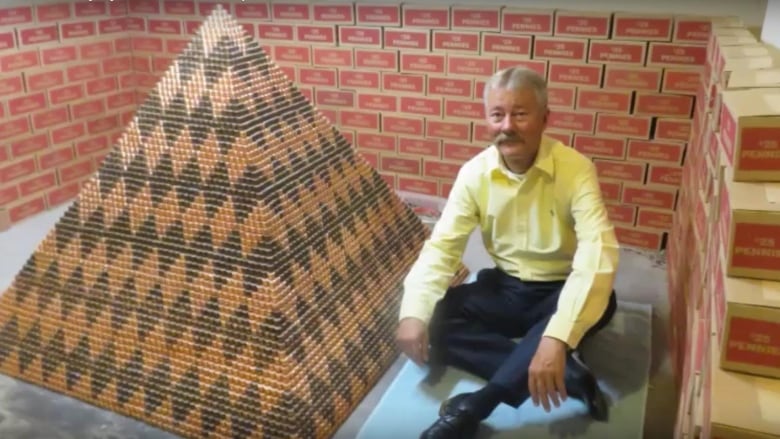
Cory Nelson poses with his World Record creation (screen grab from YouTube)
In an interview with CBC Radio, Nelson said that after building a coin pyramid with 41,000 coins on his desk, his coworkers asked if it was the world’s largest. He said that if it were not, he would make sure it is.
According to the Guinness World Records, the record was 1,000,935 Lithuanian one-cent coin by Vytautas Jakštas and Domas Jokubauskis. The pair built their coin pyramid in 2014 using Lithuanian Litas as a celebration before Lithuania converted to the Euro.
After three years of work on it for 20 hours per week, 45 YouTube videos tracking his work, and 1,030,315 Lincoln cents later (that is $10,303.15 worth of coins), Nelson submitted his creation to become the world records holder. It will take a while for GWR to verify the record.
Here’s the final video of Nelson’s pyramid:
60 Minutes on Minting Costs
CBS News’ ubiquitous weekly news magazine, 60 Minutes, broadcasted a report on Sunday that discussed the costs of producing cents and nickels (see embedded video below). According to the US Mint, over 8 billion copper-coated zinc cents were produced ($80 million) costing the Mint $134 million to produce. Producing 1.3 billion nickels ($65 million) made with the .75 copper alloy that has been in use since 1866, and cost $124 million.
Source: CBS News
Mint Director Edmund Moy, who was interviewed for the report by Morley Safer, said that the costs were a direct result of the rising metal prices. “You know, coins are made out of metal,” Moy said. “And worldwide demand for copper, nickel and zinc have dramatically increased over the last three years. That’s what’s primarily driving up the cost of making the penny and nickel,”
Stephen Dubner, the co-author of the bestseller Freakonomics, puts the penny in the same category as your appendix and other useless relics. “It’s just not useful,” Dubner said. Unfortunately, Dubner may not have heard that researchers may have found that the appendix does have a useful function.
The focus of the report was to look at the economics of continuing the production of Lincoln Cents. While the report mentioned the tradition of the cent and the coin features Abraham Lincoln, probably the country’s greatest president, and the 2009 redesign program, the argument about removing these coins from circulation are based on their economic worth. But if they are useless and have no value, then why is there a demand for these coins being produced?
I have previously explained that the Mint’s primary “is to produce an adequate volume of circulating coinage for the nation to conduct its trade and commerce.” To carry out this mission, the Mint distributes coins to the Federal Reserve System banks and branches as necessary. Regardless of the cost of production, is it really necessary for the Mint to produce so many cents for circulation?
Unlike commemorative or other collectible items, the number of business strike coins distributed is determined by the individual Federal Reserve banks. As the need arises, the Federal Reserve banks place orders with the Mint for coins to distribute to the nations banks. From those banks, coins are circulated to the public through business or teller operations. Although there are some stockpiles of under used coinage (mostly halves and dollars), the Mint uses “just-in-time” inventory management and distribution like many other manufacturing facilities. Thus, productions of business strikes are based on the demand created by the ordering practice of the various Federal Reserve banks.
If the cent is obsolete and economically infeasible with little buying power, then why is the Federal Reserve ordering so many for circulation?
Source: CBS News
Tornados Close US Mint Fulfillment Center
The following was posted today on the front page of the US Mint catalog website:
February 7, 2008 – Due to the severe weather in the Tennessee area, the United States Mint is currently not shipping from its fulfillment facility in Memphis for the next one to two weeks. Expedited shipping will not be available until further notice. We apologize for this inconvenience. Please be assured that we will ship your orders as soon as possible.
Orders continue be accepted from the website and the toll-free ordering line. The orders will be processed a week or two later.
Mint Catalog Site to be Down on Saturday
Dave Harper, editor of Numismatic News, reported on his blog that the US Mint will be taking their catalog website off line at 4:00 AM on Saturday, February 9. The outage should last for four hours. The telephone ordering service begins its day at 8:00 AM when the catalog website should be active again.
Let’s see if the Mint has learned anything from its past outages. Stay tuned.
Expanding a New York Collection
In 1636, the area we know as Long Island was settled by Algonquin tribes who settled there to escape more war-like tribes. The Algonquin call the island Paumanok, meaning “The Island that Pays Tribute.” On the arrival of the first Dutch settlers, they negotiated for a section of land just off of what we know as Jamaica Bay. They called the land Lange Eylandt (Long Island) in reference to its 118 mile length, and their settlement was named Breuckelin after a town in Holland. It was the first European settlement on the island.
By 1640, the English Puritans started settling the eastern end, coming down from New Haven, Connecticut. Subsequently, the English began to assert dominion over the region and claimed the propriety. In 1694, the English renamed the land as Long Island, the original Dutch Settlement became Brooklyn, and the Dutch colony founded on Manhattan Island was renamed as New York.
After 300 years, the United States was in a depression but collectors were being inundated with commemorative coins. In 1936, 16 new designs were issued and five others had not reached their authorized mintage. However, the Long Island Tercentenary Committed lobbied for a commemorative coin to coincide with the 300th anniversary of the first European settlement in May, 1936. But the bill allowing the mintage of 100,000 coins was not passed until April 13 of that year.
 The coin was designed by Howard Kenneth Weinman, the son of Adolph A. Weinman. To honor the settlement, the obverse features a right-facing bust of a Dutch colonist overlapping a bust of an Algonquin tribesmen. The reverse features a 17th-century ship under full sail traveling over a rolling sea. Because maps showed west-to-east passages as being from right-to-left, critics noted that the right-facing ship appeared to be heading back to Holland. Howard Weinman’s placed his initials under the the Algonquin’s chin by placing an H atop of the letter W, which was similar to the way his father included AW on his coin designs. In passing, the monogram could be mistaken for the elder Weinman’s.
Since 2008 will be the year I concentrate my collecting on items related to the areas once called New Amsterdam and Lange Eylandt, it was time to find a nice Long Island Tercentenary commemorative for the collection, I wanted to find a nice, even colored, mint state example. With a net mintage of 81,773 coins sold during the year after its release, I knew I would be able to find a nice example. The one I found was graded as MS60 by the dealer and purchased for a good price. It is a beautiful coin to add to the growing New York/Long Island collection.
American Buffalo and the Chinese New Year
On Friday, the US Mint announced that the American Buffalo 24 karat gold coin will begin selling on Tuesday, February 5. It was noted that the release coincides with the Lunar New Year that begins on February 7 since the number “8” is traditionally associated with wealth and prosperity in Asian cultures. For 2008, the Mint will be producing special packaging associated with this occurrence.
Although the US Bureau of Engraving and Printing has been offering the Lucky Money Collection products for a few years, this is the first time such a product is being offered by the US Mint. Of course, it is easier for the BEP to offer such products using the properties of the serial numbers to promote these products. Also, it should be noted that Mint Director Edmund Moy is the first Asian-American to hold this position.
Notably different will be the price of the proof coin. With the price of gold at historical highs ($907.90 when the market closed on Friday), the Mint has priced the coin at $1,018.88. The last price for the 2007 American Buffalo was $899.95. The press release notes that “as with all precious metal numismatic products, a future pricing change may be required.”
Given the state of the economy, it will be interesting to learn how this product will sell. I know I will wait before purchasing.
Support the Coin Collectors Blog
 Buy me a coffee
Thank you for your support!
Let Me Know What You Think
Are you going to the World's Fair of Money
Total Voters: 17
 Loading ...