
Brace yourself, the U.S. Mint is about to release another product for the kids
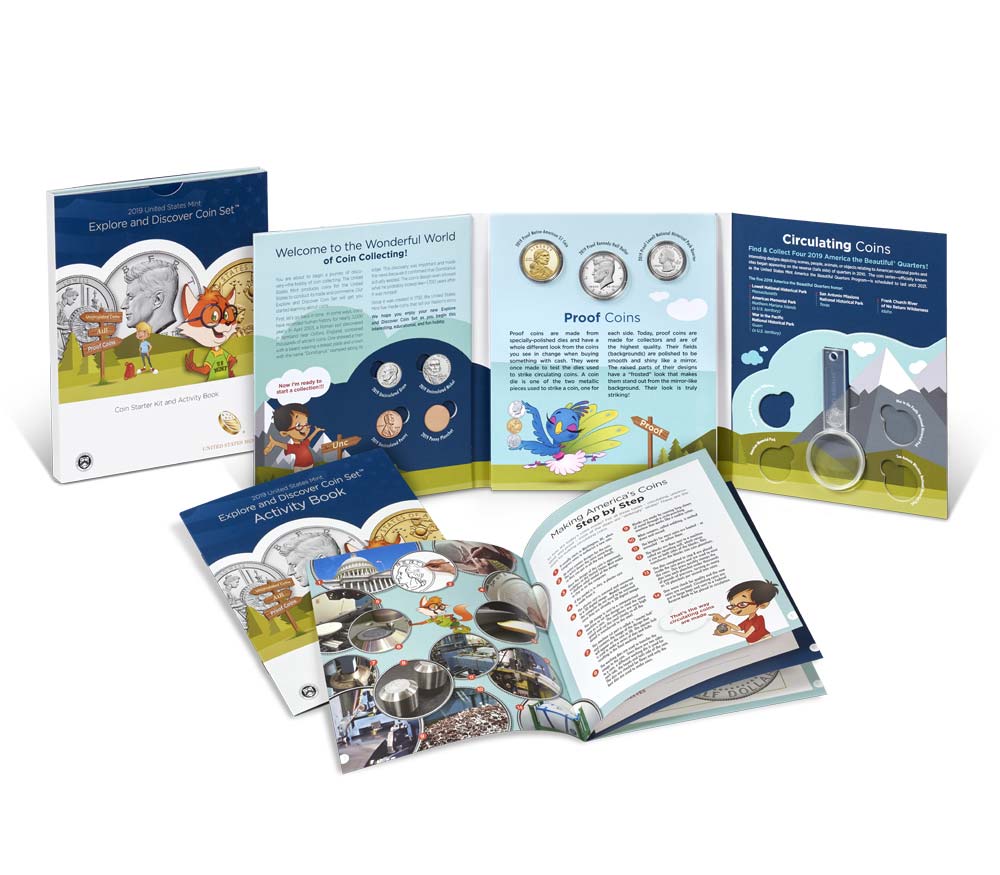 Although the U.S. Mint has not formally announced it, on March 28, 2019, they will make the 2019 Explore and Discover Coin Set (Product Code 19XGB) available to the general public. It is the second of three sets to be issued this year designed to get kids interested in coins.
This set features new characters they call the Mighty Minters.™ According to the U.S. Mint, the Might Minters are “fun, diverse, and relatable ambassadors to children, parents, and gift-givers. Each character projects its own style while introducing a variety of new Mint products to kids.” Although the concept may seem cheesy to us alleged adults, those who deal with the diverse population daily understands that in order to get the younger people interested they have to be engaged on their level.
I know. I know. It was different when we grew up. Back then you could still find silver coins in pocket change. Wheatback cents were about as common as Memorial cents are today. People even tried to use Susan B. Anthony dollars in their daily lives before confusing it with a quarter.
But that was the past.
Today’s children have a much different view on things. For one, if they are 18 years old or younger, they were born after 9/11 or were an infant and do not remember what happened. They grew up with the Internet, smartphones, and computers everywhere doing nearly everything. You can get access to everything at almost any time while their parents always bought things online.
Not only is money still important but the United States government owns the world’s largest money manufacturing business. No other mint manufactures, sells, or is more profitable than the United State Mint. It is an agency that does not get enough credit for producing billions of dollars of goods that our economy thrives on.
The U.S. Mint’s products are useful and collectible. And while there have been a few design issues, it is able to produce millions of versions of the art that people carry around daily and with an error rate that should make any company envious.
Errors are a fun aspect of the hobby because the rate of the errors is low. This is likely why the U.S. Mint is including a blank one cent planchet in the set. Not only does it show what a coin looks like before it is struck, but it also introduces kids to error collecting.
The Explore and Discover Coin Set introduce kids to the full range of circulating products produced by the U.S. Mint including the longest running design in the Mint’s history: Victor D. Brenner’s Lincon cent design.
In addition to a 2019 Jefferson Nickel and Roosevelt Dime, they are introduced to the Kennedy Half-Dollar. One of the quickest coin designs ever produced, the Kennedy half-dollar is not circulated as half-dollars once were. Although there are a lot of theories as to why half-dollars stopped circulating, one was that the 1964 half-dollar, which was made using an alloy that was 90-percent silver, was saved by many in honor of the slain president coupled with the coin shortage that followed effectively ended the coin’s circulation.
Also in the set is the first 2019-issued Lowell National Historical Park Quarter and 2019 Native American $1 Coin featuring American Indians in the Space Program honoring the achievement of Native Americans dating back to Mary Golda Ross (Cherokee Nation), the first Native American engineer at NASA.
These are two coins that should help kids not only learn about the coins but also about the subjects they depict. This should not discount the dollar coin’s obverse of Sacagawea carrying her baby, Jean Paul Baptiste.
It is another opportunity for the hobby purists to weigh in on how the U.S. Mint is getting it wrong before it sells out!
Spying Using Canadian Coins
United State Defense officials are reporting that American contractors were carrying coins planted on them in Canada that contained radio frequency identification (RFID) transmitters. RFID transmitters are small chips that contain a small power source to allow these items to broadcast small bits of information. RFID is used for inventory tracking, security tagging, keyless door locks on cars, and electronic toll systems. Transmission ranges can vary by the type of chip used and the environment.
Reports confirm that an unidentified Canadian coin was hollowed out and its metal replaced with the RFID transmitter. The coins were “planted” on three security cleared contractors between October 2005 and February 2006 as they traveled through Canada.
RFID transmitters can be used to track the movements of those carrying the coins. “You might want to know where the individual is going, what meetings the individual might be having and, above all, with whom,” said David Harris, a former Canadian Security Intelligence Service (CSIS) officer. “The more covert or clandestine the activity in which somebody might be involved, the more significant this kind of information could be.”
 Containers made to look like US dollar coins are a familiar tactic to US intelligence agencies. The CIA displays such a case on their museum website. The International Spy Museum in Washington, DC has similar displays.
  As for Canadian coins, the most likely coin used is the $1 coin, nicknamed the Loonie because its traditional reverse design features a Common Loon, a dominant bird in Canada. The Loon is 26.5 millimeters in diameter and 1.95 millimeters thick. The $2 coin, nicknamed the Twoonie, is a bi-metallic coin and would be more difficult to modify.
Although the type of RFID chip has not been identified, experts are saying that the transmitter in a coin would have a limited transmission range. It is said that the metal casing could constrain its range. Some of the technologies do have limited transmission ranges, but there are versions of the technology that could be tracked for a few kilometers.
“I’m not aware of any (transmitter) that would fit inside a coin and broadcast for kilometers,’ said Katherine Albrecht, an activist who believes such technology carries serious privacy risks. “Whoever did this obviously has access to some pretty advanced technology.”
The risk of the carrier spending the coin is great. but the ability to track a potential target would be a risk spies might take. As our Canadian friends search their change, they may want to see if the coins have been hollowed and contains an RFID chip. That would be an interesting find!
Jamestown 400th Anniversary Commems On Sale
 Today at noon, the US Mint made the first coins of 2007 available for purchase from their on-line catalog. To celebrate the 400th Anniversary of the first permanent settlement in North America at Jamestown, Virginia, the Mint is issuing proof and uncirculated gold and silver commemorative coins.
The Mint will be offering all coins at a pre-release discount until February 12. The proof silver sells for $35 but will be raised to $39 after the pre-release period. The uncirculated coins will sell for $33 then be raised to $35. The gold proof is selling for $232 and the uncirculated gold coin for $220. Both gold coins will be increased by $25 after the pre-release period. Shipping is expected to begin in late January or early February.
Coins may be ordered from the Mint on-line or via the telephone at 800-USA-MINT (800-872-6468).
Surcharges from the sale of these coins will be donated to the Jamestown-Yorktown Foundation of the Commonwealth of Virginia, the Department of the Interior, and the Association for the Preservation of Virginia Antiquities to support programs that promote the understanding of the legacies of Jamestown.
BREAKING NEWS: Whitman Loves Charm City
Whitman Publishing, publisher of A Guide Book of United States Coins, has purchased the Baltimore Coin and Currency Convention. Reports say that the announcement was made by Ed Kuszmar and Gordon Berg, the show’s founders, at the Florida United Numismatics (FUN) convention in Orlando. Although an official announcement has not been published, the contact information for the Baltimore show’s website says “Whitman Baltimore Coin and Currency Conventions, L. L. C.” in Atlanta.
More information as it becomes available.
Up Next… Jamestown 400

 The US Mint announced that the launch of the Jamestown 400th Anniversary Commemorative Coins will be held on January 11, 2007, 10 A.M., at the Jamestown Settlement in Virginia. Collectors attending the ceremony will be able to purchase the gold and silver collectibles on site. Those unable to attend may order these coins from the Mint’s online catalog starting at noon on January 10.
Images from the US Mint. Click to see larger versions.
Westward Journey into History
With the authorization provided to the US Mint under Section 8 of the San Francisco Old Mint Commemorative Coin Act (Public Law No 109-230 [GPO: Text, PDF]) expiring, sets and rolls containing the 2005 Westward Journey Nickels are no longer for sale. If you missed the opportunity to purchase these items, you will have to find them in the secondary market.
If you are still looking for nice collectibles for the Westward Journey Nickel series, the Mint continues to sell the First Day Coin Covers for the 2004, 2005, and 2006 nickels.
Support the Coin Collectors Blog
 Buy me a coffee
Thank you for your support!
Let Me Know What You Think
Are you going to the World's Fair of Money
Total Voters: 17
 Loading ...