
It was wurst than I thought
After my last post about the Staatliche Münze Berlin, the Berlin State Mint, a few German readers provided a lesson in the political structure of Germany to understand the institution’s role in the country’s coin production.
Unlike what I wrote previously, the Berlin State Mint is a government mint but for the government of the Federal State of Berlin.
Berlin is one of two cities that is also designated as a state. The other is Hamburg. The divisions trace back to the many small states that existed in the region during the days Holy Roman Empire. In short, it was an attempt to bring unification to the region by attempting to allow each smaller states, kingdoms, principalities, cities, etc. to provide their own rule for the common good. Some reference suggests that there were over 300 individual governments with their own governing rules at the height of the Empire.
Arguments, wars, and Napolean brought about many changes where many of the smaller states merged into larger ones and others changed by conflict. Following the Treaty of Versailles that ended World War I, Germany was forced to give up territories that left the current state boundaries were mostly set as they are today.
Although the Third Reich tried to unify the country around a federal government, there were a number of administrative functions left to the states including the minting of coins and printing of currency. Even Adolph Hitler learned that to keep his version of an orderly government, he had to work with each of the states.
Following World War II, the concept of the confederation of states continued with the formation of the Federal Republic of Germany (West Germany) and the German Democratic Republic (East Germany). Although the federal government has evolved with more central power, the states continue to have a degree of independence in their operations that a person with a background in United States history would consider a confederation.
As the country evolved and times mandated change, many of the mints were closed. Production consolidated with the changes in the political structure of Germany. Following the unification of Germany in 1990, only five state mints remained:
- A: Staatliche Münzen Berlin, the Berlin State Mint (www.muenze-berlin.de)
- D: Staatlichen Münzen Baden-Württemberg, State Mint of Baden-Wuerttemberg, Munich (www.mintbw.de)
- F: Bayerisches Hauptmünzamt, Barvarian Main Mint, Stuggart (hauptmuenzamt.bayern)
- G: Staatlichen Münzen Baden-Württemberg, State Coins Baden-Wuerttemberg, Karlsruhe (www.mintbw.de)
- J: Hamburgische Münze, Hamburg Mint (muenze.hamburg.de)
NOTE: First letter on the line is the mintmark associated with the mint.
-

- Berlin State Mint
-

- State Mint of Baden-Wuerttemberg, Munich
-

- Barvarian Main Mint, Stuggart
-

- State Mint Baden-Wuerttemberg, Karlsruhe
-

- Hamburg Mint
When the euro was introduced, German law mandated that the minting of the euro coins would be distributed evenly among the five mints. Any production beyond the federally mandated requirement to produce the euro is between the mint and the Finance Minister of the state.
As for the currywurst coin, although it is produced by the Berlin State Mint, it is a product of that mint and not a product endorsed by the German federal government.
If you are confused you are in good company. Even after spending parts of three days looking into the history, I am not sure I am right. It is more confusing than the structure behind the U.S. Mint!
Proposal to Extend the 50 State Quarters Program
Few programs from the US Mint have driven the interests of numismatics that the 50 State Quarters program. Reports from the Mint and industry resources have shown that the interest in new issues is more popular than ever. With the end nearing, will the interest continue after Hawaii’s quarter is issued? One solution is to extend the program one more year to honor the District of Columbia and the territories: the Commonwealth of Puerto Rico, Guam, American Samoa, the United States Virgin Islands, and the Commonwealth of the Northern Mariana Islands.
H.R.3885, District of Columbia and United States Territories Circulating Quarter Dollar Program Act, was introduced on September 9, 2005 proposes to extend the program one year to issue six quarters for DC and the territories. The bill was introduced by DC Representative Eleanor Holmes Norton and co-sponsored by Rep. Madeleine Z. Bordallo (Guam), Rep. Donna M. Christensen (Virgin Islands), Rep. Eni F. H. Faleomavaega (American Samoa), and Rep. Luis G. Fortuno (Puerto Rico). None of these representatives are allowed to cast a vote on the floor of the House of Representatives—but they do have voting privledges in committees.
As a resident of the metropolitan District of Columbia area, I know there are many who feel that DC’s status as a non-state but the home of the federal government hurts the District in many ways. Pro-statehood groups readily show how badly the District is treated by the carpet baggers called Congress, who oversees its affairs. DC even provides three electors to the Electoral College. So why not have a quarter honoring the home of the federal government and the 450,000 residents who are taxed without real representation in congress?
But why stop with DC? Each of the territories are very distinct in their culture and background that could lead to some very interesting designs for the quarters. Since the residents of these territories are Americans (the carry US passports) and each add their own part to the American culture, they should have a quarter to commemorate for when they became a territory. It could make the 2009 set one of the most beautiful one-year series of the entire program!
If H.R.3885 was to pass, 2009 will be a fantastic year for numismatics. Aside from the DC and territory quarters, the Presidential $1 Coin Act that commemorates the presidents begins along with the new Lincoln Head Anniversary Cents issues. The thought makes the collector in me excited. I think I will write to my representative and ask him to support of H.R.3885 and make 2009 an exciting numismatic year.
Bully for TR
Part of my day job is to analyze the impact of laws and policies on the security of computing systems. Although I enjoy the research, there are times it gets tedious and I need a diversion. Today’s diversion was to log into THOMAS, the website of the Library of Congress where citizens can look up bills and resolutions from congress, where I entered “coin act” as a search string.
The search turned up 55 bills—many of which are different versions of the same bill. Many of the bills are for commemorative coins along with the Presidential $1 Coin Act (codified in Public Law 109-145). But what caught my eye is the Theodore Roosevelt Commemorative Coin Act (S.863) to honor the centennial of his winning the Nobel Peace Prize. Roosevelt was the first US citizen to win Alfred Nobel’s prize, the first sitting president to be so awarded (the only other sitting president to win the Nobel Peace Prize was Woodrow Wilson for his founding of the League of Nations, the forerunner to the United Nations).
Roosevelt was known as a reformer with a real vision as to how to modernize a nation still recovering from a bloody Civil War and draconian laws from the Victorian Age. Roosevelt was a man of strength and a man of peace. He won the Nobel Peace Prize for negotiating the 1905 peace treaty ending the Russo-Japanese War. A truly remarkable American.
For us numismatists, Roosevelt initiated the “Golden Age of American Coin Design.” Using his bully pulpit, he held the designs of the US Mint’s Chief Engraver Charles E. Barber in contempt and ordered coinage whose designs were more than 25 years old to be redesigned. Roosevelt was a fan of sculptor Augustus Saint-Gaudens and asked Saint-Gaudens to redesign the small cent. Rather than use the Liberty design in an Indian Headdress for the small cent, it was used on the 1907 $10 gold coin. Roosevelt also asked Saint-Gaudens to design the $20 gold double eagle coin to rival the beauty of all classic coins.
Unfortunately, Saint-Gaudens died of cancer before he could redesign the small cent. Roosevelt continued to look to revitalize US coinage and seized on Abraham Lincoln’s 100th birthday to redesign the small cent. He was steered to Victor David Brenner, whose bust of Lincoln was used as the model for the new Lincoln Cent first issued in 1909. Not only was Lincoln the first president to appear on a circulating coin, but Brenner’s obverse is still in use today.
The impact of Roosevelt’s redesign continues to be felt today. Saint-Gaudens’ image of Liberty from the $20 coin is being used today on the American Eagle Gold Bullion Coins. With his impact on American coinage, it is astounding that Roosevelt was not honored with a commemorative coin of his own.
The Theodore Roosevelt Commemorative Coin Act is the perfect way to honor this great American. The Act calls for three commemorative coins: one to represent his presidency using designs from James Earl Fraser and Augusts Saint-Gaudens; one with the obverse commemorating Roosevelt as a Rough Rider with a reverse from the Saint-Gaudens $20 coin; and an “Adventurer” coin with an image of Roosevelt on horseback that is based on the Fraser statue that stands at the American Museum of Natural History in New York City. Although I am not a collector of commemoratives, I would purchase these coins.
S.863 was passed by the Senate on December 16, 2005 and sent to the House of Representatives the next day. The next day, the bill was “Held at the Desk” since the calendar makes aspects of the bill impractical to enact. It was too late to complete the bill in order to honor Roosevelt in 2006. This bill was discharged from the Senate a few weeks later, which formally lays it to rest.
Although it is too late to honor Roosevelt for the 100th Anniversary for winning the Nobel Prize, it is never too late to bestow this honor to a reformer, veteran, peace maker, and great President. Hopefully, congress will give us numismatists and fans of Teddy Roosevelt a present and revive this act for the future.
End of May Update
It has been a very busy few weeks. Now that our Memorial Day weekend is over, I thought it was time to catch up on a few items.
Tom Noe, the indicted coin dealer charged with allegedly bilking the Ohio Bureau of Worker’s Compensation (BWC), pleaded guilty to three counts of federal campaign finance violations. Noe was charged with using friends and associates to funnel $45,400 to President Bush’s re-election campaign. It was reported that the plea deal came with a recommendation for a 2-year prison sentence. If Noe had gone to trial, a guilty verdict could have resulted in a 15-year sentence and over $900,000 in fines. Noe still faces charges in Ohio for the BWC case.
In Rock Me Amadeus, I wondered if the Austrian Mint would issue commemoratives honoring the 250th birthday of Wolfgang Amadeus Mozart. My posting said that the Austrian Mint scheduled the release of Mozart collectibles on May 10th. A visit to their site lead me to Euro Collections International, the official dealer for the Austrian Mint’s North American Market. My quick search found an 2006 Austrian 5 Euro siver commemorative in a special collectors card and a 50 Euro gold commemorative coin. I also found a 2006-D uncirculated and proof 10 Euro commemorative coins from the German Mint (the D mint mark indicates the was struck at the Munich Mint).
I also have been waxing poetic on the beauty of silver and its price. Silver closed at $12.42 today, below the $13 price I wrote about earlier. Like all investments, you have to decide what is best for your needs regardless of what Bill Gates and Warren Buffet do for their portfolios! I am still buying silver, but I am watching the price a little more closely.
Finally, my friends have been asking me about hoarding Lincoln cents since it costs more to make than face value. One thing everyone missed was that the cost to mint the coin also includes labor, materials, and other costs. The costs of the metal used to make the Lincoln Cent costs less than face value and not worth hoarding. Spend those little brown beauties. A future posting will look at the arguments for keeping or doing away with the cent.
Honoring Memorial Day
On this Memorial Day, I want to take this opportunity to remember those who gave the ultimate sacrafice while defending freedom at home and abroad. Whether it was wars for this country’s freedom, helping allies overseas, world wars, or helping others settle armed conflict around the globe, it is important we take this day to honor their service that helped make this country what it is today.
Regardless of how you view the current world conflicts, the men and women who serve in our military deserve the honor and respect for their service. Pray for their ability to safely return home.
We will resume numismatic writings shortly.
When is a Penny not Worth a Penny?
 Last week, I was as intrigued with the political stories as many of you have been. Since I had purchased a copy of USA Today to read these revelations, I decided to read the rest of the paper. In the business section was the article “Coins cost more to make than face value” explaining that the US Mint estimates that it will cost 1.23 cents to strike the Lincoln Cent and 5.73 cents to strike the Return to Monticello nickel.
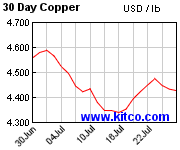
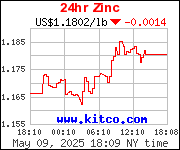
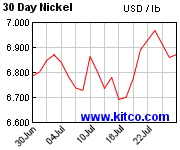 This article and a similar article from Numismatic News explains that along with the rising metal prices, fuel and processing costs will has caused the price of production to rise. The composition of the cent is 97.5% zinc plated with copper (2.5 grams) and the nickel is made with 75% copper and 25% zinc (5 grams). As I write this, the closing price per pound of zinc is $1.4952, nickel is $9.4092, and copper closed at $3.6266. Prior to the change in 1982, the composition of the Lincoln cent was 95% copper and the rest tin and zinc with a weight of 3.11 grams.
 Before anyone starts to hoard these coins, the Mint told USA Today that the actual metal content of the cent is less than face value and the nickel is only fractionally more. Even if one was to hoard Lincoln cents from before 1982, the cost to process those coins to remove other metals and impurities would cost more than the net refined copper. With the rising cost of base metals, the future hoarding of US coinage could present an interesting problem.
The Mint is one of the few profit-making agencies of the federal government. They reported a profit of $730 million last fiscal year. Mint officials estimate that profits will be down by approximately $45 million.
I wonder how that would change if the Bureau of Engraving and Printing stopped making $1 Federal Reserve Notes and the demand for $1 coins increased? But that is a discussion for another entry.
Support the Coin Collectors Blog
 Buy me a coffee
Thank you for your support!
Let Me Know What You Think
Are you going to the World's Fair of Money
Total Voters: 17
 Loading ...