Mar 24, 2007 | coins, dollar, GSA, shows
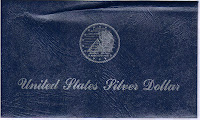 While walking around the ANA National Money Show on Saturday with my father, I met a dealer who had a blue envelope that said “United States Silver Dollar” in a fancy script on the cover with a 1922 Peace Dollar in a shrink wrap next to the envelope. I was intrigued and asked the dealer about the coin. The dealer removed it from his case and told me that he bought as part of a lot with other items. The dealer did not know much about the coin except that it was sold as part of a “GSA Hoard Sale” that was offered after the sale of the well known Carson City Dollars.
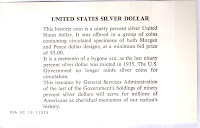
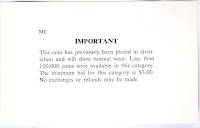 I like Peace Dollars. Aside from being a classic beauty, the are the first non-modern set I put together—which includes the 1928 Peace Dollar my fiancée (now my wife) bought for me as a gift! Within the envelop was the dollar shrink wrapped with a special GSA token and two information cards. One card was about the coin and the other about the sale. The more I looked, the more interested I became.
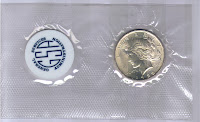 With loupe in hand, I looked closely at the coin. Even though the cards say that the coin is circulated, the dealer and I agreed that if it was circulated, that it was very lightly handled. Some wearing on Liberty’s cheek and neck along with the nice luster had both of us agreeing that the coin should grade MS62/63. The dealer was asking for a modest price over the price he paid, so I made the purchase.
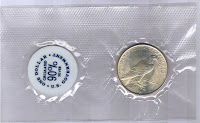 When I came home, I searched for more information and found this site that explained how the GSA sold what has been called the “GSA Hoard” that included the famed Carson City Dollars and over 100,000 additional circulated and uncirculated silver dollars. This report noted that there were “84,165 circulated and 27,980 uncirculated coins minted between 1859 and 1935.” The 84,165 circulated silver dollars were various types including Seated Liberty, Morgan and Peace Silver Dollars with mint marks from other US Mint branches.
The article reports that the GSA never published the number that they sold of the blue softpack dollar. It is estimated that there were 100,000 of these coins sold.
The ANA National Money Show in Charlotte was a lot of fun. Now it is time to go to Baltimore for the Whitman Baltimore Coin and Currency Convention.
Mar 22, 2007 | coins, dollar, errors, US Mint
The US Mint announced the availability of Sacagawea Dollars this week. Under the provisions of the Presidential $1 Coin Act (GPO: [text]/[pdf]), the Mint has to produce one Sacagawea Dollar for every three Presidential Dollars struck. Since the Mint is scheduled to produce 300 million George Washington Dollars, they are required to strike 100 million Sacagawea Dollars to be in compliance with the law. According to the Mint, the 2007 Sacagawea Dollars will benefit from the improved processes developed for the Presidential Dollar Program including shinier surfaces and a treatment to prevent the unusual toning of the past.
Although the Glenna Goodacre design is one of the Mint’s best in recent memories, the coin has not gained popularity with the public. As long as the Bureau of Engraving and Printing continues to print one-dollar Federal Reserve Notes, one-dollar coinage will not be popular. The only significant circulation of these coins was in the year 2000, its first year of issue. That year, the Mint struck 1.2 billion coins which are reportedly still being warehoused by the Mint and the various Federal Reserve banks.
The proliferation of edge lettering errors has prompted a lot of discussion in the numismatic industry. Professional Coin Grading Service (PCGS) has joined the fray and announced rewards for finding specific types of errors caused by the edge lettering. Recently, PCGS awarded $2,500 to a Colorado collector who found a Presidential Dollar blank planchet with edge lettering.
Since the Sacagawea Dollar is struck on the same planchets, presses, and post finishing process as the Presidential Dollar without the edge lettering, there is speculation that some may appear with edge lettering. While some insist this type of error is highly unlikely because the edge lettering is a separate process, PCGS is offering a $10,000 reward for being able to certify a genuine Sacagawea Dollar with edge lettering of a Presidential Dollar.
If you find a Sacagawea Dollar with edge lettering, contact me through this blog. I would love to be first to report the find and post pictures.
Mar 20, 2007 | ANA, coins, shows
I arrived at the Charlotte Convention Center at 9:45am and waited for the “official” opening. After registering, I milled about the crowd and noticed members of the ANA Board of Governors congregating at the entrance area. Executive Director Chris Cipoletti climbed on the podium to open the show. After words from ANA President Bill Horton and the Chairman of the Charlotte National Money Show, the ribbon was cut to allow the show to open.
After walking passed the club booths I entered the exhibit area. Since this was my first ANA convention, I wanted to see the exhibits to understand what I could do in the future. Some exhibits were very impressive. One on Israeli tokens won a blue ribbon was very good. Another showed State of Georgia error notes that was presented very well won second place in its class. It a few adjustments from a blue ribbon. Then there were some in the history category that did not include any numismatic items that confused me. Overall, most of the exhibits were very interesting and has inspired me to create one in the future.
As I was leaving the exhibit area, I found Don Pearlmann standing with the George Walton 1913 Liberty Head Nickel. Pearlmann, who is just as entertaining in person as he is in print, held court near the famous nickel talking about his role in its introduction to the world after it was authenticated in 2003.
Entering the bourse floor, I noted that the traffic was brisk but smaller than expected. In fact, compared to what I have seen in Baltimore, the ANA show is less than half the size. I started by meandering through the “high rent” district where the auctioneers and high-end dealers were located. I saw a quite a few very nice gold coins, all beyond the limitations of my budget. But I looked anyway. In that area, I did find a dealer with some nice raw Morgan Dollars and picked up an 1879-CC Morgan Dollar in Extra Fine condition for a good price.
Touring the floor, I spoke with a number of dealers. Most are very friendly and are willing to talk about their coins, the show, the weather, or almost anything. I had a nice conversation with Joan Miller of Miller’s Mint out of Patchogue (pronounced PATCH-oag), NY; a short greeting with Julian Liedman of Silver Spring, MD; and the DC-area members of the United States Mint and Bureau of Engraving and Printing. I also met Dave Harper (editor of Numismatic News) and was able to thank Dave Lang (NGC Director of Research) personally for autographing a book I won from the Numisma-Quest weekly trivia question on the Collectors’ Society chat boards.
It was also an honor to meet Ken Bressett, the editor of the Red Book. Bressett was at the Whitman Publishing booth autographing copies of the new Red Book. Usually, I purchase the Red Book cheaper from a dealer. But I could not pass up the opportunity to have one autographed by Ken Bressett. Bressett is a small, slight gentleman who is very gracious and pleasant. This copy of the Red Book is now one of my treasured possessions.
I continued to walk the bourse floor looking for top quality 1976 coins for my registry sets. All things considered, I was very surprised to find a lot of dealers did not have many 1976 coins. Of the modern coins, State Quarters, Westward Journey nickels, and Kennedy Half Dollars seem to dominate the cases. But I sat in front of a number of tables with my loupe looking at some nice coins. My efforts lead me to find some really nice 1976 Kennedy Halves and Washington Quarters that I will be sending to NGC for grading.
Every show I have been to in the last few years, there is one coin type that seems to be there in abundance. For this show, there were a lot of Morgan Dollars. Nearly every dealer had rows and piles and Morgan Dollars of every year and every grade. If you were looking for Morgan Dollars for a collection, you could not have been happier in Charlotte.
While looking in the budget area, I found a dealer with Mint rolls of uncirculated 2007 American Silver Eagles. That dealer opened the roll and allowed me to pick out two beautiful coins that I purchased for $2 over the spot price! One goes in an album and the other will go to NGC for grading.
At 3:30pm, I returned to the BEP booth for the next drawing of the limited edition show print. BEP was selling 100 intaglio prints made at the show that was autographed by the printer on site. In order to win, you had to write you name on a piece of paper and put it in a bowl. When they drew the names, you had to be there to claim the print. After watching the demonstration and listening to the discussions, I put my name into the bowl and waited for the 4pm drawing. After 16 were claimed and many were disqualified for not being present, my name was picked from the bowl. This gave me the ability to purchase print number 37. I purchased the print and one of the regular prints and walked to the USPS booth. There, I purchased a 39-cent stamp, placed it on the regular print, and had it stamped with the special postmark the USPS made for the show.
Finally, at 6pm I went to the ANA Board of Governors candidate forum where I met Cliff Mishler. But that is another story for another time.
I returned to the show on Saturday afternoon with my father. While there, I purchased a 1922 Peace Dollar in a GSA package, something I have never seen before. My father looked at a lot of gold coins but did not buy anything. I even saw a Stella $4 goloid coin that Superior Galleries are selling for $500 thousand!
Over all, I had a wonderful time. I hope to have some time to take pictures of some of my better items soon. In the mean time, real work awaits.
Mar 14, 2007 | coins, dollar, errors
There have been reports of various minting errors for the new Washington Dollar coins, but a Denver couple found a number of blank planchets with edge lettering. Somehow, the coins missed the striking process but were processed passed inspectors to have the lettering pressed into the edge. Coins are from the Denver Mint Facility. There were no reports as to how many of this error may be in circulation.
Mar 14, 2007 | coins, dollar, grading, varieties
ANACS, the oldest certification service, has now published their population report. The report is accessible via the web and requires a free user account. Their population report not only includes the standard varieties, but also a listing of all of the errors of a particular type. For example, a search of 1976-P Type 2 Eisenhower Dollars shows that ANACS has graded Broadstruck, Clip, Double Clip, Double Struck, Die Adjustment Strike, Indent, Off-Center, Partial Collar, Split Planchet, Struck Thru, and Struck Thru Grease errors. I like that!
ANACS is also offering grading of Washington Dollars for $8 through March 31, 2007. There is a 10 coin minimum for their 10 day grading service. I may buy a roll from the bank and see what I can send to ANACS for grading because this is a good deal!
Mar 13, 2007 | ANA, coins, Eagles, US Mint
Before I leave for the Queen City of the Carolinas, I wanted to first let my readers know that the US Mint announced that the American Silver Eagle Proof coins will go on sale at noon on March 27. This beautiful one-ounce silver coin, featuring the Walking Liberty design by Adolf A. Weinman, will be sold for $29.95.
Other than that, I am off to Charlotte. I will have a report when I return. Have a good weekend.
Mar 9, 2007 | coins, dollar, errors
Susan Headley, the Coins Guide on About.com, wrote a great frequently asked questions (FAQ) article that is worth reading. It sets the records straight as to what is known about the smooth or plain edge error on the George Washington Dollars. Read about it here.
Mar 9, 2007 | coins, dollar, errors, US Mint
A March 7, 2007 press release issued by the US Mint recognized “that an unspecified quantity of [George Washington Dollar] coins inadvertently left the United States Mint at Philadelphia without edge-lettering on them.” Calling it a quality control issue, the Mint said that they are “looking into the matter to determine a possible cause in the manufacturing process.”
Unfortunately, there are media abusers whose knee-jerk reaction was to call this a way to “remove God from our coins.” This could be the furthest from the truth and readers are advised to consider the source before trusting any information these smear merchants may pronounce.
Mar 8, 2007 | coins, dollar, errors, scams, varieties
If you search the online auction sites, you will find less than honest sellers trying to sell variations in the positioning of edge lettering of the new George Washington Dollars errors or varieties. Letters that are pointed up, or the top of the letters towards the obverse, are considered “normal” by these sellers. Letters that are pointed downward, or the top of the letters closer to the reverse of the coin, have been called errors or varieties. They are neither.
An accepted definition of a variety “is any variation in the normal design of a given coin, usually caused by errors in the preparation or maintenance of the coin dies.” They are also errors caused in the striking process. But these definitions do not account for the differences in the orientation. The problem is that after the planchets are struck into coins by the high speed coining machines, they are mechanically collected and fed into a machine that will press the lettering into the edge of the coins.
The machine that adds the edge lettering uses a three part collar to impress the incuse lettering does this without regard to position. not only could the edge lettering face any direction, but the lettering can appear at any position along the edge. The US Mint confirms this by saying that because of “the minting process used on the circulating coins, the edge-incused inscription positions will vary with each coin.”
Since the Mint is saying that the process can vary, these variations are normal for the design. Since these are normal variations, they are not numismatic varieties or errors. Thus, the coins with variations of orientation edge lettering are not worth the premiums being sought online. They are worth their face value of $1.
There have been errors found with the edge lettering. The most infamous has been called the “Godless Dollars” for coins missing their edge lettering and the motto “In God We Trust.” Most of these coins were minted in Philadelphia and discovered in Florida. Others have found doubling of edge letters and what looks like breaks in the three-part collars where letters have moved out of place. These are legitimate errors and worth a premium above face value. Orientation variations of the edge lettering are not errors.
If you want to consider these varieties, please save your money and visit your local bank. You can purchase these coins for face value without shipping and handling fees. If you purchase a 25-coin roll, you can spend the coins you do not want since they are legal tender.
Mar 1, 2007 | coins, commemorative
As March begins, it is time to check with our friends in congress to see what is next on the numismatic agenda. Using Thomas, the legislative service of the Library of Congress, I found that Michigan Senator Debbie Stabenow (D), co-sponsored by Senator Carl Levin (D), introduced S.587, Model T Ford Automobile Commemorative Coin Act, to commemorate “the Model T Ford Automobile and the 100th anniversary of the Highland Park Plant, Michigan, the birthplace of the assembly line.”
The impact of the assembly line that Henry Ford developed to manufacture the Model T in 1910 is considered a hallmark in the growth of industry in the United States. It made the Model T more affordable to more people and turning the United States into a culture built around he automobile. By 1918, half of the cars sold were the Ford Model T.
Ford did not stop with the assembly line. Ford paid the assembly line workers $5 per day, a significant mount in the early 20th century, understanding that by paying more it will make his workers consumers.
S.587 calls for the minting of 500,000 commemorative coins made from 90-percent silver, weigh 26.73 grams, and have a diameter of 1.5 inches (38 mm). The design is supposed to “be emblematic of the Model T Ford and the assembly line.”
If passed, this commemorative will be sold in 2010. Sales of these coins will include a $10 surcharge that will be shared with the Automobile National Heritage Area Partnership Inc. to create an educational endowment and The Edison Institute.
The bill was introduced on February 14, 2007 and has been referred to Senate Banking, Housing, and Urban Affairs.

 While walking around the ANA National Money Show on Saturday with my father, I met a dealer who had a blue envelope that said “United States Silver Dollar” in a fancy script on the cover with a 1922 Peace Dollar in a shrink wrap next to the envelope. I was intrigued and asked the dealer about the coin. The dealer removed it from his case and told me that he bought as part of a lot with other items. The dealer did not know much about the coin except that it was sold as part of a “GSA Hoard Sale” that was offered after the sale of the well known Carson City Dollars.
 I like Peace Dollars. Aside from being a classic beauty, the are the first non-modern set I put together—which includes the 1928 Peace Dollar my fiancée (now my wife) bought for me as a gift! Within the envelop was the dollar shrink wrapped with a special GSA token and two information cards. One card was about the coin and the other about the sale. The more I looked, the more interested I became.
 With loupe in hand, I looked closely at the coin. Even though the cards say that the coin is circulated, the dealer and I agreed that if it was circulated, that it was very lightly handled. Some wearing on Liberty’s cheek and neck along with the nice luster had both of us agreeing that the coin should grade MS62/63. The dealer was asking for a modest price over the price he paid, so I made the purchase.
 When I came home, I searched for more information and found this site that explained how the GSA sold what has been called the “GSA Hoard” that included the famed Carson City Dollars and over 100,000 additional circulated and uncirculated silver dollars. This report noted that there were “84,165 circulated and 27,980 uncirculated coins minted between 1859 and 1935.” The 84,165 circulated silver dollars were various types including Seated Liberty, Morgan and Peace Silver Dollars with mint marks from other US Mint branches.
 Loading ...