Apr 30, 2007 | coins, history
George Washington was President of the United States. The United States Senate held its first public session in 1794. Eli Whitney patented the cotton gin. The Whiskey Rebellion occurred when farmers in the Monongahela Valley of Pennsylvania rebelled against federal liquor taxes and the army was called in to put down the uprising. Fort Wayne was founded.
Matthew Perry, an American commodore who was instrumental in opening relations with Japan, was born on April 10. Cornelius Vanderbilt, entrepreneur and first railroad tycoon, was born on May 27. Abraham Clark and John Witherspoon, both signers of the Declaration of Independence died that year.
Alexander Hamilton was the Secretary of the Treasury but the US Mint was under the Secretary of State Edmund Randolph. David Rittenhouse was the first Director of the US Mint. Robert Scot was the first Chief Engraver of the Mint. In 1794, only half-cents and large cents were minted because the money for surety bonds could not be raised in order to allow for the minting of silver coins. Even though there were half dismes struck with the 1794 date they were actually minted in 1795.
Two hundred and thirteen years have passed since 1794. We have seen wars and peace; prosperity and poverty; great philanthropists and robber barons. We have transformed our economy from agrarian through the industrial revolution that saw great factories built only to be replaced by a largely service-based economy. We had presidents whose grand monument in South Dakota is dwarfed only by their achievements, presidents who left in violence, to presidents who left in shame.
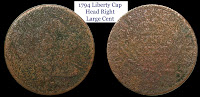 What has this country seen in 213 years? Imagine holding in your hand a coin that reads “ONE CENT” that has been worn over time and has a barely readable date of 1794. The edge lettering is worn away. This coin once helped feed someone, maybe a family. This coin may have helped a family with housing. It may have seen the pockets or great men or the purses of great women. It could have provided a worker with libations in a dockside pub or a moment of release for someone down on their luck. It was part of the birth of a nation and stay around as it matured.
In 1794, Robert Scot added the Liberty Cap, a Phrygian cap on a Liberty Pole, behind the effigy of “Liberty” to symbolize the country’s freedom. It was reported that 918,521 of these pure copper coins were minted. Like the country that minted it, this coin has survived.
When someone asks why I collect coins, I show them this old and worn 1794 Liberty Cap Large Cent and ask if they can imagine what this coin may have seen. It is an awesome thought!
Apr 27, 2007 | ANA, coins, Red Book, shows
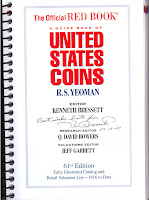 After the ANA National Money Show in Charlotte I wrote about meeting Ken Bressett, the editor of the Red Book. Bressett was at the Whitman Publishing booth autographing copies of the newly released 2008 Red Book. Rather than purchase my copy from a dealer, I could not pass up the opportunity to have one autographed by Ken Bressett.
Bressett is a small, slight gentleman who is very gracious and pleasant. When I arrived at the table where Bressett was having a conversation with what seemed like an acquaintance, Bressett excused himself to speak with me. Unfortunately, I stammered like a star-struck teenager not knowing what to say to this icon of the industry. While being at a loss for words is not a usual occurrence, Bressett eased into small talk about the show.
For many years, the Red Book was the price guide for collectors. It was the first numismatic book I owned in the early 1970s. While that book is no longer part of my collection after being lost in one of my many moves, this autographed copy of the Red Book is now on my desk and will remain one of my treasured possessions.
Apr 26, 2007 | coins, nickels, rareties
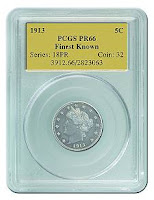 An unnamed California-based collector purchased the Eliasberg 1913 Liberty Head Nickel for $5 million. The finest known of the existing 1913 Liberty Head Nickel was graded PR66 by the Professional Coin Grading Service was owned by Legend Numismatics of Lincroft, New Jersey and Bruce Moreland, a Washington state business executive. They paid $4.15 million in May 2005 for this coin.
The pedigree of this coin is attributed to Louis E. Eliasberg Sr., a Baltimore banker whose renowned collection included “one of everything.” His collection was sold following his death in 1976.
Of the five examples known to exist, one is owned by the Smithsonian Institute and the other by the American Numismatic Association.
Slab image from Legend Numismatics.
Apr 25, 2007 | coins, state quarters, US Mint
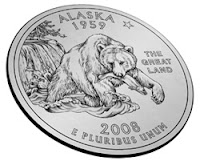 Alaska Governor Sarah Palin unveiled the design for the quarter that would represent Alaska as part of the 50 State Quarters® program. The design will feature a bear wading in a stream with a salmon in its mouth and the caption “The Great Land.” An addition design element is the star that will appear to the right of the state name acknowledging Alaska’s place as our northern most state.
Governor Palin will forward the design to the US Mint for inclusion in the program. Once called Seward’s Folley for Secretary of State William H. Seward Jr., who promoted the purchase in 1867. Alaska was seen as a frozen waste and too far from the mainland of the United States. Later, the abundance of natural resources, including petroleum, redeemed Seward from eternal scorn. Alaska entered the union in 1959 as the 49th state. Its quarter is scheduled to be issued during the summer of 2008.
Coin image from the Alaska Commemorative Coin Commission.
Apr 24, 2007 | coins, state quarters
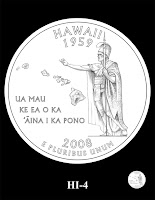 Hawaii Governor Linda Lingle announced that she has selected the state’s recommended design for the last of the 50 State Quarters.® Governor Lingle accepted the recommendation of the Hawaii Commemorative Quarter Advisory Commission which validated the results of a public on-line poll. The design selected received the most number of votes in the poll.
The design chosen includes the King Kamehameha I statue on the right side of the coin, with his hand stretching toward a map of the eight main Hawaiian islands. The State motto, “Ua mau ke ea o ka ‘āina i ka pono” (The life of the land is perpetuated in righteousness) will be on the lower left side of the coin. The rest of the elements are what is required by the 50 State Quarters program.
The governor said that the design will be submitted to the US Mint for approval. Hawaii’s Commemorative Quarter is scheduled to be released in the fall of 2008 and will be produced for 10 weeks as the last quarter of the series.
Image courtesy of the Hawaii Governor’s office.
Apr 24, 2007 | ANA, Carson City, coins, dollar, shows
Morgan Dollars were not popular during the time they were being struck by the US Mint. They were not considered particularly beautiful and most people outside of a few western states preferred to carry paper currency. But the Bland-Allison Act of 1878 and the Sherman Silver Purchase Act of 1890 prescribed large purchases of silver from western mines and the minting of silver coinage to back silver certificates. This continued until the Panic of 1893 when the decline in the economy created a run on the gold supply. Then many were melted as a result of the silver recall prescribed in the Pittman Act while others were stored in Treasury buildings to be discovered by the General Services Administration in the 1960s.
Since their last mintage in 1921, the dollars designed by Mint Engraver George T. Morgan did not enjoy wide popularity until the GSA Hoard. Of the Morgan Dollars that hold the mystique are the ones struck at the Carson City Mint. Situation near the famous Comstock Lode, the Carson City Mint. Most CC minted dollars were amongst the lowest minted of the series. The highest mintage was the 1890-CC where over 2.3 million were struck.
Finding nice, affordable examples of CC mint Morgan Dollars can be difficult. Those of us on a budget compromise and purchase cleaned or polished coins in order to own at least one example. But when I had the opportunity to buy a nice, “common” CC coin for a good price, I could not resist.
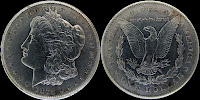 I was walking the floor at the American Numismatic Association National Money Show in Charlotte and found a dealer selling quite a few ungraded Morgan Dollars. As I searched through several boxes, I came across a nice 1878-CC Morgan Dollar (2.2 million minted). The 2×2 holder the coins was in said the coin was in Almost Uncirculated. It was a nice, clean coin with some mint luster showing a great strike. I was sure that if it was slabbed it would have graded higher than what was written on the holder. It was priced as if it was an Extra Fine coin.
I could not resist… I bought my first no-problem CC Morgan Dollar!
It is a beautiful coin that looks great in the blue album shining next to my other Morgan Dollars.
Apr 15, 2007 | coin covers, coins, gold, medals, policy, US Mint
I was very surprised to learn that the George Washington First Day Covers were sold out at the US Mint. There have been very few sellouts for the 50 State Quarters™ First Day Covers and others, like the Westward Journey Nickel™ First Day Covers, went off sale after the legal sales date expired. I wonder if this is a “first issue” or it will continue for all presidents? Maybe it will only be for popular presidents where Abraham Lincoln would sell out but not Millard Fillmore?
There has been talk of creating fractional American Buffalo 24-Karat Gold Coins but no indication from the Mint that this will happen. The Mint is offering uncirculated American Silver Eagle coins with the “W” mint mark on a subscription basis. I wonder if the expanded product line is too much for the Mint to handle the additional Buffalo gold coins and whether they are trying to protect the American Eagle gold program?
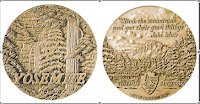 Although I am not a collector of medals, I am amazed at the artwork on the medals produced by the US Mint. While looking at the Mint’s online catalog, I found the new Yosemite Nation Park Centennial Bronze Medal and was just captivated by its design. It seems to capture the grander and beauty of Yosemite. Other medals are just phenomenal in their design. These medals are struck on 90-percent copper and 10-percent zinc blanks in Philadelphia. It may be worth looking into.
On December 14, 2006, the Mint announced a ban on the melting and limited the export of cents and nickels for 120 days (4 months). That period was up on Saturday, April 14, 2007 with no further statement from the Mint. Rumor has it that the Mint will issue a statement continuing the melting ban, raise the individual traveler’s limit from $5 to $25 and the numismatic shipments from $100 to $250. It is speculated that this will be a six month extension of the melting ban.
I would like to end with a non-numismatic review. Last night, my wife and I saw the performance of Titus Andronicus by the Shakespeare Theatre Company of Washington, DC. Titus Andronicus is Shakespeare’s most violent plays depicting the revenge strategies and violence of ancient Rome. It is a powerful play about the misplaced sense of honor some have to authority and tradition and how revenge based on that honor can feed upon itself to the detriment of everyone. It is an interesting commentary on today’s society regardless of your political persuasion. Director Gale Edwards did a fantastic job of bringing this play to the stage with great visuals and heart-pumping music. If you live, work, or visit Washington, DC during its run (until May 20), I highly recommend this play.
Image courtesy of the United States Mint.
Apr 7, 2007 | coins, personal
My Uncle Bill died this past week, succumbing to the pancreatic cancer that he fought for the last year. His funeral was last Monday. Aside from being the patriarch of the family, he was a consummate teller of corny jokes, offerer of simple and sage advice, and an avid stamp collector. Although he gave up his philatelic endeavors a few years ago, he had a good sense for collecting. Uncle Bill was an inspiration for aspects of how I work with my current collection.
A few years ago, I hosted Thanksgiving dinner at my home. I spend the few days prior preparing and cooking for the few who avail themselves of my invitation for a home cooked Thanksgiving that includes my chestnut stuffing, which always gets rave reviews. While in my home, I showed Uncle Bill the row of Whitman Folders with my coins and the few albums I had. He noticed the age of the Whitman Deluxe album with the Roosevelt Dimes and suggested that I replace the album with a newer one and the folders for albums. Aside from updating to more archival quality materials, the albums will allow the viewing of both sides of the coins.
One thing I had not counted on was the toning from the older album. While looking at the dimes, Uncle Bill pointed out the album toning on a few coins. After the holiday weekend I purchased Whitman Classic albums, transferred the coins, and replaced the album toned coins. Then I systematically purchased Whitman Classic albums to replace the folders. With some exceptions, all of the folders have been replaced with albums.
It was Uncle Bill’s simple and sage advice that has improved the presentation and enjoyment of this hobby of kings. Thank you, Uncle Bill. Thank you for the advice. Thank you for all of the corny jokes. Thank you for your love and support. Thank you for improving the lives of all around you.
Mar 30, 2007 | coin covers, coins, dollar, US Mint
When it comes to modern collectibles, I am into the “oh, neat!” of collectibles. I collect American Silver Eagles, silver Chinese Pandas, and British Britannias because they are neat! One neat collectible I discovered are First Day Coin Covers sold by the US Mint.
For those who do not collect philatelic items, First Day Covers are envelopes with stamps that are canceled on the first day of issue. Coin covers, also called Philatelic Numismatic Covers (PNC), are covers with coins or medals encased and usually postmarked on the first day of issue of the numismatic item. I have come to learn that PNCs are popular in Europe. The Royal Mint and Royal Mail partner to create wonder PNC collectibles in the United Kingdom.
The Mint has participated in the production of PNCs in the past but did not produce their own products until the 50 State Quarters program. Since 1999, the Mint as produced covers for all special circulated issues including the 50 State Quarters, Sacagawea Dollar, and the Westward Journey nickels. I have collected these covers from the beginning.
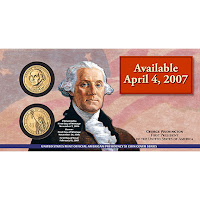 I was perusing the Mint’s online catalog to see what products are on the horizon. There, I found that the Mint will be issuing The American Presidency $1 Coin Cover Series. These covers will feature uncirculated Presidential Dollars from the Denver and Philadelphia mints from the first day of manufacturing. The coins will be attached to an envelope that will include a portrait of the President being honored and a paragraph describing his term of office. The envelope will have the prevailing stamp of the day and will be postmarked on the first day of issue in the president’s hometown. The Mint limits the production to 50,000 covers and cost $14.95—a bargain compared with similar offerings from other sources.
As opposed to the First Strikes or Early Releases coins designated by the third-party grading services, the coins included on the cover are from the first day of production for the coins. This makes them true first day of issue coins as guaranteed by the US Mint. This will be another interesting way to collect the new Presidential Dollar coins. I am looking forward to seeing these covers!
Image from the US Mint.
Mar 27, 2007 | coins, dollar
John Adams was the second President of the United States, the first to be a father of a future president, and the first president to occupy the White House. Adams was a career diplomat serving in France and Holland during the Revolutionary War. On his return to the new country, he became the first Vice President of the United States.
Adams will be featured on the second coin in the Presidential Dollar program. His coin is scheduled to be released in May. In the mean time, the US Mint is preparing for the release of this new coin. If you want to read about the creating of this coin, this article from the Patriot Ledger of Quincy, Massachusetts has a very good article. You may want to see the slide show that shows Mint Engraver Charles Vickers engraving the master plaster cast, rolls of coin metals, and other interesting pictures.

 What has this country seen in 213 years? Imagine holding in your hand a coin that reads “ONE CENT” that has been worn over time and has a barely readable date of 1794. The edge lettering is worn away. This coin once helped feed someone, maybe a family. This coin may have helped a family with housing. It may have seen the pockets or great men or the purses of great women. It could have provided a worker with libations in a dockside pub or a moment of release for someone down on their luck. It was part of the birth of a nation and stay around as it matured.


 Loading ...