Jul 5, 2006 | coins
Sitting at my desk eating a late lunch after long weekend, I was surfing the Internet looking for news from the numismatic community. I surfed to the website for the US Commission of Fine Arts (CFA) and started to read their meeting notes from their June 15 meeting. The notes include a letter to David A. Lebryk, Deputy Director of the US Mint, about the proposed designs for the San Francisco Old Mint Commemorative Coin.
Judging by CFA’s response to Lebryk, the Mint may have been thinking about concepts to use for the commemorative but did not try to execute anything until the passage of the San Francisco Old Mint Commemorative Coin Act (Public Law 109-230 [GPO: text/pdf]) and submitted designs to the CFA for consideration. Apparently, the CFA was not quite happy with the submissions. For their review of the reverse of the $1 silver coin, they wrote:
“The Commission did not like either SR-01-A or SR-01-B, because the drawing of the Mint used for both was so poor. The suggestion was to use one of the designs proposed for the gold reverse or, if it was felt necessary to use a design based on Shirl J. Winter’s medal, at least make a better drawing of it.”
When I wrote “This bill is going to put the system to a real test,” in The Granite Lady Gets Her Commem, I was anticipating problems since the bill says that the coins can be issued “only during the 1-year period beginning on January 1, 2006.”
While I applaud the Mint for its quick work and the CFA for its quick consideration, I wish the Mint would have done a better job. It is not clear if the Mint can just use the rejected reverses from the gold coin and start making dies or do they have to return to the CFA for approval. If approval is necessary they have until the next CFA meeting on July 27 to come up with a new design.
Jul 4, 2006 | coins
On this, the 230th anniversary of the signing of our Declaration of Independence, it is fitting that while searching my pocket change I found a Bicentenial Washington Quarter. Remember, this quarter was issued in 1975 and 1976 with the dual date 1776-1976. The reverse features a colonial drummer boy designed by artist Jack L. Ahr. Ahr’s design was selected amongst 12 semi-finalists. He was awarded $5,000 for the design.
On this Day of Independence, I wish those in the military who are helping others gain and maintain their Independence best wishes and a safe return home.
Jul 1, 2006 | coins, currency
It was a very tough week here in the Mid-Atlantic Region. We had more rain in four days than we had all year. Then it rained on Wednesday and Thursday to add insult to injury. Days of flooding and horrendous traffic left a lot of us thinking we were having a eight day work week. I had to find something numismatic to soothe my nerves. I found it on Wednesday.
 Although I am not a currency collector, I have been watching the currency market out of curiosity. Over the last few years, that market has been seeing a phenomenal growth in interest, which has lead to record auction prices.
  While visiting the website for Heritage Auction Galleries, I saw that they sold two notes for $2.1 million! One was a Series 1891 $1000 Treasury Note and the other was a Series 1863 $100 Gold Certificate (images are from the Heritage website). These are very rare notes that were sold to a single collector.
 While reading about this auction, I remembered that the Bureau of Engraving and Printing (BEP) was selling the Texas Coin and Currency Set that started at noon. This set contains uncirculated Series 2003 $1, $2, $5, and $10 notes with matching low serial numbers that represent the Federal Reserve Bank of Dallas. The set also includes uncirculated Texas State Quarters. BEP announced that only 2,000 sets will be sold at $129.95 each.
Sure the set includes Texas State Quarters, but it extends BEP’s Federal Reserve Evolution Collection (FREC). When the FREC sets were sold last July, it included $20 and $50 notes with matching low serial numbers along with a special book for the Federal Reserve Banks (FRB) of New York, Philadelphia, St. Louis, and San Francisco. Other Evolution sets features FRB of Richmond, Atlanta, and Chicago. All are sold out and command premium prices at the bourse. With the Baltimore Coin and Currency Convention set to begin on July 14, I am interested to see what the dealers will be selling these set for.
As a numismatist whose collection consists mainly of coins, finding a new collectible that includes coins and adds a little diversity to the collection is a lot of fun. But to find a hot collectible with a limited distribution that has quickly appreciated within days of a sell-out, buying a few extra is a nice investment. So I bought five sets with remorse that I could not afford to purchase more!
Jun 22, 2006 | coins
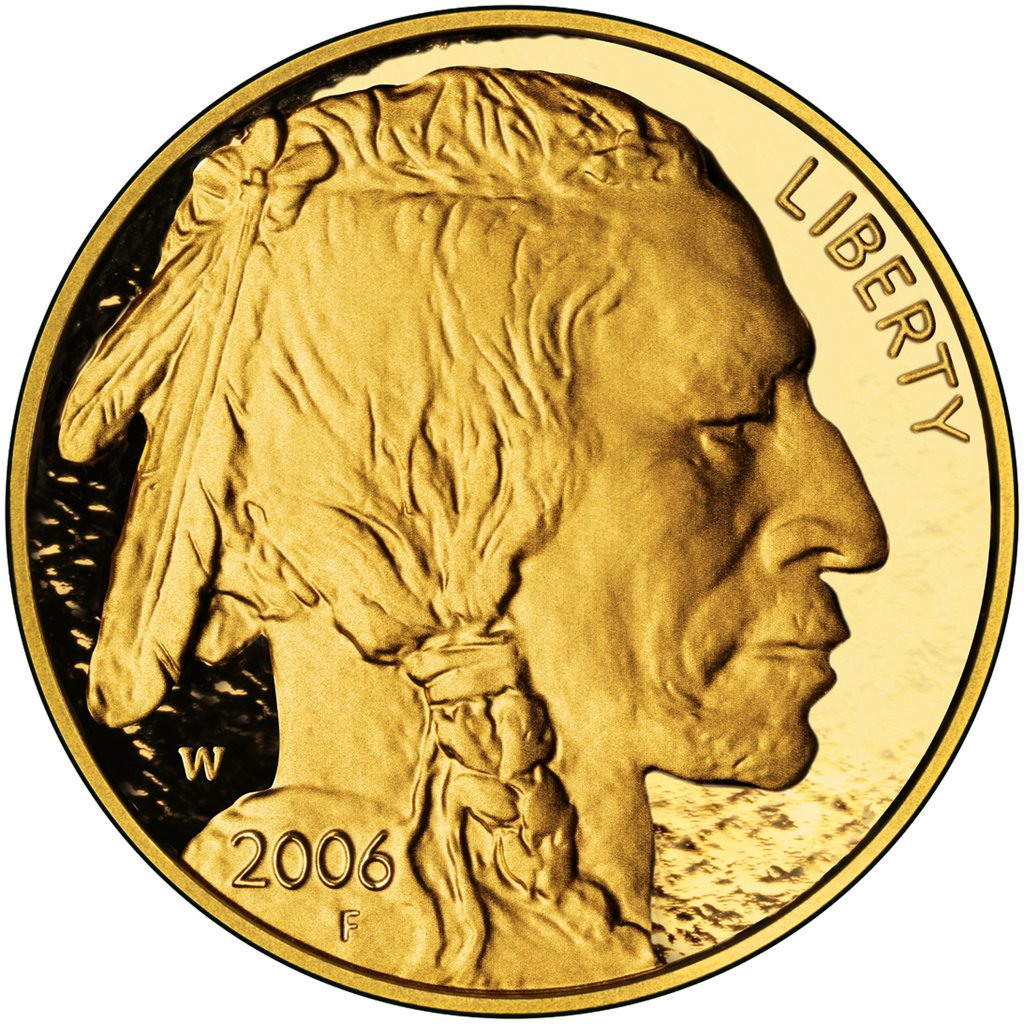
The 2006 American Buffalo Gold Proof One Ounce Coin is now on sale from the US Mint for $800. There is a purchase limit of 10 coins with delivery scheduled for July 13, 2006.
Although the Mint is selling only proof coins to the general public, dealers have sending offers to sell the uncirculated coins in the range of $675-699. As I write this, the spot price of gold is $580.
The James Earle Fraser Type 1 Buffalo design is one of my favorite coin designs. It is a truely American design. It will be interesting to see how the rest of the world reacts to this coin. I only wish I could afford one!
Jun 21, 2006 | coins
The US Mint has been very active the last two weeks announcing new coins and collectibles. Colorado is the latest state to be honored in the 50 States Quarters program with formal ceremonies being head Denver, the Colorado capital. Yesterday began the Buffalo 24-karat Gold Coin program with a striking ceremony at the West Point branch mint. But somewhat lost in the fanfare was the unveiling of the design for the 2007 Jamestown 400th Anniversary Commemorative.
Jamestown was founded in 1607 by members of the Virginia Company who were sent across the Atlantic Ocean on three ships to make a profit from the natural resources found in the New World. From 1607 through 1698, Jamestown was the capital of the Virginia colony and the primary gateway for shipping goods back to England and other areas of the world. Today, archeologists are excavating the original settlement as part of the Jamestown Rediscovery project. Their findings will be part of the overall 400th anniversary celebration.
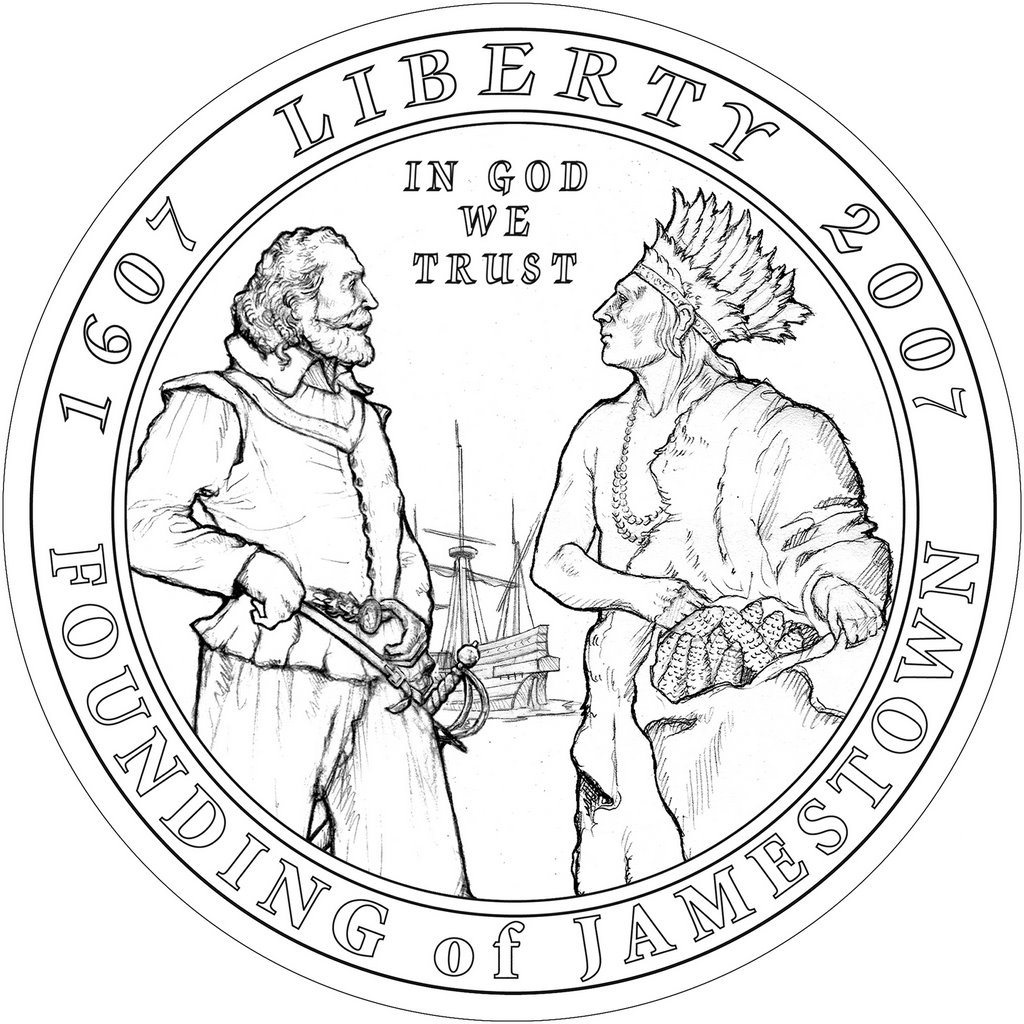
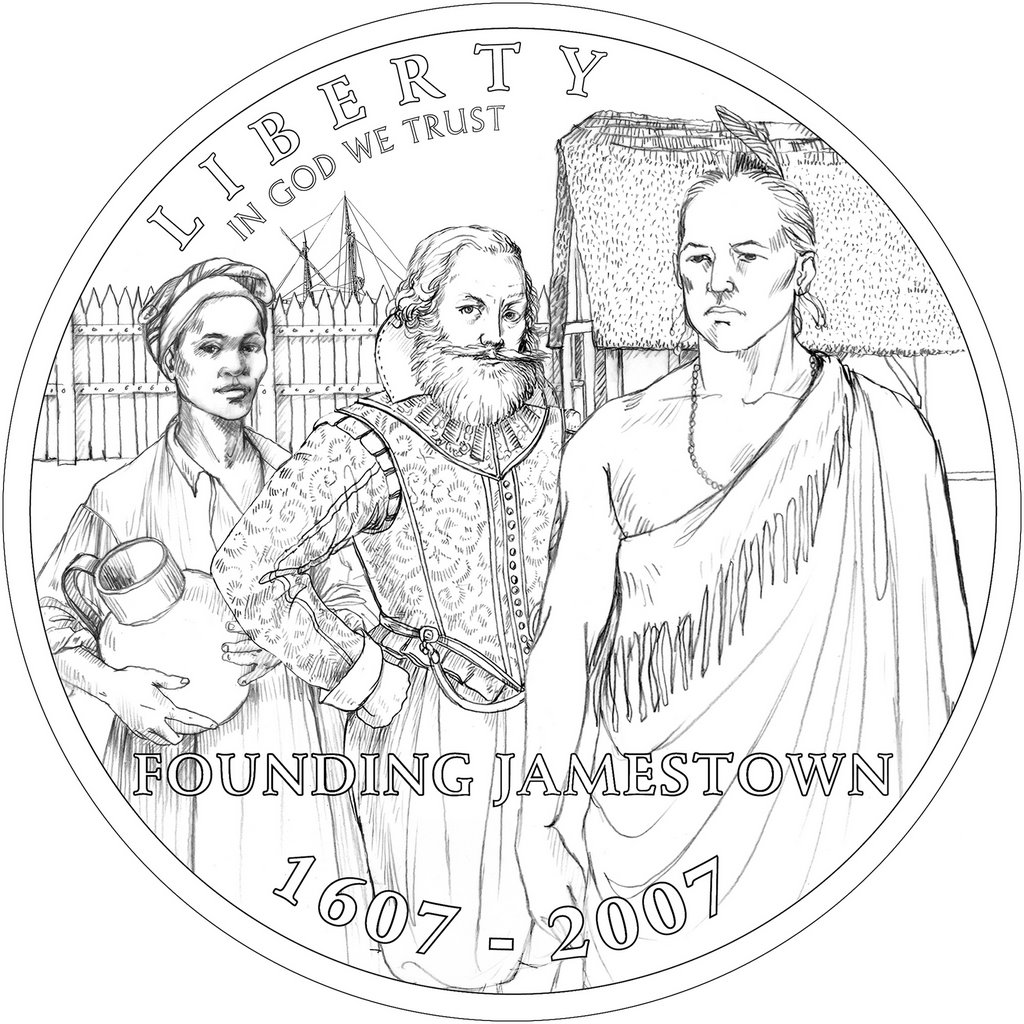
To commemorate this anniversary, Public Law 108-289 [GPO: text/PDF] authorizes the minting of 100,000 $5 coins made from 90-percent gold that weighs no more than 8.359 grams and 500,000 $1 coins made from 90-percent silver that weighs no more than 26.73 grams. Surcharges from the coin will be given to the Jamestown-Yorktown Foundation. The Mint unveiled the designs to the public on June 16, 2006. Line art images of the coins are from the US Mint Image Library.
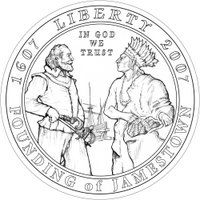
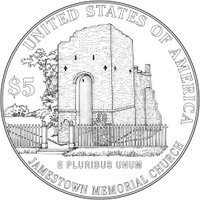 Mint Sculptor-Engraver John Mercanti designed the obverse of the $5 gold coin depicting Captain John Smith conversing with an American Indian. The reverse of the gold coin shows the Jamestown Memorial Church, the only structure remaining from the original settlement. It was design by Artistic Infusion Program Master Designer Susan Gamble.
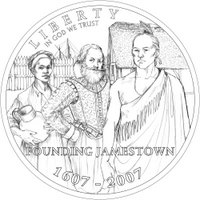
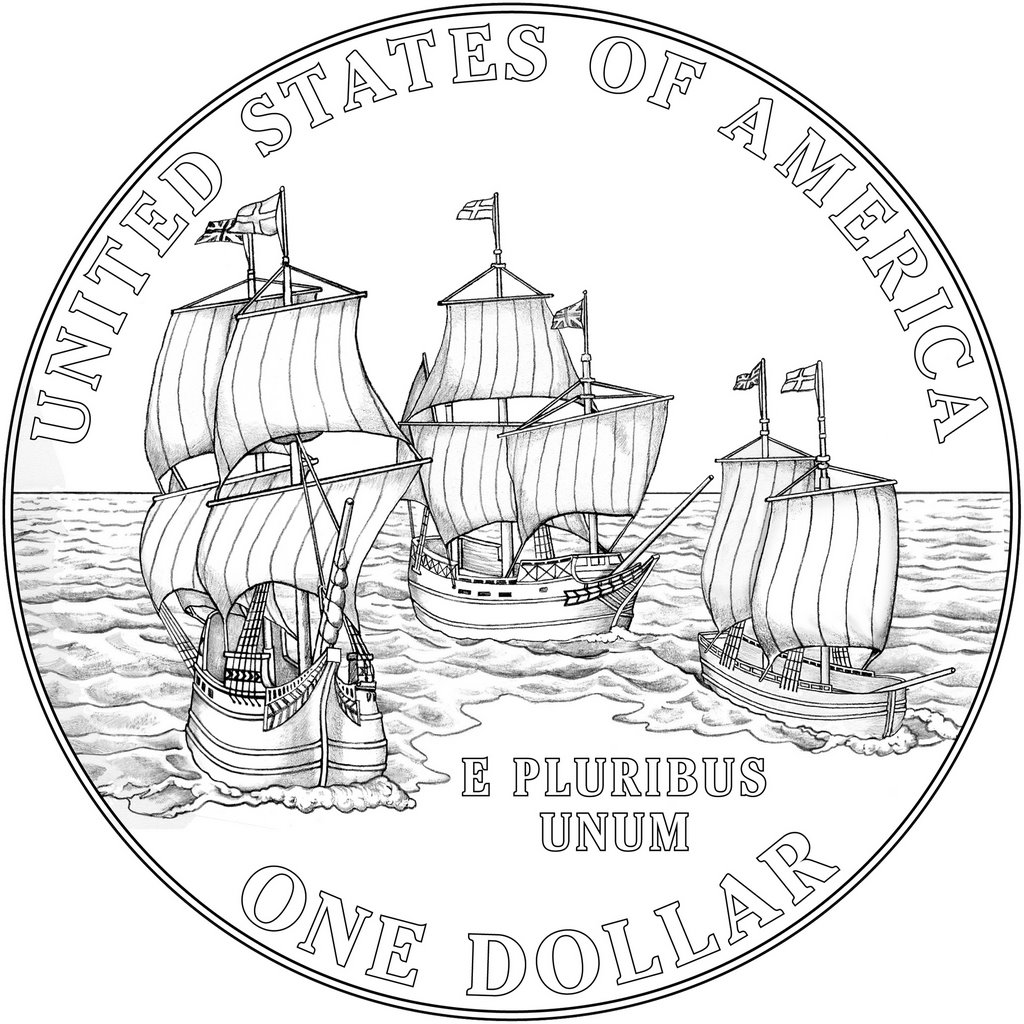
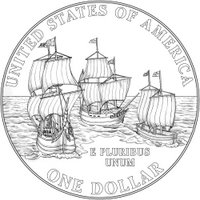 Donna Weaver, the recently retired Mint Sculptor-Engraver, design the obverse of the $1 silver coin to depict the “Three Faces of Diversity” to represent the three cultures that came together in Jamestown. Susan Gamble designed the reverse of the silver coin to depict the three ships that carried the first settlers across the Atlantic Ocean: the Godspeed, the Susan Constant, and Discovery.
Both appear to be very pretty coins in their line art form. The reverse of the coins by Susan Gamble from the Artistic Infusion Program look to be well executed and has the potential for great eye appeal in the yellow and white metals. This is going to make a nice collectable and confirm the success of the Artistic Infusion Program.
Jun 20, 2006 | coins
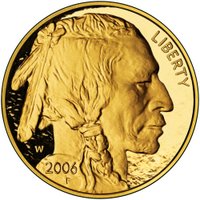 With the push of the button, James Earle Fraser’s Type 1 Buffalo design is now preserved in 24-karat gold as part of the American Buffalo Gold Coin program. During the ceremonial striking ceremony, the Mint’s Deputy Director David A. Lebryk said the design “which have been American favorites since they were first used in 1913, recall a golden age of coin artistry.” The one ounce coin will be produced in uncirculated and proof versions. The accompanying pictures of the coins are from the US Mint Image Library (click the images to enlarge).
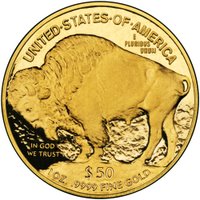 With the issue of the $50 American Buffalo Gold Coin, the Fraser Buffalo design joins Augustus Saint-Gaudens’ Liberty Double Eagle and Adolph A. Weinman’s Walking Liberty as classic coin designs that grace US bullion coins. Both Weinman and Fraser studied and worked with Saint-Gaudens. Their coin designs are the result of President Theodore Roosevelt’s push to update US coinage to be the most beautiful in the world. Roosevelt commissioned Saint-Gaudens to produce classic, yet modern designs. Saint-Gaudens responded with the famous Liberty design used on the $20 double eagle and the Indian $10 eagle coins prior to his death.
Roosevelt was also instrumental in pursuing the Victor David Brenner designed Lincoln Cent to honor the 100th birthday of Abraham Lincoln. We will celebrate the Lincoln’s 200th birthday and the cent’s 100th anniversary in 2009 with four coins to commemorate the the life our 16th President.
That “golden age of coin artistry” continues is a tribute to the vision of Theodore Roosevelt and the love he felt for this nation. BULLY!
Jun 16, 2006 | coins, legislative
On Thursday, June 15, 2006, the White House announced that President George Bush signed H.R.1953, San Francisco Old Mint Commemorative Coin Act, into law. Now as Public Law 109-230, [GPO: text/pdf] the US Mint has until the end of this year to design, strike, and sell these commemoratives. This will be a real test for the Mint and the Citizens Coinage Advisory Committee (CCAC) and Commission of Fine Arts (CFA) bureaucracies.
Jun 16, 2006 | coins, US Mint
On June 14, the US Mint issued a press release inviting the media “to get a rare glimpse inside the United States Mint at West Point, New York, on Tuesday, June 20, 2006, to see the Nation’s first 24-karat, pure gold (.9999% fineness) one-ounce coin, the American Buffalo, being minted in both investor bullion and collectible proof versions at an official strike ceremony. A tour of the United States Mint, which will include its store of gold bars, will follow the ceremony.”
The American Buffalo 24-Karat Gold Coin program was authorized under Public Law 109-145 [GPO: text/pdf] that required the Mint to use the James Earle Fraser Type 1 Buffalo Nickel design to produce a coin containing one ounce of .9999 fine gold purchased from US sources. The law requires the Mint to strike and issue the coins within six months of enacting the law. The press release says that the sale of these coins will being at noon on June 22, 2006.
As with the American Eagle Bullion program, the Mint will sell uncirculated coins through pre-approved Authorized Purchasers. Uncirculated coins will be priced according to the current spot price of gold plus a small premium. Collectors will be able to purchase proof coins directly from the Mint and will be priced at $875.
This is one time I wish I was a member of the media since they will be allowed into the West Point branch mint that is usually closed to the public. Nicknamed “The Fort Knox of Silver,&rdquo it should make for a very interesting tour. I hope the numismatic media takes and publishes many pictures of their tour so they can share the experience!
Jun 15, 2006 | coins
If you have not attended a meeting of your local coin club, you should find the time and go. Not only will you meet fellow collectors, but you might learn something that can inspire you in your collecting endeavors. One of the reasons I try to ensure I make it to the monthly meeting of the Montgomery County Coin Club is because I always go away with an appreciation for something different about the hobby.
At these monthly meetings, members are encouraged to bring in their monthly finds. After the brief business portion of the meeting, members make a short presentation on their finds. This week, Jerry Grzenda, a collector of world coins, brought in coins representing the last century of Iran. Jerry’s presentation included a history of Iran as seen through its coinage. It was a great learning experience and the coins were beautiful.
Another highlight of the meeting was the presentation by Ron Brais about Hobo Nickels. While I have heard about Hobo Nickels, all I knew about them was what I learned in passing. In listening to Ron talk, I learned that the original Hobo Nickels were created between 1913 and 1935 using only Buffalo Nickels because the design had large figures on both sides that could be used as the basis of the design. These elements allowed the carver to make just about any design, and usually did. Designs were as varied as the artists who carved them. Hoboes would use the carved nickels to trade for food, shelter, or other favors during their travels.
The most famous Hobo Nickel artist was George Washington “Bo” Hughes. Bo ran away from home at a young age and was befriended by a hobo identified as Bert. After a train yard scuffle, Bert took Bo under his wings, protected him from the tramps and bums and taught Bo how to carve realistic images into the Buffalo nickel. For many years, Bo would ride the rails and carve nickels living the life of the hobo as he looked for work to survive. Bo’s work on Hobo Nickels allowed him to eventually get a job as a craftsman. It lasted until 1957 when he cut his left hand while carving a nickel. At that time Hobo Nickels were no longer popular and Bo just faded away. He died in 1982.
The life and history of George Washington “Bo” Hughes has been immortalized in the book Hobo Nickels by Delma K. Romines (out of print).
Today, the Original Hobo Nickel Society has a number of artist members that are carving images into Buffalo and Jefferson nickels to keep the art alive. Some of the designs are ingenious and beautiful while others are copies of carving on older coins. Modern nickels are made using modern tools that allows the carving to look much cleaner than their older examples. The old methods and tools were not able to make clean lines but it gave them a character that cannot be matched.
The example of a Bo Hughes carved nickel Ron showed us was beautiful in its design and execution. The care and craftsmanship that went into carving that coin was evident. Hobo Nickels can sell from $200-$1500 depending on condition and the artist. Coins by Bo Hughes are worth more than others. I may have to add one to my collection.
Jun 10, 2006 | coins, legislative
I was updating the Bloglinks (see Numismatic Links in the sidebar) when I clicked on the link for H.R.1953, San Francisco Old Mint Commemorative Coin Act, and found that it has been enrolled after being passed by both the House of Representatives and Senate. Once a bill has been enrolled, it is sent to the President for action. This bill is likely to be signed by President Bush.
The Act “require[s] the Secretary of the Treasury to mint coins in commemoration of the Old Mint at San Francisco, otherwise known as the ‘Granite Lady’.” The bill specifies that the design will represent the San Francisco Old Mint Building and its role in rebuilding San Francisco after the 1906 San Francisco Earthquake. The bill calls for 100,000 $5 coins be minted using a 90-percent gold alloy along with 500,000 $1 coins be made from a 90-percent silver alloy. Coins will be offered in proof and uncirculated qualities and requests that the coins be struck “at the San Francisco Mint to the greatest extent possible.”
Sales of the commemoratives will include a $35 surcharge for the gold coin and $10 for each silver coin. Proceeds will be distributed to the San Francisco Museum and Historical Society to rehabilitate “the Historic Old Mint in San Francisco as a city museum and an American Coin and Gold Rush Museum.” It has a potential to raise $8.5 million for the project.
This bill is going to put the system to a real test. Unless the US Mint has been preparing for this bill’s passage, the bill says that the coins can be issued “only during the 1-year period beginning on January 1, 2006.” Not only does the Mint have to make at least one design, but the design must be approved by the Citizens Coinage Advisory Committee (CCAC) and the Commission of Fine Arts (CFA). It appears that both groups meet during the third week of the month. It may take as little as three months for the design to be approved before die making and production begins.
With such a short time period to move the bureaucracy, the numismatic community should be prepared for the varieties and errors as the Mint rushes to have these coins minted and sold by the end of this year.




 Loading ...