Mar 29, 2008 | coins, legal
Litigation between the Langbord family and the United States government continues over the ten 1933 Saint-Gaudens double eagles that were found by the daughter of Israel Switt in a safe deposit box and confiscated by the US government. When the coins are not being displayed, they are stored at United States Bullion Depository in Fort Knox, Kentucy.
Joan Langbord, 76, and her two sons Roy and David, filed a lawsuit in US District Court against the government to retrieve the coins. The Langbords are represented by Barry H. Berke who represented Stephen Fenton in the lawsuit for the Farouk specimen.
In a recent ruling, the court denied the plaintiff’s motion to depose those involved with the decision making process of the Farouk specimen. While more than 40 separate motions have been filed by both sides, it appears that this is the first one denied to the plaintiffs.
As the case moves on, there continues to be speculation of at least one more example in existence. The result of this lawsuit will determine whether that piece comes out of the shadows.
Who said numismatics did not have mystery and intrigue!
Mar 3, 2008 | Baltimore, coins, shows, supplies
After having a procedure done on my arthritic knee, I made sure that my doctor said it was all right to travel to attend the Whitman Baltimore Coin and Currency Convention. I could not miss the show. It is the largest regular show in the area—although the ANA Worlds Fair of Money will be held in Charm City this summer. When my doctor said that there should not be a concern, I made plans to attend on Saturday.
The procedure left me a little sore which made sleeping an issue. After waking up late, I made it to the Baltimore Convention Center by 3 o’clock. One of the problems with arriving later on Saturday is that at least one-third of the dealers closed and left the convention center. I tried to understand the situation from the dealer’s perspective, but when I am walking the bourse floor with a pocket full of money and a half-dozen nice slabbed coins to sell, I feel cheated. Within an hour, at least half of the tables were empty.
With the buying option lessened, I first concentrated on finding a few special items. For bullion coins, I was not able to find 2008 uncirculated American Silver Eagles, Silver Maple Leafs, and British Britannias. I was looking for some 20th century Morgan Dollars in at least almost uncirculated or better, not in slabs, and priced fairly—at least Greysheet prices. If nothing else, I wanted to find improvements to my 1976 registry sets.
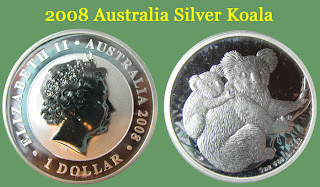 Rather than finding anything real interesting, I purchased some uncirculated 50 State Quarters to fill holes in my album. I also found a number of circulated early Lincoln Cents for a set of folders I am putting together. But the most interesting coin find was the 2008 Australia Silver Koala. Struck by The Perth Mint, this is the second year of issue for this 99.9-percent silver coin. Taking the lead from the Chinese Panda, the reverse features artistic depiction of the marsupial native to the eastern and southeastern regions of Australia. The obverse features the Ian Rank-Broadley effigy of Her Majesty Queen Elizabeth II.
An interesting aspect of the reverse design is what the Perth Mint calls the “shimmer background.” The reverse background is textured background with full luster that helps the koala image stand out from the “shimmer” created by angling the coin under the light. It is an interesting concept that makes the coin a unique collectable.
One change Whitman made from previous shows was that the sales of Whitman Publishing products were in the lobby outside of the halls inside a plexiglass booth that can be locked at night. Although there are supply vendors on the bourse floor, only one general supplies dealer is there to offer discounts but they sell very few Whitman supplies. For this show, that dealer was moved to the opposite end of the hall from their previous location and had a smaller table area. Whitman owns the show and probably feels they should protect any profits they could realize.
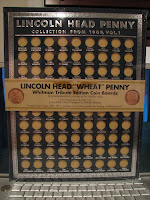
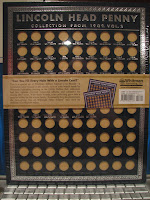 Capitalism aside, I do prefer Whitman albums and folders over other brands. In addition to buying additional pages for my Sacagawea Dollars album, I found the Whitman Tribute Coin Boards for the Lincoln Cents and Buffalo Nickels. Whitman calls these board “a commemorative reissue in the classic style of coin boards made by Whitman Publishing starting in the 1930s.”
From what I can tell, these 11×14 inch boards are close to the original issues using modern materials and modern printing techniques. One addition to these boards are the mintage totals featured under the dates for each coin. The Lincoln Cent boards covers the wheat-back issues from 1909 through 1959, with no varieties, using two boards. The second board has 39 blank spaces following 1959 with no markings. Of course I will fill those in with Memorial back issues until I run out of holes.
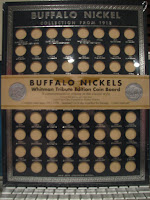
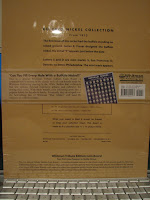 The Buffalo Nickel board collection requires a single board to cover the issues from 1913 through 1938 with no varieties—except for the 1913 issues where there are holes for the “Raised Ground” coins along side the ones just marked with the year. The nine holes at the bottom do not have date markings except for “NEW TYPE JEFFERSON NICKELS” above the boarder; Obviously, I will have to fill those holes with the appropriate nickels.
Although I have not removed the shrink wrap from the boards, I noticed the back of the Buffalo nickel board has a box that has the number for other boards. I wonder if this is a reproduction of the original board or an indication that Whitman will produce those coin boards in the future. It would be interesting if they produced other tribute boards in the future. I would certainly buy them.
Of course you cannot go through a bourse floor without talking with a few people. Some I saw in passing and did not get to speak with them. I saw Patti Finner, Vice President of the ANA, working at the Kids Table—something the native Baltimorean has done for many years. I spoke with her during the last Baltimore Show but did not have an opportunity this time. Walking from the parking garage and through a nearby hotel, I saw NGC’s Dave Lange dashing away from the Convention Center. That was too bad because I wanted Dave to autograph the coin boards! Considering his interest and books about vintage coin boards, I thought that would be great for these tribute boards. Oh well… maybe next time.
I spoke with many dealers who are really wonderful people. One of my favorites is Wayne Herndon. Amongst our conversations, we spoke about the recent eBay issues and how our future on the site will be effected. We agreed that eBay is not as cost effective as it has been and may not be worth using in the future since it hurts the small seller and sellers who are trying to work on slim margins to give collectors value. I have bought from Wayne in the past and will continue to buy from him. Even before we started to talk, I always thought his prices were fair.
When it came time to leave, I discovered that Whitman set the policy to only have the main doors to Halls A and B as the entrance-only and forced attendees to exit through the doors in Hall C. While Halls A and B create one large area, Hall C turns the space in the el-shape that people may be bypassing. Moving the exit to the doors leading out of Hall C may be one solution but it caused a problem for me and my hurt knee. Although my doctor said a four hour walk on the bourse floor should not be a problem, my knee was in a lot of pain. I was limping, even grabbing onto chairs, tables, and anything nearby to prevent from falling. I tried to exit the nearby main doors, but was turned away by the security guard. So I had to schlep around to the Hall C doors while staying close to the tables to maintain my balance. In the future, I hope Whitman would allow those leaving within the last hour of the day to exit the nearest doors.
If I had to rank this show with the others, it would rank below other Whitman sponsored shows and on par with those by the previous organizers. While I can have fun at a coin show with 20 dealers, one expects a show that spans three halls of the Baltimore Convention Center to be better. Hopefully my experience was an anomaly and the show on June 5-7 (with no Sunday hours) will reach their usual standards.
Feb 24, 2008 | coins, grading, video
Here in the United States, it is common to see coins encased in holders by third party grading services whose label includes that service’s opinion of its state of preservation. We have slabbed everything, from the most worn large cent to the American Eagles just received in the mail from the US Mint. There is even a service that grades the graders by placing a sticker on the holder to say that this service agrees with the opinion of the original grader.
Coin grading is less common outside of the United States. For example, in Canada, collectors who want coins graded sends them to the US-based services or use the Toronto-based International Coin Certification Service (ICCS). ICCS encapsulation offers a different type of encapsulation that includes a small certificate with the coin. But an informal scan of Canadian coin dealers show that the US-based services dominates the grading of Canadian coins.
We’ve accepted coin grading. Overseas collectors have not. They reject coin grading for the reason most of my collection is not graded: there is something satisfying about holding that key coin in my hands. But with the rise in counterfeit of key coins and the raising interest in US coins outside of the US, some collectors are looking to slabbed coins to ensure they are purchasing genuine products. Or are they?
There are a finite number of key coins and there is enough anecdotal evidence that suggests the grading population of key coins has reduced. To maintain their viability, the top tier grading services have to look for additional outlets for revenue. These services are expanding their brands into grading currency, sports cards, and even special labels for modern coins. Expanding into grading world coins for the collectors outside of the United States may be an attempt to find new markets. It appears that the next untapped market is grading world coinage for non-US collectors.
This is not lost of Professional Coin Grading Services President Ron Guth. PCGS, a subsidiary of the publicly traded Collectors’ Universe (NASDAQ: CLCT), may be trying to use the international market as a way to expand PCGS‘s market.
Recently, Guth spoke with Numismatic News Editor Dave Harper at the World Money Fair earlier this month in Berlin, Germany, and file this report:
From this interview it is difficult to say whether the international market is ready for PCGS or any third-party grading service’s service. It appears that this will be one of the “let’s wait and see” issues.
Feb 21, 2008 | coins, dollar, errors, quarter, US Mint
James Monroe was the fifth president of the United States. Monroe, a Democrat-Republican (the forerunner of the modern Democratic Party) and former governor of Virginia, believed in the Jeffersonian principle of a stronger federal government who would look out for the welfare of the states. He was opposed to the colonization of the Western Hemisphere by foreign powers and worked to have them withdraw from the hemisphere.
Monroe was elected during a time of good feeling after the War of 1812 where Great Brittan tried to prevent the US to trade with France while they were at war with Napoleon. Monroe worked to set the US place in the world, first by convincing Spain to cede Florida to the United States in 1821. Subsequently, Great Brittan, weary of war, wanted the US to oppose the reconquest of Latin America.
Monroe consulted ex-presidents Thomas Jefferson and James Madison who agreed with the concept. Monroe then consulted with Secretary of State John Qunicy Adams. Adams was not only concerned about British meddling in the region, but there was a concern about France and Russia also meddling in the Americas. Adams suggested making it US policy against nation trying to recolonize the west.
Monroe accepted Adams’ suggestion. In a message delivered to congress on December 2, 1823, Monroe say “… the American continents, by the free and independent condition which they have assumed and maintain, are henceforth not to be considered as subjects for future colonization by any European Power.“ Twenty years after Monroe died, this became known as the Monroe Doctrine.
 The James Monroe $1 coin was released to the public on February 14, 2008. However, prior to the coin’s release, there was a report that a number of “irregular” coins were returned to the Mint by the contractor hired to wrap coins.
It was reported that between 70,000 and 100,000 Monroe Dollars were struck on quarter planchets at the Philadelphia Mint. When questions, the US Mint issued the following statement:
In mid-January, the United States Mint’s coin-wrapping contractor alerted the agency when it found some irregular James Monroe Presidential $1 coins. The coins in question were immediately returned to the United States Mint. The United States Mint has performed an internal inquiry and presently has no evidence to indicate that any irregular James Monroe Presidential $1 Coins have been sent to the nation’s banks. The United States Mint expects to make an estimated 103 million James Monroe Presidential $1 Coins.
When I go to the bank tomorrow to pick up some rolls, I will be buying a few extra rolls to check for these wrong planchet errors because I do not believe that all of these “irregular” coins have been found.
Feb 16, 2008 | coins, gold, US Mint
On February 8, 2008, a report from the Moscow News reverberated in both the numismatic press and found its way into some mainstream media outlets said that a couple in Egypt found a 1933 Saint-Gaudens $20 Gold Double Eagle. The forbidden coin, which there is only one legal tender specimen, could be the most valuable coin if it is real.
Online forums have parsed the words of this short article noting that the line “Specialists believe that the double eagle found in Egypt could be part of Theodore Roosevelt’s 1933 collection of coins redesigned by famed American sculptor Augustus Saint-Gaudens and given to King Farouk of Egypt as a present,” contain significant factual errors. For instance, Roosevelt did not collect coins, but did commission Saint-Gaudens to design the coin and owned a high-relief coin. Even if Roosevelt did collect coins, he died in 1919 and would have never collected this coin. Saint-Gaudens died in 1907.
Further, evidence discovered by David Tripp and published in his book Illegal Tender suggests that the Farouk coin was sold to an emissary by a dealer.
After parsing the words, you have to realize that this is a story by a Russian news organization quoting a Qatar news organization reporting an event in Egypt. Aside from translation being an issue, even some collectors are confused by the provenance of these coins. So the mistakes could be understandable. But is it a real coin?
The 1933 Saint-Gaudens Double Eagle coin sold in 2002 for $7.6 million was assumed to the be the Farouk coin based on the assumptions of its travels until its confiscatio But part of the evidence was that a 1933 Double Eagle coin was removed from the 1954 auction of King Farouk’s coin collection. Although a coin was confiscated from British dealer Stephen Fenton who testified that it was the Farouk specimen, no evidence exists to prove the claim.
Since the sale of the only legal tender 1933 Double Eagle, ten coins found by the family of the late jeweler and coin dealer Israel Switt where authenticated as genuine by the US Mint and subsequently confiscated them. While the family is suing the government for the coins’ return, it was though that this may be the last of the escaped Double Eagles… until now.
If the coin is real, the US government considers the coin government property and illegal to own since it was never released into circulation. Although the US Secret Service has not commented on this story, history suggests that the coin will be confiscated should it return to the United States.
If the coin is real, the $15 million estimate in the Russian article may be possible, but could be too expensive. Should the coin be accurately linked to King Farouk with convincing evidence, $15 million may be a low estimate. However, it would have to be sold overseas to prevent its confiscation by the US Secret Service.
This may not be the last we hear of this coin. But I still want to know how the grandfather of this tailor came to own this coin. Even in 1954, the coin was known to be very rare, so how did it end up in a box in the bottom of a closet? It will make an interesting story!
Feb 11, 2008 | cents, coins, nickels, US Mint, video
CBS News’ ubiquitous weekly news magazine, 60 Minutes, broadcasted a report on Sunday that discussed the costs of producing cents and nickels (see embedded video below). According to the US Mint, over 8 billion copper-coated zinc cents were produced ($80 million) costing the Mint $134 million to produce. Producing 1.3 billion nickels ($65 million) made with the .75 copper alloy that has been in use since 1866, and cost $124 million.
Should We Make Cents?
Source: CBS News
Mint Director Edmund Moy, who was interviewed for the report by Morley Safer, said that the costs were a direct result of the rising metal prices. “You know, coins are made out of metal,” Moy said. “And worldwide demand for copper, nickel and zinc have dramatically increased over the last three years. That’s what’s primarily driving up the cost of making the penny and nickel,”
Stephen Dubner, the co-author of the bestseller Freakonomics, puts the penny in the same category as your appendix and other useless relics. “It’s just not useful,” Dubner said. Unfortunately, Dubner may not have heard that researchers may have found that the appendix does have a useful function.
The focus of the report was to look at the economics of continuing the production of Lincoln Cents. While the report mentioned the tradition of the cent and the coin features Abraham Lincoln, probably the country’s greatest president, and the 2009 redesign program, the argument about removing these coins from circulation are based on their economic worth. But if they are useless and have no value, then why is there a demand for these coins being produced?
I have previously explained that the Mint’s primary “is to produce an adequate volume of circulating coinage for the nation to conduct its trade and commerce.” To carry out this mission, the Mint distributes coins to the Federal Reserve System banks and branches as necessary. Regardless of the cost of production, is it really necessary for the Mint to produce so many cents for circulation?
Unlike commemorative or other collectible items, the number of business strike coins distributed is determined by the individual Federal Reserve banks. As the need arises, the Federal Reserve banks place orders with the Mint for coins to distribute to the nations banks. From those banks, coins are circulated to the public through business or teller operations. Although there are some stockpiles of under used coinage (mostly halves and dollars), the Mint uses “just-in-time” inventory management and distribution like many other manufacturing facilities. Thus, productions of business strikes are based on the demand created by the ordering practice of the various Federal Reserve banks.
If the cent is obsolete and economically infeasible with little buying power, then why is the Federal Reserve ordering so many for circulation?
How Cents are Made
Source: CBS News
Feb 3, 2008 | coins, commemorative
In 1636, the area we know as Long Island was settled by Algonquin tribes who settled there to escape more war-like tribes. The Algonquin call the island Paumanok, meaning “The Island that Pays Tribute.” On the arrival of the first Dutch settlers, they negotiated for a section of land just off of what we know as Jamaica Bay. They called the land Lange Eylandt (Long Island) in reference to its 118 mile length, and their settlement was named Breuckelin after a town in Holland. It was the first European settlement on the island.
By 1640, the English Puritans started settling the eastern end, coming down from New Haven, Connecticut. Subsequently, the English began to assert dominion over the region and claimed the propriety. In 1694, the English renamed the land as Long Island, the original Dutch Settlement became Brooklyn, and the Dutch colony founded on Manhattan Island was renamed as New York.
After 300 years, the United States was in a depression but collectors were being inundated with commemorative coins. In 1936, 16 new designs were issued and five others had not reached their authorized mintage. However, the Long Island Tercentenary Committed lobbied for a commemorative coin to coincide with the 300th anniversary of the first European settlement in May, 1936. But the bill allowing the mintage of 100,000 coins was not passed until April 13 of that year.
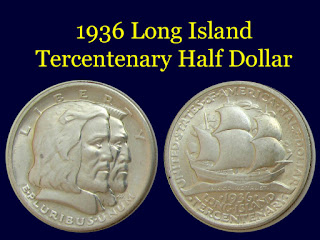 The coin was designed by Howard Kenneth Weinman, the son of Adolph A. Weinman. To honor the settlement, the obverse features a right-facing bust of a Dutch colonist overlapping a bust of an Algonquin tribesmen. The reverse features a 17th-century ship under full sail traveling over a rolling sea. Because maps showed west-to-east passages as being from right-to-left, critics noted that the right-facing ship appeared to be heading back to Holland. Howard Weinman’s placed his initials under the the Algonquin’s chin by placing an H atop of the letter W, which was similar to the way his father included AW on his coin designs. In passing, the monogram could be mistaken for the elder Weinman’s.
Since 2008 will be the year I concentrate my collecting on items related to the areas once called New Amsterdam and Lange Eylandt, it was time to find a nice Long Island Tercentenary commemorative for the collection, I wanted to find a nice, even colored, mint state example. With a net mintage of 81,773 coins sold during the year after its release, I knew I would be able to find a nice example. The one I found was graded as MS60 by the dealer and purchased for a good price. It is a beautiful coin to add to the growing New York/Long Island collection.
Feb 2, 2008 | BEP, coins, gold, US Mint
On Friday, the US Mint announced that the American Buffalo 24 karat gold coin will begin selling on Tuesday, February 5. It was noted that the release coincides with the Lunar New Year that begins on February 7 since the number “8” is traditionally associated with wealth and prosperity in Asian cultures. For 2008, the Mint will be producing special packaging associated with this occurrence.
Although the US Bureau of Engraving and Printing has been offering the Lucky Money Collection products for a few years, this is the first time such a product is being offered by the US Mint. Of course, it is easier for the BEP to offer such products using the properties of the serial numbers to promote these products. Also, it should be noted that Mint Director Edmund Moy is the first Asian-American to hold this position.
Notably different will be the price of the proof coin. With the price of gold at historical highs ($907.90 when the market closed on Friday), the Mint has priced the coin at $1,018.88. The last price for the 2007 American Buffalo was $899.95. The press release notes that “as with all precious metal numismatic products, a future pricing change may be required.”
Given the state of the economy, it will be interesting to learn how this product will sell. I know I will wait before purchasing.
Jan 24, 2008 | coins, quarter, state quarters, US Mint
While checking the US Mint website about the outage of the online catalog, I noticed that the D.C. & U.S. Territories Quarters will be treated as their own program. According to the program fact sheet, the new “program immediately follows the 50 State Quarters® Program, which ends in 2008.”
The D.C. & U.S. Territories Quarter program will feature six coins released in equal intervals during 2009. The Mint has set the order of release as: The District of Columbia, The Commonwealth of Puerto Rico, Guam, American Samoa, The United States Virgin Islands, and The Commonwealth of the Northern Mariana Islands. The design process will be run in the same manner as the Mint has run the 50 State Quarters program.
With the addition of the D.C. & U.S. Territories Quarter program, 2009 will also see the Native American $1 Coins and the redesign of the Lincoln Cent for the Lincoln Bicentennial. Although it is only January 2008, this makes it fun to anticipate 2009!
Jan 17, 2008 | coins, fun, pocket change, quarter, silver
Many collectors are cherrypickers. We search change, dealer junk boxes, and other places for bargains. Then there are those hardcore cherrypickers who look for slight errors, die varieties, and other subtle features missed by the casual onlooker. I am not a hardcore cherrypicker. But I do search pocket change to see what I find.
After returning home from dealing with family business, my wife left a sandwich bag full of change and later told me she needed soda money. That means pick out the quarters, see if there is anything interesting, and fill up the quarter tube so she can buy her daily Coca-Cola. I started picking out the quarters and one caught my eye. It was worn but it had a distinct color. I dropped the coins on the desk and heard a distinct “ting.” It was the sound of days gone by. It was the sound of a silver quarter!
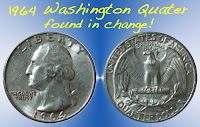 Somewhere, my wife received a 1964 Washington Quarter in change. If I was to have it grade, it would probably be slabbed in Extra Fine condition. There is some slight luster and it shows the signs of once being in someone’s collection. According to coinflation.com, the coin is worth about $2.85 in metals (as I type this), which is probably more than its numismatic value. But that does not matter… it was fun to find!!



 Loading ...