
Weekly World Numismatic News for June 7, 2020
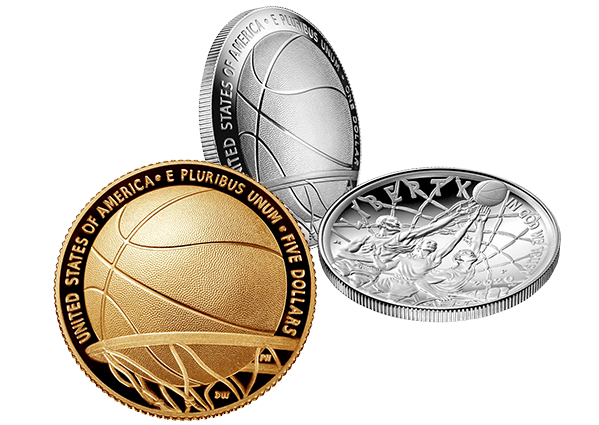 It is always fun when there is something numismatic to report. This week, the U.S. Mint released the Basketball Hall of Fame Commemorative Coins. The curved or domed coins of the program feature a basketball going into the basket on the reverse or convex side. The reverse features three players reaching for a rebound.
The coins are available as a $5 gold, silver dollar, and clad half-dollar coins in proof and uncirculated finishes. The U.S. Mint is also offering an uncirculated half-dollar in a special folder for kids that will not be available until September.
Introductory pricing for the silver and clad coins expire on July 6. After July 6, the price will go up by $5. The market value of the gold determines the gold coin’s price.
Previously, there was a discussion of a colorized coin. According to the U.S. Mint, it will be available in the future.
The Naismith Memorial Basketball Hall of Fame is unique amongst sports halls of fame in that enshrinement is not limited to professionals or college players. Inductees include college and professional basketball players, teams, coaches, and broadcasters. From my undergraduate alma mater, the University of Georgia, Theresa Edwards and Katrina McClain are honored alongside Dominique Wilkins.
From Senda Berenson Abbot, the “Mother of Women’s Basketball,” to Pat Summitt, the most successful coach of women’s college basketball, the Hoop Hall presents basketball beyond the NBA.
Although it has been over 20 years since I visited the Hoop Hall, I would recommend that you visit. Maybe you could consider a trip when the Hall reopens.
And now the news…
 May 31, 2020
 → Read more at thisweeknews.com
June 1, 2020 → Read more at northumberlandgazette.co.uk
June 1, 2020 → Read more at abc.net.au
June 1, 2020 → Read more at itsnicethat.com
June 2, 2020 → Read more at dailynews.com
June 3, 2020 → Read more at worldatlas.com
June 3, 2020 → Read more at robbreport.com
→ Read more at thisweeknews.com
June 1, 2020 → Read more at northumberlandgazette.co.uk
June 1, 2020 → Read more at abc.net.au
June 1, 2020 → Read more at itsnicethat.com
June 2, 2020 → Read more at dailynews.com
June 3, 2020 → Read more at worldatlas.com
June 3, 2020 → Read more at robbreport.com
Exploring Charlotte Numismatically
Many years ago, my father accepted a job with a company named North Carolina National Bank in Charlotte. Growing up on Long Island, I knew this was going to be a culture shock. What I knew about the south was printed in the newspapers. No matter how my parents tried explain that living in Charlotte was not that bad, I was skeptical. It did not help when my parents bought a house just beyond the city limits in a neighborhood with no street lights and was very quite. A sharp contrast from an area that was across Jamaica Bay from JFK Airport!
Charlotte is an interesting city with some interesting quirks. For as long as I remember, Charlotte has always been concerned with its image. Charlotteans are so worried about what the rest of the world thinks of them that they lose sight with the concept of “just be yourself.” While this attitude continues, Charlotte has moved up in the “major leagues” by concentrating on itself and building itself into something more than a 2½ horse town and Atlanta’s little sister.
One thing that Charlotte has going for it is that it is really the financial capital of the south. Charlotte is second to New York as being the largest banking centers in the U.S. Charlotte was the home of that little bank named North Carolina National Bank. Today, that bank operates under the name of Bank of America. It also was the home of First Union before being bought by Wachovia which was later purchased by Wells Fargo. Charlotte is the home of Wells Fargo’s east coast operations.
I bring this up after reading a Charlotte Observer story, “Museums of Money”that appeared last week on their website. The story begins by reminding us that Charlotte has had a long financial history dating back to the 1799 discovery of gold of Conrad Reed’s farm along Little Meadow Creek in nearby Cabarrus County. Conrad’s son John further explored the area in 1802 and began mining operations in 1804. The Reed Gold Mine is now a privately owned historic landmark open year round to visitors. You can still pan for gold to find the slivers still floating in the waters.
The story was prompted by the opening of the new Wells Fargo History Museum in the building they purchased from Wachovia in downtown Charlotte. The museum pays tribute to the gold and banking heritage of the area along with the history of Wells Fargo dating back to its founding in 1852. You can read about Wells Fargo’s history on line and see some the artifacts at their museums nationwide at www.wellsfargohistory.com.
Another museum mentioned is Mint Museum of Art. With the discovery of gold in the Charlotte area, congress authorized the first branch mints outside of Philadelphia. The U.S. Mint in Charlotte was opened in 1837 and was the first mint ousted of Philadelphia to strike gold coins. The Charlotte Mint produced over $5 million in gold coins until it was taken over by the Confederacy after North Carolina seceded from the Union in 1861. After the war its status was changed to an assay office. When the building was set to be demolished in 1931, a group of private citizens bought the building and moved it a few miles south of its downtown Charlotte location. The building was rededicated in 1935 as the Mint Museum of Art. Today, the museum has expanded to a new location in downtown Charlotte and the location of the original Mint building is called Mint Museum Randolph. The Randolph location has a small gallery dedicated to when it produced coins including a model of the layout showing where the coins were struck and stored along with examples of the half and quarter eagles struck at the old Mint.
Not to be outdone, Bank of America has a its flagship museum at its corporate headquarters in Charlotte. The Bank of America Heritage Museum does focus more on its heritage from its founding as North Carolina National Bank in 1961, but does recognize the full history of all the banks that it acquired over the years which dates its history back to The Massachusetts Bank founded in 1784. If your interest leans to the Bank of America before being purchased by Nations Bank, their museum in San Francisco will provide you with that opportunity. For those not in either location, the Bank of America Heritage website provides some information of interest.
One museum of note was the Levine Museum of the New South and its permanent exhibit “Cotton Fields to Skyscrapers.” This award willing museum concentrates more on the growth of Charlotte and the area from the end of Civil War until today. One of the exhibits shows one of the first ATMs developed by IBM in Charlotte first used by First Union bank.
So if you are in, near, or traveling to Charlotte, these are all good places for a numismatist to go and explore.
Silver Eagle Set Sells Out, But…
After going on sale at noon, the U.S. Mint changed the catalog page for the 2011 American Eagle 25th Anniversary Silver Coin Set to say the sets have been SOLD OUT at 6:00 PM.
Those of us who were able to order sets found that the U.S. Mint early was faced with slow response time at the website and busy signals on the phone. In fact, the phone system was the most frustrating. After calling 1-800-USA-MINT, the interactive voice response (IVR) system answered and presented the options. After pressing “1” to order products, we were told “Your call may be monitored for quality assurance purposes.” Sometimes, it was followed by a message saying that I was selected to participate in a survey after the call. But I never got to the survey when the call reverted to a busy signal.
The website was no better. Many times it did not respond. When it did, users could only get back to the front page. After being able to select the sets and change the quantity, trying to check out became an act of futility. For the first hour, if you could get back to the online shopping cart, requests to checkout was not responded to by the U.S. Mint servers.
Fifty minutes into this adventure, my call sailed past the intro to actually place me on hold. A few moments later, a pleasant woman answered the phone and helped me place my order for five sets, the household limit.
Once the order was completed, I turned back to the computer and continued trying to place an order anyway. After trying for 90 minutes, I gave up and decided to have lunch.
U.S. Mint ordering limits prevented a quicker sellout. Two friends were able to order sets by phone at 3:00 PM. They called from work and each placed their order with the same representative.
Although I do my work for a different government agency, we always attempt to architect the systems, including the VRS, for the worst case scenario. Although predicting the maximum load and how to build systems is more of an art than a science, there are tools that helps the performance engineers’ job easier. The U.S. Mint should consider finding system engineers who come with performance engineering support to fix their systems.
Now that I have that off my chest, I am looking forward to seeing this set, especially the reverse proof. The reverse proof was the highlight of the 20th Anniversary set and should be the highlight of the 25th Anniversary Set.
E-Numismatist Now Available for Android Phones
The American Numismatic Association announced today that users of Android-based smartphones can now read The Numismatist electronically. While the app is free from the Android Market, members are required to login in order to be able to read The Numismatist electronically.
This expands the ANA’s electronic reach following the release of their iPhone app and HD version for the iPad. You can read “Review: E-Numismatist Is Worth Its Quirks” for more about the iPhone and iPad apps (rated MS63).
Since I do not own an Android device, I am inviting a guest reviewer for this app. If you are an ANA member with the ability to log in and read The Numismatist electronically, I will publish your review here on the Coin Collectors Blog.
Guidelines:
- Before sending me the review, you must contact me via email (I don’t want to be bombarded with reviews)
- Your review must include screen images of the running app (see my review of the iOS apps as an example)
- Your review must conclude with a rating on the 70-point Sheldon scale with a short justification
- Reviews are subject to editing (spelling and grammar) and reviews by both of us before posting
- I will also need a proper spelling of your name for the by-line and an email address for readers to contact you
Your review will be a great service to the numismatic community and you will have my gratitude.
Perth Mint Introduces 1 Tonne Gold Coin
Early this morning U.S. time, the Perth Mint unveiled the world’s largest gold coin. The 1 Tonne Gold Kangaroo Coin is made from 99.99-percent pure gold, weighs one tonne (1,000 kilograms or 2,204.62 pounds), is 80 centimeters (31.49 inches) in diameter, and 12 centimeters (4.72 inches) thick. The obverse features Queen Elizabeth II and the reverse features a Red Kangaroo. The coin has a face value of AU$1 million ($1.04 million U.S. Dollars) and contains $55.23 million in gold (at the spot price $1718 per troy ounce).
Perth Mint surpassed the effort by the Royal Canadian Mint whose 2007 CA$1 million face value coin, made with 99.999-percent pure gold, and weighed only 100 kilograms.
Why did the Perth Mint do this? As a publicity stunt, of course. In a video produced by the Perth Mint (see below), the director said that it will be part of their exhibit for the 100,000 people per year who come to visit their facility. Certainly, the chance to see the World’s Largest Coin will be an attraction that will increase the number of visitors.
You can see how the Perth Mint made the coin in their video below.
25th Anniversary Silver Eagles Price Set
 On Thursday, October 20, the U.S. Mint not only confirmed that the American Eagle 25th Anniversary Silver Coin Set at noon Eastern Time (ET) on October 27, 2011, but that the price was set at $299.95 with a limit of 5 sets per household. The U.S. Mint caveated the price noting that the price is subject to change depending on the price of silver.
Earlier this week, I attempted to predict the price of the set. At that time, the guess was $368.95 with the price of silver at $42—which was the price when I did the calculations, not posted the article. If we give me the approximate $10 drop in silver ($50 for five coins), and take away the 33-percent markup ($16.50) should have lowered my guess to $312.45. That would be only a $13.50 difference. So my guess was only significantly off by my assumed price of silver.
Spin aside, I am looking forward to this set. Hopefully, their website will stay up long enough to allow me to place my order!
Image courtesy of the U.S. Mint.
Support the Coin Collectors Blog
 Buy me a coffee
Thank you for your support!
Let Me Know What You Think
Are you going to the World's Fair of Money
Total Voters: 17
 Loading ...