
A Look at the American Eagles: The American Silver Eagles (UPDATED)

- American Silver Eagles ← you are here
- American Gold Eagles
- American Platinum Eagles
- The New American Palladium Eagles
NOTE: This is an updated article that was first published on September 18, 2018.
After the Coinage Act of 1965 removed silver from United States coinage, the federal government held the silver in the national stockpile. By the 1980s, the supply that far exceeded the needs of the national stockpile. Following several years of discussion that almost led to the bulk auction and sale of the silver, congress decided to use the silver to create a silver investment coin, the American Silver Eagle.
The American Silver Eagle program was so successful that following the depletion of the Defense National Stockpile in 2002, the original law was changed to continue the program by purchasing silver from U.S.-based mines at market prices to be used for future production.
American Silver Eagle Design
The obverse of the coin is the much-beloved design that was used on the Walking Liberty Half-Dollar coin from 1916 to 1947, designed by Adolph A. Weinman, a former student of Augustus Saint-Gaudens. The reverse features a heraldic eagle using a design by John Mercanti. Mercanti engraved both sides of the coin that including copying Weinman’s original design. Mercanti would later become the 12th Chief Engraver of the U.S. Mint.
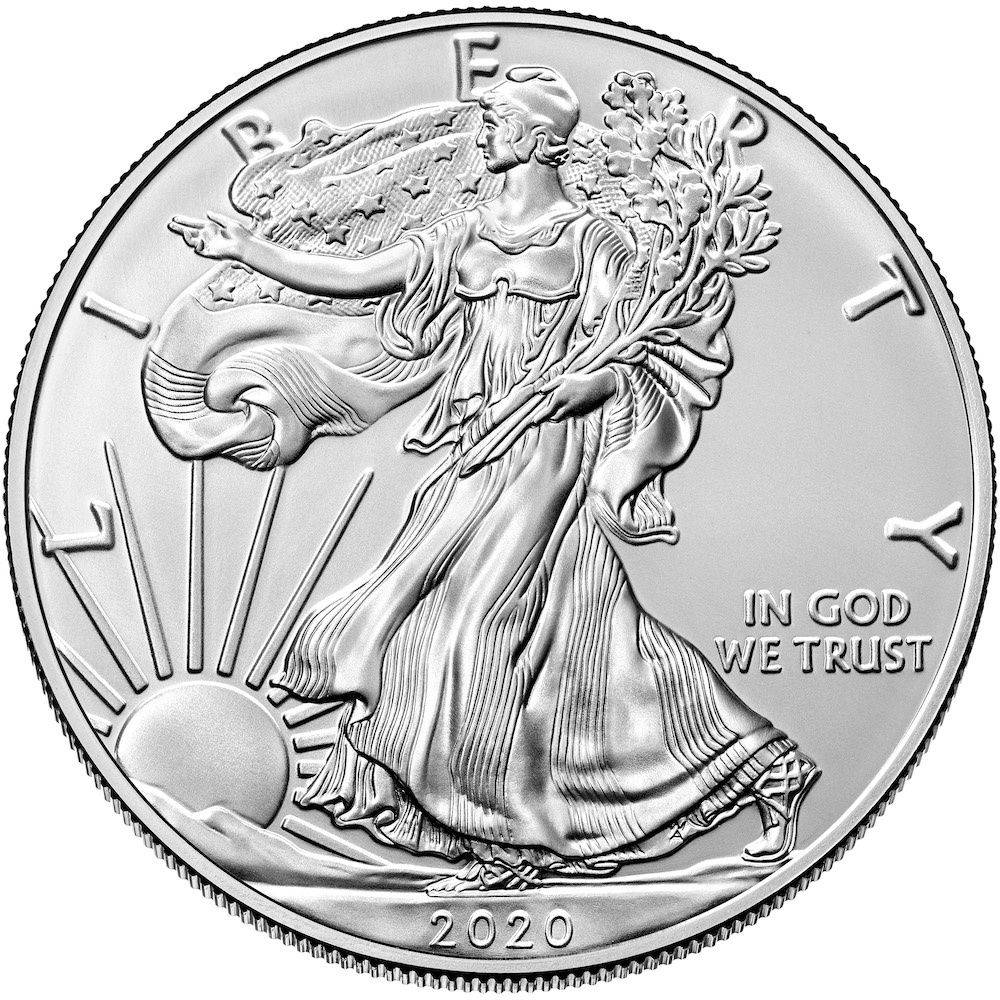
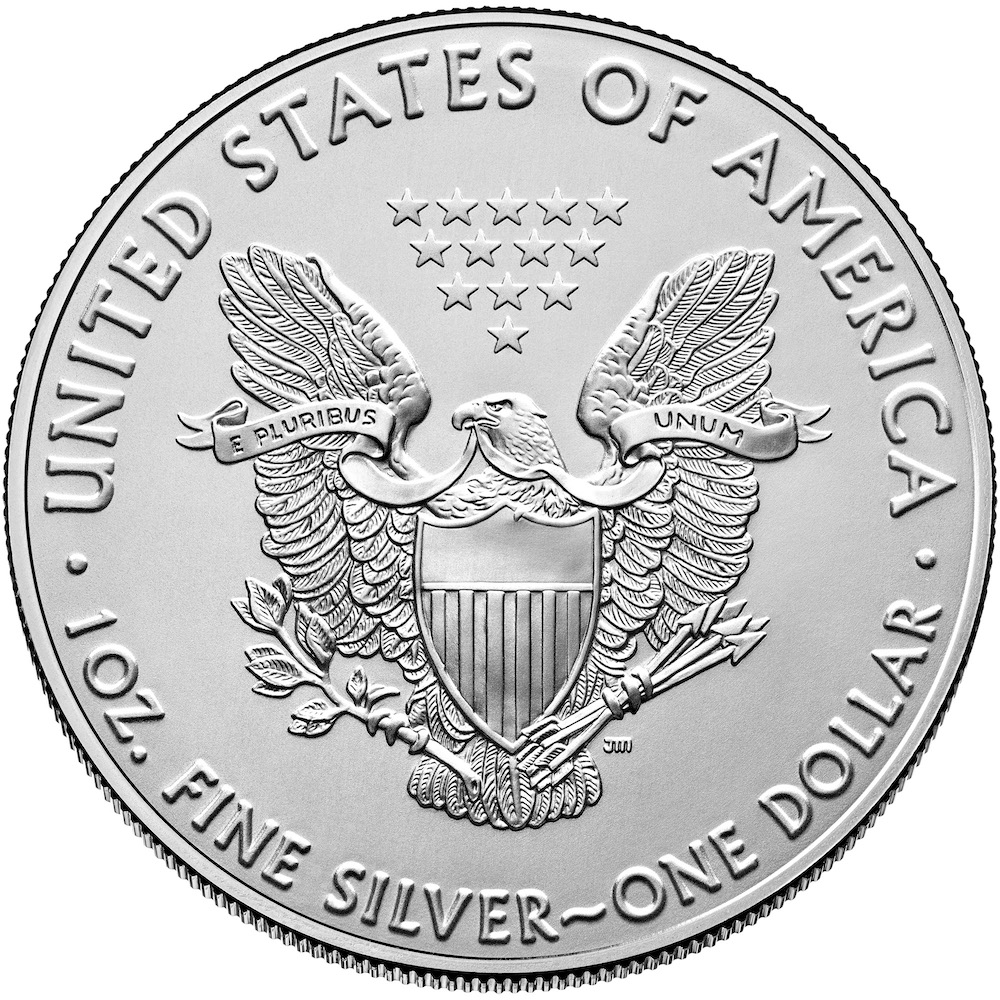
| American Silver Eagle Specifications | |
|---|---|
| Composition | .999 Fine Silver |
| Weight | One Troy Ounce (31.103 grams) |
| Diameter | 40.6 mm (1.598 inches) |
| Thickness | 2.98 mm (0.1173 inches) |
| Edge | Reeded |
| Face Value | $1.00 |
| Designers | Adolph A. Weinman (obverse), John Mercanti (reverse) |
| Engraver | John Mercanti |
Bullion American Silver Eagle Coins
The American Silver Eagle program produces bullion coins for the investment market and collectible versions of these coins. As bullion coins, the U.S. Mint tries to eliminate the factors that drive the price of collectible coins (mintage, rarity, and condition) by making each coin the same. The U.S. Mint strikes American Silver Eagle to meet the market demand and can be stuck at any branch mint. Bullion coins do not have a mintmark.
The U.S. Mint does not sell bullion coins directly to the public. They sell the coins to “Authorized Purchasers,” who then resell the coins to the market. Although the American Silver Eagle bullion coins are produced for the investment market, some people collect these coins.
As with other investments, American Silver Eagle bullion coins are subject to taxes when sold. Please consult with a financial advisor or tax professional for any tax implications.
Mint of Origin for Bullion Coins
The U.S. Mint branch facility in West Point, New York, has been the primary manufacturer of American Silver Eagle bullion coins. Over the years, the mint facilities in San Francisco and Philadelphia have supplemented production.
Following an investigation, researchers learned that the U.S. Mint struck American Silver Eagle bullion coins at San Francisco and Philadelphia from 2011-2017. Some have tried to use shipping records from the U.S. Mint, shipping labels, packaging materials, and other means to try to investigate the origin of the coins.
In 2015, the industry thought they understand how to tell which Mint struck the coins. According to a statement issued by the U.S. Mint in 2018, the Philadelphia Mint produced 79,640 bullion coins. However, 140 coins were “condemned” and not issued. They shipped 79,500 coins to West Point for distribution to authorized purchasers. Although the boxes contain labels and serial numbers, there was no attempt made to separate the coins by Mint. Further, the U.S. Mint acknowledges that they identified cases of duplicate labels and tracking numbers written on the box. The information creates a reasonable doubt as to determine the manufacturer of the coins.
The third-party grading services believe they identified strike characteristics of the 2015 bullion coins that occurred at the Philadelphia Mint. They have encased American Silver Eagle bullion coins with labels noting their Philadelphia pedigree with no additional evidence.
In 2020, the novel coronavirus (COVID-19) pandemic caused the U.S. Mint branch at West Point to close temporarily. In order to keep up with production, the U.S. Mint struck 240,000 bullion coins in Philadelphia.
The third-party grading services asked the U.S. Mint about the production of these coins. Rather than leave the industry guessing, the U.S. Mint identified which boxes contained American Silver Eagle bullion coins struck in Philadelphia. The grading services are noting the origin of the bullion coin on the label of their slab.
Unlike the 2015(-P) coins, the 2020(-P) coins have an identifiable trail that leaves little doubt to the origin of the coins.
Collector American Silver Eagle Coins
The U.S. Mint produces collector versions of the American Silver Eagle are sold directly to the public in specialty packaging. The U.S. Mint sells American Silver Eagle proof coins in a specially made capsule stored in a blue velvet-covered case in a blue box with a Certificate of Authenticity.
Beginning in 2006, the U.S. Mint has produced an uncirculated business strike coin for the collector market. Most uncirculated American Silver Eagle collector coins are struck in West Point and bear the “W” mintmark. Uncirculated coins are burnished, a process by treating the surface with fine particles to give the surface a smooth, satin finish. The U.S. Mint sells these coins in a capsule with packaging that varies from year to year.
The U.S. Mint has produced coins with reverse proof and enhanced uncirculated finishes. A reverse proof coin is when the elements show a mirror-like appearance and the fields have a matte finish.
In 2009, the U.S. Mint was unprepared for the financial collapse that increased the demand for silver bullion coins. So that the U.S. Mint could produce the coins to meet the investor demand, the U.S. Mint did not produce collector American Silver Eagle coins. Although the American Silver Eagle proof coin returned to the market in 2010, the U.S. Mint did not produce uncirculated burnished coins.
American Silver Eagle collector coins returned in 2011.
OGP vs. GRADED
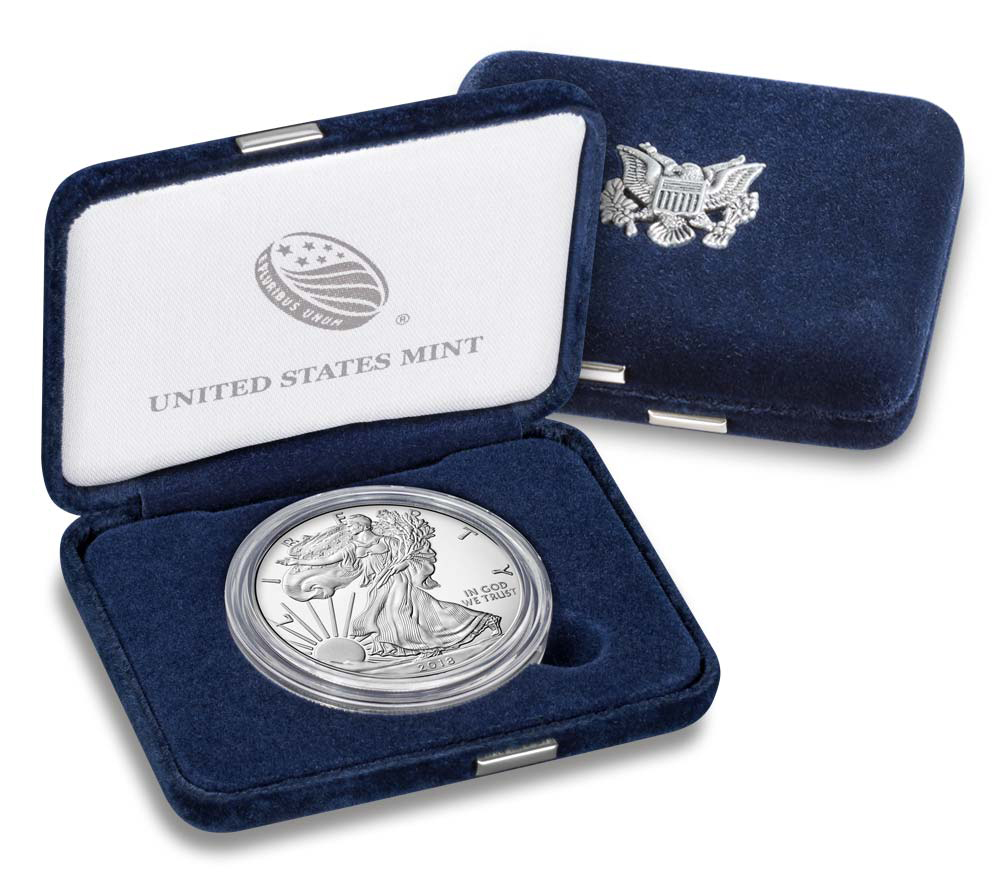
2018-W American Silver Eagle Proof in Original Government Package
Collector American Silver Eagle coins can be purchased either in their original government package or graded. When searching for coins that are in their original government packaging on most online auction sites, it is recommended that you add “OGP” as part of the search.
Dealers and collectors will remove the collector American Silver Eagle coins from their original government package in order to submit them to a third-party grading service for grading. Collectors who prefer the encapsulated coins are not concerned with the package. Some dealers will sell the package without the coin for a few dollars, but for collectors of graded coins, this is not a priority.
2007 Reverse Variety
In 2008, the U.S. Mint updated the reverse dies of the American Silver Eagle, giving it a slightly different appearance. The reverse die was only supposed to be used on collector American Silver Eagle coins in 2008 before being used for bullion coins in 2009.
As a result of the human factor required with operating the minting equipment at the West Point Mint, the reverse dies used for the 2007 American Silver Eagle coins were mated with 2008 collector coins creating a new variety for collectors. These coins are known as a 2008-W Silver Eagle Reverse of 2007 Variety.
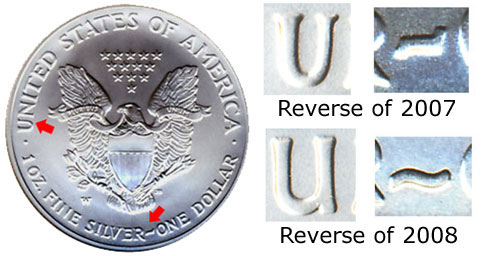
2008-W Silver Eagle Reverse of 2007 Variety
(Image courtesy of the Silver Eagle Guide)
The 1995-W
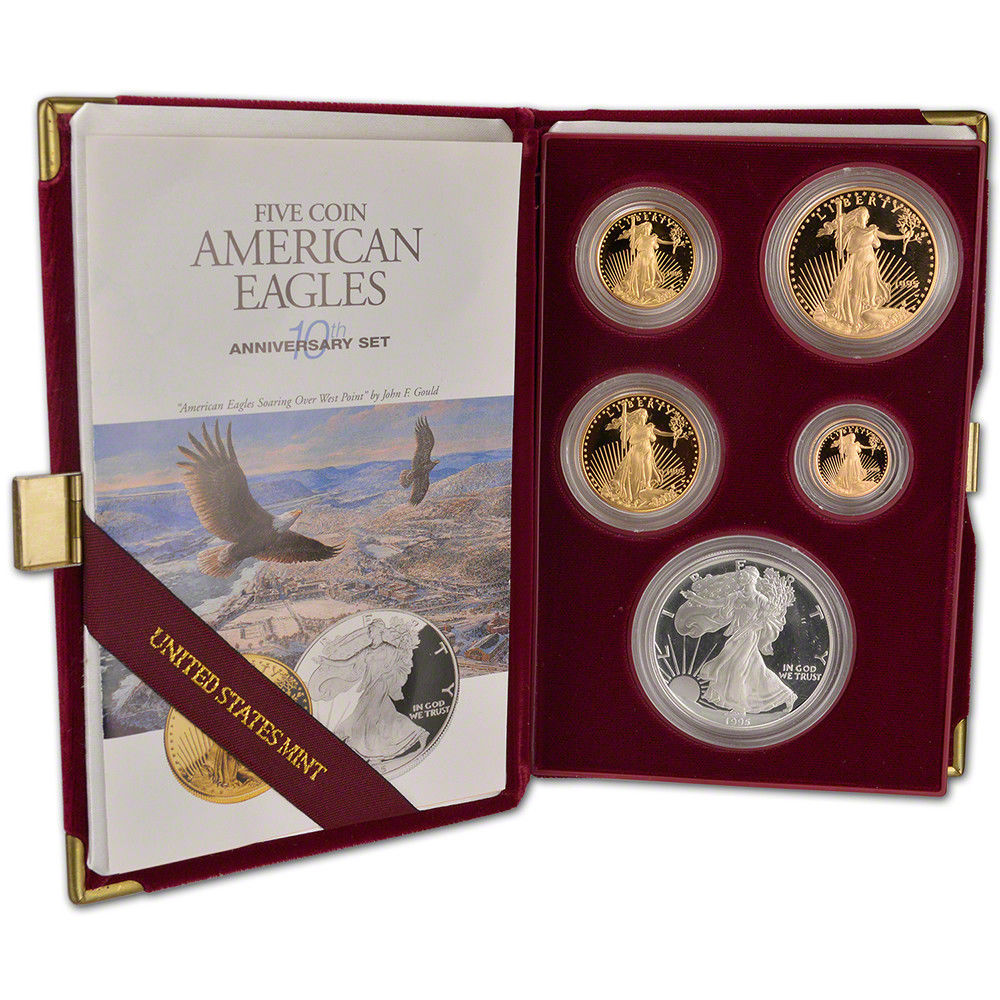
Tenth Anniversary American Eagle Set
In 1995, the U.S. Mint created the 10th Anniversary American Eagle set to celebrate the program’s decade. The set contained a 1995-W American Silver Eagle proof coin that was made available only to collectors buying the set. Collectors wanting to add the 1995-W American Silver Eagle proof coin to their collection had to purchase the entire five-coin set that included four American Gold Eagle proof coins ($5, $10, $25, and $50 gold American Eagles). The $999 price for the set helped limit the number of coins sold.
As gold prices have risen, collectors sold the gold coins separately. However, the limited availability has caused the 1995-W American Silver Eagle to rise significantly on the secondary market. Cost to purchase this coin averages about $5,000-6, depending on the grade and finding the entire set with the American Gold Eagle coins in their original government package averages over $8,000.
Special Sets
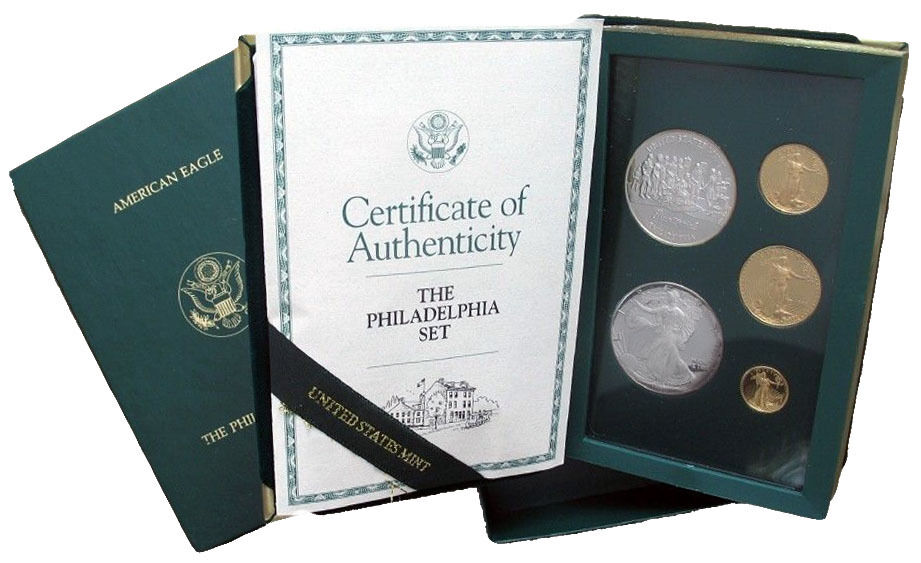 In 1993, the U.S. Mint offered The Philadelphia Set, which was issued to commemorate the 200th Anniversary of the striking of the first official U.S. coins at the Philadelphia Mint. This set included each of the Proof American Gold and Silver Eagles struck at the Philadelphia Mint and containing the “P” mintmark. The set included a 1993-P Proof Silver Eagle along with the one-half ounce, one-quarter ounce, and one-tenth ounce 1993-P Proof Gold Eagles. Also included was a silver Philadelphia Bicentennial Medal, which specially produced for this numismatic product.
To mark the launch of the new American Platinum Eagle bullion and collector coin series, the U.S. Mint offered the 1997 Impressions of Liberty Set. This set contained the one ounce 1997-W Proof Platinum Eagle, one ounce 1997-W Proof Gold Eagle, and one ounce 1997-P Proof Silver Eagle. Production was limited to 5,000 individually numbered units. The serial number for each set was engraved on a brass plate affixed to the wooden display case.
In 2004, the U.S. Mint worked with the United Kingdom’s Royal Mint to create a numismatic product containing the silver bullion coins from each country. The Legacies of Freedom Set contained one 2003 American Silver Eagle bullion coin and one 2002 British Silver Britannia bullion coin. The special packaging highlighted the importance of the two national icons.
To celebrate the 150th Anniversary of the founding of the Bureau of Engraving and Printing and the 220th Anniversary of the United States Mint, the two bureaus joined together to release the 2012 Making American History Coin and Currency Set. The set contained a 2012-S American Silver Eagle Proof coin and a $5 note with a serial number beginning in “150.”
As part of the 2016 Ronald Reagan Coin and Chronicles Set the U.S. Mint included a 2016 Proof American Silver Eagle along with a 2016 Ronald Reagan Presidential reverse proof dollar, and a Nancy Reagan Bronze Medal. To complete the set, it included a presidential portrait produced by the Bureau of Engraving and Printing and an informational booklet about President Reagan.
In 2019, the U.S. Mint partnered with the Royal Canadian Mint to issue the Pride of Two Nations silver coin set. The set contained a reverse proof American Silver Eagle struck at West Point and a reverse proof Silver Maple Leaf struck at the Royal Canadian Mint’s facility in Ottawa, Ontario. Production was limited to 100,000 sets in the United States and 10,000 sets in Canada.
Later in 2019, the U.S. Mint released an Enhanced Reverse Proof coin struck at the San Francisco Mint. Its mintage limit of 30,000 coins is less than the number of 1995-W coins issued.
Annual Sets
To extend the product line, the U.S. Mint began to create special annual issue sets to entice people to collect U.S. Mint products. The first annual set containing an American Silver Eagle coin was the Annual Uncirculated Dollar Coin Set. First offered in 2007, the set includes the issued uncirculated Presidential dollar coins, an uncirculated Native American dollar coin, and an uncirculated American Silver Eagle. Since the Presidential Dollar Program ended in 2016, it is unclear whether the U.S. Mint will issue the set in 2017.
Since 2012, the U.S. Mint has been producing the Limited Edition Silver Proof Set that contains 90% silver versions of the year’s five America the Beautiful Quarters, Kennedy Half Dollar, and Roosevelt Dime, along with the standard annual Proof American Silver Eagle. Sets are limited to 50,000 units annually.
Starting in 2013, the U.S. Mint has been producing the Congratulations Set as part of a new line of products targeted towards gift-giving occasions. The set includes the standard annual Proof Silver Eagle within specially designed packaging that allows the gift giver to add a personalized message.
Anniversary Sets
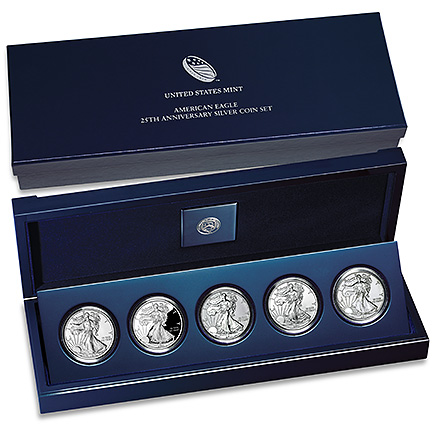
2011 American Silver Eagle 25th Anniversary Set
Since the American Eagle Program has been one of the most successful programs in the history of the U.S. Mint, they have used its popularity to extend the product line. Aside from celebrating the anniversary of the program, the U.S. Mint has produced anniversary sets to celebrate Mint facilities.
The Anniversary sets issued are as follows:
- 1995 American Eagle 10th Anniversary Set included a 1995-W American Silver Eagle Proof coin and four American Gold Eagle coins.
- 2006 20th Anniversary American Silver Eagle Set was a special three-coin box set included a 2006-W American Silver Eagle with a burnished (satin) finish, a 2006-W American Silver Eagle Proof coin, and a 2006-P American Silver Eagle Reverse Proof coin.
- 2011 25th Anniversary American Silver Eagle Set was a five-coin box set that contained five different coins. The U.S. Mint produced only 100,000 sets that sold out within the first 10 minutes they were offered online. This extremely popular set is averaging $800 on the secondary market in the original government package. The set includes the following coins:
- 2011-W (West Point) American Silver Eagle Uncirculated coin
- 2011-S (San Francisco) American Silver Eagle Uncirculated coin
- 2011-W (West Point) American Silver Eagle Proof coin
- 2011-P (Philadelphia) American Silver Eagle Reverse Proof coin
- 2011 (no mintmark) American Silver Eagle Bullion coin
- 2012 American Eagle San Francisco Two Coin Silver Proof Set was issued to celebrate the 75th anniversary of the current San Francisco Mint. The set included a 2012-S American Silver Eagle Proof coin and a 2012-S American Silver Eagle Reverse Proof Coin.
- 2013 West Point American Silver Eagle Set was issued to celebrate the 75th anniversary of the facility in West Point, New York. The set included a 2013-W American Silver Eagle Reverse Proof coin and a 2013-W American Silver Eagle Enhanced Uncirculated coin. The set was instantly popular with collectors since it was the first appearance of the Enhanced Uncirculated finishing process.
Although the U.S. Mint did not issue a set to celebrate the 30th Anniversary of the American Silver Eagle in 2016, West Point struck proof and burnished uncirculated collector coins with edge lettering that read “30TH ANNIVERSARY.”
Rolls and the Green Monster Box
Bullion coins are packaged in 20-coin hard plastic rolls with 25 rolls packed in a specially designed green box that contains 500 troy ounces of silver. The U.S. Mint seals the box before shipping them to authorized purchasers. The term Green Monster Box refers to the green box with 500 silver coins.
Resellers sell Green Monster Boxes with the intent of selling to investors. Resellers also sell unopened rolls from the Monster Box.
Sealed Green Monster Boxes have the benefit of being unsearched and unhandled since leaving the U.S. Mint. These boxes are usually offered for sale by bullion dealers at a small premium over the current market (spot) price of silver. Unsealed Monster Boxes with the U.S. Mint’s labels intact can attest to the authenticity of the coins.
In the next installment, we look at the American Gold Eagle coins.
Striking the ATB Bullion Coins
I have not seen the five-ounce America the Beautiful Silver Bullion Coins. Aside from rarely seeing the circulating versions, I have no desire to purchase a five-ounce silver coin, especially from a series that does not inspire me.
What does inspire me is watching what the U.S. Mint has to go through in order to strike these coins. For those of us who love to watch how this works, the U.S. Mint’s YouTube channel has a video showing the production process.
Watch the video:
Imagine what it takes to strike these coins. According to the video, the U.S. Mint strikes the 3-inch planchettes twice with 430 tons of force. I also did not get the impact of the planchette size until I saw the video.
I also did not know about the edge lettering and that there were two different versions—a reverse proof-like as the bullion version and a matte finish for collectors. The reverse proof-like coins are beautiful. I wish they would do this with the regular proof coins because it would make a great collectible series.
Olympic National Park Launched
Olympic National Park in Washington is one of the most unique National Parks because of its biodiversity. There are three distinct ecosystems in just under a million acres: sub-alpine, coastal, and forest. Cool weather and rain are regular weather indicators that makes it very comfortable to visit during the summer as long as you remember your rain gear!
On the 234th anniversary of the adoption of “Old Glory” as the U.S. flag, the U.S. Mint held its launch ceremony for the Olympic National Park Quarter at Port Angeles, Washington. Associate Director for Sales and Marketing for the U.S. Mint, B.B. Craig, was joined by Washington’s First Gentleman Mike Gregoire, Vanessa Fuller of the Port Angeles Regional Chamber of Commerce, and Olympic National Park Superintendent Karen Gustin were joined by local school children. Ms. Fuller served as master of ceremonies and First Gentleman Gregoire read proclamation declaring June 14 “Quarter Day in the Classroom.”
The following is the B-Roll video from the release ceremony:
Who Are the Third Party Grading Services
Can you name the third party grading services?
When I thought about this question I came up with NGC, PGCS, ICG, and ANACS. I did think about DGS, but they were shutdown last year. But recently, I received an email with an advertisement from another third party grading service that may not be on most people’s RADAR: SEGS.
SEGS started as Sovereign Entities Grading Service but seems to have dropped the full name. While not considered one of the top-tier grading services, SEGS was known as the service that would best attribute the variety of the coin in their holders.
In the past, I have said that competition is good in any market, including amongst the third-party grading services, but who is SEGS competing against? Right now, NCG and PCGS are at the top of the heap. The new ANACS seems to have sold its soul to the television hucksters while ICG showed promise a but lost ground in the shakeup caused by ANACS. Where does SEGS fit into this ecosystem?
SEGS boasts their consultants include Larry Briggs, Jeff Oxman, and Bill Fivaz—all well known numismatic experts in their areas. But is that enough? How is SEGS’ grading abilities compared to the other services? How does the market feel about their service?
Based on the 2006 survey conducted by the Professional Numismatic Guild (PNG) and Industry Council For Tangible Assets (ICTA), SEGS Was rated “Poor” along with the now defunct PCI. NCG and PCGS were rated “Superior” while ANACS and ICG were rated as “Good.” There seems to be little market movement that has changed the perception of those ratings.
Competition is good and should be welcome in any market. However, if SEGS is going to survive in this already tight market, they must figure out how to differentiate themselves from their competitors. All of these grading services have noted experts and consultants. They all provide attribution services and their prices range from the affordable to the premium. Just being better is not enough.
NOTE: This is the first post I created on my new iPad. As a touch typist, it will take some getting used to since there are no real keys to touch. Also, I need to download the app that allows me to type short codes I use on my Mac for better formatting of these posts. Otherwise, I think I can take the iPad on the road and still write blog posts—including reviews of coin-related iPad apps.
A Dealer’s Experience with PCGS SecurePlus
It is not often I receive comments on posts older than a few weeks. But I found it curious that I would receive a comment on my post “PCGS Demonstrates Its New Technology” from last January. When I read the reply, I thought it deserved more attention than a response to a five-month old post.
The comment is from Christopher Neal Wyatt, President of Superior Bullion from Cincinnati, Ohio who has not had a good experience with PCGS SecurePlus service. Rather than have me explain the problem, Mr. Wyatt has given me permission to make his comment as a main post:
I am a coin dealer on eBay and I have been submitting coins to PCGS for years.
Regarding the new SecurePlus service, I am growing less enthusiastic with each and every submission.
I have come to the conclusion that the there are two critical problems with the PCGS SecurePlus service:
1.) The coin grading staff is now able to see an extremely high-resolution scan of each coin, such that tiny, minor imperfections- which would not have been visible even under 10x magnification- are now being blown out of proportion, and as a result I am now receiving grades which are lower than I believe I would have received under the old method.
2.) Now that PCGS has a ‘fingerprint’ of my coin, I feel as though it is no longer possible for me to re-submit the coins in hopes of a higher grade, as my duplicate submission will immediately be detected, and they will likely send the coin back to me with the same grade as before, without taking the time to properly reconsider the coin for a possible higher grade.
Up until this past month, I felt as though PCGS was giving me consistent grades on every coin I submitted. More recently, however, it seems as though the grades have not been fair; one coin should have been an MS 68, but was given a 67, and a second was graded PR68DCAM, when it clearly should have been PR70DCAM- this coin has no scratches, a full strike, and beaming mint luster. I have the photos to prove it.
I have never posted my thoughts about third-party grading since I have mixed feelings about this type of service. I see justification for both sides of the argument. One aspect about third party grading I worry about is the concept of “market grading” and how some high volume dealers try to play on the subjective nature of market grading to try to get coins graded higher with each submission. I understand this is why PCGS created the SecurePlus service, but the need for it strikes me as a bit unseemly.
My collection includes graded coins and I participate in NGC’s Registry Set competition. But the vast majority of my collection consists of raw (not graded) coins and will probably remain that way. This is how I feel today, but I may change my mind in the future.
Mr. Wyatt said that he will be resubmitting his coins for review and will let me know what happens when they return. I will post the results when I receive them.
A Driving New Collectible
In keeping with my “that’s neat” collecting theme, I added another set of interesting non-circulating legal tender coins to my motorcycle coins. This time, it’s sports cars!
In 2010, the Federal Republic of Somalia continued its series of odd-shaped coins and added a series to honor famous sports cars. While the motorcycle coins are based on the designs of various motorcycles and not supposed to depict actual production models, the Sports Car Coins were made to represent the real classic sports cars—the cars of my boyhood dreams.
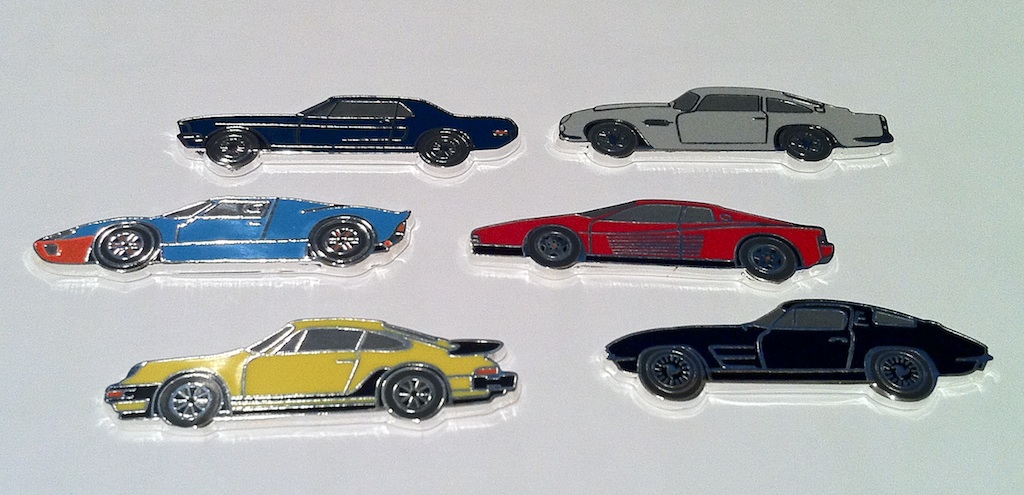 The six coins include (see picture, left-to-right, top-to-bottom) a green 1965 Ford Mustang, a gray 1964 Aston-Martin DB-5, blue and orange Lamborghini, red Ferrari, yellow Porsche, and a black Corvette. Fans of the James Bond movies will recognize the Aston-Martin DB-5 as the car Sean Connery drove in Goldfinger and Thunderball.
If you were wondering, car that was used in the movies was sold at auction in 2010 to an Ohio man for $4.6 million (£2.9 million), which includes the 12-percent auction premium.
Now if they would make a coin based on my all-time favorite classic car I would be the first on line to purchase one. That would be a 1959 Cadillac Eldorado Biarritz Convertible in red—big fins and all!
Click on image to see a larger version.
Support the Coin Collectors Blog
 Buy me a coffee
Thank you for your support!
Let Me Know What You Think
Are you going to the World's Fair of Money
Total Voters: 17
 Loading ...