
Opening my eyes about growing the hobby
While thinking about how to grow the hobby, I was reading the numismatic-related news from around the world. What do other people consider when they are collecting coins?
Stories about buried coins or hoards of ancient coins generate a lot of interest. Whether it is builders and archeologists digging in the Middle East or metal detectorists hunting the British countryside, the stories about these finds make for exciting reading.
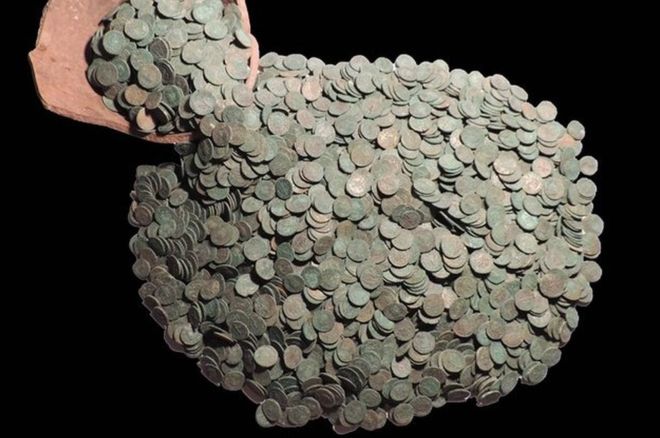
Largest hoard of Roman coins found in Lincolnshire
(Image courtesy of the BBC)
Modern error coins seem to be of interest. News outlets in Great Britain and Australia regularly publish stories about an error someone found or sold online. Although these stories cause people to become treasure hunters, there have been reports that some have turned into collectors.
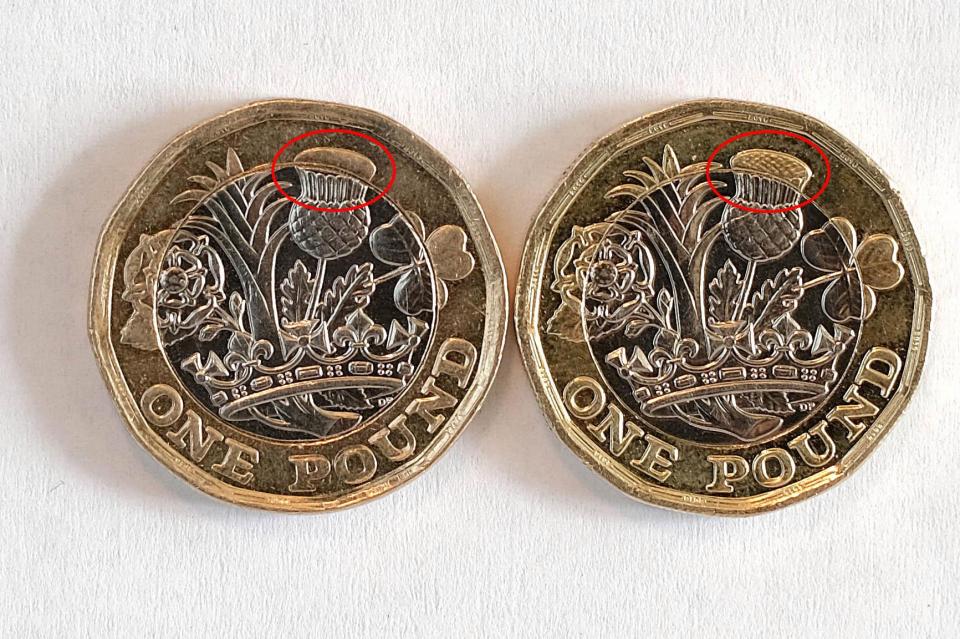
First new £1 coin error found with missing detail on the thistle
Finally, when a mint issues a coin with a different, the interest grows. Both Royal Mint and the Royal Australian Mint issued coins with letters of the alphabet and an image of something that begins with that letter. The news created a buzz and new collectors in both countries.
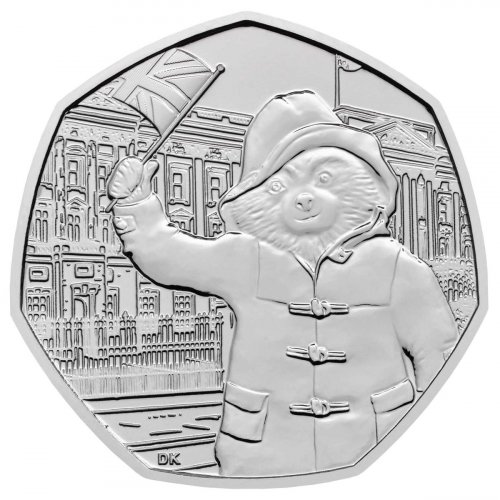
2018 Paddington Bear 50p reverse.
Recently, the U.S. Mint issued the quarter honoring the National Park of American Samoa with the reverse image of a fruit bat mother hanging in a tree with her pup. It is such an unusual design for a United States coin that it made the news.
It also has people talking about the coin. On a recent trip to the grocery store, I quickly looked at my change to see if anything was unusual. The cashier, whose accent suggested she was not a native of the area, asked if I was looking for “coins with the bat?” She was looking for one for her young son after a neighbor showed him the coin.
Through 2019, there were 50 coins released as part of the America the Beautiful Quarters program. Before the American Samoa quarter, these quarters only generated local interest, as the Fort McHenry quarter did in Maryland.
The only other coin that I can recall generating national interest was the 2014 National Baseball Hall of Fame Commemorative Coin. Aside from baseball’s popularity, the curved coin was something different.
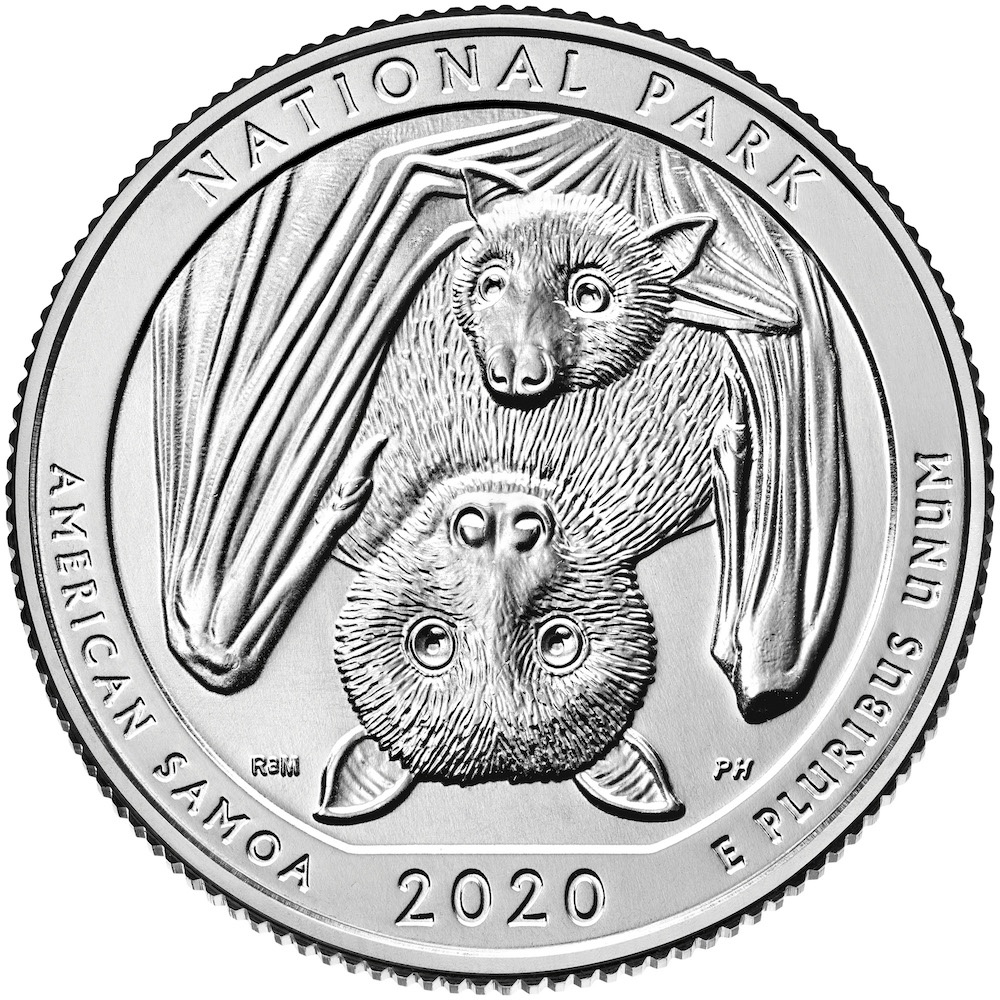
I love the image of the fruit bats!
The purist will argue that these are gimmicks. I will counter that if you want to grow the hobby, you need to give the people something that will interest them.
It is not enough to push the collecting of every Morgan Dollar varieties in the VAM catalog. Some people do not have that kind of patience. And you cannot blame that on younger collectors since I am one of those people. I find the study of VAM fascinating but not something I want to do.
However, if you release coins honoring the rock band Queen, I will order as soon as possible. I will watch with interest to see who else the Royal Mint honors. I am looking forward to coins honoring bands like the Beatles, Pink Floyd, and The Rolling Stones. I own their vinyl, why not own their coins!
Unfortunately, the U.S. Mint is bound by the whims of congress. They cannot create programs that could generate interest in the general public without permission. Someday, if congress could get its act together, maybe they will allow the U.S. Mint to create a yearly program around a theme.
Think about the possibilities. One year the U.S. Mint can have a five-quarter series of dinosaurs. Another year would be for great discoveries. Whatever themes are selected, make it something that will generate enthusiasm, and allow the U.S. Mint the freedom to produce coins that would generate interest. Even if it means introducing colored coins into circulation, it has not hurt Canadian coins!
If we are to grow the hobby, congress has to be encouraged to let the U.S. Mint pursue new markets. Hopefully, those who think that their way is the only way to collect will either accept new ideas to increase the hobby or step away and let the rest of us enjoy what we collect, even if it is not Barber coins.
First Find of 2010
It did not take as long to find a 2010 coin in pocket change this year as it did to find a 2009 coin last year. After going to my favorite coffee place, I noticed a very bright Lincoln Cent amongst the change. When I put my cup down to add a little non-fat milk, I reached into my pocket and found it was one of the new sheild cents. With the exception of the fingerprint on the obverse (it could be mine), the coin looks like it just came from the U.S. Mint.
As we progress further into 2010, I am seeing a lot of 2009 coins, particularly the 2009 Lincoln Bicentennial Cents and the District of Columbia and U.S. Territories quarters.
I have yet to find 2009 nickels and dimes.
ANA versus Technology: The ANA is Losing!
In the April 2010 edition of The Numismatist, Q. David Bowers writes about the aging of the American Numismatic Association membership noting that 47-percent of its membership is between the ages of 50 and 60. While Bowers notes that there “are several reasons why numismatics has lost its appeal to younger people,” Bowers says that it is nothing “the ANA has done or not done.” Bowers sites studies that show that younger people have embraced technology and social media to fill their spare time. With all due respect to Mr. Bowers, then why has the ANA not embraced this new social media paradigm?
While the ANA has a Young Numismatist outreach program and a Scouts program for the Boy Scouts and Girl Scouts, these programs end when the YN member becomes 22 years old. YN’s who go to college are beginning their careers or starting graduate school at 22. Those who do not go to college are in the beginnings of their careers and maybe beginning a family. In either case, at 22 years old, a person’s life is in transition and the least of their worries is membership or participation in the ANA. If the ANA wants to be relevant in the lives of those in the 20-something and 30-something, the organization must adapt to be where their members are or want to be.
Over the last ten years, technology has evolved to where it is more portable, more accessible, and more communal. And recent advances and other industry activity shows that this trend is unlikely to slow down. Those of us who make this technology part of our lives understands how valuable online and accessible resources can be to enhance our lives. If the ANA wants to continue to be relevant for a broader audience, it has to join the portable, communal revolution to make it more accessible to more potential members.
Did you know that the ANA has a Facebook page? Neither did I until I saw a small note about it at the bottom of the ANA monthly email newsletter. Although I will not use Facebook (for reasons other than technology), why is this not advertised on the ANA’s website? Is it mentioned in The Numismatist? It might have appeared once, but it should be repeated monthly so that people will get the message.
If the ANA is on Facebook then why are they not using Twitter? Those of us who will not use Facebook because of recent privacy concerns will use Twitter. Why is the ANA not tweeting? There must be some news coming from Colorado Springs. Were there new books for the library? Are there new exhibits in the Money Museum? Are there press releases we should know about? What about new content on the website?
The ANA website leaves much to be desired. It appears to be a combination of cobbled together download programming and a commercial markup program that does not help manage content and does not provide for ways to better organize the information. Although better looking than the original ANA website, this version has even removed wonderful content that used to be buried under various menus. Where is this content?
For the ANA website to be relevant, it must get a makeover. I am not talking about a style makeover. It needs a technology makeover. First, it must use a content management system (CMS) for being able to organize and deliver content. Even the people at whitehouse.gov figured this out when they transformed the White House’s website to use a content management system. CMS software has the capabilities to include Really Simple Syndication (RSS) feeds on the site that will allow people to know when content has changed rather than rely on the user to periodically check the site. CMS also has the ability to create calendars that can be a reference for numismatic events, integrate photo albums from ANA sponsored events to share with the membership, and even integrate a YouTube channel that can incorporate multimedia presentations. Even congress uses YouTube!
There is so much more that can be done if the ANA embraces the technology and adds it to their daily workflow.
After the candidates roundtable at the 2007 National Money Show in Charlotte, I walked up to several candidates and said that I had an interest in helping the ANA with the technology communications plans. I handed several candidates my business card and said that after they were elected that I want to volunteer to help. I waited until a few months after the election to remind those I spoke with and those that I did not have the opportunity to speak with that I was still interested. I am still waiting for a response.
Later in 2007, The Numismatist had an announcement for volunteers to participate in an “IT Committee.” I sent my information to the email provided. This committee had one phone call, an exchange of emails, and nothing came of it. The wasted effort is discouraging.
But I am back with a very public platform to inform the ANA that this member is ready to step in and help. Although I am now part of the 47-percent demographic I do not have the same mindset as many in my peer group. I have been in the computing business for 30 years and evolved as the technology has evolved. I am as passionate about technology as I am about collecting and would volunteer to work with the ANA to help.
However, this offer does come with conditions. Since the last effort fell short and the ANA has not shown great interest in member suggestions, my conditions require a commitment from the ANA Board of Governors that such work will be fully supported. I want a commitment from the Executive Director that he will participate with providing input regarding the daily operations of the organization and how to integrate technology into their workflow. I want a commitment of money—not for me but a budget that would be used to make the improvements necessary and any future operations and maintenance issues. Finally, I want a commitment that the group that would do this be small—limited to the Executive Director, one member from the Board of Governors, and three members at large. Two of the three members should have a technology background and the third be in the 20-something to 30-something age bracket who may or may not have a technology background. And since I am volunteering, the ANA only has to find two more members at large!
If the ANA is interested, I can write a committee charter that would propose the structure, goals, outcomes, and milestones that the Board of Governors could consider. I am also prepared to provide my own credentials to become of a member of this committee. All I would need is to start this conversation with ANA President Cliff Mishler or Executive Director Larry Shepherd. Both may contact me via email to begin the conversation. I look forward to hearing from these gentlemen.
ANA Show Schedule Favors Dealers, Not Collectors
“We can now move immediately to ‘brand’ Chicago as an ANA city.”
With that statement by Larry Shepherd, the American Numismatic Association has begun to reverse the progress it has made to reach out to its members over the last few years. Rather than finding a way to bring the largest of the ANA shows closer to the membership, Shepherd convinced the ANA Board of Governors to anchor the summer show in Chicago.
“Successful conventions and auction contracts are critical to our future,” Shepherd was quoted as saying. But is he implying> that no other city can put on a successful convention. This would include Baltimore where a successful World’s Fair of Money was held two years ago.
Shepherd also said that the National Money Show in the spring and a new fall show, which was announced to begin in 2011 in Pittsburgh, would be available on a rotating basis with pre-selected cities.
Shepherd stressed the importance of branding Chicago as the home of the summer ANA World’s Fair of Money, noting the success FUN has had branding Orlando as its home, and Whitman establishing Baltimore as a destination for its shows. What makes this argument ridiculous is that Orlando is a central location in the area represented by the Florida United Numismatists and and easy place to travel in the state. Anyone who has travelled through O&rdsquo;Hare International Airport understands the effect of being the nation’s second busiest airport.
There is also a difference in using the location as the branding for the show. Orlando is a travel destination in a way Chicago will never be. Don’t get me wrong, I love Chicago. I think Chicago is a great city. I have friends in the Chicagoland area and look forward to visiting them. But unlike Orlando, Chicago is not the national or international destination Orlando is. Chicago is a great place to visit, but it is absurd to compare Chicago with Orlando. Face it, you are not going to hear the next Super Bowl MVP announce that he is going to Navy Pier!
To further add to the fallacy of Shepherd’s statement is that while Whitman has turned the Baltimore show into a bigger success than it was before they bought it, Whitman is also expanding their reach to Philadelphia and Nashville. While Whitman expands its reach, the ANA now has favored locations and if you are not able to travel to those locations then the ANA will not come to you.
Interestingly, not only is the ANA fixing the locations for their shows, no announcement has been made as to how to improve the outreach to those shows. This can be done using a little imagination and technology to allow members to virtually attend the show. I will have more on this in a future post.
In the past, Shepherd had been discussing the scheduling and handling of the ANA shows so as to not lose money. One consideration was to find what he described as “a good bourse city” primarily to make the dealers happy. What is not mentioned is what would make the collectors happy. Rather, Shepherd is saying that it is not enough to use what is probably the world’s largest numismatic show as the destination in different cities as outreach to its members and future members, the ANA, a non-profit organization, is using the show to make a profit and enforce profits for its dealers. While I am not against dealers making profits, I am against the profit motive as a driving factor for the placement of the ANA convention.
In the May 2010 edition of The Numismatist, ANA President Cliff Mishler quoted ANA Governor Jeff Garrett that Mishler told him, “He reminded me that there are not two classes of ANA membership—dealers and collectors—but rather a single community, one that cares about the well-being of the hobby.” It is interesting how Mishler could tell an ANA governor that the ANA is a community yet support a convention policy that is clearly geared to the dealer community.
I do not recommend quitting the ANA out of protest. This is where being a member helps. As an ANA member I am letting our elected Board of Governors know that this is not a good decision. It is not in the best interest of the ANA nor does it advance the ANA’s chartered mission for numismatic outreach and education. ANA members who are not happy with this decision should use this opportunity to contact the Board and tell them how you feel.
Are The Dead Presidents Getting Younger?
There seems to be a case of reinventing history not only in our education system but it appears to have come to the redesign of U.S. currency. After the Bureau of Engraving and Printing announced the release of the new $100 Federal Reserve Note, Newsweek performed a study on the evolution of the images that have appeared on US currency.
“Over time, America’s iconic forefathers come off looking good, even better than they used to—and it’s not just some airbrushing and smoothing out,” the article stated. “Put simply, if the Founders and their notable descendants lived in modern times, they might find themselves on magazine covers beside words like ‘nip and tuck.’”
Newsweek asked Dr. David Hidalgo, a New York-based plastic surgeon, to analyze pictures of the changes as if these were the images of patients. In his analysis, Dr. Hidalgo noted changes to the images as they the notes have been redesigned. The most dramatic may be the image of Alexander Hamilton, the nation’s first Secretary of the Treasury, that might have taken ten years off his look.
Unlike changes to US coinage, the BEP is not required to have their designs approved by the Commission of Fine Arts. The CFA is supposed to maintain the artistic integrity of the projects they examine but they are also supposed to consider the historical significance of the images. Although it is fair to question whether the CFA would make the same mistakes as the BEP, it can be safe to say that an external review may have been a good idea.
Tweeting the CCAC
As a proponent of using technology to advance all my favorite activities, I was happy to read about Citizens Coinage Advisory Committee member Donald Scarinci was tweeting about the last CCAC meeting in Philadelphia. The posts on his Twitter account (@Scarinci) made for an interesting read as to what was discussed at the meeting.
If you are unfamiliar with Twitter, I recommend that you read my previous blogpost about the service.
A few days after the meeting, I heard from Scarinci via email who said that he had been studying Twitter for a few months before deciding to use the service. This is understandable because for the uninitiated, Twitter can be confusing. Scarinci, whose interests include law, numismatics, and art, decided to try Twitter to share his interest with others. “I decided to go forward with Twitter in order to communicate to people and at the same time make it worthwhile for people to follow. I didn’t want to focus just on law or just on numismatics or just on art,” Scarinci wrote. “I wanted to show myself as a full multidimensional person—opinionated, insightful, diverse, sensitive, at times insensitive. If used thoughtfully, twitter will allow me to display my personality and my interests as a mosaic rather than as a single static snapshot.”
What makes Scarinci’s perspective on using Twitter interesting is that it provides an insight into one member of the CCAC. Many of us never meet the CCAC members. Sometimes we hear them speak at various shows. But using Twitter as a way to allow us to meet him, at least virtually, allows us to understand at least one of the personalities making the selection on the coinage we care about.
When Scarinci contacted me, I said that I wish I would have known before the meeting because I would have followed his tweets. Since discovering his tweets, I have added @Scarinci to my list of followers on both the account that I use with this blog (@coinsblog) and my personal account. Although it was difficult to be one his followers when he tweeted he went to Katz Deli in Manhattan the other day (stop thinking of their corned beef… it’s the best!).
After a recent online and public “discussion” with CCAC member Gary Marks about the lack of communications from the CCAC, it was refreshing to hear from Donald Scarinci with a very different and positive attitude on communication with the public. Scarinci wrote:
Reporting from the CCAC meeting as it was happening is something I always thought should be done. I never understood and still don’t understand why the Mint does not web cast the CCAC meetings. We are, after all, a citizens committee. Each one of us on the committee has different perspectives and different levels of knowledge about numismatics and about art. The CCAC is very much as congress intended it to be—a peoples’ committee. While imperfect, it is probably the only way to debate and decide coinage designs in a democracy. So why not bring people in as the discussion unfolds and involve anyone who has an interest into the very core of the process. Twitter allows that to happen in real time without attaching people to a viewing screen for hours at a time. Instead anyone interested in the subject can get information in brief sentences. If the writing is clear and simple, the communication will work for busy people with day jobs even better than a web cam. That’s my opinion.
Amen!
I applaud Scarinci’s initiative and appreciate his efforts. I hope the concept of using modern communication techniques can be institutionalized by the CCAC and the US Mint and expanded to include more citizens in the process. Scarinci will be tweeting during future meetings. I will be following those updates (@Scarinci) and suggest anyone interested in the work of the CCAC to follow, too.
Support the Coin Collectors Blog
 Buy me a coffee
Thank you for your support!
Let Me Know What You Think
Are you going to the World's Fair of Money
Total Voters: 17
 Loading ...