
I like the idea of Privy Marks on US Coins
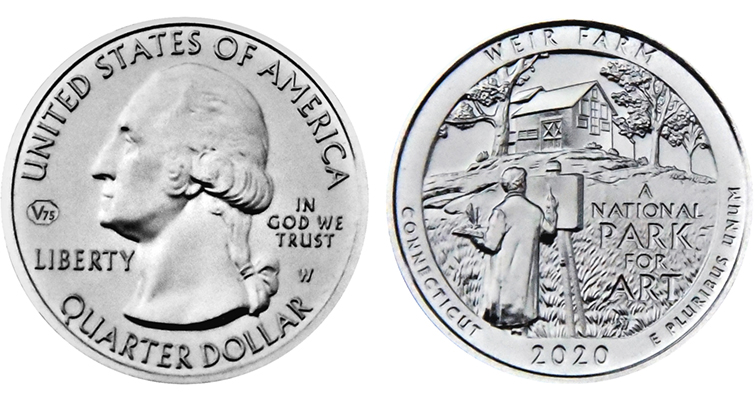
2020-W Weir Farm Quarter with privy mark
(U.S. Mint image via Coin World)
Amongst the comments are “it is a gimmick,” “beneath the stature of the mint,” and “it’s ugly.” Some have admitted to not collecting or caring about modern coins. Others are regular critics of the U.S. Mint.
There is also a group of people with a pedantic image of the alleged integrity of the U.S. Mint. The same organization that has allowed the release of many patterns are a source of error coins available to the public, and one that has contradictory policies by attacking those with 1933 double eagles while doing nothing about the 1913 Liberty Head Nickels.
When it comes to the U.S. Mint’s policy history, it is as sketchy as any U.S. government agency. The difference is that its products have fans that will defend it because of the final results and not the process that came before it.
Since the U.S. Mint has legal restrictions as to what they can do when it comes to striking coins, I applaud whoever made this decision. We should be celebrating the end of World War II. Even though I was not alive at that time, we need to honor the sacrifice many Americans gave to ending totalitarianism and preventing an evil takeover of the world.
The U.S. Mint found a way to honor the 75th anniversary of the end of World War II without violating the law. I can’t wait to try to find these quarters in my change—or buy them from a dealer since I have had no luck finding W mint marked quarters in my pocket change.
Costa Rica Recalls Platedas
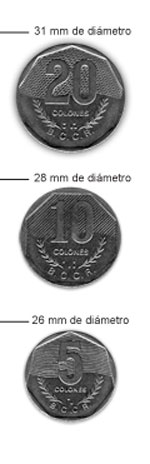 The Central Bank of Costa Rica is in the final stages of recalling all ₡20, ₡10, and ₡5 “platedas” or silver plated coins. Coins can continue to be exchanged only at Central Bank’s office located in downtown San Jos´.
Withdrawal began on December 31, 2009 after the Central Bank announced that it was withdrawing the coins because they could not be distinguished by the blind. New coins will be issued on April 5 will be lighter than the previous coins and include the denomination in Braille Braille.
Reports indicate that merchants have stopped accepting the coins fearing that there would not be enough coins to meet the demand. The Central Bank released a statement assuring the public they had enough coins to meet the demand. Under 20-percent of the estimated 205 million coins in circulation have been turned in.
Withdrawn coins will be sold as scrap metal.
The Central Bank will be issuing new paper notes and other coins later in the year to standardize the size for each denomination. The sizes are expected to help the blind detect the denomination based on the size of the coin or note.
Interestingly, the Bureau of Engraving and Printing had performed a study Visual Impairment Study and Process to Create Meaningful Access to Denominate U.S. Currency. So far, the BEP has not acted on any issues in the report.
Image of platedas courtesy of ticotimes.net.
Happy 218 to the US Mint
Be it enacted by the Senate and House of Representatives of the United States of America in Congress assembled, and it is hereby enacted and declared, That for the purpose of a national coinage be, and the same is established; to be situate and carried on at the seat of the government of the United States, for the time being: And that for the well conducting of the business of the said mint, there shall be a Chief Coiner, and Engraver, a Treasurer.
—Coinage Act of 1792 (1 Stat. 246)
The second Congress of the United States meeting in Philadelphia passed the Coinage Act of 1792 to establish the dollar as the unit of currency, created a decimal currency system, authorized the production of coins, and established the United States Mint. It was signed into law by President George Washington at the President’s House in Philadelphia, the first executive mansion of the United States.
President Washington appointed noted astronomer David Rittenhouse as the Mint’s first director on April 14, 1792. Rittenhouse was paid a yearly salary of $2,000 and charged with obtaining the land and establishing the first Mint. This was a yoeman’s effort for the 60 year old Rittenhouse who was in bad health at the time.
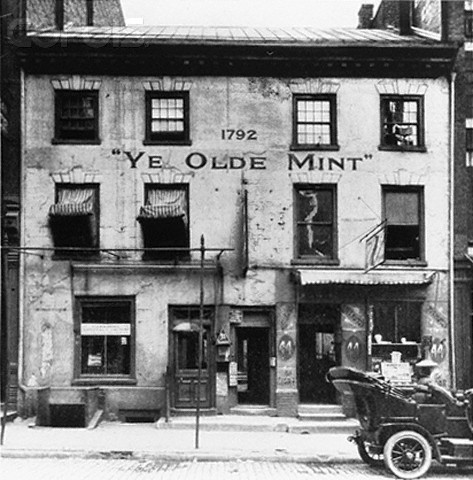 Pressing forward, Rittenhouse purchased and L-shaped lot with three buildings on Market Street in Philadelphia to establish the Mint in May 1792. Henry Voigt was appointed as Chief Coiner and Joseph Wright as Chief Engraver. Before Wright was able to prepare dies, he died of yellow fever in September 1792. He was replaced by Robert Scot who is considered the Mint’s first Chief Engraver.
Rittenhouse resigned on June 30, 1795 with the Mint in operation. He died on June 26, 1796 at the age of 64.
From those humble beginnings in 1792, the US Mint is the largest manufacturer of coins in the world. The US Mint operates mints in Philadelphia, Denver, San Francisco, and West Point. The Mint also operates the United States Bullion Depository in Fort Knox, Kentucky and the Silver Depository in West Point. During fiscal year 2009, the US Mint produced $777 million in circulating coins with a total seigniorage (profit) of over $904 million from all sales including bullion.
Although there have been issues with the recent operations of the Mint, its 218 year history makes it a uniquely successful bureau in the United States government.
PCGS’s Big One Is A Big Deal
This week, the Professional Coin Grading Service announced “The Big One,” a service called PCGS Secure Plus.™ A new service line that will be an option for most collectors except for rare and ultra rare coins which must be certified by PCGS Secure Plus. The significant part of this service is that PCGS is adding modern computer imaging to coin grading.
Coins grade through Secure Plus will be scanned by an optical device that will map the surface of the coin creating a digital signature of its characteristics that can be used for later reference. The digital signature is a unique identification of the coin that can withstand potential coin doctoring and to prevent the users from removing the coin from the slab to try to have it graded higher. It can also be used to determine if the coin was doctored from its previous submission such as being artificially toned.
During the announcement PCGS President David Hall (videos Part 1 Part 2) said that this should end “gradeflation” as well as work out errors in the population reports when people submit coins multiple times. Hall said that multiple submissions did not serve the industry and hope that this would end the practice. Hall noted “We did not start PCGS to grade a coin 40 times.”
Hall said that PCGS has been working on this service for two years with “industry leaders” who were not mentioned. However, in the follow up presentation by PCGS CEO Don Willis (videos Part 3 and Part 4), his technical explanation included an image of the CoinSecure, Inc. to use the CP16 CoinAnalyzer. During his part of the announcement, Willis said that the process is being patented.
CoinSecure, Inc. is a Palo Alto, California based company whose president is Richard M. Haddock. Haddock is the former CEO of the LaserCard Corporation, a company specializing in secure identity solutions that include difficult to counterfeit identification cards and the technologies to detect counterfeit cards. A search of patent records at the World Intellectual Property Organization shows that Haddock has been awarded 16 international patents for various types of optical-related work including for security-related devices. Patents pending for Haddock and CoinSecure are as follows:
| Application Number | Title | |
|---|---|---|
| 1. | 20100039818 | Numismatic Storage Container To Prevent Counterfeiting Of Coinage |
| 2. | 20090303478 | Apparatus For Producing Optical Signatures From Coinage |
| 3. | 20090296365 | Calibrated And Color-Controlled Multi-Source Lighting System For Specimen Illumination |
| 4. | 20090295912 | Coin Edge Imaging Device |
| 5. | 20090286458 | Self-Centering Loading, Indexing, And Flipping Mechanism For Coinage And Coin Analysis |
| 6. | 20090284754 | Method For Optically Collecting Numismatic Data And Associated Algorithms For Unique Identification Of Coins |
As part of the PCGS Secure Plus workflow, coins will be imaged using the CP16 CoinAnalyzer and the data saved in an internal database. Will said that once the coin is imaged, it will go through the normal grading process where it will be reviewed by three graders before being reviewed by a finalizer. Only the finalizer will have access to the digital information and will take appropriate actions.
The Plus
As part of the announcement, PCGS said that it will mark premium quality coins for its grade with a plus as part of the grade. When Willis made the announcement, he said that PCGS has been experimenting with a 700 point grade scale to score a coin based on its technical grading and eye appeal. Coins that grade in the upper end of the grade range will receive the plus. As Hall noted, this will “unlock the value” of better quality coins. Plus grades will be available for grades XF45 through MS68 except for MS60 and MS61.
The plus designation was announced in conjunction with Numismatic Guaranty Corporation. This service will only be available for selected classic series and not planned for modern issues.
More Plus at CCE
As part of the plus designation announcement, Collector’s Universe, the parent company of PCGS, announced that their Certified Coin Exchange market place will offer sight unseen bidding for plus grade coins. Sight unseen bidding means that purchasers will not be allowed to return a coin after auctions through the exchange. Since CCE is an exchange for dealers, it will be interesting to hear what those dealers think of this policy.
An Additional Plus
One understated announcement is that PCGS has updated their holder and added new anti-counterfeiting features to the label. Coins graded as part of the Secure Plus service will be placed in a holder that has a label with a shield. The shield will be printed with a color shifting ink that makes it difficult to duplicate. Color shifting ink is similar to the technologies that are being used on US Federal Reserve Notes. Also, Willis announced that microprinting will appear behind the shield.
Microprinting prevents the vast majority of imaging technologies from being able to duplicate the label. However, PCGS should provide a guideline as to what to look for so that collectors can verify the labels of the coins they buy.
Having been an advocate for computer based grading, this is a great start to using technology to assist in grading. Add the ability to digitally fingerprint the coin to prevent coin doctoring and crackout artists from resubmitting the coins multiple times hoping for better grades, PCGS has created “The Big One” in the world of third party grading.
US Mint Unveils First Five Coins in America the Beautiful Quarters Program
WASHINGTON (adapted from the US Mint press release)—The US Mint unveiled the designs for the first five quarters in the America the Beautiful Quarters Program in a special ceremony today at the Newseum in Washington, D.C. US Mint Director Ed Moy treated special guests and the media to a first look at the new designs, which celebrate the spectacular natural wonders that are found in the United States’ national parks, forests, shores and other national sites. Other speakers included Congressman Mike Castle, one of the lead co-sponsors of the legislation; United States Treasurer Rosie Rios; Harris Sherman, Under Secretary of Agriculture for Natural Resources and the Environment; and Secretary of the Interior Ken Salazar.
The first quarter in the series, which honors Hot Springs National Park in Arkansas, will be released into circulation on April 19, with an official launch ceremony in Hot Springs on April 20. It will be followed by quarters honoring Yellowstone National Park in Wyoming (to be released in June), Yosemite National Park in California (July), Grand Canyon National Park in Arizona (September), and Mount Hood National Forest in Oregon (November).
The following is the video from the introduction of the designs at the Newseum along with interviews and B-Roll footage.
America the Beautiful Quarters Designs
- The image on the reverse of the Hot Springs National Park quarter depicts the façade of the Hot Springs National Park headquarters building with a fountain in the foreground. The headquarters was built in the Spanish colonial revival style and completed in 1936. The National Park Service emblem is featured to the right of the door.
- The image on the reverse of the Yellowstone National Park quarter features the Old Faithful geyser with a mature bull bison in the foreground.
- The image on the reverse of the Yosemite National Park quarter depicts the iconic El Capitan, which rises more than 3,000 feet above the valley floor and is the largest monolith of granite in the world.
- The image on the reverse of the Grand Canyon National Park quarter features a view of the granaries above the Nankoweap Delta in Marble Canyon near the Colorado River. Marble Canyon is the northernmost section of the Grand Canyon. Granaries were used for storing food and seeds (A.D. 500).
- The image on the reverse of the Mount Hood National Forest quarter depicts a view of Mount Hood with Lost Lake in the foreground.

Each coin in the series features a common obverse (heads side) with the 1932 portrait of George Washington by John Flanagan, which has been restored to bring out subtle details and the beauty of the original model. Inscriptions are UNITED STATES OF AMERICA, LIBERTY, IN GOD WE TRUST and QUARTER DOLLAR.
For more information on the America the Beautiful Quarters Program, please visit www.americathebeautifulquarters.gov.
Learning through the America the Beautiful Quarters Program
The America the Beautiful Quarters Program will also introduce a brand new lesson plan format with a series of interactive educational tools for students from kindergarten through high school. Students will be able to take a virtual visit to the national sites highlighted each year and have the opportunity to learn about forest communities and the plants and animals that live in our national parks and sites. For more information about America the Beautiful Quarters Program educational resources, please visit www.usmint.gov/?action=educators.
National Park Quarters Media Event in DC
A public relations firm sent out a media alert announcing that the US Mint will unveil the designs for the first five quarters in the America the Beautiful Quarters Program. The program that begins this year is a new multi-year initiative honoring 56 national parks and national sites in each state, the District of Columbia and the five US territories and will run through 2021.
The media event will be held Wednesday, March 24, 12:00 noon at the Newseum in Washington, DC (map). The event will feature US Mint Director Ed Moy unveiling the new designs of the first five quarters in the program and a video of the featured national sites showcasing the natural and historic significance of the first five quarters.
Hot Springs National Park in Arkansas will be first quarter and will be released on April 19 to be followed by Yellowstone National Park in Wyoming (to be released in June), Yosemite National Park in California (July), Grand Canyon National Park in Arizona (September), and Mount Hood National Forest in Oregon (November).
Additional featured speakers scheduled include US Treasurer Rosie Rios, Secretary of the Interior Ken Salazar, and Dayton Duncan the writer and co-producer of the Ken Burns documentary The National Parks: America’s Best Idea.
This may be a media-only event and not open to the public. If you are going to be near the Newseum on March 24, it might be worth trying to attend. Besides, the Newseum is one of the great museums in Washington and worth the time to visit.
Support the Coin Collectors Blog
 Buy me a coffee
Thank you for your support!
Let Me Know What You Think
Are you going to the World's Fair of Money
Total Voters: 17
 Loading ...