
Weekly World Numismatic News for May 19, 2019
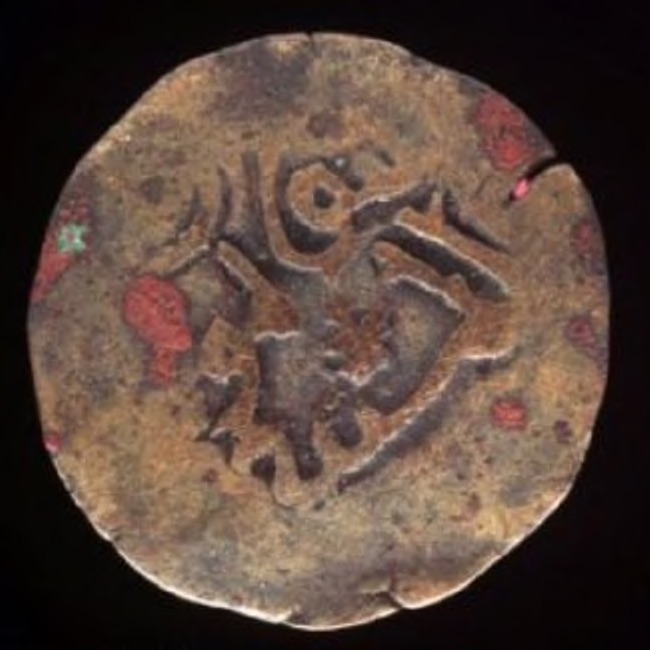
A Kilwa Coin similar to those found on the beach in Australia (Source: news.com.au)
In recent years, the coins have sparked interest in understanding how they ended up in Australia. Even though they are from a time after the arrival of the Aboriginal people, it presents questions as to whether there were other European settlers before James Cook.
Coins are not only a holder of value; they are also a representation of art, history, and commerce. Coins tell us more about our lives than history, which is written by the victors and not the ordinary people who may have done more to guide history than those whose writings may be less than accurate for their glory or the glory of their sponsors. Nowadays, we call that spin.
If finding five coins on a beach in a remote fishing spot in Australia can rewrite history, what will the coins in our pockets tell future generations about us? What stories do any of the coins we collect tell? While it may be nice to hold a mint state 19th-century dollar in our hands, what impact did that worn large cent have on history? Or the history of those who used it?
The term “history in your hand” could never be more impactful than the story of those five coins found while fishing in Australia.
And now the news…
 May 12, 2019
Who needs a boring coin purse when you can surprise shoppers at the cash register by popping the lid on your miniature rice cooker?  → Read more at soranews24.com
May 13, 2019Remember when you were taught Australia was first claimed for the British throne when it was discovered in 1770 by James Cook who promptly declared it “terra nullius”? → Read more at news.com.au
May 15, 2019The 10,000-yen (US$92) coin costs a lot more than 10,000 yen. → Read more at soranews24.com
May 16, 2019The Japanese government has announced a new design for the ¥500 coin. The updated version, slated to hit pockets in fiscal 2021, retains the familiar paulownia design but adds a two-tone look and features like microlettering to thwart counterfeiters. → Read more at nippon.com
May 16, 2019QUEEN ELIZABETH II has her portrait printed on every UK coin in circulation, as well as on the coinage of many Commonwealth countries. Now, a Royal Mint designer has shed some light on a coin which is a particular favourite. → Read more at express.co.uk
Mint Shows Customer Non-service
Hi, I am a human being, and I made a mistake!
I am not talking about a tragic mistake. I am talking about not using the right credit card to buy proof sets from the US Mint.
With the release of the silver proof set and the Jefferson cover, I decided it was time to place an order before these items are sold out. I logged into my account on the Mint’s website and entered my order. The process proceeded as expected until I was at the final page asking how I wanted to pay for the order. Since the Mint had my credit card stored from my last purchased, I clicked the approval button with the comfort that my order would be processed.
Unfortunately, between my previous order and this new order I had accidentally left the card at a cash register and had that card canceled. I had forgotten that I used that card with the Mint. So the Mint tried to process the order using a canceled credit card.
Obviously, the credit card transaction was denied. In fact, the US Mint tried to charge that card twice only to be met with failure. The Mint suspended the order did nothing. The order stayed suspended for three weeks until I checked its status when I wonder why my coins had not been delivered.
Rather than send a letter to the address provided or send an email note to that address provided, the US Mint does nothing. Thankfully, the items I ordered were still available, but the Mint should allow me to fix the situation. In this case, I was able to provide the new account number to complete the order. But what would have happened if a product sold out during the wait time?
Unless the Mint verifies the account number during the transaction, they should notify the customer if the credit card authorization fails. Sure, it was my fault for fusing the account number associated with a lost card. But I should be given the opportunity to rectify the issue without the potential for losing the order.
Giving me the opportunity to fix my mistake is good customer service—something the Mint need to learn!
It Did Not Play In Peoria
It was reported in the Peoria Journal Star that police were investigating the alleged use of counterfeit Presidential Dollars at a Peoria McDonald’s restaurant. The coins were very shiny and gold colored that included George Washington, John Adams, Thomas Jefferson, and James Madison. It raised a concern at the local bank when an employee noted that the Madison dollar was not yet released. Following an examination of the coins, police said that they were proofs from a US Mint proof set.
This was one of those shake-your-head stories. One would think that a banker would know the difference between a business and proof strike coins. Then I remembered the blank stares I was given when trying to buy rolls of Washington dollars the day they were issued. Also, why did someone break up a Presidential Dollar Proof Set and use them as four-dollars when they are worth four times that? We may never know the answer but I can think of better things to buy for $4 than a Big Mac!
A New Feature to the Blog
When I started writing this blog, nearly two years ago, I was not sure if anyone would be interested in reading what I had to say. I wanted to have a mix of reporting the news, talk about my collecting, editorialize on some issues, and write about something other than the information security issues I do for the federal government. While I like my work, I need another outlet. And judging by the multiple statistical reports I receive, there are quite a few people following my my musings. Thank you!
Those who have been reading a while should notice that I like playing with the format of the page. Whenever I find something interesting that looks interesting, I will see how I can use it to improved your reading of this blog. Not long ago, I changed the format of the page to a three-column view. My primary motivation was the find a place for the few advertisements I use. Since this is not a commercial blog and the money goes to offset my Internet access bill (so far, it has paid less than one bill in two years), I wanted to keep the ads prominent but not obtrusive. I think this format helps.
Recently, I just installed a tool on this site called Snap Shots. If you move your mouse over a link, it will show you a little preview of the site. Using Snap Shots, every link that points to an external site like for Wikipedia articles, book recommendations at Amazon.com, related videos, stock prices, or just about anything else. Snap Shots’ standard blurb says that they bring you the information you need, without your having to leave the site, while other times it lets you “look ahead” before deciding if you want to follow a link or not. Should you decide this is not for you, just click the Options icon in the upper right corner of the Snap Shot and opt-out.
As always, if you have any comments or suggestions, please feel free to send them to me.
CCAC Recommends 2009 Reverse Designs
The Citizens Coinage Advisory Committee met on September 25 to discuss the proposed reverse designs for the 2009 Lincoln cents. Enacted into law as part of the Presidential $1 Coin Act of 2005 (Public Law 109-145 [GPO: Text, PDF]), the Abraham Lincoln Bicentennial 1-Cent Coin Redesign calls for four reverse designs to honor his birth and early childhood in Kentucky, his formative years in Indiana, his professional life in Illinois, and his presidency in Washington, DC.
 According to reports, the CCAC decided on two reverse designs for each category. These recommendations will be sent to the Commission of Fine Arts for their decision. Remember, the selection by the CCAC is their consensus recommendations. The CFA can, and has, overruled the CCAC and has recommended redesigns of the recommendations. It is this bureaucracy that has produced the unfocused three-element reverse of the Florida quarter and the hanging astronaut on the Ohio quarter.
In the image to the right, the bottom two drawings were recommended for the design representing Lincoln’s birth and early childhood. The drawing on the upper-left is one of the recommendations for the design representing Lincoln’s formative years. The upper-right drawing is one of the recommended designs representing his professional life in Illinois. Without seeing the other designs, I am not sure what to think about them.
Although the CCAC is a government committee, obtaining the designs for public examination are difficult, if not elusive. Images are not published on the CCAC or CFA websites. The CCAC does make some of the images available to the media who chooses not to publish them. The image published here is from the Associated Press as published in the Journal Gazette of Fort Wayne, Indiana. I appreciate their publication of of this image. I will be sending a note to the CCAC requesting these images. Stay tuned!
Sac Back Now the Law
The White House announced that President Bush signed H.R. 2358, the “Native Americans $1 Coin Act.” Now the law, it will require the US Mint to issue Sacagawea Dollars with new reverses in commemoration of Native Americans beginning in 2009.
Between the Presidential Dollar coins and the new Sacagawea reverse designs, these coins will continue to be a curiosity to the general public and another entry into collections while the $1 Federal Reserve Note continues to be printed. It is time for the United States to join the rest of the world and eliminate the paper-based unit currency to allow the less expensive coinage to take its place.
Although many understand and accept the reason for discontinuing the $1 note, it will not happen. I will explain why in a future posting.
Support the Coin Collectors Blog
 Buy me a coffee
Thank you for your support!
Let Me Know What You Think
Are you going to the World's Fair of Money
Total Voters: 17
 Loading ...