Sep 12, 2007 | CFA, coin design, coins, legislative, state quarters, US Mint
In the final step before becoming a law, congress presented the president with H.R. 2358, Native American $1 Coin Act, for his signature. Introduced in the House of Representatives by Dale Kildee (D-MI 5th), and expected to be signed by the president, the bill calls for the reverse of the Sacagawea Dollar be redesigned every year to commemorate “of Native Americans and the important contributions made by Indian tribes and individual Native Americans to the development of the United States and the history of the United States.” The obverse will continue to have the Sacagawea design.
The bill calls for the denomination to be inscribed as “$1,” making it consistent with the Presidential dollars. The bill also calls for the same edge lettering used by the Presidential dollars to include the date and mint mark along with the inscriptions E Pluribus Unum and In God We Trust. As for the reverse designs, the bill calls for the Mint to consult the Committee on Indian Affairs of the Senate, the Congressional Native American Caucus of the House of Representatives, the Commission of Fine Arts, and the National Congress of American Indians, along with the usual bureaucracy of the Citizens Coinage Advisory Committee to vet the coin design. With the burden of this bureaucracy, the bill changes the start date to January 1, 2009 if enacted after August 25, 2007.
An interesting clause in the bill says that the design are to be issued “in the chronological order in which the Native Americans lived or the events occurred.” Since there is no specific end date to the program, it appears that the bureaucratic hurdles the Mint is being asked to jump for this program will need the extra year to determine a schedule. And if that was not enough, congress, who is not shy in making its own design suggestions, included the following potential designs in the bill:
- the creation of Cherokee written language
- the Iroquois Confederacy
- Wampanoag Chief Massasoit
- the “Pueblo Revolt”
- Olympian Jim Thorpe
- Ely S. Parker, a general on the staff of General Ulysses S. Grant and later head of the Bureau of Indian Affairs
- code talkers who served the United States Armed Forces during World War I and World War II
In addition to these new reverses, change to the circulating coinage will include new reverses on the Lincoln cent and Presidential Dollars with the reverses honoring, William Henry Harrison, John Tyler, James K. Polk, and Zachary Taylor. Non-circulating legal tender coins will include the Abraham Lincoln and Louis Braille commemoratives, special 2009 cent with the original copper composition, and the First Spouse gold coins honoring Anna Harrison, Letitia and, Julia Tyler, Sarah Polk, and Margaret Taylor. Finally, if H.R.392 is passed in the Senate (it passed in the House last January), the 50 State Quarters program will be extended to include the District of Columbia and the five territories.
It looks like 2009 could be a great year in numismatics!
Sep 5, 2007 | coins, grading
Grading and encapsulation of coins has grown since the ANA started with the certification process 35 years ago. Over that time, the process and materials have evolved in an attempt to make the process better. Although the process has its flaws, the major third party grading services try to adhere to rigorous procedures to ensure integrity of their evaluation.
Although both NGC and PCGS have written nice details on how they grade coins, nothing really beats a good video. With the help of another intrepid numismatic surfer, the following video made by PCGS was found on YouTube. Yes, it has a number of self-serving propaganda statements (count the number of times the narrator mentions their “world-class graders”), but it does provide a very good overview of the grading process.
I found it interesting how they put together the slab. I knew of the process, but seeing it being done on the video was very interesting. I hope you enjoyed this as much as I did.
Sep 4, 2007 | coins, registry sets
Here in the United States, the first Monday of September is Labor Day. Labor Day is a United States federal holiday that dates back to 1883 to create a day off for the “working man.” Today, it is a symbolic mark of the end of summer as school begins either the week before or after the holiday.
Along with the start of school comes the start of Meteorological Fall. As opposed to astronomical fall, the meteorological seasons are aligned with the calendar and not the orientation of the Earth from the Sun. It is supposed to signal the beginning of atmospheric cooling.
With the summer over and the return of the routine, this change has me thinking about my collection. While I have a number of interests, including the “oh neat” factor, I have a number of collections that I am assessing whether I want to continue. Of today’s concerns are the dollar coin Registry Sets at the Collectors’ Society. Two of those sets are of a Susan B. Anthony Dollar uncirculated and proof Registry Sets. Although these sets are 50-percent completed, I am just not interested any more. I might keep the 1979 Wide Rim dollar because it is worth a bit more than the others. But the rest of the coins my be sold soon.


I also feel the same about my Eisenhower Dollar Registry sets. Aside from being my first set, I find the coin appealing as the last large dollar coin produced in the United States. But like my Susie B. sets, that spark is no longer there. If I sell this set, all but the 1976 dollars will be sold, including the 1971 coin graded MS65 where NGC Census reports that no 1971 Eisenhower Dollar has graded higher than MS66. This makes my MS65 worth a bit more than other coins of the same grade.

Regardless of what I do with these sets, I will continue to build the Bicentennial and the uncirculated American Silver Eagle sets. In fact, I have a number of coins I sent to NGC for grading that I hope improves my scores. I still like the competitive aspect of Registry sets as I wrote about in Competitive Collecting. But there is no need to collect something I am not interested in just for the competition.


If I decide to sell off the Eisenhower and Susan B. Anthony dollars, I will be posting them on eBay. Watch that space for these coins, possibly including the 1971 dollar that brings in over 300 registry points!
Aug 27, 2007 | coins, fun
For some of us, collecting is fun in and of itself. But sometimes, you just have to have more fun and play with your money. We use our money to make art. We can also use nice coins to test our memory. But what about using coins to make jewelry? No, this is not about drilling a hole in the coin to make bracelets or necklaces. How about using a Kennedy half-dollar to make a ring?
 The instructions found at this site requires a half-dollar, steel base, a spoon or small machinist hammer, a drill, sandpaper, channel lock plyers, a Dremmel or similar device, and metal polish. From the looks of the pictures, a 1964 silver Kennedy half-dollar was used. Silver may be softer than clad coinage, but the clad layering may make for an interesting 3-color look.
I have not done this. But I might consider using a 1965-1970 40-percent silver clad half-dollar for a different look. Enjoy!
Image from the website discussed.
Aug 19, 2007 | coins, errors, grading
As I was preparing to write this entry, I was looking for the posting where I wrote about a coin my wife gave me as a gift. I had taken a new picture of the coin before sending to NGC for grading. Apparently, I posted it elsewhere and not here. How dare I do something like that! I need to make up for this and now is as good a time as any.
My wonderful wife seems to be into errors, which sometimes makes me wonder. But the errors she finds are coins. For Chanukah in 2005, she gave me a 1955 DDO that ended up being graded by NGC as AU58BN. Last Chanukah, she gave me a 1937-D 3-legged buffalo. I did not get that graded. After a cent and nickel, what’s next?
On my birthday, I found a wrapped package on the table. I sat in my chair and unwrapped the package. It is a book. But not just an ordinary book. It is a children’s book about the planets. She tells me I have to read the book. I read the book aloud noting that the book is up to date since it shows that Pluto was voted out of the solar system! As I flip the pages, the book then explains the different parts of the solar system starting with the Sun. I turn the page to start with the planets and in the middle of the page is a piece of paper taped over the description of Mercury that says “Did you know that dimes come from Mercury?” Next to the note is a 2×2 holding a Mercury Dime. The holder had “AU” written on it by the dealer.
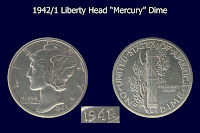 But this is just not an ordinary Mercury dime. It is a 1942/1 Mercury Dime! One of the most desirable Mercury dime errors. A beautiful coin with nice luster. The grade of AU is probably accurate.
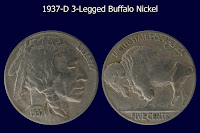 While I am preparing to send the 1942/1 Mercury Dime for grading, the 1937-D 3-legged Buffalo Nickel is also being submitted. For a while, this coin was sitting in the album with the rest of my Buffalo Nickels. But a number of people suggested that I get this coin slabbed for many reasons including for insurance purposes. Although I would rather have the hole in the album filled, I agree with the arguments about protecting the coin and having a record for insurance purposes for this key date coin.
Aug 16, 2007 | coins, dollar, grading, US Mint
With a light work load, I was able to take the afternoon off and travel to 9th Street, NW in Washington, DC, the headquarters of the United States Mint. The building is a plain, white stone office building at the corner of 9th and H Streets, a block away from Chinatown and the Verizon Center. It has the official US Mint seal over the front door, flags flying overhead, and a sandwich board sign announcing the sales counter sitting on the street near the front door.
I made the trek downtown after noon by taking the Capital Beltway to the George Washington Parkway. The GW Parkway is owned by the National Park Service and is a nice drive through the trees along the Virginia side of the Potomac River. A turn to North I-395 and I was heading into downtown DC. Driving in downtown DC is not like other big cities. The streets are wider, cleaner, and you have to watch for double-parked vehicles in strange places. But I made it to the Mint’s headquarters.
When I entered the lobby, there were several people in line for the sales counter. I joined the line so I could purchase a 2007 proof set. Next to the line were three change machines, the type you might see at an arcade or laundromat. As I scanned the machines from right to left, the first machine dispensed Sacagawea Dollars. Insert any bill, and the machine would drop the equivalent amount in Sacagawea Dollars. The next machine to its left was filled with Idaho quarters. With Idaho being the current issue in the 50 State Quarters program, this machine changed four quarters for one paper dollar. Ironically, this machine did not accept one-dollar coins.
Finally, with a queue of its own, was a machine set up to dispense presidential dollars. With today being the first day of issue for the Thomas Jefferson Dollar, people were lined up to obtain this coin. As I waited to purchase a proof set, I watched as someone with a backpack and a fist-full of twenties feed the machine. As the coins were dropped in the outside bin, he placed the coins into white plastic trays. When a tray was full, he placed the coins into a plastic zip bag and into his backpack. It appeared as if the tray was the size of five rolls. He was filling his third tray as I was leaving.
When it was my turn at the counter, I was told that the last proof set was sold while I was waiting. Ironically, I was at the Philadelphia Mint last week trying to purchase a proof set when the power went out. The Mint did not reopen that day and I went home without a proof set. I guess I will have to order the set online. Then I set my sights on the machines. Three twenty dollar bills and one five dollar bill later, I had my stash of Jefferson dollars and left… after stopping for two dollars of Idaho quarters and eight Sacagawea dollars.
I returned home to a hungry dog who needed a walk. After taking care of his needs, I went to my computer, opened the blinds, turned on the Ott Lite, and started to examine the coins. First they were separated by type, then by mint mark. I found 29 Jefferson dollars from Philadelphia and 36 from Denver. Only one of my eight Sacagawea dollars were from Philadelphia and all of the Idaho quarters were from Denver. Not bad for being closer to Philadelphia! Then I focused on the Jefferson dollars. Any coin with a visible nick or problem was set aside. I was looking for clean surfaces, no visible scarring on the high points, and good luster. Finally, I used my loupe to find the best.
In the end I found 22 coins I was confident would do well under NGC’s scrutiny. I logged on to NGC’s website and filled in the online order form. With the coins, order form, and a check packaged, I drove to the nearby Post Office, which is the main distribution station for the region, and was told that Express Mail was a two-day guarantee delivery to Sarasota. I wonder if this has anything to do with Sarasota being referred to as “the Redneck Riviera” according to MSNBC’s Joe Scarborough.
All that work for the First Day of Issue designation on the holder. The last time I did this was for the Washington dollars. The next time will be for Abraham Lincoln. To borrow a phrase from Billy Joel, “You may be right/I may be crazy,” but I am having fun!
Aug 15, 2007 | coins, dollar, US Mint
I just spoke with a friend who brought his two children attended the introduction of the Jefferson Dollar coin. The festivities were held this morning at the Jefferson Memorial, a beautiful marble structure with a bronze statue of our third president in the middle. The renovated structure now has a bookstore, restrooms, and concessions. But on this day, Mint Director Edmund Moy, President of the Thomas Jefferson Foundation Daniel P. Jordan, and a Jefferson re-enactor held a Thomas Jefferson quiz along with the release of the coin.
I was told that the event included about 100 school-age children who had taken part in the Jefferson quiz. With parents, chaperons, onlookers, and the press, my friend estimated about 250-300 people attended the festivities. About $50 in coins were given to children who answered questions. Following the press conference, people were given the opportunity to exchange up to $5 in currency for coins. My friend reported that few of the Mint’s employees followed that rule and allows some to even purchase rolls at face value.
Rolls were popular amongst the speculators looking for edge errors. My friend opened his roll in his car to check the edges. Although he did not find any errors, he did receive a roll of coins struck in Denver.
For the rest of us, the coins will be released into circulation tomorrow, August 16. I will be playing hooky to go to the Mint’s headquarters in the District in order to stuff the in-lobby machine with $5 bills to trade for Jefferson coins. From there, I will be heading to the main Post Office on Massachusetts Avenue, the one next to the National Postal Museum, to send the coins directly to NGC for First Day of Issue grading.
Yes, the First Day of Issue designation is a bit crazy, but I think there is an “oh neat” factor at work. Besides, I have other plans for these coins. Stay tuned!
Jul 23, 2007 | cents, coins, fun
Many people look at Mondays with disdain. It can be difficult to get back into the swing of the workweek after two pleasant days off. Nevertheless, I have a lot of work to do in order to wind down my participation on my current project so I can transfer to do something else. As the clock struck noon, my iPod finished playing the playlist I selected and decided it was time for lunch.
The company cafeteria is nothing special except that it is convenient. After being handed the takeout carton of my food, I went to pay for the purchase. When the cashier handed over my change, I noticed something strange… all the cents were wheat backs! I asked the cashier to look in the draw and see what else was there. We separated 38 wheat back cents from the draw. She then opened the next roll and we found more. The third roll did not have any wheat cents. When I was finished, I had found 88 wheat back cents.
I returned to my office and emptied my pocket onto my desk. While eating lunch I quickly checked to see what I found. When I separated coins by decade, I found 43 coins from the 1950s, 38 coins from the 1940s, and six cents from the 1930s. Twelve were shell casing cents (1944-45) and there was one Canadian cent from 1958. Most were minted in Philadelphia although there were more Denver minted coins amongst those with mint marks.
As a result, all I found were 87 common wheat back cents in Good to Fine condition. According to Coinflation.com, these coins are worth $2.15 in melt value, although it is illegal to melt cents. Hoarding is legal and these coins will be added to my tubes of cents from the various decades.
It was a little numismatic pleasure during lunch!
Jul 11, 2007 | coins, commemorative, US Mint
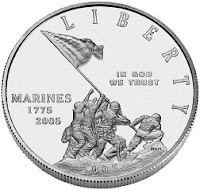
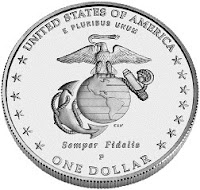 On July 2, the publisher of World Coin News announced that the 2005 Marine Corps 230th Anniversary Silver Dollar has been named “Coin of the Year” (COTY). This commemorative coin features an engraving by United States Mint Sculptor-Engraver Norman E. Nemeth of the Joe Rosenthal Pulitzer Prize winning photograph of the Marines raising the flag over Iwo Jima in 1943. The reverse features the official emblem of the Marine Corps engraved by United States Mint Sculptor-Engraver Charles L. Vickers.
The US Mint issued their press release today.
Coin of the Year is selected from winners of ten categories. The Marine Corps commemorative was the winner of the “Best Crown” category. Other US coins in winning categories include the 2005 Oregon State Quarter as the “Best Trade Coin” and the 2005 American Bison Nickel as the “Most Popular” coin.
COTY was created by the editors of World Coin News to “encourage and honor creativity in the coinage issues of the mints of the world.” World Coin News delays the selection to allow coins to be nominated and reviewed.
Jul 2, 2007 | Baltimore, Canada, coins, currency, Israel, personal, registry sets, shows
When Friday rolled around, I needed a break. I needed something to take my mind off the daily grind of trying to guide the government to do right with technology. I needed coins. Lots of coins. More coins than can be experienced even when contained under one roof. I needed the Whitman Baltimore Coin and Currency Convention.
After sleeping in, I woke to kiss my wife goodbye and started to pack my backpack. Into the bag went the current editions of the Coin Dealer Newsletter, my Palm T|X that stores my inventory list, my iPod for the trip to Baltimore, and a loupe. I finished my morning constitutional before feeding and walking the dog. After a bite to eat and throwing two bottles of water in my backpack, I was off to Charm City.
The trip to Baltimore is a little more than an hour from home. It is a trip down I-270, across the top of the Capital Beltway, then north on I-95. The trip down I-395 into Baltimore passes M&T Bank Stadium, home of the Baltimore Ravens, to the warehouse beyond right field at Camden Yards home of the Baltimore Orioles. I parked in my usual lot at the Sheraton and walked through the hotel to the walkway to the Baltimore Convention Center.
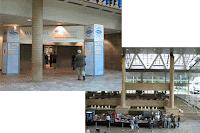 This is Whitman’s second time running this show and their mark was seen riding down the escalator when I noticed that the food court was moved. Rather than being outside the door, the service area was moved to the front lobby at the foot of the escalator. The tables were moved out closer to the lobby and Whitman placed convention-style booths for registration. Also, the entrance had a new canopy announcing the show. It looked more professional than in the past.
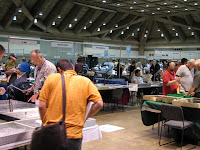 It is still an awe inspiring experience to walk into the hall and see wall-to-wall dealer tables. Adding to the depth of vision was the framing that Whitman used during the last show behind the tables to allow dealers to hang banners. As I began to walk to the left side of Hall A, I noticed that Whitman placed stickers on the floor to mark the row numbers. Looking up, on the columns, they also placed numbered signs showing row numbers and the table number group. The best way I can describe this is that the numbers resemble address numbers on street signs. It is a small touch, but when looking for a specific dealer it really helps.
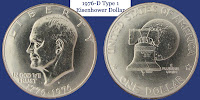
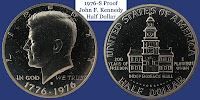 I saw a number of dealers I have bought from and spoken with in the past. Of note I was able to speak with Wayne Herndon, author of the last-page article in July’s Numismatist. The article is really good dry, tongue-in-cheek humor that I found fit Wayne’s personality when you talk with him. Wayne is a good guy and a very fair dealer. From Wayne, I was able to find some 1976 coins that I want to submit to NGC for the registry set. Finding really nice Eisenhower Dollars is very difficult, but Wayne had this 1976-D Type 1 Dollar that I could not pass up. Amongst the other coins I bought was a 1976-S Proof JFK Half Dollar is beautiful.
Watch out NGC, these coins (and other coins) will be sent this week!
One thing I noticed was that there was a lot of table sharing. While this is a common practice with small dealers, there were some higher volume dealers sharing tables, especially on the corners. For the buyer, this meant that there were more options. I was able to pickup some nice items while junk box diving for resale that I will be posting on eBay soon. Yes, there were some nice items in many of the junk boxes which was surprising.
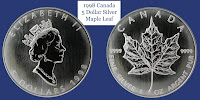 I also had taken the opportunity to try to complete my set of Silver Maple Leaf coins. I was able to find a 1989, 1992, 1996, and 1998. All I am missing from the set is 1990 and 2007. I forgot about the 2007 and did not buy one at the show. All are beautiful coins, but the 1998 is the best. Images of these coins are difficult, but I tried so I can show off their beauty.
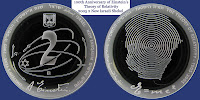 As I complete many of my United States sets, I am looking for other areas to explore. One area of interest is the currency of Israel. Coins are interesting, but the Israeli paper is beautiful with nice historical images. But first, I wanted the 2005 Theory of Relativity Commemorative Proof. I purchased a beautiful proof coin from noted dealer in Israeli Numismatics, J.J. van Grover. Van Grover is also the Vice President of the American Israel Numismatic Association, an organization which I recently joined, and we had a chance to talk about AINA and other Israeli issues. But the coin is beautiful whose image cannot do it justice.
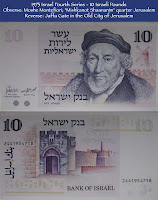
I did buy some Israeli paper money. These two notes are from the Fourth Series Pounds dated 1973 but issued in 1975. These notes were demonetized in 1983.

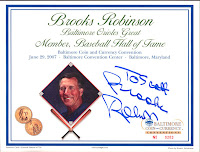 Before going through the rest of the show floor, it was time to take a pause to do something non-numismatic. Appearing at the show was Baltimore Orioles Great and Member of the Baseball Hall of Fame, Brooks Robinson. Robinson is a very gracious gentleman whose current wrist injury he blames on old age. At 70, he may not be able to defend the hot corner but he is not ready for the home either. I did stand on line for his autograph and have my picture taken. Even though my Mets beat his Orioles in 1969, I cannot deny that he was a great player and a classy person. It was a joy to meet him.
 Before returning to the bourse floor, I stopped at the nearby Whitman booth. During registration, we were given a coupon for a free copy to The Expert’s Guide to Collecting & Investing in Rare Coins, the latest tome from Q. David Bowers, with a $25 purchase. I almost walked away from the booth before noticing Whitman was selling something that was not numismatic or philatelic related. Whitman now creates something called Football Vault Books. With the publisher from the south, it is not surprising that the series started to cover the Southeastern Conference. When I found the University of Georgia Vault Book I decided to use my coupon after buying the book. The Vault Book is fantastic! It has the history and reproduction of memorabilia from the era being discussed. Ok… back to the coins.
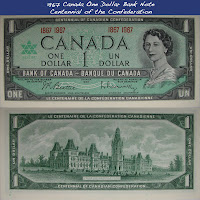 This time, the foreign section was smaller than usual. I was looking for some Canadian coins but was a little disappointed at the selection and the lack of dealers with good Canadian inventory. Rather than walk away empty handed, I bought a 1967 Centennial of the Confederation One Dollar note. It is a crisp, uncirculated note that has a look very reminiscent of the formal aspects of the 1960’s.
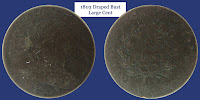 As the day was winding down, I needed to buy something old. Somebody had to have something not that expensive but old and fun. I happened upon the table for The Butternut Company out of Clifton, Virginia. Butternut has a nice business of Civil War memorabilia along with the coins. But the had a junk box of well worn large and half cents. Ah ha! Something old! So I searched the small box looking for something with a readable date. In the box I found an 1803 Large Cent that satisfied my old and fun criteria. It is 204 years old and is just loaded with history.
As I left with ten minutes to closing, dealers were already closing down and vacating. I walked through the Sheraton, purchased a beverage and candy bar from the hotel shop, and retrieved my car from their lot. I left driving around traffic on their way to an Orioles game and found my way to I-395 to head back to the Washington, DC area. During the trip I called my wife to discuss dinner plans and made good time going south on I-95 to the Capital Beltway. I picked up something for dinner and headed home. After being happily greeted by Boomer, I cleaned up and served dinner while telling my wife about the fun I had. Show-and-tell occurred before desert.
In all, it was a wonderful day and a wonderful show.
Click on any image to enlarge. Vault Book cover from Whitman Publishing.



 Loading ...