Jun 27, 2007 | ANA, coins, fun
One thing that slipped my mind following the ANA National Money Show™ in Charlotte was that the candidates forum was being tapped for showing on line. I should have remembered since I was sitting next to David Lisot, Executive Producer at cointelevision.com. I was reminded of this site by a mailing from Numismatic News.
In short, Lisot attends coin shows and tapes the key activities. Videos are digitized and posted on the cointelevision.com website for anyone to view. Videos are posted in Quicktime format and viewable to anyone with Internet access.
Cointelevision.com is a marvelous idea. For those of us who cannot attend every coin show, having the videos available for some of the key highlights is wonderful.
For those interested in seeing the candidate forum from the National Money Show,™ you can find the video on ANA’s website.
Jun 25, 2007 | Baltimore, coins, fun, shows
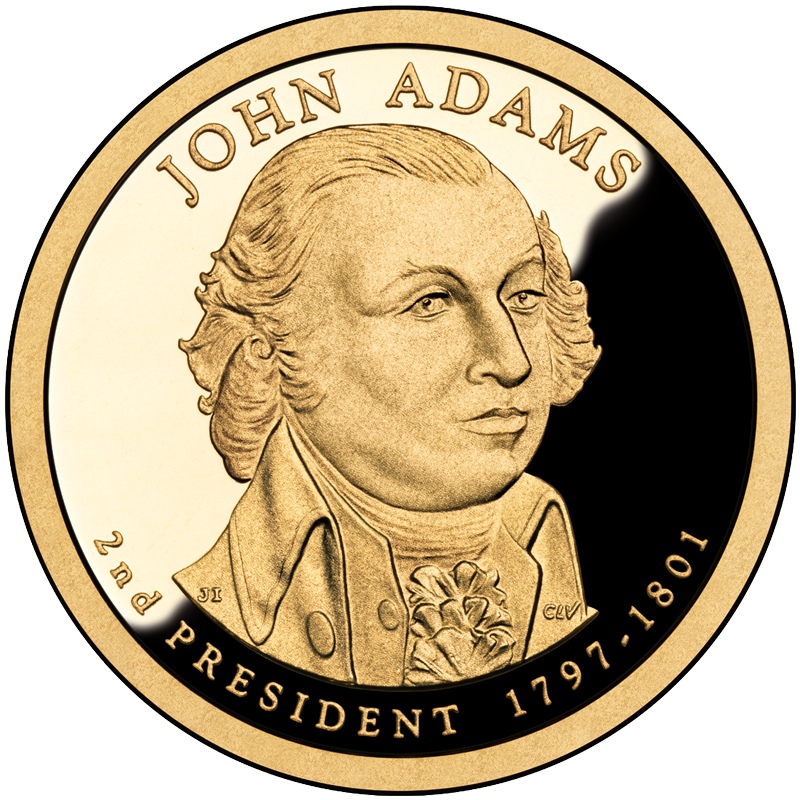
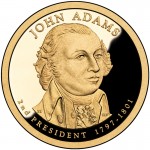 A is for Adams, John Adams, our second president. He was our first vice president and the only president elected from the Federalist Party. Adams is currently being honored on his first coin as part of the Presidential $1 Coin Program. The Adams dollar coin has seen fewer errors than the Washington predecessor, but the reports of errors have been reduced.
 B is for Brooks, as in Robinson, Hall of Fame third baseman for the Baltimore Orioles. The defender of the hot corner at Memorial Stadium for Earl Weaver’s O’s will appear at the Whitman Baltimore Coin on Currency Convention. Robinson will be at the Baltimore Convention Center on Friday, June 29 from 2 PM to 5 PM giving out 100 Adams Dollars to Young Numismatists attending the show. Robinson will also be providing autographs to other attendees. I wonder if I can get him to autograph an Adams Dollar?
C is for coins. Lots of coins. Three halls of coins! I have been a regular attendee of this show for the last six years and I still am amazed and overwhelmed when I enter the hall. I have made a made a few friends with some dealers. I hope to see them at this show. It is just fun, and that is what collecting should be about.
Adams Dollar image courtesy of the US Mint.
Brooks Robinson ad courtesy of Whitman Coin and Collectibles Conventions, LLC.
Jun 22, 2007 | coins, First Spouse, gold
When the Presidential $1 Coin Act of 2005 (Public Law 109-145 [GPO: Text/PDF]) was passed, I was concerned that the minting of the First Spouse 24-karat gold coins would not be a success. With the price of gold soaring over $600 per ounce for the last few years and the requirement to use domestic sources of gold, it was speculated that the coins would cost over $400 each. Eventually, the US Mint priced the proof coins at $429.95 and the uncirculated coins at $410.95. Would people buy the coins at these prices?
The Mint has never had a program like this making it difficult to make the comparisons against other US Mint products. There have been other gold coin programs and the American Eagles are produced in gold, but the First Spouse coins are the first 24-karat fractional gold series. It would even be difficult to compare these coins with the various commemorative coin programs that have not been successful. Thus, the Mint is charting new territory.
With a production limit of 40,000 for both proof and uncirculated coins, the Mint has sold out of the Martha Washington and Abigail Adams First Spouse Gold Coins after two days of being available. It is difficult to tell whether this is the result of first issue sales or there is a genuine interest in these coins. Only time will tell.
Jun 13, 2007 | coins, dollar, state quarters, US Mint
The US Mint turning June into a busy month for collectors by releasing a lot of products. It started on June 4 with the Idaho quarters bags and two-roll sets. Yesterday, the Mint released the John Adams Coin Cover. Today, June 13, the 2007-W uncirculated American Silver Eagle bullion coin is now on sale. Next Tuesday, July 14, the proof and uncirculated First Spouse gold coins honor Martha Washington and Abagail Adams will be on sale. The Mint will also produce 1 5/16-inch bronze medals using the First Spouse designs without a denomination. Finally, on June 21, the Mint will release the Presidential $1 Coin Proof Set.
If you collect everything the Mint produces, the month of June will be expensive. As for me, I am interested in the American Silver Eagles and the Adams Coin Cover. I am not excited about the First Spouse coins. Aside from being expensive, I am not excited about the theme. I am not planning on purchasing the bronze medals.
As for the Presidential $1 Coin Proof Set, I will probably purchase a few sets since first issues tend to resell at a good premium. But the Mint has not said whether the proof, silver proof, and mint sets would contain the Presidential $1 coins. I will hold onto one until the Mint announces what they will do with those annual sets.
Is this too much product for the Mint? If you watch the releases from the Royal Canadian Mint, you may say that the US Mint is quite austere in their offerings. Although I wish the Mint would try to show more class, but their product offerings are regulated by law. Since the law requires the Mint to sell these products, it is difficult to blame them for legally implementing the policies forced upon them.
Jun 1, 2007 | coins, commemorative, US Mint
Every month, the US Mint’s History In your Pocket (H.I.P) program chooses one coin to feature and provides education materials for teachers to use in teaching history using numismatics. This month’s coin is the 1915 Panama-Pacific $50 commemorative coin.

 Minted to commemorate the 1915 Panama-Pacific Exposition in San Francisco that celebrated the opening of the Panama Canal and rebuilding of San Francisco following the Great Earthquake of 1906. The Mint created five different commemoratives for the exposition including an octagonal gold coin with a $50 face value. Its unusual shape makes it intriguing.
Robert Aitken, a New York artist born in San Francisco, was selected to design the fifty dollar round and octagonal coins. The obverse is based on the Roman goddess Minerva and an owl on the reverse to symbolize wisdom. Although the coin was ridiculed as not having American symbols. But the designs are well executed and appreciated by collectors today.
May 29, 2007 | coins, halves, history
As our 35th President, John Fitzgerald Kennedy became the youngest person to ever be elected as President and the first Roman Catholic. At 43, Kennedy was the promise of a new future; a new vision that would have the United States leading the world in fighting the “common enemies of man: tyranny, poverty, disease, and war itself.” In his inaugural address, he called the nation to arm when he said, “ Ask not what your country can do for you, ask what you can do for your country.”
From standing up to the Soviet Union’s Nikita Khrushchev, to the success of the Cuban Missile Crisis, to the failures of the Bay of Pigs, the starting of the Peace Corps, and challenging the United States’ resolve using the space program by proclaiming, “We choose to go to the Moon in this decade and do the other things, not because they are easy, but because they are hard.” In over two years, Kennedy made an impact on this country in such a short period of time that one can wonder what would had happened if….
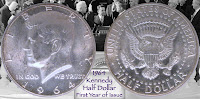 A few days after Kennedy’s assassination on November 22, 1963, US Mint Director Eva Adams, Chief Engraver Gilroy Roberts reported that there was discussions about putting Kennedy’s portrait on a silver coin. Since Jacqueline Kennedy did not want to replace Washington’s portrait on the quarter, it was decided to use the half-dollar. Roberts used models from the inaugural medal for the obverse design and Assistant Engraver Frank Gasparro prepared the reverse design using the Presidential Seal.
Since the law stated that coinage design could not be changed more often than 25 years, and that the Franklin Half was only 15 years old, it required Congress to authorize the change. The Act of December 30, 1963 allowed the design to be changed.
When the coin was released in 1964, the 90-percent silver coin was saved by a grieving nation wanting something that represented the fallen President. Over 273 million coins were struck in Philadelphia and 156 million in Denver. The composition was changed in 1965 with the introduction of clad coinage. Half dollars consisted of 40-percent silver that included a core made from 79-percent copper and 21-percent silver. In 1971, the composition was changed to current copper-nickel clad that is in use today.
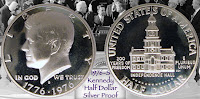 There has been one design change to the coin and that occurred in 1975 and 1976 in honor of the American Revolution Bicentennial. A special reverse depicting Independence Hall in Philadelphia was designed by Seth G. Huntington. For both years, the obverse featured the dual date 1776-1976 in celebration.
On what would have been Kennedy’s 90th birthday, we salute this great president with the coin minted in his honor. Happy Birthday, Mr. President from a grateful nation.
May 25, 2007 | cents, coins, history, US Mint
People lined the streets in front of the Philadelphia Mint on May 25, 1857 so that they can trade their foreign coins for newly minted Flying Eagle small cents. The scene must have pleased Mint Director James Ross Snowden, whose push for the coinage law passed by congress on February 21, 1857 allowed him to drive out all foreign coins from circulation.
When Snowden became Mint Director in 1853, he was faced with the issue that the price of copper and the increasing labor costs were making the large cent uneconomical to make. Snowden also knew that for the nation to continue to thrive, the lower denomination foreign coins that were still being used in the United States had to be removed from the economy. Aside from the large cent not being popular with the public, Snowden also believed that the value of subsidiary coinage can be based on trusting the government as the issuing authority and not necessarily the intrinsic value of the metals used.
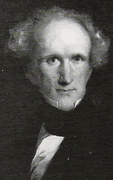 Snowden tasked James B. Longacre with designing a smaller coin to replace the large cent. Longacre borrowed the Christian Gobrecht/Titian Peale design that was used on pattern dollars twenty years earlier to create a unique obverse. For the reverse, Longacre adapted the wreath he made for the 1854 one and three dollar gold coins. Snowden ordered 1,000 of these 1856 Flying Eagle Cents to struck in order to distribute to congress and other politicians as part of his lobbying effort to allow for their regular production.

 At least 634 of these pattern coins were distributed amongst official Washington. Although many of the politicians liked the coins, it did not produce immediate action. Snowden continued to lobby congress for the new coin and the demonetization of foreign coins circulating in the United States until the coinage law was passed.
Without waiting for the bill to be singed by President Franklin Pierce, Snowden ordered news dies to be made and a large number of coins to be struck. Although the exact number ordered is lost to history, it is estimated that between two or three million Flying Eagle cents were struck.
On May 25, 1857, the Mint constructed temporary wooden teller windows to trade the new cents for subsidiary foreign coins that were demonetized by the new law. The new coins were a success and the Mint went on to strike over 42 million of these coins driving all demonetized foreign coinage out of the market.
Longacre’s design was difficult to strike because of the relief and the placement of the eagle over the reverse elements. So the Flying Eagle design lasted two years with attempts at a die change in 1858. Snowden changed the design in 1859 to the Indian Head cent claiming the relief was too high and the design was not accepted by the public. Although the explanation has been disputed, Snowden was successful with introducing a coin that was accepted by the public and driving out foreign coins—150 years ago today.
Longacre portrait courtesy of uspatterns.com
May 20, 2007 | coins, currency, fun, history
Yes, I know the John Adams Dollar was released this week. But Real Life™ got in the way and I was not able to go downtown Washington to buy first day of issue coins. For now, I will by pass talk of the Adams Dollar in favor of some fun.
The Futures Channel is an online video service that creates multimedia content to bridge the gap between the Real World™ and the subjects students are learning in school. It is a great idea with interesting results. Two videos that I thought would be of interest to numismatists, collectors, and hobbyists are First American Coins and Printing Money.
Although First American Coins does not mention where it was taped, there are mentions of the ANA World’s Fair of Money that was held in Denver the Summer of 2006. Amongst the video’s vignettes is a picture and discussion of the Brasher Doubloon as the first US gold coin and the half dismes as the first silver coins made from George and Martha Washington’s silver.
Printing Money also has images from the ANA World’s Fair of Money in 2006, but also has what appears to be stock footage that is rumored to have been provided by the Bureau of Engraving and Printing. Still, it is an interesting video.
Both videos make an attempt to tie the content back to mathematics in order to provide benefits for the students. For the rest of us, it just interesting.
May 16, 2007 | coins, commemorative, foreign, fun
Every so often, you have to buy a coin or a set of coins because they are just neat. Here is something about my recent purchase.
One of my non-numismatic interests are motorcycles. I used to love riding bikes in my younger days. It was fun to drive through the woods that were behind the house we lived in during my teen years. Unfortunately, real life has limited my current interest to watching the guys on American Chopper create neat bikes. For my mid-life crisis, I will buy a nice motorcycle—maybe one of those wonderful OCC bikes!
Last year, the Federal Republic of Somalia issued a set of six coins in the shape of guitars. These non-circulating legal tender coins were made from silver plated copper-nickel shapes and enameled with the design. They are non-circulating legal tender issued at the value of one dollar, even though the shilling is the standard currency of Somalia.
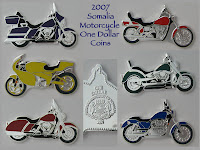 This year the theme is motorcycles. The six coin set is based on designs of Harley Davidson motorcycles and other bikes. With my interest in motorcycles, I decided to buy the set at the last Whitman Baltimore Coin and Currency Convention. I think these coins rank on the “oh neat” scale!
It is not enough to post images here, coins like these have to be displayed. I want a display that enhances their “oh neat” appeal. One idea is to frame the coin with a sheet of the Postal Service’s American Motorcycle Stamps. A full sheet of the stamps would be framed in the center of a mat and three coins on either side. But while surfin’ the Internet, I came across the Sturgis Motorcycle Museum. In their Museum Gift Shop they offer the framed motorcycle stamps canceled on the First Day of Issue that were first made available at the 2006 Sturgis Motorcycle Rally. I may buy one and see if I can incorporate the coins into that display or use it for another.
Either way, these coins are neat!
Click on image to see a larger version.
May 12, 2007 | CCAC, coins, commemorative, gold, US Mint
It was a busy week for me and the US Mint. While I was toiling to help another government agency from failing on one job, the Mint was demonstrating why it is the world’s largest manufacturer of numismatic items. So let’s look at the news…
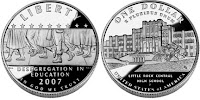 On May 4, the Mint announced that it will begin to take orders for the Little Rock Central High School Desegregation 50th Anniversary Silver Dollars on May 15, starting at noon. This coin commemorates the historical significance of the desegregation of Little Rock Central High School following the landmark 1954 Brown v. Board of Education decision by the US Supreme Court. For more about this coin, read my article “Little Rock Central High Commem Design.”
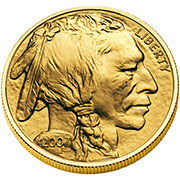 The Mint quietly dropped the discussion of producing fractional American Buffalo 24-karat Gold Coins and extended the potential release date until June. It is suspected that the Mint may require congress to pass necessary legislation in order to authorize the production fractional Buffalo coins, although this has not been confirmed by the Mint. Uncirculated 2007 Buffalo coins can be purchased from dealers and on the secondary market.
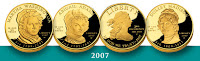 Earlier this month, the Mint advertised that they would sell the First Spouse gold coins by the set at $1,675.95. But the Mint announced this week that they will begin to sell First Spouse gold coins individually started at noon on June 19, 2007 for the Martha Washington and Abigail Adams coins. Jefferson’s Liberty coin will be for sale on August 16 and the Dolley Madison coin on November 15. No set will be offered. Individual coins will sell for $429.95 as proof coins and $410.95 as uncirculated coins.
The Mint also announced that the Citizens Coinage Advisory Committee (CCAC) will meet Tuesday, May 15, at the Philadelphia Downtown Marriott Hotel at 9 A.M. On the agenda is the design of the Congressional Gold Medal to honor the Dalai Lama as well as the proposed design for the 2008 American Bald Eagle Commemorative Coins.
Time to go take some pictures so I have some fun stuff to talk about.
All images from the US Mint.



 Loading ...