Aug 13, 2016 | coins, dollar, pocket change
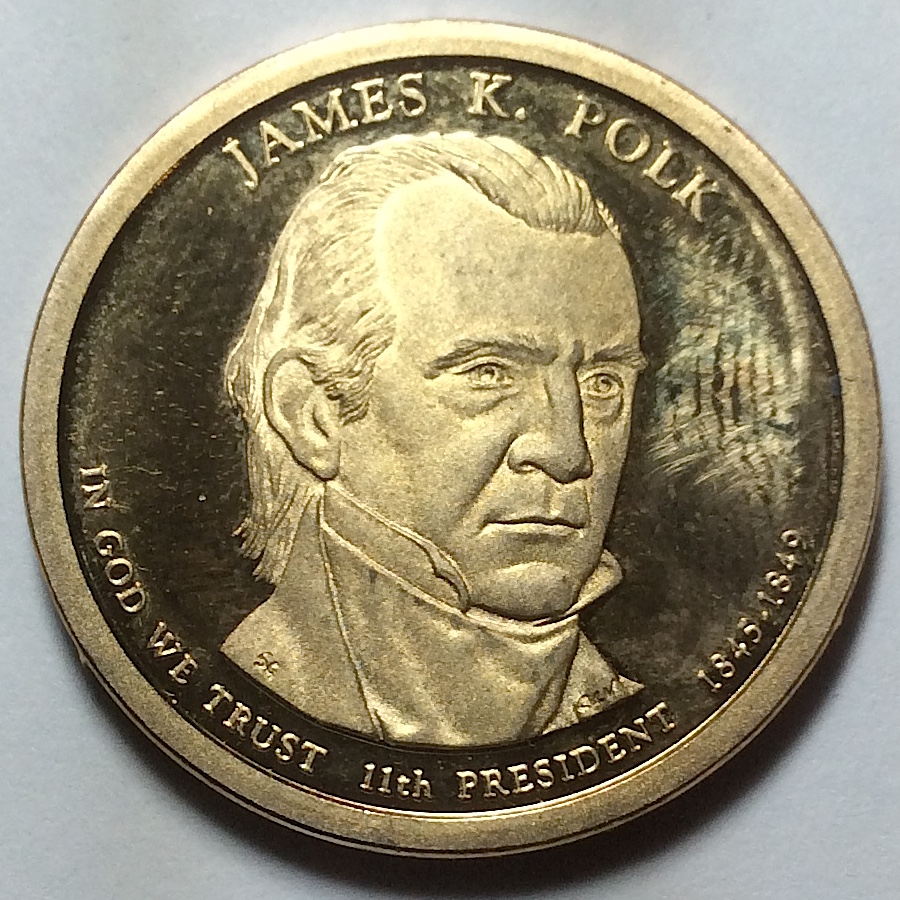
2009-S James K. Polk Dollar PROOF found in change
During a visit to a numerically named convenience store for a cold beverage, I noticed that there were a few “golden dollars” in the register. The cashier hesitated to give them to me but I told her I was a collector and was interested especially since the one on top was very shiny. After trading three paper notes for the coins my suspicion was correct. The coin is a 2009-S James K. Polk Presidential dollar.
While the coin can be used for one dollar in trade, whomever purchased it paid more and could have sold it for at least $5 rather than placing it in circulation. While we do not know the conditions that caused this coin to be in the cash register at the time I stopped in the store, it has been rescued from circulation and will find its way into a collection. I will probably add it to my coin club’s charity auction this December.
Aug 8, 2016 | coin design, coins, commemorative, legislative, US Mint
 Thanks to congressional lawmaking, the U.S. Mint is holding competition for the two commemorative coin programs that will be issued in 2018. Earlier this year, the competition was opened for designs of the 2018 World War I Centennial Commemorative silver dollar. Now, the U.S. Mint has begun a competition for the 2018 Breast Cancer Awareness Commemorative Coins.
Signed into law on April 20, 2016 by President Obama (Public Law 114-148), the law requires the U.S. Mint to have an “juried competition” for a design “emblematic of the fight against breast cancer.” As part of the design, the law says that “The Secretary shall encourage three-dimensional designs to be submitted as part of the proposals.”
There is a caveat: you have to be an artist of some type and a U.S. citizen 18 years of age or older. You can read the Official Rules on the U.S. Mint website, but in summary Phase I of the competition is the evaluation of three-to-five examples of your work submitted digitally to the U.S. Mint. You have to be able to submit a digital portfolio. Even if your work is good and you think you can be part of the competition, you either have to be able to take a good picture of your work or find a photographer who can help.
An “expert” will review the submissions and select no more than 20 artists for the second phase.
In Phase II, those selected artists will be asked to submit one design along with a plaster model of both the obverse and reverse for the proposed coin that includes all of the necessary elements required of a coin. Only one artist’s design will be selected. The winning artist will receive “not less than $5,000.” If your design is selected, you will have your name etched in numismatic lore for being the designer of the coin. For this, your initials will appear on the coin, the Certificate of Authenticity, and in places like the Red Book!
Full details can be found on the U.S. Mint website.
Summary of the Breast Cancer Awareness Commemorative Coin Program
- Commemorative coins issued in 2018
- Design, emblematic of the fight against breast cancer, selected from a juried competition with no less than $5,000 going to winning design
- “The Secretary shall encourage three-dimensional designs to be submitted as part of the proposals”
- 50,000 $5 “pink gold” coins with an alloy of at least 75-percent gold with a $35 surcharge
- 400,000 one-ounce silver dollars made with not less than 90-percent silver with a $10 surcharge
- 750,000 clad half-dollar coins with a $5 surcharge
- Surcharges will be distributed to the Breast Cancer Research Foundation of New York, to further breast cancer research funded by the Foundation.
Pink gold can has been more commonly described as “rose gold.” Rose gold is an alloy of 75-percent gold with 20-percent copper and 5-percent silver. The color can be adjusted by changing the ratio of copper and silver.
Jul 20, 2016 | celebration, coins, history, medals
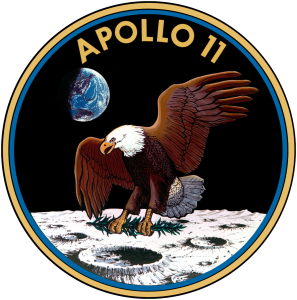 It was July 20, 1969, Neil Armstrong and Edwin “ Buzz” Aldrin, made history by being the first humans to land on Earth’s only natural satellite. A mere 238,900 mile trip began with the launch of the Saturn V rocket from the Kennedy Space Center on July 16, 1969, with Michael Collins who orbited over the moon in the command module, the trip fulfilled the promise of President John F. Kennedy who said to congress on May 25, 1961, “I believe that this nation should commit itself to achieving the goal, before this decade is out, of landing a man on the moon and returning him safely to the earth.”
Kennedy would have been pleased with the events of 47 years ago, today.
Michael Collins design the mission insignia. Collins said that he wanted a symbol to represent a “peaceful lunar landing by the United States.” He also left the names of the astronauts off of the insignia so that it would represent everyone who worked on the mission. It is one of the few mission insignias that does not include the name of the astronauts.
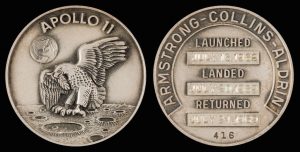
Apollo 11 flown silver Robbins Medal once owned by Wally Schirra
This medal was sold for $33,460.00 on April 18, 2013 by Heritage Auctions.
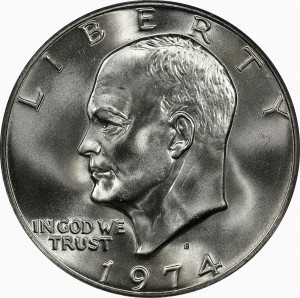
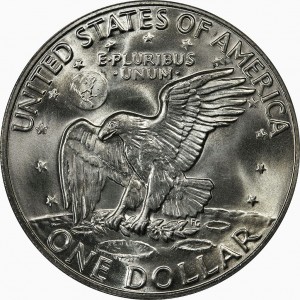
In March, before the Apollo 11 launch, President Dwight Eisenhower died of congestive heart failure at the age of 78. To honor the late president, congress passed the bill to produce what ended up to be the last large dollar coin with the portrait of Eisenhower. It was Rep. Bob Casey (D-TX) who remembered that Eisenhower created NASA and proposed that the reverse of the coin use the Apollo 11 mission insignia rather than just a heraldic eagle.
The Eisenhower dollar was released in 1971 and struck until 1978. Other than relief and varieties, the only design change was made in honor of the nation’s bicentennial in 1975-76.
-
-
-
Eisenhower Dollar Reverse featuring the Apollo 11 mission insignia
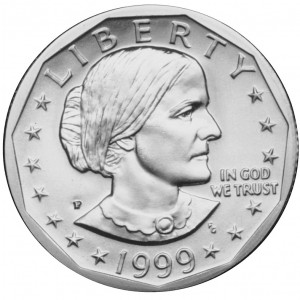
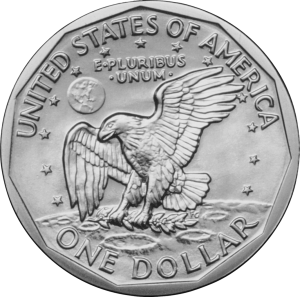
Beginning in 1976, the U.S. Mint was looking to reduce the costs of coin production and was testing different shapes and compositions for a new dollar coin. In order to appease the powerful vending machine industry, the result was a coin that was too similar in size and composition to the quarter dollar. Congress made the decision to honor Susan B. Anthony and leave the Apollo 11 mission insignia on the reverse.
-
-
Susan B. Anthony dollar
-
-
Reverse of the Susan B. Anthony dollar featuring the Apollo 11 mission insignia
Chief Engraver Frank Gasparro designed the reverse for both the Eisenhower and SBA dollars using the Apollo 11 mission insignia. An iconic design even though the coins were less than successful.
Credits
- Apollo mission insignia courtesy of NASA.
- Apollo 11 flown Robbins Medal courtesy of Heritage Auctions
- Coin images courtesy of the U.S. Mint.
Jul 19, 2016 | ANA, coins, Eagles, silver
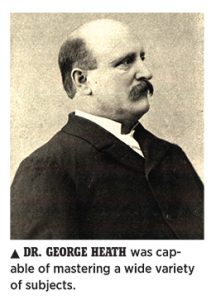 It has been 125 years since Michigan physicist Dr. George Heath founded the American Numismatic Association in 1891. Heath, who operated a coin business on the side, began this journey by publishing his own magazine in 1888 called The Numismatist. He used the magazine as a call to other collectors to create the ANA.
The ANA will celebrate this milestone at the upcoming World’s Fair of Money. In an interesting coincidence, or maybe planning, the celebration will be help practically next door to the place called “The Happiest Place on Earth.” Irrespective of whatever issues anyone sees or perceives with regard to the ANA, you have to admit that an organization like the ANA to survive 125 years is pretty amazing.
If you are interested in a long-form history of the ANA, I recommend reading “125 Years of Collecting with the American Numismatic Association” written by Q. David Bowers. It is not a quick read, but 125 years of history was not easy to create. The current page is in seven parts with an eighth promised for next month. There is no indication if that will be the last part. Still, it is a recommended article.
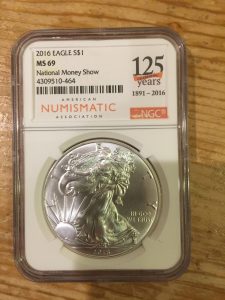
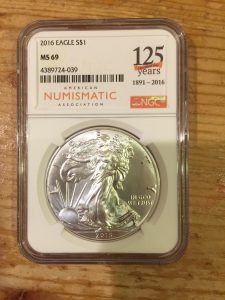
Currently, if you become an ANA member or renew your membership for 3 years or donate $125, you can receive a 2016 American Silver Eagle graded MS-69 by Numismatic Guarantee Corporation with a special Anniversary Label. I there is a limit of 2,500 coins. If you become a life member or donate $500, you can receive one graded MS-70. There is a 250 limit on the higher graded coins.
-
-
2016 American Silver Eagle graded MS-69 by NGC with 125th Anniversary Label from the National Money Show
-
-
2016 American Silver Eagle graded MS-69 by NGC with 125th Anniversary Label
There was also a set of coins created for the National Money Show with a special label. There was a renewal opportunity that allowed existing ANA members to renew and receive their coin with the National Money Show label. These were coins left over from the show in Dallas.
Not only did I take advantage of the renewal offer but added a donation to receive both versions of the coin in MS-65. Although I do not collect grading service labels, this was an opportunity to support the ANA. There may be a limited number of coins left. If you are not a member, you may want to consider joining. If you are a member, either consider a three-year renewal or donate $125 to help the ANA. I believe it is a good cause!
Image of Dr. George Heath courtesy of the
ANA.
Jul 11, 2016 | coins, currency, poll
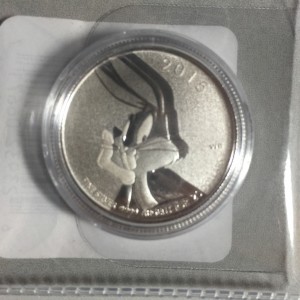
From my collection, a 2015 Canada Bugs Bunny $20 for $20 Silver Coin
I am asking for two reasons: first, I am curious. I know that my tastes are different from yours and I am curious about yours. There is no wrong answer to this question because whatever you like to collect is right for you. It should not matter what anyone thinks of your collection because it’s your collection and you are the one that has to be happy with it. I want to know what makes you happy.
The second reason is so I know a little about who is reading the my blog. It will allow me to could tailor some content to your tastes. It is good for me to stretch out of my comfort zone a bit to learn about something else. But I want to do so in a way that I can write about it and someone will have an appreciation for the content.
The poll is anonymous. The usual set of website logs are kept on the server but it does not identify you or how you voted. Comments are encouraged and moderated only to prevent spam. If you are reading this from a site that aggregates web content, you will have to visit the page on my site in order to participate.

Loading ...
Jul 8, 2016 | coins, commentary, dollar, Federal Reserve, US Mint
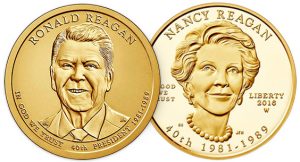
2016 Ronald Reagan dollar & 2016-W Nancy Reagan $10 gold coin
On the Friday before the Independence Day celebration weekend, the U.S. Mint released the Ronald Reagan dollar and Nancy Reagan first spouse coin marking the end of the program.
The Presidential Dollar program has had an interesting history. Passed by congress in December 2005 and later signed by President George W. Bush, the Presidential $1 Coin Act (Pub. L. 108-145) ordered the U.S. Mint to create a $1 coin to commemorate the Nation’s past Presidents and an accompanying $10 gold coin to commemorate the President’s spouse (First Lady). Coins appeared in order that the president served and the president must be deceased for two year prior to the coin’s issue. Since Jimmy Carter is still living, he was bypassed and the last coin was for Ronald Reagan.
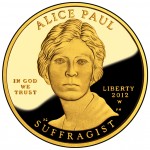
2012 First Spouse coin featuring Alice Paul
For the first time in the modern era the date, mintmark, and mottos “E Pluribus Unum” and “In God We Trust” struck into (incuse) the edge of the coin. The last time edge lettering was used on circulating U.S. coinage was in the 1790s.
With the edge lettering a new process for the U.S. Mint, it was no surprised that coins left the Mint without the mottos stamped in the edge. Dubbed the “godless dollar” the error caused an uproar over some people suggesting that the government was conspiring against religion by leaving the motto off of the coin. This was described as either a willful omission or a way to attack religion. There was no narrative that accepted that this was just a mistake.
Our national nightmare ended when congress updated the law (Pub. L. 110-161) to move the motto from the edge to the obverse of the coin. E Pluribus Unum, the date and mintmark was left on the edge.
Then there was the breathless story by National Public Radio that decried the tax dollars being wasted by the approximately $1.4 Billion of dollar coins being stored in the Federal Reserves’ vaults. The story was filled with partial truths and did not properly explain the situation. When I tried to reach out to NPR, I was rebuffed by a reporter who decided a low-level Treasury staffer who did not have the first clue about reality was more credible
While the media was blaming the U.S. Mint and the Federal Reserve, they forgot to read the law. According to the law, there were mintage minimums that congress wrote into the law including the one that said the Sacagawea dollar was to comprise one-third of the dollar coin production. As part of the legislation, the U.S. Mint and Federal Reserve were supposed to promote the coin’s use and provide educational materials for the public.
Congress, who wrote and passed the original legislation, was tripping all over themselves to introduce bills to end the program while pounding their collective chests claiming they were acting in the public interest.
This nightmare ended when then Treasury Secretary Tim Geithner ordered a reduction in the production of all dollar coins. None of the bills introduced to eliminate the dollar coin were ever heard in committee and died at the end of the 113th congress.
But the series couldn’t continue without one more controversy. The way the law was written, it was interpreted that it would end with the first living president. In this case, the program would have ended with the coin honoring Gerald Ford since Jimmy Carter is still living. This did not sit well with the fans of Ronald Reagan who have spent the time since his convalescence and death trying to plaster his name all over everything including an airport that employed air traffic controllers he fired placing the nation’s skies at risk.
The same members of congress that introduced bills to eliminate the program were now demanding the program be extended by one president. Ironically, they waited until after the resignation of Mint Director Edmund Moy and approached the acting Director Richard Peterson. Although Peterson was named acting director, he was a career government employee with impeccable credentials but had to have a different relationship with the politicians than an appointed director would. The matter was deferred to Treasurer Rosie Rios and Secretary of the Treasury Jack Lew who approved the extension of the program.
Presidential Dollars
- 2007:
- George Washington, John Adams, Thomas Jefferson, James Madison
- 2008:
- James Monroe, John Quincy Adams, Andrew Jackson, Martin Van Buren
- 2009:
- William Henry Harrison, John Tyler, James K. Polk, Zachary Taylor
- 2010:
- Millard Fillmore, Franklin Pierce, James Buchanan, Abraham Lincoln
- 2011:
- Andrew Johnson, Ulysses S. Grant, Rutherford B. Hayes, James Garfield
- 2012:
- Chester A. Arthur, Grover Cleveland, Benjamin Harrison, Grover Cleveland
- 2013:
- William McKinley, Theodore Roosevelt, William Howard Taft, Woodrow Wilson
- 2014:
- Warren Harding, Calvin Coolidge, Herbert Hoover, Franklin D. Roosevelt
- 2015:
- Harry S Truman, Dwight D. Eisenhower, John F. Kennedy, Lyndon B. Johnson
- 2016:
- Richard M. Nixon, Gerald Ford, Ronald Reagan
First Spouse Gold $10 Coins
- 2007:
- Martha Washington, Abigail Adams, Thomas Jefferson’s Liberty,† Dolley Madison
- 2008:
- Elizabeth Monroe, Louisa Adams, Andrew Jackson’s Liberty,† Martin Van Buren’s Liberty†
- 2009:
- Anna Harrison, Letitia Tyler,‡ Julia Tyler,†† Sarah Polk, Margaret Taylor
- 2010:
- Abigail Fillmore, Jane Pierce, James Buchanan’s Liberty,* Mary Lincoln
- 2011:
- Eliza Johnson, Julia Grant, Lucy Hayes, Lucretia Garfield
- 2012:
- Alice Paul,¶ Frances Cleveland (first term), Caroline Harrison,‡ Frances Cleveland (second term)
- 2013:
- Ida McKinley, Edith Roosevelt, Helen Taft, Ellen Wilson,‡ Edith Wilson††
- 2014:
- Florence Harding, Grace Coolidge, Lou Hoover, Anna Eleanor Roosevelt
- 2015:
- Elizabeth Truman, Mamie Eisenhower, Jacqueline Kennedy, Claudia Taylor “Lady Bird” Johnson
- 2016:
- Patricia Ryan “Pat” Nixon, Betty Ford, Nancy Reagan
Footnotes:
- †
- President was widowed prior to inauguration
- ‡
- First Spouse died during the president’s term
- ††
- Married the president during the president’s term
- *
- James Buchanan was the only bachelor president
- ¶
- President Chester Arthur was widowed prior to inauguration. However, the authorizing law gives the coin honor to Alice Paul, a suffragette who was born during Arthur’s administration
When the Reagan dollar was issued, 39 presidents representing 40 terms were issued.
Along with Nancy Reagan, 35 other first spouses were honored (Frances Cleveland appeared twice), four different Liberty coins were issued, and one was issued to honor suffragette Alice Paul.
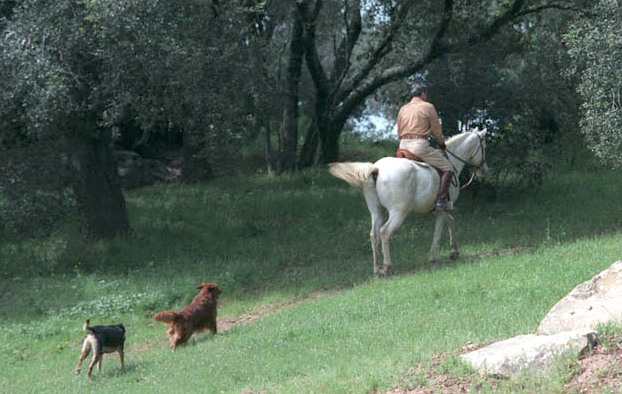
President Reagan horseback riding at Rancho del Cielo with Freebo (his daughter’s dog) and Victory the golden retriever following.
As the program now quietly rides off into the proverbial sunset, maybe it is time to let the America the Beautiful Quarters® complete their run through 2021 and give the circulating commemoratives a rest.
Credits
- Coin images courtesy of the U.S. Mint
- Reagan on horsback “April 4, 1986 photo courtesy Ronald Reagan Presidential Library and Museum.” Downloaded from PresidentialPetMuseum.com
Jul 2, 2016 | coins, commemorative, legislative, US Mint
 It has been another head scratching month for us policy wonks who watch congress for more than the political theater, although both sides of the aisle provided quite a sideshow this month. With the ever eroding sense of civility, there was a few numismatic-related items that occurred. Introduced as a matched, related bills are proposals for commemoratives in 2020 and 2021:
H.R. 5598 Plymouth 400th Anniversary Commemorative Coin Act of 2016
Sponsor: Rep. William Keating (D-MA)
• Introduced: June 28, 2016
• Referred to the House Financial Services Committee
This bill can be tracked at https://www.govtrack.us/congress/bills/114/hr5598.
S. 3105 Plymouth 400th Anniversary Commemorative Coin Act of 2016
Sponsor: Sen. Edward “Ed” Markey (D-MA)
• Introduced: June 28, 2016
• Referred to the Senate Banking, Housing, and Urban Affairs Committee
This bill can be tracked at https://www.govtrack.us/congress/bills/114/s3105.
The bill calls for 100,000 $5 gold coins, 500,000 $1 silver coins, and 750,000 clad half-dollar with the usual surcharges ($35, $10, and $5 respectively), to be divided up between five related organizations surrounding the landing of the settlers at Plymouth Rock including 50-percent Plymouth 400, Inc., the organization formed by the Commonwealth of Massachusetts to manage the celebration.
Similarly, Sen. Markey and Rep, Keating are sponsoring bill (S. 3104 and H.R. 5599) “To establish the Plymouth 400th Commemoration Commission.” Not sure why this is necessary since it looks like Massachusetts’ “Plymouth 400” seems to have things covered.
Finally, the Senate Appropriations Committee reported on S. 3067, the Financial Services and General Government Appropriations Act, 2017 which will allow the U.S. Mint to withdraw up to $20 million from the U.S. Mint Public Enterprise Fund for its operations.
Jun 17, 2016 | CCAC, CFA, coin design, coins, history, national park quarters
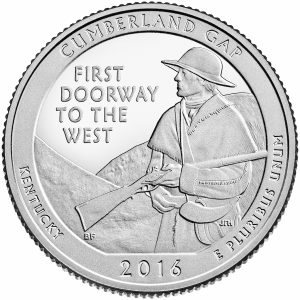
Revere of the 2016 Cumberland Gap Quarter
The artistic error was found by a member of my local coin club who also participates in re-enactments from the Revolutionary War era. Since he is acquainted with the how items from that period look, he told fellow club members about his find.
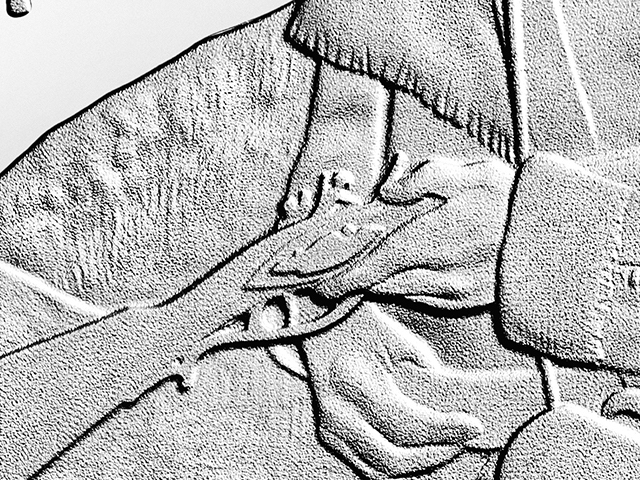
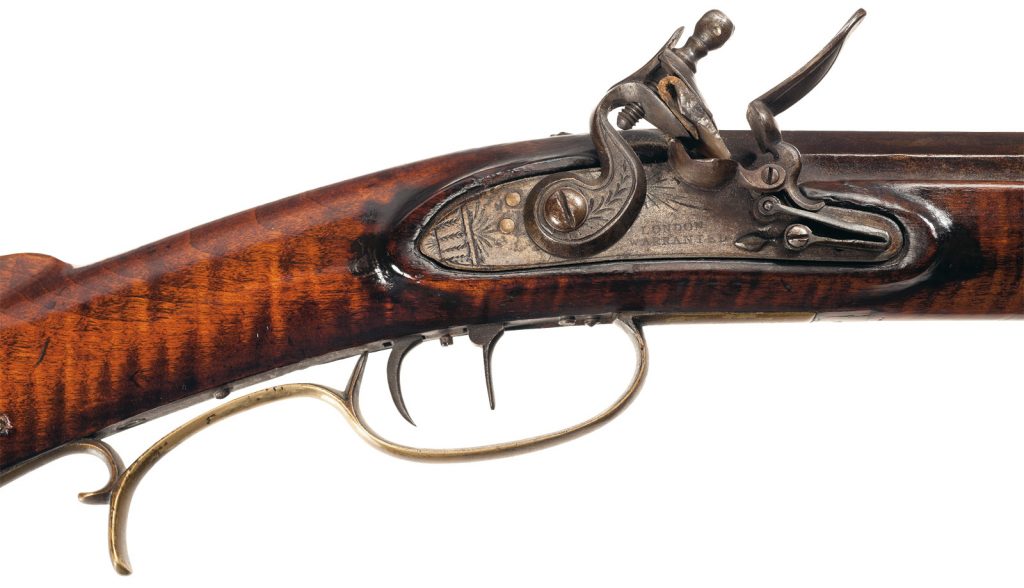
While looking at the quarter celebrating the Cumberland Gap National Historical Park in Kentucky he noticed something was wrong. A careful examination of the gun shows the flintlock is mounted on the wrong side.
During that time, since most people were right-handed or learned to shoot with their right hand on the trigger, the flintlocks were placed on the right side of the stock. Doing so allowed the flash created by striking the flint to be guided away from the shooter. If the flintlock was placed on the left, the flash would fire into the shooter causing injury.
Manufacturing technology was very different prior to the industrial revolution. Parts were either case manually with molds or formed one at a time where speed was important, especially to satisfy a government’s order to arm soldiers. It would be impractical to alter the basic mechanism for the majority of guns made. Left-handed guns were custom projects that only the wealthy could afford. A frontiersman would not be the type with the means to purchase a custom made gun with a left-handed flintlock.
-
-
Closeup on the backwards flintlock on the Cumberland Gap Quarter
-
-
Closeup on the flintlock of an M. Martin Flintlock Kentucky Rifle
Further, look how the frontiersman is holding the gun. He is not cradling the gun with the trigger nearby so that he can fire if necessary. The butt, or stock of the gun is extended forward and the barrel pointed backward. Someone suggested that the perspective on the flat coin may make this look different but think about it, how would you hold the gun if you were standing on a ridge looking westward over an untamed landscape?
Although I did not have the eye or knowledge to pick up on this mistake, surely one of the specialists on the CCAC especially the one appointed to the commission who is a specialist in American history. I do not expect much out of the CFA since their specialties are not really fine arts since the majority of their work deals with the aesthetics of buildings, facades, and fencing around the District of Columbia.
There are 11 members of the CCAC and seven in the CFA and not one of them noticed any problems with this image? If they are allowing historically inaccurate images on United States coinage, then what is their purpose?
Jun 16, 2016 | bullion, coins, Eagles, US Mint, video
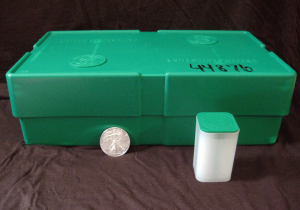
American Silver Eagle Monster Box
Another of my guilty pleasures is How It’s Made on the Science Channel. How It’s Made is simply a show that will demonstrate how every day and other items are manufactured. I am fascinated by seeing the process of manufacturing. Some of the machines that are created to make our everyday items is fascinating. Take something simple as a pencil and think about how a company makes thousands over the course of a day and the non-standard machines required to do this.
The U.S. Mint infrequently posts videos about their coins, people and operations. What I find fascinating is the How It»s Made like videos that shows how they deal with the basic manufacturing process. In the latest video, the U.S. Mint shows how they package American Silver Eagle bullion coins into tubes for shipping to dealer.
The machine is called an Auto Tuber and can be found at the West Point branch mint where bullion coins are struck. After the coins are struck, they are laid flat on trays with the trays being stacked on a rack. From the rack, a machine takes one of the trays, places it next to the Auto Tuber, and pours the coins into the tracks. Using a suction cup fingers, the machine lifts the coins and places them into tube. The tubes are capped, weighed, packaged, inventoried, and sent for shipping.
At the end of the line is a human worker who picks up the packed green boxes you might have seen some dealers advertise for sale as “Monster Boxes” and places them on a pallet for shipping. That is where the one-minute journey ends.
BONUS VIDEO
Similar to the standard production videos is the proof set production video from the U.S. Mint in San Francisco that includes a similar machine that places the coins in the holders.
Credits
- Monster box image courtesy of Wikipedia.
- Videos courtesy of the U.S. Mint.
Jun 12, 2016 | coins, news, shows, video
 Watchers of the @coinsblog Twitter feed have seen that I post storied of robberies of coin collections. These are heart breaking stories not because the owner lost something of value. They lost something of emotional value.
I have seen stories of a stash of mostly Morgan silver dollars that have been stolen from a dresser draw that the owner either has saved all of these years or were from a relative who saved them as part of a hedge from a depression. There was a story that a young single mother found gold coins in her late father’s house and was going to use the coins to care for her children only to have someone she trusted later steal the coins. Then the story of the Flying Eagle and Indian Head cent collection with most coins in almost uncirculated quality including a 1909-S coin put together by a late grandparent that was stolen while the family was on vacation.
While these are heartbreaking, it is great to hear about the community working together to capture a thief.
Two thieves went to the Long Beach Expo looking to cash in on their ill-gotten gain when a dealer thought he recognized the coins as described from an earlier robbery. The dealer notified on-site security who apprehended the criminals. They were handed over the Long Beach police.
It is wonderful that the community will pay attention to these unfortunate incidents and help law enforcement recover these coins!
This is the press release was issued on behalf of Positive Protection, Inc.Positive Protection, Inc. of Temecula, California, and in cooperation with Stack’s Bowers Galleries of Santa Ana, California.
Positive Protection Guard Tackles
Suspected Coin Thief In Long Beach
(Long Beach, California) — A suspected thief was tackled by a Positive Protection, Inc. (
www.ppius.com) security guard as he tried to escape at the Long Beach Coin, Currency, Stamp & Sports Collectible Expo (
www.LongBeachExpo.com) on Friday, June 10, 2016. An alleged accomplice with a backpack containing more than $300,000 of rare coins was also taken into custody.
Both suspects were turned over to Long Beach police on suspicion of burglary, robbery and possession of stolen property. Two other suspects were arrested the next day and more stolen coins were recovered.
“They reportedly were trying to sell coins at the Long Beach Expo in the Long Beach Convention Center. One dealer they approached, Karl Stephens, thought the coins they were offering had been stolen earlier in a robbery in the San Bernardino, California area,” said Patrick Coward, a guard for Positive Protection of Temecula, California, a company that provides security services for coin and jewelry dealers.
“When the suspects tried to leave, the dealer shouted out to stop them. I was nearby and when one suspect started to run I chased him and tackled him at the door. Additional security personnel from the show helped subdue him. The second suspect was stopped without a problem at the door as he tried leave. His backpack was filled with more than 100 ancient coins and other gold and silver coins worth more than $300,000,” explained Coward, a former New York City homicide detective.
The brief chase and the tackle were captured on surveillance video at the booth of Stack’s Bowers Galleries (
www.stacksbowers.com) of Santa Ana, California and New York City.
“With the help of a knowledgeable dealer and the fast action of trained security professionals, two suspected thieves were caught and valuable, stolen rare coins have been recovered,” said Robert Brueggeman, President of Positive Protection which provides on-site security for all the Whitman Expo and American Numismatic Association convention shows. “We always want a safe, enjoyable environment for dealers and the public at these collectible shows, but we also must always be on alert.”
A day after the capture of the two suspects at the coin show, Long Beach Police arrested two more suspects who reportedly came to retrieve the car of the first two suspects. Investigators recovered from the car what is believed to be the remainder of the stolen rare coins.
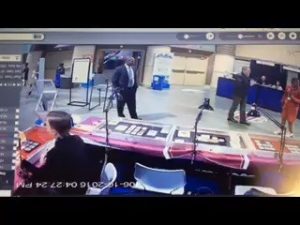
This surveillance video shows Positive Protection, Inc. security guard and former New York City Police homicide detective Patrick Coward on the left as he immediately chased and tackled a suspected coin thief when the suspect tried to flee from a coin show in Long Beach, California on Friday, June 10, 2016. His alleged accomplice is then stopped at the door while carrying a backpack with a reported $300,000 in rare coins believed stolen in an earlier theft in the San Bernardino, California area.
Stacks Bowers Long Beach Surveillance Video
Video courtesy of Stack’s Bowers Galleries.