Apr 18, 2010 | BEP, coins, currency, Federal Reserve, national park quarters, US Mint
In what has the potential to be an exciting week in numismatics, the US Mint and the Bureau of Engraving and Printing will be introducing newly designed money to the public.
 As part of the 2010 National Coin Week, on April 20, the U.S. Mint will launch the America the Beautiful Quarters™ Program with the release of the Hot Springs National Park Quarter. The ceremony will take place on the park’s 178th anniversary in front of the Administration Building at 10 A.M. Central Time (CT). A coin exchange will follow the event. The ceremony will be broadcast live on the web at americathebeautifulquarters.gov beginning at 9:55 A.M. (CT).
The United States Mint will hold a Coin Forum on Monday evening, April 19, at 5 P.M. (CT) at the Quapaw Bath House. The Coin Forum is an opportunity for the public to express their views about future coinage, and to learn about upcoming United States Mint coin programs and initiatives.
As part of the promotion for the launch, the US Mint has released B-Roll with images of the site, design footage showing the computer design of the coin, production footage including creating of the dies, and striking of the quarters.
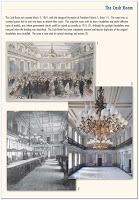 Then, on April 21 in the Treasury Cash Room, the Bureau of Engraving and Printing will unveil a newly designed $100 Note. The U.S. government redesigns currency in order to stay ahead of counterfeiters and protect the public. The BEP has not previewed the new design.
The unveiling of the $100 note is the first step in a global multi-government agency public education program implemented by the Department of the Treasury, the Federal Reserve Board and the U.S. Secret Service, to educate those who use the $100 note about its changes before it begins circulating. The $100 note is the highest value denomination of U.S. currency in general circulation, and it circulates broadly around the world.
Program will begin at 10 A.M. Eastern Time (ET) and will include Secretary of the Treasury Timothy Geithner, Chairman of the Board of Governors of the Federal Reserve System Ben Bernanke, Treasurer of the United States Rosie Rios, Director of the United States Secret Service Mark Sullivan. Education and media materials, including the B-roll, will be available at www.newmoney.gov.
Hot Springs Quarter courtesy of the US Mint
Cash Room images courtesy of the US Department of the Treasury
Apr 4, 2010 | bullion, coins, foreign, Israel
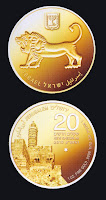 In their last catalog, the Israel Coins and Medals Corporation, the exclusive manufacturer and distributor of coins and medals issued by the Bank of Israel, announced the “Jerusalem of Gold” bullion coin series, an annual series that will depict famous Jerusalem landmarks. The coin will contain one troy ounce of .9999 pure gold and will have a face value of 20 New Sheqalim. There will be a maximum mintage of 3,600 coins.
According to the ICMC catalog, “The coin will bear a roaring lion with a beautiful curved tail, take from a 2,800-year-old ancient seal dating from the 8th century BCE, discovered in archeological digs at Armageddon (Megiddo). The roaring lion is the symbol of Jerusalem and the Kingdom of Judah and it has appeared on Israel circulation coins, the 5 Lira Coin of 1978 and the Half Sheqel Coin of 1980.
“The reverse of the first coin will picture the Tower of David, located near Jaffa Gate in the Old City of Jerusalem. The Tower of David was constructed during the second century BCE and rebuilt in succession by the Christian, Muslim, Mamluk and Ottoman conquerors of Jerusalem. It is a well-known landmark, housing a museum and hosting varied cultural events associated with the history of Jerusalem.”
Coins are schedule to be released on Jerusalem Day, May 12, 2010. The price was not provided in the catalog.
Image courtesy of the Israel Coins and Medals Corp. scanned from their catalog.
Apr 3, 2010 | coins, foreign
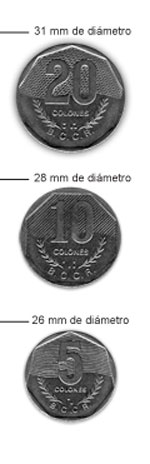
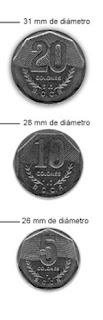 The Central Bank of Costa Rica is in the final stages of recalling all ₡20, ₡10, and ₡5 “platedas” or silver plated coins. Coins can continue to be exchanged only at Central Bank’s office located in downtown San Jos´.
Withdrawal began on December 31, 2009 after the Central Bank announced that it was withdrawing the coins because they could not be distinguished by the blind. New coins will be issued on April 5 will be lighter than the previous coins and include the denomination in Braille Braille.
Reports indicate that merchants have stopped accepting the coins fearing that there would not be enough coins to meet the demand. The Central Bank released a statement assuring the public they had enough coins to meet the demand. Under 20-percent of the estimated 205 million coins in circulation have been turned in.
Withdrawn coins will be sold as scrap metal.
The Central Bank will be issuing new paper notes and other coins later in the year to standardize the size for each denomination. The sizes are expected to help the blind detect the denomination based on the size of the coin or note.
Interestingly, the Bureau of Engraving and Printing had performed a study Visual Impairment Study and Process to Create Meaningful Access to Denominate U.S. Currency. So far, the BEP has not acted on any issues in the report.
Image of platedas courtesy of ticotimes.net.
Mar 12, 2010 | coins, dollar
Normally, I do not make it a practice to post stories that are sent to me but I think I can relate to what this correspondent wrote. Reader Troy Brown wrote:
Remember the Taco Bell $2 bill story? Well today I was reliving it at Wendy’s with a few Kennedy Half Dollars! After a day of searching for 40% & 90% silver halves I took a few to the gas station then a few more to get some lunch. When I tried to pay for lunch at the local Wendy’s with a few half dollars the casher told me that she didn’t know if they could accept the coins. She then went to the other casher who took the halves to the manager. After a few minutes (and after the food was made sitting in front of me) I was told that they could not accept the money. I asked why and the cashier said because her manager said she couldn’t. With the line growing longer I asked, “so with all the starving people in the world you would rather throw away this food and not take the money?” She replied, “it’s not me, it’s my boss”. They then told me, “take the money to the bank and come back”. Really, you want me to spend my money here? I ended up at KFC where they took the money.
Troy wrote that he called Wendy’s corporate offices who said that they will look into the situation.
Today I went to a Subway sandwich shop near where I am working. When I went to pay for my “Five Dollar Foot-Long” I handed the cashier a five dollar bill and a 2010 Native American $1 coin to cover the sales tax. The cashier looked at the coin and I asked if there was a problem. She said that she cannot take foreign money. I showed her where it said “United States of America” and “$1” on the reverse. She was so afraid of taking the coin that I switched my payment to a $20 bill to pay for my lunch. I will not be calling Subway’s corporate offices. I am not sure Jared is interested!
As part of the Presidential $1 Coin Act of 2005 (Pub. Law 109-145 [pdf]) told the US Mint to research how the one-dollar coins could gain more acceptance and for the US Mint to launch an education campaign along with the new coins. Not only is it clear that the education process failed, but the research lead to same conclusion everyone else has made using reason: if you want the one-dollar coin to be more accepted, stop printing the one-dollar Federal Reserve Note. This is why I wish I could take members of congress out to lunch in the real world so they could see the failures of their actions first hand.
Feb 27, 2010 | Canada, coins, fun
After a busy few weeks, it was that time. It was time to put the plan into motion.
I check the flight schedules to find the plane was on time. This was good with all of the bad weather in the northeast.
I checked the flight path. The plane was to fly around the bad weather. Again, this is good because it was going to be on time.
I checked the traffic. I wanted to get to the airport on time without having to fight Washington’s infamous traffic.
Everything in place, it was time to go. I handed a treat to the dogs and off I went.
Driving to the airport went smooth except for one construction zone that was not on the list I checked on line. A quick detour allowed me to bypass the backup and coast into National Airport.
Parking was easy and close to the walkway over the road and passed the entrance for the Metro Blue and Yellow lines. Down the elevator and I found a seat near baggage claim.
After a few moments the reason I went to the airport arrived. Standing by the entrance to the baggage claim area was my mother-in-law, who flew from the frozen northeast to surprise her daughter (my wife) for her up coming birthday. We drove back and after a minor glitch in the plan—my wife was home walking the dogs and not in her office—we managed to complete the surprise!
Although my mother-in-law lives in Maine, the rest of their family is from Canada. I have not met them and have only had short conversations on the phone since I do not speak French and their English is limited, they do know I collect coins. One relative sent two different coins that my mother-in-law gave me tonight.
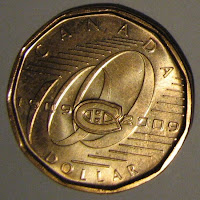 The first is a 2009 Canadian one-dollar coin. Instead of a Loony—the reverse with an image of a common loon—the reverse features a commemorative to the one hundred anniversary of the Montreal Canadiens hockey team. The standard Loonie is an eleven-sided smooth edged coin that is 26.5mm in diameter and made from bronze plated nickel. The 2009 Loonies with the Canadiens Centennial reverse was only circulated in Quebec making it a unique collectible.
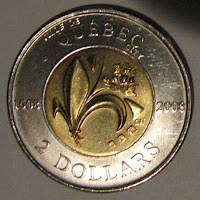 The other coin is a 2008 Canadian two-dollar coin commonly called the Toonie. The Toonie is a 28mm bimetallic coin with an outer ring made from nickel and a brass inner core. Normally, the reverse of the Toonie is a polar bear during the early summer ice flow. This Toonie commemorates the 400th Anniversary of the founding of Quebec City and the first French settlement in North America.
All Canadian coins feature the portrait of Queen Elizabeth II, Queen of Canada.
Surprising my wife and getting two coins for my collections made this a good day.
Feb 15, 2010 | cents, coins, US Mint, video
While the Washington, DC area continued to dig out of Snowmageddon II, US Mint held a ceremony on Friday, February 11, 2010 at the Abraham Lincoln Presidential Library and Museum to introduce the 2010 Lincoln Cent. The new coin features the new shield reverse as being emblematic of the “Preservation of the Union.” The shield is featured in many of the frescos painted by Constantino Brumidi throughout the US capitol. Brumidi was the Artist of the capitol during Abraham Lincoln’s presidency.
The obverse is a slightly modified bust of Lincoln designed by Victor David Brenner that has been used since the first Lincoln cent was released in 1909.
Although the launch of the 2010 Lincoln Cent went on as schedule, the sales and distribution in the Washington, DC area was postponed because of the weather conditions. No announcement was made as to if or when the sale will be rescheduled.
The following video has scenes from the launch in Springfield, Illinois and some B-Roll footage:
Here is the video from the State Journal-Register from Springfield, Illinois:
Feb 10, 2010 | bullion, cents, coins, economy, Federal Reserve, US Mint
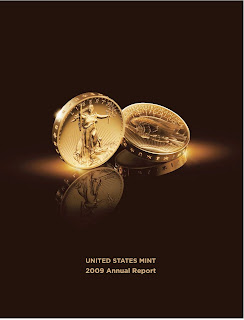 After reading a few stories on how the president’s 2011 federal budget was proposing changes to coin composition. Many of these articles point out how the budget projects that changes could save the US Mint about $150 million per year after making over $777 million in circulating coins (business strikes) in fiscal year 2009. The US Mint’s Fiscal Year 2009 Annual Report says that the US Mint earned over $904 million in seigniorage from all sources.
While everyone is concentrating on the costs of changing coinage metals, there is a missing point: even if the US Mint was able obtain the copper covered zinc planchets for the cent at no cost, the US Mint will lose 0.62-cents per cent struck just for the labor and administrative costs.
In 2009, the US Mint shipped $777 million in circulating coins after shipping over $1.2 billion in 2008. The 40-percent reduction in production also was matched by a 40-percent reduction in the amount the US Mint spent on the metals. In other words, the increase in the costs of metals between 2008 and 2009 was minimal. However, the cost to produce the 40-percent fewer coins cost the US Mint 1.1-percent more in 2009! With presses sitting idle for long periods of time for the first time in many years, the US Mint paid $98.1 million in 2009 for striking few coins and costing $97 million in 2008.
The US Mint documents the costs in the Annual Report as Sales, General & Administrative (SGA). In the Annual Report the reported SGA from 2006 through 2009 has remained stable. Increases have roughly followed the rate of inflation. When looking at the SGA for individual coins, the US Mint spent $65.3 million to sell $459 million one-dollar coins to the Federal Reserve in 2009. In 2008, it cost $52.2 million to sell $475 million one-dollar coins.
The US Mint’s core responsibility is to manufacture the coins required by the Federal Reserve for commerce. In 2009, the seigniorage for business strikes was $427.8 million while making $32.7 million for bullion sales.
The problem is not the cost of the metals. The problem is the inefficiency of operations at the US Mint. “In FY 2009,” the US Mint’s FY2009 Annual Report reads, “the worsening economic environment challenged our ability to maintain efficient manufacturing operations but also presented opportunities for long-term efficiency gains.” Then where are the efficiencies? If the US Mint has an efficient manufacturing process, then why did it cost the US Mint 1.1-percent more in 2009 to producing 40-percent fewer coins than they did in 2008?
If the Obama Administration wants the US Mint to produce more in seigniorage, then the place to start is to immediately replace the political hack that is the current director. A replacement should be someone that has had a manufacturing background working in a regulated environment to lead the US Mint forward.
Feb 2, 2010 | coins, pocket change, US Mint
I finally found a DC quarter in the DC area. I am working on a new project in Alexandria, Virginia and stopped by a local grocery store after work. Before shopping, I stopped by the in-store coffee stand for a warm beverage where I was handed a DC quarter in change. Although I was able to purchase these quarters at the US Mint headquarters building, this is the first one I found in change.
Almost a year after their issue, I am beginning to see 2009 quarters and the Lincoln Bicentennial Cents in circulation. I have yet to find 2009 nickels and dimes in change. With a production of 84.64 million nickels and 146 million dimes are the lowest mintage totals since the 1950s.
The US Mint’s Annual Report says that production of circulating coinage was down 70-percent and it is not anticipated that their primary customer, the Federal Reserve, would increase their purchasing of new coins. It might be more difficult to find 2009 and 2010 coins in pocket change.
Dec 27, 2009 | coins, COTY, foreign
Last week, Krause Publications announced that the voting is open for the 2009 People’s Choice Coin of the Year is now open (login required; free registration). Voting will take place on their numismater.com website and will run through January 10, 2010.
Voters can choose from 20 coins from around the world issued in 2008. Coins were nominated by their respective mints and selected by a panel of experts assembled by Krause Publications. This year’s nominations are:
- Latvia, 1 Lats silver, 90th anniversary of statehood
- Hungary, 5,000 Forint gold, Tokaj wine region
- China, 10 Yuan silver, Panda 1-ounce silver
- Germany, 10 Euro silver, Max Plank
- Perth Mint, 1 ounce silver
- Royal Australian Mint, 1 dollar silver, Kangaroo proof
- United States, 25 cents, Alaska state quarter
- Poland, 20 Zlotych silver, 65th anniversary of Warsaw ghetto uprising
- Belarus, 20 Roubles gold, house warming
- Canada, 25 dollars silver, Vancouver Olympics colorized bobsled
- Lithuania, 100 Litas gold, millennium of name of Lithuania
- Pobjoy Mint, 2 pounds silver, oldest reigning monarch
- Italy, 10 Euro silver, 500th anniversary of the birth of Andrea Palladio
- Austria, 5 Euro silver, 100th birthday of Herbert von Karajan
- Denmark, 20 Kroner gold, Sea stallion from Glendalough
- Japan, 500 Yen nickel-brass, centenary of the Japanese Immigration to Brazil
- Finland, 10 Euro silver, Flag of Finland
- United Kingdorm, 2 pounds gold, London Olympics centenary
- Israel, 10 Sheqalim gold, 60th anniversary of Independence Day
- South Africa, 25 Rand gold, Gandhi
Winners of the People’s Choice Awards, and other Coin of the Year winners, will be announced at the World Money Fair in Berlin, Germany, on January 30, 2010.
Dec 26, 2009 | cents, coins, commemorative, dollar, quarter, US Mint
Around this time last year, I wrote that 2009 would be quite a year. As 2009 comes to an end, I know why I am not a prognosticator. With the down economy, the convergence of so many coin programs, and the performance questions of the US Mint it is difficult to call 2009 a successful year; yet it was not a failure.
Some of the success of this year included the 2009 Ultra High Relief Gold Coin, the District of Columbia and US Territories Quarters, and the Lincoln Bicentennial One Cent program. Although finding the cents and quarters have been difficult to find in change, these new coins had nice designs and was a chance for people to learn about Lincoln’s life and the history of our territories.

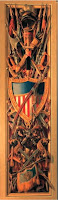 As the Lincoln Cent enters its 101st year of production, it will be given a new reverse. The Union Shield was selected as the symbol of a united country. The shield is featured in many of the frescos painted by Constantino Brumidi throughout the US capitol. Brumidi was the Artist of the capitol during Abraham Lincoln’s presidency. The fresco shown here is one of the eight trophy panel from room S-128 (from the Senate side) of the capitol. It was design by Brumidi and painted by English artist James Leslie.
Starting in 2010, the US Mint will begin the American the Beautiful Quarters Program. It will be a program with 56 quarter-dollar coins featuring designs depicting national parks and other national sites. Although this program might be overkill, the designs show that the program has the promise to show new and interesting designs. The first five quarters for 2010 will honor Hot Springs National Park in Arkansas, Yellowstone National Park in Wyoming, Yosemite National Park in California, Grand Canyon National Park in Arizona, and Mount Hood National Forest in Oregon. It will be interesting to see if this program will catch on.
 In the second year of the Native American $1 Coin program, the theme for the 2010 reverse is “Government–The Great Tree of Peace.” The reverse design features five bound arrows and the Hiawatha Belt. Hiawatha was the helper to the Great Peacemaker who negotiated peace amongst the Seneca, Cayuga, Onondaga, Oneida, and Mohawk tribes in the area now known as New York state. The alliance was known as Haudenosaunee, the Iroquois Confederacy, and is featured on the reverse. The words “Great Law of Peace” is also on the reverse to honor the constitution that created the confederacy. It is a wonderful design that follows up the great design of 2009.
Continuing the Presidential $1 Coins, 2010 will include coins for Presidents Millard Fillmore, Franklin Pierce, James Buchanan, and Abraham Lincoln. We may see an increase of interest in these coins with the introduction of the dollar honoring Lincoln as we pass the (ho-hum) early 19th century presidents.
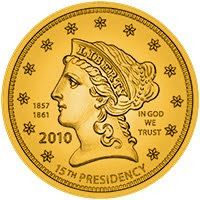 Along with the Presidential dollars will be the First Spouse Gold Coins. Along with the presidents will be gold coins to honor Abigail Fillmore, Jane Pierce, Buchanan’s Liberty, and Mary Todd Lincoln. President James Buchanan was not married. His first spouse coin will be a reproduction of the Liberty Head Quarter Eagle designed by Christian Gobrecht minted and issued from 1840 through 1907. The reverse design depicts the future President as a boy working as a bookkeeper in his family’s small country store design by Artistic Infusion Program Associate Designer David Westwood.
To round out circulating coinage, no changes are in store for the nickel, dime, and half-dollar.
Commemorative coins for 2010 will include the 2010 Boy Scouts of America Centennial Commemorative Coin and the American Veterans Disabled for Life Commemorative Coin. The Boy Scout commemorative celebrates the 100th anniversary of the Boy Scouts of America. The program will produce 350,000 silver dollar coins with the $10 surcharge will be paid to National Boy Scouts of America Foundation who issues grants to local council for the extension of scouting in hard-to-serve areas.
The American Veterans Disabled for Life will also produce 350,000 silver dollars in proof and uncirculated version to honor disabled veterans. The $10 surcharge will be paid to the Disabled Veterans’ LIFE Memorial Foundation to support the construction of the American Veterans Disabled for Life Memorial in Washington, DC.
Considering what happened this year, it will be difficult to predict what will happen to the American Eagle Bullion and American Buffalo 24-Karat Gold coins. Because of how the law is written, American Eagle bullion will be produced but we are not sure whether American Eagle proof coins will join them. I hope the proof coins will be produced in 2010, but with the current Mint administration, we will not know until they announce a commitment to their production.
I hope 2010 sizzles as much as 2009 fizzled!
Fresco image from Constantino Brumidi: Artist of the Capitol.
Coin images courtesy of the US Mint.

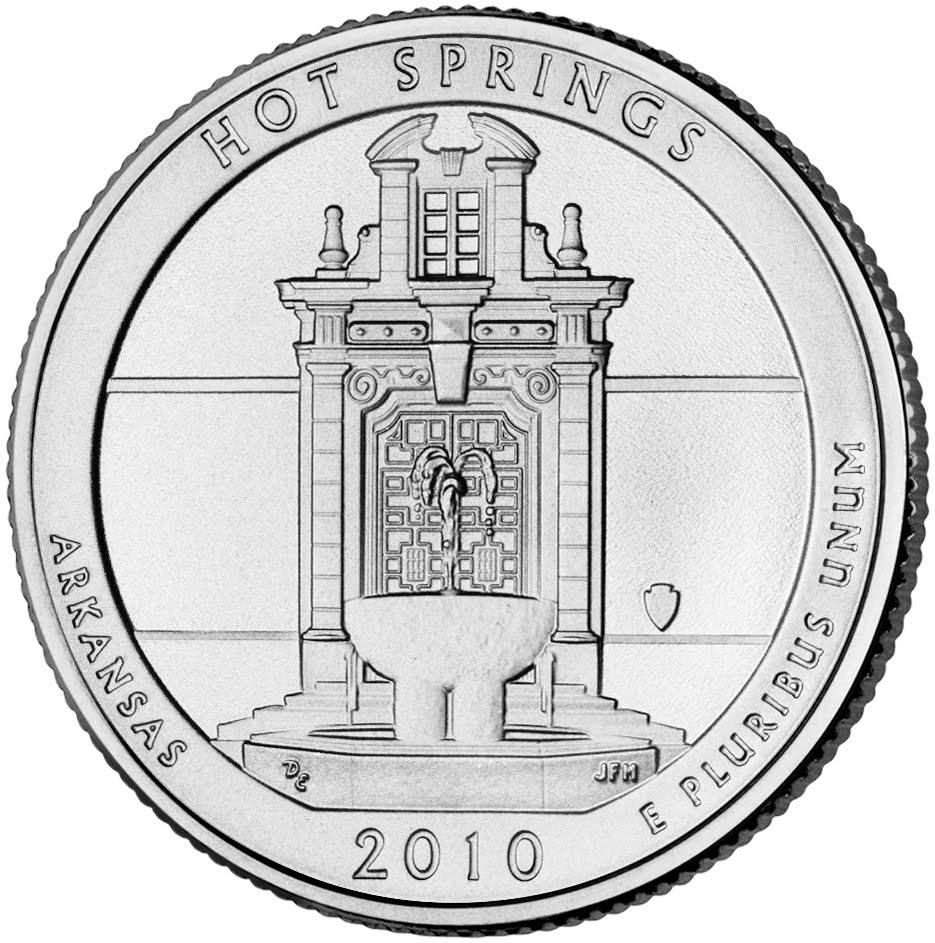 As part of the 2010 National Coin Week, on April 20, the U.S. Mint will launch the America the Beautiful Quarters™ Program with the release of the Hot Springs National Park Quarter. The ceremony will take place on the park’s 178th anniversary in front of the Administration Building at 10 A.M. Central Time (CT). A coin exchange will follow the event. The ceremony will be broadcast live on the web at americathebeautifulquarters.gov beginning at 9:55 A.M. (CT).
 Then, on April 21 in the Treasury Cash Room, the Bureau of Engraving and Printing will unveil a newly designed $100 Note. The U.S. government redesigns currency in order to stay ahead of counterfeiters and protect the public. The BEP has not previewed the new design.


 Loading ...