Nov 6, 2009 | coins, commemorative, policy, US Mint
As part of the restructuring of the US Mint, the area of commemorative coins have to be a significant concern. With both the classic and modern commemoratives, congress could not help itself by using commemorative coins as a form of fundraising for pet causes. While some of the beneficiaries of the funds are worthy, others have caused significant controversy. Additionally, there were commemorative programs that have lost money for the US Mint causing more losses than what has been seen in the cent and nickel.
The first reform in commemorative coinage would be that no commemorative would be struck for the sole purpose of raising money for any organization. Regardless of how worthy the organization may be, the association of the commemorative with fundraising taints the process. Thus, this proposed reform recommends that no commemorative coin may be proposed with the purpose of fundraising.
Once the commemorative coin has been approved, related groups may petition congress to attach their organization to the commemorative for fundraising purposes. If congress approves, the organization will be paid for the profits beyond the cost of manufacturing, packing, and distribution of the coin. The US Mint must be able to recover their costs before any money is distributed to the approved organization. Payments will be made quarterly after the US Mint has broken-even. As part of this plan, the US Mint holds back 5-percent of the dispersal in order cover future expenses. When the sales of the commemorative coins are complete, the US Mint’s costs will be recalculated and the remainder will be paid to the approved organization.
Before choosing an organization for fundraising, the commemorative coin must be selected. Since congress has bungled this over the years, congress should no longer select topics or how the program is to run. As part of the reformed commemorative coin laws, the congress sets parameters for how commemorative programs and leaves the decisions to the Citizens Coinage Advisory Committee. When the CCAC makes their selection, the process will be limited to something of national interest. It may be something relating to history (e.g., War of 1812), the anniversary of a government institution or program, someone of national historical significance, or a building of national importance (e.g., the Capital Building, White House). The commemorative must be something representative of the national interest.
All commemoratives will be proof strikes. There seems to be no purpose to uncirculated commemorative coins nor is there a purpose for clad commemorative. Commemorative programs may contain up to four coins with the priority being $1 silver, $10 gold, half-dollar silver, and $5 gold. In this scenario, if the commemorative program is to only have three coins, then the $5 gold coins would not be used. If the commemorative is used for a fundraiser, the US Mint will add a $5 premium for the half-dollar, $10 premium for the dollar, $25 premium for the $5 gold coin, and the $35 premium for the $10 coin.
Because it may be impossible for the egos in congress to remove themselves from the commemorative process, the law should allow that they be given the ability to vote in one commemorative program per year. As opposed to their current practice, a congressional commemorative program may specify everything except the design and where the coins will be struck. The design will be created by the CCAC and the US Mint engravers to match the theme of the program and the branch mint used to strike the coins will be selected by the US Mint in a manner to make efficient use of the facilities.
As part of the transition, any commemorative program passed by congress prior to the restructuring will be issued as required by the enacted law. However, those commemoratives will count against the one program that congress is allocated per year.
Fixing the commemorative coin program is a combination of making it relevant and removing the fundraising aspect of the programs. With the compromise of allowing congress one commemorative program a year and giving them the ability to add a controlled fundraising aspect after the fact, this should prevent commemorative coins from becoming irrelevant.
The restructuring continues next with the bullion programs.
Nov 5, 2009 | coin design, coins, policy, US Mint
Now that the US Mint has been reorganized, it is time to strengthen the product line. The US Mint’s primary product are the circulating coins that are sold to the Federal Reserve. At this moment, there should be no changes to the required denominations and composition. Although there have been recent issues with the rise in the costs of zinc and nickel that affected the seignorage of the one and five cent coins, the US Mint produces enough coins in other denominations to mitigate those losses. Business calls selling a product at or below it manufacture price is called a loss leader. As long as the US Mint is meeting its obligations to the Federal Reserve, it is not a problem for the US Mint to downgrade the cent and nickel to loss leader status.
Numismatists are most vocal over the design of the coinage and the number of rotating series that drives up the costs to collectors. In order to add sanity to the process, there must be some rules. Thus, under this reorganization, no coin design is to last more than 25 years. The coin design can refer either to the obverse, reverse, or both, but something must be changed. This means the end of the 50 year design pattern given to the Lincoln Cent. Once the new design is settled in 2010, it must be changed by 2035. At that point, the CCAC and the US Mint will decide to redesign the entire coin or, once again, replace the reverse only.
Under this rule, the dime and half-dollar are due for design updates.
This proposal does not change the elements that are required on the coin. As described in 31 U.S.C. §5112(d)(1), “United States coins shall have the inscription ‘In God We Trust’. The obverse side of each coin shall have the inscription ‘Liberty’. The reverse side of each coin shall have the inscriptions ‘United States of America’ and ‘E Pluribus Unum’ and a designation of the value of the coin.” All other rules about design in that paragraph would be eliminated under this plan.
If the US Mint creates circulating commemoratives, there should be no more than two programs in place. One program can be a multi-coin commemorative, like the Presidential $1 Coins, and the other an annual series, such as the Native American $1 Coins. Any more than that becomes too much where the US Mint apparently cannot maintain the levels of manufacturing necessary to satisfy demands for their products. Once the circulating commemorative series is completed, the coin will undergo a final design change for the year after the program’s conclusion and remain that way for 25 years. An exemption to this rule will be to maintain the America the Beautiful Quarters Program as part of the transition.
And no more circulating commemoratives of the same coin. Either have the Presidential $1 Coin or the Native American $1 Coin, not both!
The US Mint will maintain the annual coin programs for all circulating coins. Mint Set will remain coins that have come from business strike production lines and proof coins will continue to use specially treated planchets as they do today. Additionally, the US Mint will continue to produce the Silver Proof Set except that the one-cent coins will be struck in an alloy of 95-percent copper.
Finally, it is time to make the one-dollar coin worth striking. The only way to do this is to stop producing the one-dollar Federal Reserve Note. The United States is the only “First World” country that continues to produce its unit currency in paper form. Even as the $1 FRN continues to be produced, some countries are eliminating more lower denominations to save on costs. It is time for the United States to do the same. In fact, the United States should also eliminate the $2 note.
At the end of the series, there will be an article about the paper currency and the Bureau of Engraving and Printing.
There are relatively few changes necessary for circulating coins. In the next article, we will look at the commemorative coin program.
Nov 3, 2009 | coins, US Mint
The Congress shall have power… To coin money, regulate the value thereof, and of foreign coin, and fix the standard of weights and measures;
Since the ratification of the United States Constitution in 1788, congress has interpreted their Article I, Section 8 right to coin money beyond this sentence. Since the Coinage Act of 1792, congress has been heavily involved in the design of US coinage even to the point of providing exact design details.
In recent years, it appears that congress that too worried about their legacy in US coinage than their legislative legacy. The modern problem began with the success of the 50 State Quarters program. While this was a novel idea that was worth doing, congress has destroyed the novelty by making the start of the 21st century the decade of the rotating design. In this decade, congress approved the Westward Journey Nickels, Presidential Dollar, DC and US Territories Quarters, Native American $1 Coins, Lincoln Bicentennial One Cent, and the America the Beautiful Quarters programs that will begin next year. Making matters worse, the dollar coin programs have mintage requirements that the US Mint has confirmed that there is a surplus of dollars that have not been sold to collectors or the Federal Reserve.
Commemorative coins have had mixed results. What numismatists call classic commemoratives suffered from issue overload where congress authorized commemorative coins to raise money for any pet project. When congress reauthorized commemorative coins for 1982, it appeared that they learned the lessons from past mistakes by limiting the number of programs authorized. That was until congress authorized programs with multiple coin options, like the 1989 Congress Bicentennial, 1991 Mount Rushmore Golden Anniversary, and 1992 XXV Olympiad commemoratives, causing collector fatigue in the market.
After commemorative programs started showing losses, the General Accounting Office (now called the Government Accountability Office) investigated how to fix the commemorative coin program. In GAO report GGD-96-113 [PDF], U.S. Mint: Commemorative Coins Could Be More Profitable, they noted failures in the commemorative coin programs were because of over production, bad choices of subject, and the production of too many commemoratives. Subsequently, congress authorized the 32-coin Atlanta Olympic Commemorative Coin Program that lost money for the US Mint. As a result, congress codified the recommended limits on commemoratives which they have held to ever since.
With complaints coming from many directions, congress has regularly abused its constitutional powers to the point that collectors are threatening to turn away from future US Mint’s offerings. This will hurt the future commemorative market as well as the dollar coin market since collectors are the majority purchasers of these coins.
It is time to reform the coinage laws.
Even though the constitution says that congress has the authority to coin money it does not say that they have to the ability to design money or run the US Mint. Since the Coinage Act of 1792, congress has transferred the operation of the US Mint to the executive branch. But for over 200 years, congress continues to try to run the Mint from the halls of the capital so that whenever congress has asserted itself in the coining process the results have lead to failure. It is time to remove congress from the process. Congress continues to have a role in defining the denominations, metal types, and other specifications (see 31 U.S.C. §5112(a) through (c)), but what goes on the coins, how they are made, and where they are made should be removed from congressional tinkering.
Over the next week, I will look at how to improve the administration of the coining process by breaking the discussion up into four categories: circulating coinage, bullion, commemorative coins, and medals. But first, we must reorganize the US Mint to become a better operating entity. The next article will look at a reorganization proposal.
Oct 13, 2009 | coins, counterfeit
Leaders of the American Numismatic Association, the Industry Council for Tangible Assets, Numismatic Guaranty Corporation, Professional Coin Grading Service, and the Professional Numismatists Guild have issued a joint advisory warning consumers of the millions of dollars spent on fake US coins from China. Counterfeit coins have been sold through online auctions, flea markets, and swap meets.
“Millions of dollars already have been spent on these fakes and potentially
millions more may be unwittingly lost by consumers who mistakenly think they’re
getting a genuine rare coin,” warned Paul Montgomery, PNG President.
The advisory notes that copied and replica coins sold in the United States that are not marked as “COPY” are in violation of the U.S. Hobby Protection Act. However, reports of Chinese fakes that do not include “COPY” stamped somewhere on the coin has been appearing in greater numbers.
The sophistication of Chinese counterfeiters have been documented with pictures showing the use of modern coining equipment and expertly engraved dies that can fool everyone not an expert in counterfeit detection.
One problem with the attempt at enforcement are complications with Chinese Law. While it is illegal to counterfeit Chinese money (Renminbi) the law does not cover foreign money as long as it is not used as a medium of exchange and sold as souvenirs. This allows the counterfeiters to manufacture Morgan and Trade dollars for sale as collectibles but they cannot try to cash them into a local currency exchange to convert them into Renminbi.
The best way to combat Chinese counterfeits is with education. Read the article by Susan Headley and her other articles about Chinese counterfeiters at about.com. You should know about the coin you are buying so you should read the book before buying the coin. If you are buying expensive rare coins, work with a reputable dealer, one who is a member of the organizations that sponsored this advisory.
One resource is the booklet, What You Should Know Before You Buy Rare Coins. To purchase a copy, send $1 to the Professional Numismatists Guild, 3950Concordia Lane, Fallbrook, CA 92028.
Buying certified coins is an answer but there has been cases where the slabs have been counterfeited, too. It is incumbent on the buyer to do your homework before spending money on a coin with questionable authenticity. Remember, if the deal sounds too good to be true, it probably is not true!
Oct 5, 2009 | coin design, coins, national park quarters
Over the weekend, Mike Zielinski of the Mint News Blog posted a slide show of the candidates for the America the Beautiful Quarters program. Starting in 2010, the US Mint will release five quarters per year until 2020 and one quarter in 2021 honoring one National Park or National Historic Site in the 50 states, District of Columbia, and five insular territories.
The first five quarters for 2010 will be as follows:
Mike put together a slide show of the design candidates.
The first thing I notices is that the image of the proposed obverse of the new quarters show a better executed design. George Washington’s hair looks less spaghetti-like and the features are stronger. While I would have preferred to see Teddy Roosevelt on the obverse of this quarter, a better image of our first president is a good consolation.
In looking at the designs, there seems to be an effort by the Mint to come up with meaningful designs than the State Quarters. I am sure that they will not be coming up with dead skulls and cuds for designs.
Regardless of the designs, I continue to not be excited about these quarters.
Sep 29, 2009 | coins, commemorative, history
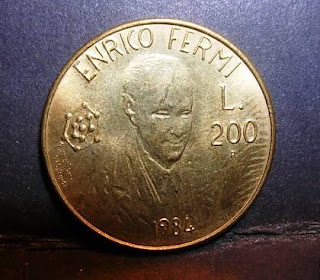 Today, we wish a Happy Birthday to Enrico Fermi. If he was still alive, Fermi would be 108 years old.
Fermi was a Nobel Laureate physicist who is commonly credited with harnessing the nuclear power. Fermi won the Nobel Prize in Physics in 1938 “for his demonstrations of the existence of new radioactive elements produced by neutron irradiation, and for his related discovery of nuclear reactions brought about by slow neutrons” This work made him an important contributor to the Manhattan Project.
Fermi, who is considered one of the premier scientists of the 20th century, was granted 14 patents and was instrumental in the development of nuclear energy. He is called the father of nuclear energy.
In 1984, the Republic of San Marino,the oldest sovereign state and constitutional republic in the world, issued a 200 Lire commemorative coin (KM# 166) honoring Fermi on the 30th anniversary of his death. The coin is made of copper-nickel and is worth about $2.50 as an uncirculated coin.
Happy Birthday, Enrico, and thank you for sharing your work with the world!
Sorry, I forgot where I found the picture to give that person credit.
Sep 28, 2009 | BEP, coins, currency, US Mint
Over the last ten years, US coinage has seen many changes. Starting in 1999, the 50 State Quarters® Program and the DC and US Territories Coin Program has taught us about our country and entertained us with “interesting” designs. The Westward Journey Nickels, Presidential Dollars, and this year’s Lincoln Bicentennial One Cent Redesign have kept us examining our pocket change looking for something new.
US paper currency has also changed. But the changes are not what could be considered earth shattering. Rather than undergo a good design change, I had previously commented that the “[new] currency designs look like the Bureau of Engraving and Printing is dabbling in currency design after being mired using the same basic designs for over sixty years.” With little to no restriction on currency design, the BEP designs have gone from old to bland with no redesign planned for the one dollar bill that was designed in the 1920s!
An article that appeared in The Atlantic found a “image design consultant” who also thinks that the design of the dollar and its paper equivalents need to be upgraded.
Richard Smith, founder of the Dollar ReDe$ign Project thinks that as part of improving the US image, redesign its currency. Noting that a redesign may be looking backwards, Smith noted in an interview that “you need to go backwards to go forward.” (see video below) Without explaining this statement, Smith had to have been referring to the currency of the late 18th and early 19th century that produced phenomenal design.
Smith is approaching this issue from an image perspective. As a numismatist and a collector of Israeli paper currency, I am looking at the issue from a design perspective for making interesting collectibles.
Other countries seem to be able to handle change to their currency. In fact, the emergence of the Euro forced changes throughout Europe. Euro banknotes are printed in a variety of colors and representative designs that are accepted through out the European Union.
Also, the European Union and most other industrial countries does not issue their unit currency in paper. The United States continues to print the one-dollar note which I have written costs the government more to maintain.
Maybe if the numismatic angle is not working with the BEP, maybe the we could try the angle from the image consultant. Anything that could update the US staid currency design.
Sep 20, 2009 | coins, gold, legal, US Mint
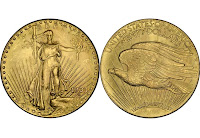 Thanks to an article that appeared in The New York Times, the case of Langbord v. U.S. Mint was back in the news. Apparently, the order [PDF] for the government to turn over the ten 1933 Saint-Gaudens Double Eagle coins to the Langbord family was posted to the website for the US District Court for Eastern Pennsylvania.
In the order, Judge Legrome D. Davis, Jr. agreed with the plaintiff (Langbord family) that the coins were illegally seized and order the government to turn over the coins or initiate a judicial forfeiture procedure by September 28, 2009. There has been no comment issued by the US Mint or the Department of the Treasury. It is expected that the government would file a forfeiture procedure that would have to prove the coins were stolen from the US Mint. Since the alleged crime occurred 75 years ago and none of the principals are still alive, the government has a very high standard to meet.
The 1933 Saint-Gaudens Double Eagle coins has been the source of legends. After the sale of the Farouk-Fenton Coin for $7.59 million in 2002, its story became the inspiration for two books, Illegal Tender and Double Eagle, and inspired legislation to protect older coins and patterns that left the Mint under allegedly nefarious conditions.
But would the addition of ten coins reduce the value of the Farouk-Fenton specimen?
Along with condition and rarity, any special story or provenance of a coin will affect its price. The story and provenance of the Farouk-Fenton specimen is extraordinary. It was the subject of international intrigue including the overthrow of King Farouk of Egypt and the chase by the US Secret Service for the coin that lead to the sting at the Waldorf Astoria Hotel where British coin dealer Stephen Fenton was arrested trying to buy the coin.
Two books, a court case, and a sale by Southeby’s for $6.6 million (plus the 15-percent buyer’s fee making the total $7.59 million) makes it a one-of-a-kind coin.
Even if the Switt-Langbord coins enter the market they may never reach the status of the Farouk-Fenton example. The only factor that could bring down the price of the Farouk-Fenton coin would the be effect of the economy. Otherwise, it will stand alone as the first 1933 Saint-Gaudens Double Eagle that comes with a very unique story.
Image courtesy of the US Mint and NY Times.
Sep 9, 2009 | cents, coins
Henderson, North Carolina is a small town north of Raleigh. Henderson was founded in 1785 by Samuel Reavis, Sr. and named for North Carolina Supreme Court Chief Justice Leonard Henderson. Reavis was a tobacco farmer and the town grew with the tobacco industry in North Carolina. When the Raleigh & Gaston railroad line was completed in 1835, Henderson became a regional trading area for tobacco, cotton, and textiles.
For most travelers today, Henderson is just about the only place to stop along I-85 between the northern most point of the highway in Petersburg, Virginia and Raleigh. Like many travelers, as I made my way north, I checked my car’s gas gauge and levels of personal fluids and made the decision to stop at one of Henderson’s fine service areas.
Following my purchase, I notice that the change handed to me included a few very shiny Lincoln cents. Considering my past experience, I dropped the coins in my pocket and returned to my car. After sitting for a few seconds thinking about the possibilities, I reached into my pocket to check my find. To my amazement I found three Lincoln Log Cabin Cents! All three were from the Philadelphia Mint and looked like they were from recently opened rolls.
This is the second time I found new Lincoln Cents in North Carolina. In fact, it is the only state where I have found 2009 coins! So when I returned to the DC area, I promptly spent the coins to put them in circulation here.
I still have not found any other 2009 coin in change including the DC and Territories Quarters. But I will keep checking.
Jul 25, 2009 | coins, currency, history, video
Regular readers know I have an affection for television shows that are a cross between reality and history. This is why I like to watch The History Channel. On of my favorite shows on The History Channel is Modern Marvels, a show that shows the “secrets”s behind things we find in modern life. From ultimate gadgets to looking at the technology of our past, I find the show fascinating.
Thanks to a posting on the Collectors Society Forums, I found that Modern Marvels was doing a show about money. For fans of the show, The History Channel posted three of the segments on their website.
The first segment, titled “Centralization of Money” give a brief history of money in the United States from the chaos of every bank issuing currency through the basics of how the Federal Reserve interacts with the Bureau of Engraving and Printing and the US Mint.
In the second posted segment titled “Currency” traces its history from the Civil War to how the paper is made. Cameras follow the process through the creation of the cotton from blue jeans by Crane & Company. I like the animation as to how the intaglio printing works.
Finally, “Coin Production” also has a great animation that shows how master dies are used to make striking dies. Then the camera moves to the Mint’s production floor to show how the coins are made.
The History Channel does not allow us to embed their images on our websites. But if you go to the first segment, you can watch the three segments in sequence. I love this stuff!



 Loading ...