Aug 9, 2010 | coins, national park quarters, US Mint, video
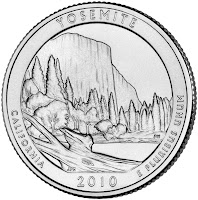 On July 29, 2010, US Mint director Ed Moy introduced the Yosemite National Park Quarter at the park in California. The coin fathers the image of El Capitan, the 3,000-foot vertical rock formation that is prominent formation that looms over Yosemite Valley.
Prior to being discovered by European-Americans in 1833, the Ahwahneechee people inhabited Yosemite Valley. As the gold-rush expanded the non-native population, U.S. troops burned Ahwahneechee villages in 1851, eventually driving them out of the valley. Within a few years, the lack of gold lead to entrepreneurs to use early photographs of the area to turn the area into a tourist destination.
By 1864, the commercial use of the area became a concern. Prominent citizens lobbied congress to pass a bill to declare the area a national park. The bill creating the Yosemite Grand was signed by President Abraham Lincoln on June 30, 1864. Yosemite Grant was managed by the Army until the National Park Service was created in 1916.
A coin exchange and roll sale followed the launch ceremony.
The following video of the launch ceremony was released by the U.S. Mint:
You can find the B-Roll package at NewsInfusion.com.
Coin image courtesy of the U.S. Mint.
Aug 2, 2010 | BEP, coins, currency, Federal Reserve, fun, gold, technology, US Mint
It has been said that the dog days of summer is when it is very hot causing a period where there is a lot of inactivity or stagnation. There has been little of the dog days here in the nation’s capital. Aside from a lot of work to do, severe storms can wreak havoc with electrical lines—which causes computers not to work. July has been an interesting month and I hope August is more like the dog days without the same heat and humidity!
For something a little different we turn to the technology website CNET. CNET is a long time resource for the consumer technology community that was acquired by CBS Interactive last year. With the commitment of growth from CBS, CNET has been expanding their technology coverage in a number of interesting ways. For CNET, reporter Daniel Terdiman, writer of the Geek Gestalt blog, is taking another road trip. Road Trip 2010 brings Daniel to the east coast where he has visited a few sites of numismatic interest.
While in Washington, D.C., Daniel stopped at the Bureau of Engraving and Printing where he was given a tour Behind the scenes with the next-gen $100 bill. Daniel opens up his trip report by saying, “I’m staring at $38.4 million in cash, and it’s hard not to drool.” It is a nice look behind the scenes at the BEP from the eyes of someone who is not a collector. Do not forget to check out the stacks of money in the photo gallery.
After making other stops, Daniel was in Philadelphia and visited the US Mint. Daniel opens his article talking about the gold-colored planchets that will be struck into dollar coins. Aside from watching the minting process, he spoke with the U.S. Mint’s Chief Engraver John Mercanti about the technology used in creating coins. Daniel spoke with Engraver Joseph Menna about the digital production process—do not forget to watch the YouTube video. When you check out the pictures and when you get to picture 18 imagine the amount of money you could make on the error market if you had access to this bin!
Finally, stopping in New York City required a stop of the Federal Reserve Bank of New York. Located at 33 Liberty Street in lower Manhattan, it is the branch of the Federal Reserve that distributes U.S. currency worldwide. Eighty feet below the bedrock that the building is constructed on is the gold vault where 36 countries have deposited $255 billion worth of gold. More gold is stored at the New York Fed than anywhere in the world including the U.S. Bullion Depository at Fort Knox, Kentucky. Since photography is not allowed at the N.Y. Fed, they did provide pictures that Daniel used in his report.
Although Daniel did not get much of a tour through the New York Fed, the series of numismatic-related articles are still a good read from someone without a numismatic background. You may want to check out stories on some of his other stops, including the one place I want to visit!
Jul 17, 2010 | coins, pocket change
I apologize to my readers for the extended silence. It has been an interesting two weeks. Now that it is over, I can go back to searching the numismatic world for interesting stories.
Well… I have not exactly been silent. Those following me on Twitter (@coinsblog) have seen a some stories of interest—other than the flurry of posts from the US Mint’s broken RSS feed. I tweeted about the following articles:
In other personal news, I found two 2009-D dimes in change. Considering where I was, I suspect that the dimes could have arrived in the area from a visitor to celebrate Independence Day. I also found a few S-mint cents from the late 1960s which might have also arrived in the pocket of a visitor.
While making a purchase in the suburbs, I was given a 2002 Canadian quarter and a 1964-D Washington Quarter. It was clear that the cashier did not know what she was giving me, but offered to buy them back. I explained to the cashier the difference between modern quarters and those minted before 1965. As I was leaving, she was going through the draw dropping quarters on the counter listening for that distinctive “ping” of a silver coin.
The next day I was buying supplies for my dogs when the clerk questioned one of the notes I handed for payment. When I looked at the note I noticed it was a Series 1957A Silver Certificate with a blue seal. It was a worn note that I might have received in change but did not pay enough attention to notice. I was asked how much it was worth and I thought it would be about $2 in its condition. Rather than keeping the silver certificate, I sold it to the clerk to $1 who could not believe how cool it was. Before taking the dog’s treats home, I told him where he could buy a sleeve to better save his new find. Who knows… I could have piqued the interest of a new currency collector.
At work we have a finicky soda machine. It will take paper dollars only if smooth and inserted in one direction. Rather than fight the machine, I have been using Presidential Dollar coins purchased by the roll from a local bank. While a coworker was having problems with his note, I traded his note for a coin to find it worked without issue. After doing this a few times, I convinced some to purchase their own rolls of Presidential Dollars. It may not increase the circulation of dollar coins by much, but it is a start!
Jul 7, 2010 | coins, currency, Euro, foreign, gold, RCM, video
Not all coin news comes from the United States. Here are three interesting non-U.S. stories from the last few weeks:
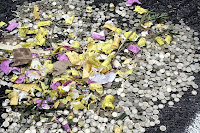 Foggia, Italy—A truck in southern Italy carrying €2 million in one and two euro coins crashed and spilled its load on the highway. Feeling they hit the jackpot, drivers stopped and started to scoop up the coins. On the scene, it was estimated that €10,000 was taken. A later count upped that estimate to €50,000. No arrests were reported.
Driver of the truck and the two cars in the accident were not seriously injured, but they were not the focus of many of the stories. With coins strewn on the roadway and the median, the company responsible for the transport of the coins will be spending the next few days trying to sweep up the coins that motorists did not take.
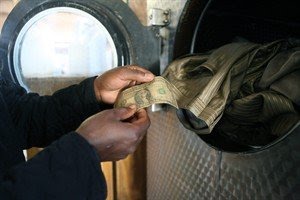
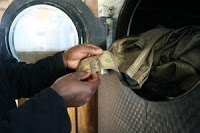 Zimbabwe—In a country where runaway inflation caused their currency to become worthless and the government made U.S. currency legal tender, Zimbabweans are washing their U.S. dollars so that they can be used.
In this poor country, low-denomination U.S notes are used until they fall apart. But in order to protect currency in crime-ridden areas, notes are carried in shoes or underwear. The obvious sanitary and malodorous issues has made it a problem causing banks and many merchants to refuse to take currency that is dirty and smelly. Some people gently hand-wash their notes and some laundry services have discovered that they can wash notes in the gentle cycle then hang the notes to dry.
Apparently this works for the poor in Zimbabwe since the notes outlive the Bureau of Engraving and Printing’s estimated life span of a $1 Federal Reserve Note of 20-months.
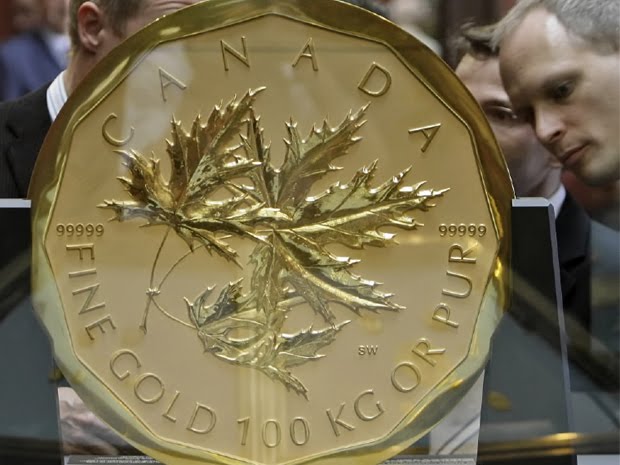
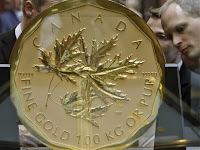 Vienna—Spanish gold dealer Oro Direct S.L.U. bought the world’s largest gold coin at auction for &euro3.27 million (approximately $4.02 million). The 100 kilogram coin with a face value of C$1 million was made by the Royal Canadian Mint in 2007. This coin currently holds the world’s record for being the largest coin ever made.
Gold was trading at $1,253.55 per troy ounce in London at the time of the auction.
“We believe that this is a way to demonstrate our opinion that gold is the ultimate store of wealth,” Oro Direct spokesman Michael Berger was reported as saying. “As long as central banks continue to print enormous amounts of paper money, we believe physical gold will be a fantastic investment.”
The following news video is from Reuters:
About the coin in a video by the Royal Canadian Mint:
Images from Italy and Zimbabwe are courtesy of the AP.
Image of the C$1 Million Maple Leaf courtesy of Reuters.
Jun 11, 2010 | celebration, coins, commemorative
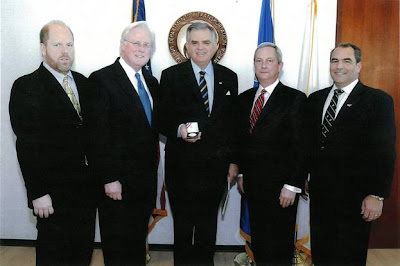
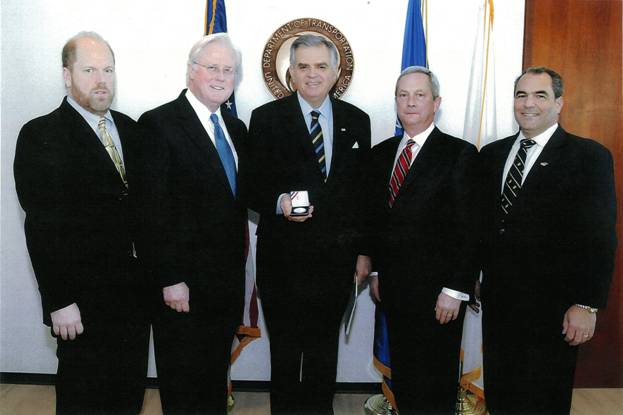
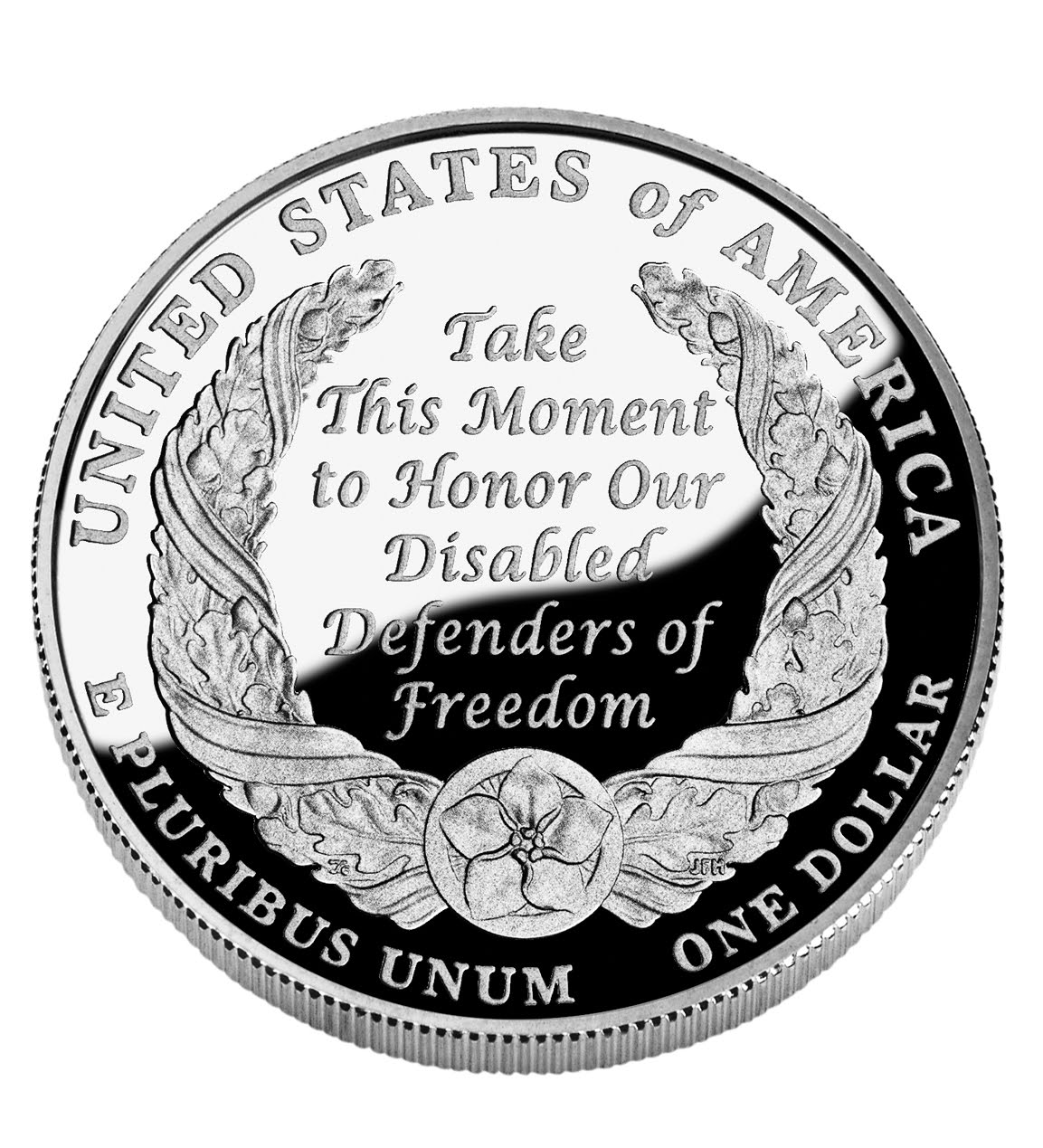
Secretary of Transportation Ray LaHood receives a 2010 American Veterans Disabled for Live Silver Dollar to thank the U.S. Department of Transportation for its support of street and road infrastructure projects surrounding the site of upcoming American Veterans Disabled for Life Memorial in Washington, D.C. The American Veterans Disabled for Life Memorial will be the country’s first national memorial dedicated to living and deceased disabled veterans and is planned for a site within view of the U.S. Capitol. For more information on the Memorial, visit www.avdlm.org. Silver dollars can be ordered from the U.S. Mint with proceeds benefitting the Memorial.
Pictured, left to right (above):
Peter Dickinson, Disabled American Veterans; Ray McGrath, Downey McGrath Group; Secretary Ray LaHood; Barry Owenby, Disabled Veterans LIFE Memorial Foundation; Joseph Violante, Disabled American Veterans.
Jun 4, 2010 | coins
While searching through my change this evening, I found two 2010 Roosevelt dimes! Considering I have yet to find 2009 nickels or dimes in pocket change, finding a 2010 dime in June of 2010 is very interesting. Could this be the economy turning around or a case of last-in/first-out from the Federal Reserve money rooms with the 2009 coins buried in the back of the room?
Jun 3, 2010 | coins, national park quarters, US Mint, video
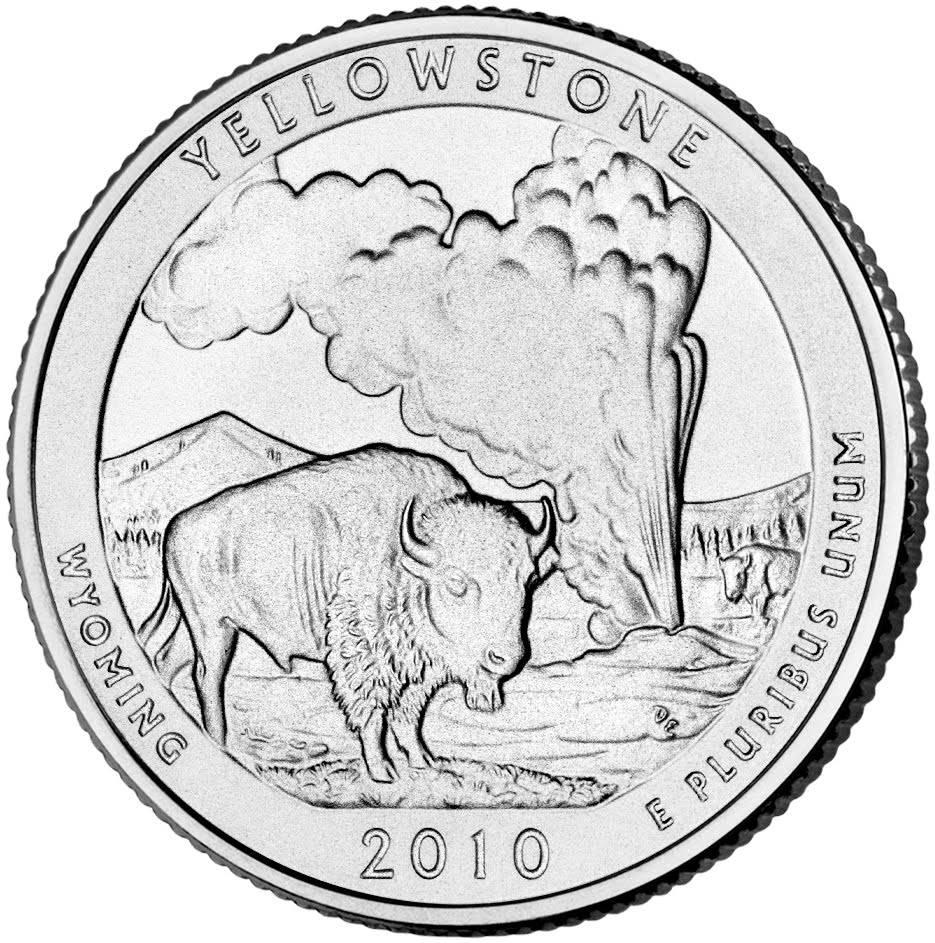
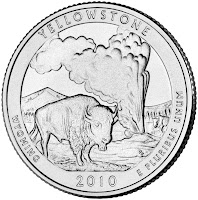 While the U.S. Mint fights trademark issues over the name of their program, Director and professional politician Ed Moy travelled to Yellowstone National Park in Wyoming today to launch the Yellowstone National Park Quarter. Moy was joined by Suzanne Lewis, Superintendent of Yellowstone National Park.
Yellowstone National Park was established by an act of congress on March 1, 1872. Its 2.2 million acres is home to grizzly bears, elk, wolves, and bison. Along with the Old Faithful Geyser are a collection of an extraordinary group of geysers that do not receive the same press as Old Faithful.
The reverse of the coin features Old Faithful Geyser and a bison, both excellent representatives of the nation’s second National Park.
Here is the B-roll video from the U.S. Mint and the launch ceremony:
Quarter image Courtesy of the U.S. Mint
May 24, 2010 | coins, rareties
Last week, a 1794 Flowing Hair Silver Dollar that may be the oldest known silver dollar was sold for a record $7.85 million! Steven L. Contursi of Rare Coin Wholesalers of Irvine, California sold the coin to Cardinal Collection Educational Foundation of Sunnyvale, California in a private sale.
The coin was graded by Professional Coin Grading Service as Specimen 66 (SP66).
The sale surpasses the $7.59 million paid (including buyer’s premium) in 2002 for the legendary Farouk-Fenton 1933 Double Eagle.
As an interesting aside, the Farouk-Fenton would be worth $9,197,822 accounting for inflation between 2002 and 2010. Of course the coin could sell for more if it should come up for sale again. However, the existance of the ten Langbord-Switt 1933 Double Eagles could change the perception of value for all of the 1933 Double Eagles.
May 22, 2010 | coins, economy, Euro
You might have noticed that a European debt crisis has caused the markets to panic where some have been saying there is no relief in sight. It started wit the economy of Greece needing its own bailout while it is questioned as to whether they can pay the money back. The the news that Portugal, Spain, and possibly Ireland may follow. As a result, the Euro is at a 4-year low against the dollar and dropping.
Aside from the economic impact, there has been questions about the viability of the European Union as an economic entity and its ability to act as a central bank in the best interests of the sovereign members of the Euro zone. Countries can no longer manipulated their currencies or manufactured more money to maintain solvency. They now have to follow the rules of the European Central Bank in order to maintain “fairness” within the Euro zone.
What would happen if these countries did not want to be beholden to the European Central Bank? Countries would have to break from the bank and issue its own currency. There has even been speculation as to the current value of the former EU currencies if they were still in circulation.
For numismatists it would add new collectibles to the market. Countries that would re-issue its own currencies would likely demonetize the Euro and force locals to trade in their Euro coins and notes for the re-issued currency. This would make the reverse designs that are country specific instantly collectible as well as the new Drachma, Escudo, Pesta, Franc, Lira, or Deutsche Mark that would be issued in its place.
Maybe Great Britain was right for not converting to the Euro. But for now, their newly issued circulating coinage is arguably the most interesting in the Euro zone. Maybe another country will join them an open new areas of collectibles.
May 21, 2010 | coins
It did not take as long to find a 2010 coin in pocket change this year as it did to find a 2009 coin last year. After going to my favorite coffee place, I noticed a very bright Lincoln Cent amongst the change. When I put my cup down to add a little non-fat milk, I reached into my pocket and found it was one of the new sheild cents. With the exception of the fingerprint on the obverse (it could be mine), the coin looks like it just came from the U.S. Mint.
As we progress further into 2010, I am seeing a lot of 2009 coins, particularly the 2009 Lincoln Bicentennial Cents and the District of Columbia and U.S. Territories quarters.
I have yet to find 2009 nickels and dimes.

 On July 29, 2010, US Mint director Ed Moy introduced the Yosemite National Park Quarter at the park in California. The coin fathers the image of El Capitan, the 3,000-foot vertical rock formation that is prominent formation that looms over Yosemite Valley.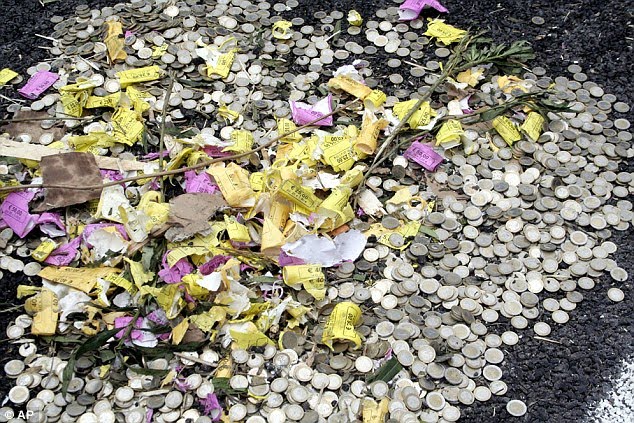


 Loading ...