
Weekly World Numismatic News for September 27, 2020
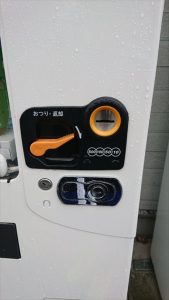
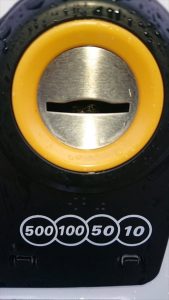
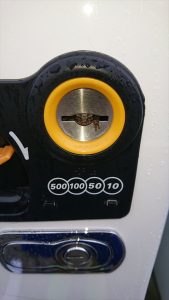
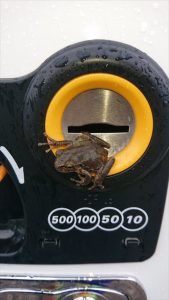
This week’s fun story comes from Japan, where coin-operated machines sell everything from candy to bitcoin. A user of a coin-op machine in Japan found that the coin slot was looking back at him.
The eyes looking back were of a tiny frog that is common in the countrysides of Japan. The frogs are so small that they seem to find their way into interesting places. It is unusual to find one of these frogs in a vending machine, especially in the cities.
According to the story, the vending machine user posted his adventure on Twitter. He tried to use small change to coax the frog out of the machine. Eventually, the coin’s weight caused the frog to seek an escape and jumped out of the coin slot.
As the Twitter user (@potetodaze1129p) wrote, “When you look into the abyss, sometimes the abyss looks back at you.”
If you want to read an interview describing the reaction from @potetodaze1129p, you can find the story here (in Japanese) or translated into English here.
And now the news…
 September 23, 2020
 → Read more at sturgisjournal.com
September 23, 2020 → Read more at marieclaire.co.uk
→ Read more at sturgisjournal.com
September 23, 2020 → Read more at marieclaire.co.uk

Rolling the Numismatic Waves in Tidewater
Greetings from somewhere over the southeastern United States as I fly to Dallas-Fort Worth on my way to the American Numismatic Association Headquarters in Colorado Springs for a meeting with the Technical Committee. What better way to celebrate technology than pulling out the iPad and writing a blog entry. Of course this will be posted after I land and can connect to the Internet.
Being on my way to the ANA brings to mind this past weekend’s coin show by the Tidewater Coin Club at the Tidewater Convention Center in Virginia Beach. After waking early, I climbed into the X3 and headed fours hours south to check out another club’s show. Although I anticipated coffee stops I was not prepared for the Sunday construction I found along the way. Although the drive took longer than expected, I arrived with plenty of time to browse and schmooze.
When I arrived at the convention center I found it full with two other events being held along with the coin show. The Tidewater Convention Center is a modern facility that would rival that in any medium size city and is a nice representative of the Virginia Beach-Tidewater region.
The coins how was held in a large meeting room upstairs, so I passed the two shows to the escalator going up. When I arrived at the greeting table I was met by members of the Tidewater Coin Club. The three gentlemen at the table were pleasant and engaging. The handed me a door prize ticket and I purchased tickets for the gold raffle—a quarter-ounce and tenth-ounce American Eagle gold coins. I do not think I won since I did not receive a call asking how they can send me the gold coin.
Once inside I was delighted and surprised. Delighted in that all of the tables were occupied and there were a number of people browsing the various offerings. I was surprised in the number of dealers that I have seen in the various shows around the Washington, DC area. At least a third of the dealers attended the Alexandria Coin Club show three weeks ago. The is nothing wrong with seeing the same people, they are all fun people with good inventory, but it would have been nice to meet new people.
As I made the rounds I looked at their various offerings and spoke to the dealers. I did buy but I was able to get in a little campaigning in between purchases.
My purchases from this show may be considered mundane but is significant in that they were all geared to putting together the One Page Cent type collection I wrote about last week. Even aft verifying prices with online price guides, I wanted to verify that it could be done. In the process. I was able to find a nice 1858 small letter Flying Eagle cent for $30, a 1859 copper-nickel Indian Head cent, a 1902 Indian head cent in red-brow, and a 1909 VDB cent all under $20 each. I was able to add a nice 1944 shotgun shell cent, 1959 blazing red Memorial cent, and the 7-coin 1982 copper and copper-player zinc set for less than $10 for all of the coins. With the four Lincoln birth bicentennial cents I already have, I was able to progress far into this collection.
I will finish this collection by the Whitman Baltimore Show in March and start on the next typeset. I am already working on a plan for a cent to represent 2, 3, and 5 cents coins on one page. As part of this effort, I will be turning my experience into a Money Talks program for the next National Money Show this May in New Orleans.
After making two passes around the floor, I found the president of the Tidewater Coin Club, introduced myself, and complemented him on a good show. He seemed a little overwhelmed since this was his first show as the club’s new president, but he seemed to be the type that could get things done. If my experience at their show is any indication, he will have a successful term as their president.
Before leaving the show area, I stopped to look at the nearby exhibits by club members. One that really is interested me was one about nickel typesets. Rather than being an extensive collection of copper-nickel composition five-cent pieces, it was a nice representative of various type coins with an index card for each coin explaining why each are part of the set. It would not win an ANA exhibit award, but it was very interesting and was really great to see.
We are getting ready to land. I will end here about the Tidewater Coin Club Show.
For the next few days, watch the @coinsblog Twitter feed and my Pinterest site for pictures and news from the ANA headquarters in Colorado Springs.
POLL: How can the ANA use technology to help you?
 By the time this is posted, I should be on a plane headed to the American Numismatic Association headquarters in Colorado Springs. This will be my first time visiting the ANA Headquarters and Colorado Springs. I hope it is not my last!
The reason for my visit is part of my role with the ad hoc Technology Committee to speak with a potential vendor who can offer services to the ANA to improve their technology infrastructure. With my background in building complex systems and information security, I hope to help the ANA create an environment that will use technology to better serve the members and the clubs. I admit there are some that will not embrace technology, but it will give the ANA an entree into a untapped population of collectors.
Technology is not the solution but the tool to use to bring the fun of coin collecting to more people than the 28,000 members of the ANA and hopefully make them members.
For this week’s poll, let’s imagine that the ANA has the technology to handle just about anything. What services would you like to see delivered by the ANA to help you or your club? The poll has nine suggestions plus an “other.” Pick your top three ideas. If you pick “other” then leave a comment here and let me know. In fact, I realize that the poll seems collector centric, so let me hear from dealers. I do not want to leave you out, especially since the collectors need you to help feed our collecting habits!
Comments are moderated only to prevent comment spam. All comments not deemed to be spam are approved regardless of your views—I especially like comments that disagree with me. If you do not want to give your name, then enter a handle or “anonymous.” Although the comment form asks for an email address, it will not be posted but will allow me to contact you if I have questions.
Let me hear from you and let’s work together to bring more the ANA to build a collector community.
What top 3 online services would you like to see the ANA offer?
Total Voters: 14
 Loading ...
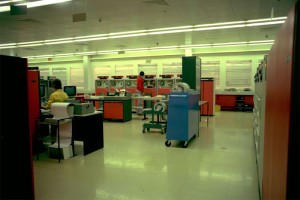
I chose the the image of the IBM 370/158 because it was the first computer I “mastered” in college. We have come a long way since then!
Something trivial for a Saturday
Did you ever have one of those weeks where something as mundane as a viral YouTube video catches your attention for longer than it should have? If not, then spend a few moments or waste a little Saturday time to watch this video. Don’t watch the whole video because it’s over an hour long. But it is hypnotic and caught my interest for 10 minutes.
Without further ado, here is Coin rolling on a treadmill:
Now that was a change. (ouch!)
One Page Collection: The Cent
Someone who may be interested in collecting coins may look at the options and think that they are too daunting. Guide books talk about series of dates, mint marks, and varieties. Type books talk about every representative type, even ones that are not affordable to the average collector. Then the folder and album publishers give their interpretation of what a type collection should look like. What the novice to average collector is left with is confusion.
Collecting coins, specifically United States coins does not have to be daunting. You can put together sets of your own design that represents any time or any period. What is great is that once you define your goals, you can have the fun in putting the set together and showing it off to friends and relatives. It is also something that you can develop your own story and include it in your own album.
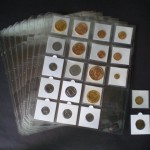
Supersafe 20 Coin Pocket Page for 2×2 holders
An alternative to the pocket page are Gardmaster Coin Albums. Gardmaster is made by Collector’s Supply House of Paris, Ontario in Canada. Their albums are based on a slide system where the coins are placed into pockets of a strip and the strip is slid into the page keeping the coin in place without the need for an extra holder. The albums are a smaller size with a “Snappy” binder to remove, mix, and match pages. I discovered these albums while putting together a collection of Canadian coins. I then adapted a blank 16-pocket version to create a year set for large cents. You can do an Internet search to find a dealer who sells Gardmaster albums.
For these articles, I will stick with creating a collection using the 20-coin pocket page.
As a general rule, the coins in this collection must gradable at Fine or better and cost under $100. When I create a set of half-dollars and dollars, the limit will have to be raised because of the silver values and the rarity of earlier coins.
Since these are 20-coin sets, many die varieties are ignored to a certain degree. However, design and composition changes are always significant.
The first set I will create are the copper coins. Cents and half-cents were specified in the Coinage Act of 1792 that authorized the creation of the U.S. Mint. Under the new law, the half-cent and its larger cousin the one-cent coin was struck in pure copper from 1793 through 1857.
The first half-cent struck in 1793 weighed 6.74 grams and was 22 mm in diameter. Subsequently, the half-cent weighed 5.44 grams and its diameter varied between 22 mm and 22½ mm.
The 1793 large cent had two designs, the controversial chain reverse which was then changed to a wreath weighed 13.48 grams and varied between 26-28 mm in diameter. In the 19th century, the large cent weighed 10.89 grams and its diameter varied between 27 and 27½ mm.
Consistency in the size of both coins would not be achieved until the introduction of steam-based coining equipment starting in 1836.
Large copper coins were eliminated by the Coinage Act of 1857. Signed into law by President Franklin Pierce February 21, 1857, this act repealed the legal tender status for foreign coins in the United States. It required the Treasury to exchange foreign coins at a market rate set by Treasury. This act discontinued the half-cent and reduced the size of the one-cent coin from 27mm (large cent) to the modern size of 19.05mm (small cent) that is still being used today.
First small cent was the Flying Eagle cent designed by James B. Longacre. The eagle was based on a design Christian Gobrecht used on the reverse of the Seated Liberty dollars. The Flying Eagle cent was a short lived series because of its difficulty to strike properly.
After having problems with the Flying Eagle cent, Longacre designed the Indian Head cent—which is not the image of an Indian but a representation of Libery wearing an Indian-style headdress.
Rounding out our copper collection is the Lincoln cent. Introduced as part of President Theodore Roosevelt’s “pet crime,” the Victor D. Brenner designed coin has been around over 100 years with a periodic change in reverses including the new Shield reverse that began in 2010, 101 years after the coin’s debut with the wheat stalks on the reverse.
Looking at over 230 years of copper coinage there is a lot to choose from to try to make a representative set. The following is what I came up with:
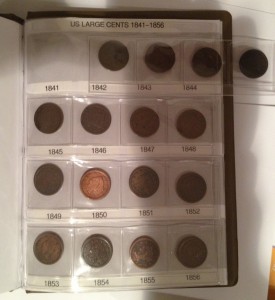
A page of Scott’s Large cent collection in a Gardmaster album
Another idea is to use the Gardmaster album, buy two 16-coin pages, and expand your collection. As you look through the types, you may want to start with my “Manageable Lincoln Cent Collection” for an idea on expanding your Lincoln cent typeset. From there, you can adapt those concepts to the other cent series.
Showgard pocket pages image courtesy of Vidiforms/Showgard.
POLL: Should the U.S. Stop Producing the One-Cent Coin

Source: Uploaded by user via CoinsBlog on Pinterest
With Canada now withdrawing their one-cent coin from circulation and the Great Britain debating whether they should stop producing their penny, some are looking to the United States to figure out a direction. In fact, a line buried in an article whose link was lost in the digital surf noted that the European Union will keep its 1- and 2-eurocent coins while waiting to see what the United States and Great Britain does.
There are good arguments on both sides ranging from the coin is too expensive to make to the argument that rounding creates a regressive tax on those who pay using cash. These coins are annoying or they provide equality with those paying cash versus those paying with credit.
An alternative would be to change the composition of the coin. Various new metals can make the coin profitable again and keeping the coin in production. Even keeping the costs at par would be better than the negative seigniorage the U.S. Mint generates today.
What do you think?
Should the United State stop producing the one-cent coin?
Total Voters: 91
Loading ...Image is The King of Errors: 1955 Double-Die Obverse that was graded AU-58BN by NGC proudly owned by the author.
Support the Coin Collectors Blog
 Buy me a coffee
Thank you for your support!
Let Me Know What You Think
Are you going to the World's Fair of Money
Total Voters: 17
Loading ...