
Desktop Treasure Hunt Leads to a Walk Down Memory Lane
 I am sure I am not the only one whose desk looks like it could be declared a disaster. My desk is so bad that during a recent recon mission, I found books about information security. It has been over three years since I retired from that industry.
A side effect of the mess is while digging under the piles, I can find coins and collectibles I forgot I had. It’s a make-my-own treasure hunt.
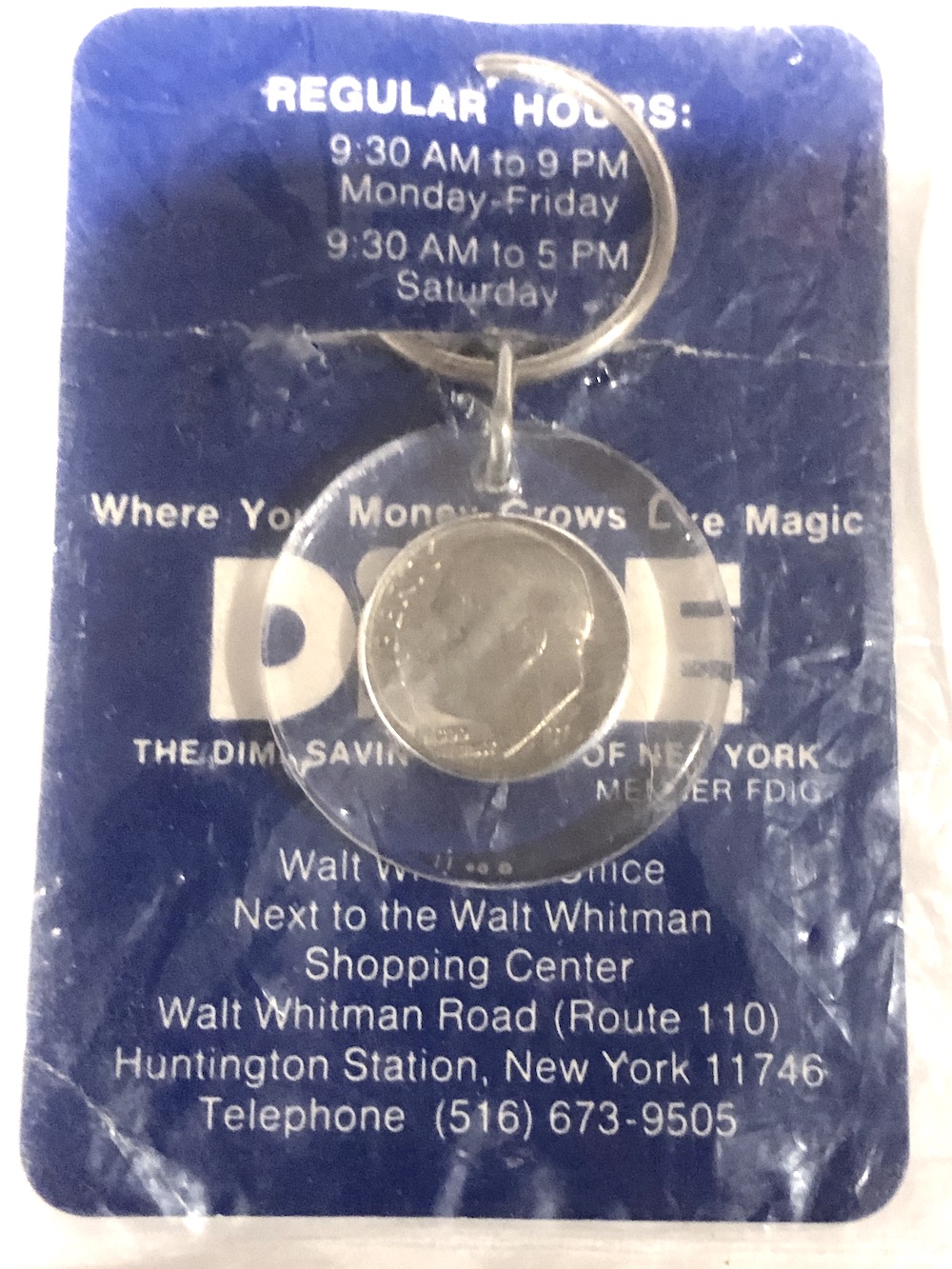
The picture to the right is a recent find. It was a giveaway from the Dime Savings Bank from a branch in Huntington Station, Long Island. It is a 1972 Roosevelt Dime encased in clear plastic attached to a keyring. The encased dime is attached to a card and wrapped in the original plastic.
I found this coin in the 1990s during a trip to Long Island. It was likely purchased from an estate sale not too far from the branch. It must have fallen out of a nearby box that holds my New York numismatic collection. It’s the box that I have been thinking about organizing for years.
Finding it brings back memories.
As a right of passage for Baby Boomers born in Brooklyn, our parents helped us open passbook savings account at the Dime Savings Bank. Founded in the Williamsburg section of Brooklyn, the Dime was as part of life as stickball. Even after moving to Long Island, we kept our accounts with Dime.
If you are too young to know about passbook savings, it was a savings account where your account activity was recorded in a passbook that resembled a passport. When you deposited or withdrew money, you handed the teller your passbook. The teller would put the book in a machine that would print the transaction on the pages. Every three months, an extra entry would be added for the interest payment. Before I understood the concept of savings account interest, I thought the bank was giving me free money.
I would deposit parts of my allowance and the payment for odd jobs around the neighborhood. When I was old enough, I started to deliver Newsday after school when it was an afternoon newspaper. When the deposits passed $100 in savings, I thought that I was rich.
Every week, I would knock on the doors where I delivered the paper to collect money for the newspaper. One day, someone paid for their delivery by including ten copper coins that I did not recognize. I showed them to my father, who told me they were Indian Head cents.
I did not know these coins existed. So I dumped the coins in my pocket on the floor and started to sort through them. I started to separate the coins by type and date, laying them across the floor. My mother did not like my collecting style, so my father bought my first Lincoln cent folder and a Red Book. I still own my first blue folders.
The deposits began to change. I no longer deposited the coins. I was too fascinated with them to let them go. Slowly I began to build a collection out of pocket change while the currency was deposited in the bank. I also accumulated more blue folders.
Then my father did something that changed everything. He took me to a coin store. Suddenly, the Roosevelt dime collection was nearing completion. The blue folder for the dimes was replaced by a blue deluxe album. I was addicted!
The deposits also began to reduce. Somewhat similar to today but on a different scale!
Passbook savings programs are a relic of the past. The Dime Savings Bank is now called the Dime Community Bank. And I got to relive this memory because I found a one-time giveaway buried under a pile on my desk.

Numismatics Is More Than Coins
Although the dominant area of numismatics is the collection and study of legal tender coins, numismatics is more than just coins. Numismatic is the collecting and study of items used in the exchange for goods, resolve debts, and objects used to represent something of monetary value. This opens up numismatic collecting to a wide range of items and topics that could make “the hunt” to put together the collection as much fun as having the collection.
Exonumia
Exonumia is the study and collection of tokens, medals, or other coin-like objects that are not considered legal tender. Exonumia opens numismatics to a wide variety of topics that could not be satisfied by collecting coins alone. An example of exonumia is the collection of transportation tokens. You may be familiar with transportation tokens from your local bus or subway company who used to sell tokens to place into fare boxes. Others may have used tokens to more easily pay in the express lanes at bridges and tunnels. A person who collects transportation tokens is called a Vecturist. For more information on being a Vecturist, visit the website for the American Vecturist Association.
Token collecting can be the ultimate local numismatic collection. Aside from transportation tokens, some states and localities issued tax tokens in order to collect fractions of a cent in sales taxes to allow those trying to get by in during down economic times to stretch their money further. Some communities issued trade tokens that allowed those who used them to use them as cash at selected merchants. Some merchants issued trade tokens that were an early form of coupons that were traded as coupons are traded today.
While tokens are items used to represent monetary value, medals are used to honor, commemorate, or advertize. The U.S. Mint produces medals that honor people, presidents, and events. Medals produced by the U.S. Mint are those authorized by law as a national commemoration including the medal remembering the attacks of 9/11.
Commemorative medals are not limited to those produced by the U.S. Mint. State and local governments have also authorized the producing medals on their behalf that were produced by private mints. Many organizations also have created medals honoring members or people that have influenced the organization. Companies have produced medals to honor their place in the community or something about the company and their community.
Many medals have designs that can be more beautiful than on coins since they are not limited to governmental mandated details and their smaller production runs allows for more details to be added. Medals can be larger and thicker than coins and made in a higher relief than something that could be manufactured by a government mint.
Exonumia collecting also involves elongated and encased coins. You may have seen the machines in many areas where you pay 50-cents, give it one of your cents, turn the wheel and the cent comes out elongated with a pattern pressed into the coin. Elongated coins have been used as advertisements, calling cards, and as a souvenir.
Encased coins are coin encircled with a ring that has mostly been used as an advertisement. One side will call the coin a lucky coin or provide sage advice with the other side advertising a business. Another form of encased coins are encased stamps. Encased stamps were popular in the second half of the 19th century and used for trade during times when there were coin shortages.
Other exonumia includes badges, counter stamped coins, wooden money, credit cards, and casino tokens. Counter stamped coins are coins that have been circulated in foreign markets that were used in payment for goods. When the coin was accepted in the foreign market, the merchant would examine the coin and impress a counter stamp on the coin proclaiming the coin to be genuine based on their examination. Although coins were counter stamped in many areas of the world, it was prevalent in China where the coins were stamped with the Chinese characters representing the person who examined the coin. These Chinese symbols are commonly referred to as “chop marks.”
One type of counter stamped coins are stickered coins. Stickered coins were popular in the first half of the 20th century; they were used as an advertisement. Merchants would purchase stickers and apply them to their change so that as the coins circulated, the advertising would reach more people. Some stickered coins acted as a coupon to entice the holder to bring the coin into the shop and buy the merchandise.
Remember the saying, “Don’t take any wooden nickels?” If you are a wooden money collector, you want to find the wooden nickels and other wooden denominations. Wooden nickels found popularity in the 1930s as a currency replacement to offer money off for purchases or as advertisement. Wooden nickels are still being produced today mostly as an advertising mechanism.
We cannot end the discussion of exonumia without mentioning Love Tokens and Hobo Nickels. Love Tokens became popular in the late 19th century when someone, usually a man, would carve one side of a coin, turn it into a charm for a bracelet or necklace, and give it to his loved one. The designed are as varied as the artists who created them. Hobo Nickels are similar in that hobo artists would carve a design into a Buffalo Nickel to sell them as souvenirs. While there are contemporary Love Tokens and Hobo Nickels, collectors have an affection for the classic design that shows the emotion of the period.
Currency collecting, formally called notaphily, is the study and collection of banknotes or legally authorized paper money. Notes can be collected by topic, date or time period, country, paper type, serial number, and even replacement or Star Notes (specific to the United States). Some consider collecting checks part of notaphily. Collectors of older cancelled checks are usually interested in collecting them based on the issuing bank, time period, and the signature. For the history of currency and their collecting possibilities, see my previous article, “History of Currency and Collecting”.
Scripophily is the study and collection of stock and bond certificates. This is an interesting subset of numismatics because of the wide variety of items to collect. You can collect in the category of common stock, preferred stock, warrants, cumulative preferred stocks, bonds, zero-coupon bonds, and long term bonds. Scripophily can be collected by industry (telecom, automobile, aviation, etc.); autographs of the officers; or the type of vignettes that appear on the bonds.
Militaria: Honorable Collectibles
Collecting of military-related items may be considered part of exonumia but deserves its own mention. It is popular to collect military medals and awards given to members since the medals themselves are works of art. Families will save medals awarded to relatives and even create museum-like displays to honor or memorialize the loved one.
Militaria includes numismatic-related items that represent the various services. One of the growing areas of collectibles is Challenge Coins. A challenge coin is a small medal, usually no larger than 2-inches in diameter, with the insignia or emblem of the organization. Two-sided challenge coins may have the emblem of the service on the front and the back has the emblem of the division or other representative service. Challenge coins are traditionally given by a commander in recognition of special achievement or can be exchange as recognition for visiting an organization.
Over the last few years, civilian government agencies and non-government organizations (NGO) have started to create and issue challenge coins. Most of those agencies have ties to the military, but not all. Like their military counterparts, a manager or director can give challenge coins in recognition of special achievement or for visiting an organization.
Another area of military collectibles is Military Payment Certificates (MPC). MPC was a form of currency that was used to pay military personnel in foreign countries. MPC were first issued to troops in Europe after World War II in 1946 to provide a stable currency to help with commerce. MPC evolve from Allied Military Currency (AMC) to control the amounts of U.S. dollars circulating in the war zone and to prevent enemy forces from capturing dollars for their own gain. Prior to World War II, troops were paid in the currency of the country where they were based. With the ever moving fronts and the allies need to control the economies to defeat the Axis powers, AMC was issued to allow the military to control their value.
After the war, MPC replaced APC in order to control the currency and prevent the locals from hoarding U.S. dollars preventing the building of their own economies. When military officials discovered that too many notes were in the circulation, being hoarded, and thriving on the black market, series were demonetized and reissued to military personnel. Those holding MPC notes not in the military received nothing and were encouraged to circulate their own currency.
MPC were printed using lithography in various colors that changed for each series. From the end of World War II to the end of the Vietnam War there were 15 series printed with only 13 issued. Although the two unissued series were destroyed, some examples have been found in the collections of those involved with the MPC system. Amongst the 13 series that were issues, there are 94 recognized notes available for collectors. Most notes are very affordable and accessible to the interested collector.
Follow Me To Baltimore
I will be attending the Whitman Coin & Currency Expo today at the Baltimore Convention Center. I will be getting a start later in the morning because of previously scheduled engagement. But I should be there for most of the afternoon. Those following me on Twitter (@coinsblog) can read my realtime thoughts on the Expo. Those following me on Pinterest can watch the board “Whitman Baltimore Expo 29-June-2012” for any images I can capture during my time in Baltimore.
While at the show, I will be attending the MSNA Distinguished Lecture to be given by Don Kagin about the bank notes of the War of 1812.
Collectors Corner CoinSearch At June 2012 Baltimore Expo
Although I usually do not post press releases verbatim, timing and relevance to the Whitman Baltimore Coin & Currency Expo this weekend makes this an exception. Besides, it is about technology and I am for any personal tech that will improve numismatics. I will be attending the show on Friday and will provide a full review thereafter.
Find Coins Fast With Collectors Corner CoinSearch™, m.collectorscorner.com, at June 2012 Baltimore Expo
(Baltimore, Maryland) – The first mobile application of its kind for collectibles, Collectors Corner CoinSearch™, will be available free during the upcoming Whitman Baltimore Coin & Collectibles Expo. The unprecedented mobile app will let collectors instantly locate specific coins they’re looking for at the show, June 28 – July 1, 2012.
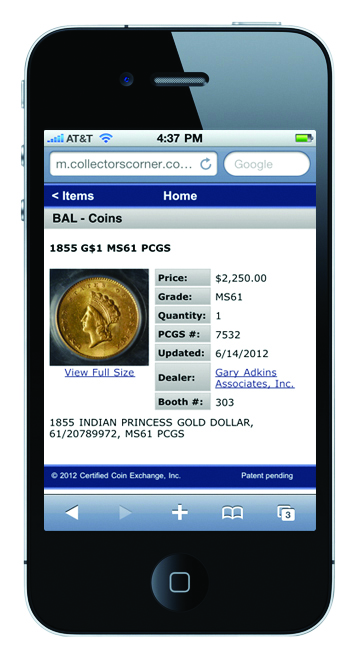
The free Coin Collectors Corner CoinSearch™ mobile app lets users see photos and information about specific coins available at the Baltimore Expo.

Collectors and dealers can use the free Collectors Corner CoinSearch™ mobile app to instantly locate Baltimore Expo dealers who have specific coins in inventory.
“The app was successfully beta tested with great results at the recent Long Beach Expo, and we’re now offering it for collectors and dealers at the Baltimore show,” said Cassi East, President of CCE, a division of Collectors Universe, Inc. (NASDAQ: CLCT).
“Coin buyers will be able to use their smart phones, iPads or other mobile tablet devices to find the exact coins they’re seeking during the Baltimore Expo, and even prior to the show. They»ll also be able to immediately pinpoint the exact bourse floor locations of the dealers who have those specific coins in their inventory.”
Before the show, dealers can list coins in their Collectors Corner inventories that they’ll have at their Baltimore tables. Collectors and other dealers then can use the Collectors Corner CoinSearch mobile app to easily locate any coins they’re seeking.
The ability to post Collectors Corner listings in the Baltimore Expo CoinSearch data base at m.collectorscorner.com will be available for all CCE member dealers at no additional charge as part of their CCE membership.
“CCE members can call us at (800) 733-6623, and we’ll walk you through the easy download mechanics,” explained East.
“This is an incredible, free service for collectors to locate exactly what they’re looking for. Everyone can use it,” said David Hall, President of Collectors Universe. “Mobile apps are the future, and this is a great collaboration between dealers, collectors and show promoters to bring together buyers and sellers.”
Additional information about the Whitman Baltimore Expo is available at www.whitman.com/expos.
Additional information about the Collectors Corner CoinSearch app m.collectorscorner.com is available by calling Collectors Corner at (888) 469-2646 or by visiting www.collectorscorner.com/marketnews/?name=CoinSearch.
Images courtesy of Collectors Universe, Inc.
Don Kagin: Our Nation’s First Circulating Currency: The Treasury Notes of the War of 1812
The Treasury Notes of the War of 1812
 The fourth speaker in the Maryland State Numismatic Association (MSNA) annual Distinguished Lecturer series will be Dr. Donald Kagin, one of the country’s leading numismatists and numismatic researchers. Don was raised in a numismatic household. His father, Art Kagin, was also a respected numismatist. Numismatic education has been a top priority for both Don and his father throughout their careers.
Don is widely recognized as the country’s leading authority on pioneer gold coins. He also has an exceptional numismatic education Don was awarded the first ever Bachelor of Arts degree in numismatics, this from Northwestern University, and holds the first (and only) Ph.D. in numismatics in the country which he earned at the Union Institute and University in Ohio. His Ph.D. major studies resulted in the book Private Gold Coins and Patterns of the United States, which won the Numismatic Literary Guild’s (NLG) Best Book of the Year award, and which remains the definitive reference on pioneer gold. His Ph.D. minor studies were on early American currency, and his chapter on the early notes of 1812, included in Friedberg’s authoritative study of American currency, is also still the definitive work in this area.
Don contributes to the Official Guide to United States Coins and the Coin and Currency Dealer Newsletter, which he founded. He regularly publishes articles in a number of leading periodicals including Money magazine, U.S. News and World Report, Barron’s, The Wall Street Journal, and The Numismatist. He has made several radio and television appearances. He received the American Numismatic Association’s (ANA) Heath Literary Award for several of his articles. As chairman of the American Money and Gold Rush Museum, he strongly contributed to the passage of a Congressional bill for the San Francisco Mint commemorative coins, the proceeds from which will go for the renovation of the historic old San Francisco Mint. Don served two terms on the ANA Board of Governors. He is also an expert numismatic investment advisor having written the book Donald Kagin’s Personal Guide to Rare Coin Investments, which won the NLG’s Best Investment Book of the Year award.
Don’s lecture is entitled “Our Nation’s First Circulating Currency: The Treasury Notes of the War of 1812.” It will be presented at 2:00 PM on Friday, June 29, 2012 in Room 301 of the Baltimore Convention Center during The Whitman Coin & Collectibles Expo. Don will also bring examples of the Treasury Notes from the time of the War of 1812.
Acadia National Park Quarter Launch
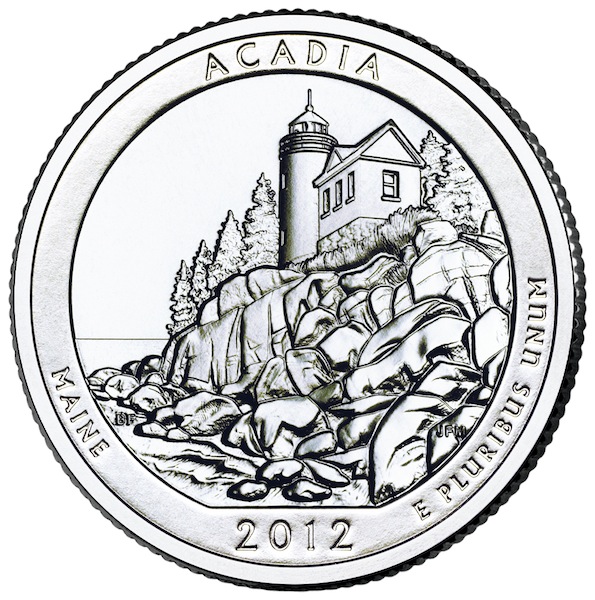 If you are going to be in the area of Acadia National Park today, June 26, the U.S. Mint will hold the launch ceremony at 9:30 AM at the Hulls Grove Visitors Center, Bar Harbor, Maine.
Scheduled to speak at the event are:
- B.B. Craig, Associate Director, Sales and Marketing, United States Mint
- Sheridan Steele, Superintendent, Acadia National Park
- Timothy Harrison, Founder, American Lighthouse Foundation
- Bill Green, Host, WCSH-TV’s “Bill Green’s Maine”
Rolls of the newly-minted coins, which feature an image of Bass Harbor Head Lighthouse, which, ironically isn’t actually in the park, will be available for sale.
For those who like video, and who doesn’t, the following is B-Roll footage from the U.S. Mint including a few seconds of U.S. Mint Sculptor and Engraver Joseph Menna working on the design of the coin using a computer. Coin was designed by Artistic Infusion Program Associate Designer Barbara Fox.
Support the Coin Collectors Blog
 Buy me a coffee
Thank you for your support!
Let Me Know What You Think
Are you going to the World's Fair of Money
Total Voters: 17
 Loading ...