
The Ancient Coin Collectors Guild Needs Your Help
 Once again, the State Department is about to do something that negatively affects a part of numismatics. Even if you are not an ancient coin collector, the ability to collect and study ancient coins helps give all of us clarity into history.
If the State Department permits the Memorandum of Understanding with Italy to pass, it will signal an end to ancient collectors’ ability to participate in the hobby. First, it will be the restriction of ancient Roman coins, then others will follow. Soon, every coin will become cultural property and locked in a museum, never to be seen again.
I heard it explained that coins were never meant to be static items. The rulers of ancient lands intended for the coins to circulate with their image. It was supposed to tie people to the empire. It was so important to pay the soldiers and circulate the money that coiners accompanied many armies. They would strike coins using the looted material and move on to the next conquest.
Most of these coins are not rare or even scarce. They are common, often seeing hoards of hundreds and accumulation of thousands across Europe. Some of the scarce coins can be readily found on the market and in museums.
However, if we listened to the archeologist, every crumb they find from the ancient past belongs in a museum. The necessity to save every widow’s mite is like wanting to save the Cross of Coronado.
From Wayne Sayles, Executive Director of the Ancient Coin Collectors Guild:
The deadline to send a comment to the Cultural Property Advisory Committee (CPAC) has been extended to July 14, 2020. Comments can be left at:
If you want more detailed information and a sample letter to the CPAC, read:
http://culturalpropertyobserver.blogspot.com/2020/06/please-help-save-roman-imperial-coin.html
In fact, read it anyway. It contains a lot of useful information.
We should stand up for the hobby, whether you collect ancient coins or not!
Exceptionalism or Follow the Leader?
Since the Canadian government announced that the Royal Canadian Mint will stop striking “pennies” in the Fall of 2012 and that cash transactions will be rounded to the nearest five-cent increment. Non-cash transactions will not be rounded.
As part of the transition to the centless society, Canada will withdraw these coins from the market using redemption programs to allow citizens to return the coins for compensation. The Canadian government has also committed to working with charities to use this as an opportunity to raise money for their causes.
Since the announcement, there has been a lot of chatter from around the world regarding the elimination of the lowest denomination coin from various countries, including here in the United States. While other countries have eliminated their lowest denomination coin, Canada is the largest economy who have made this move.
Canada’s proximity to the United States has generated a lot of discussion about the United States doing the same. Those arguing for the elimination of the cent begin with that it costs the U.S. Mint 2.11-cents to produce one coin, losing 1.11-cents per coin. Similarly, Canada began their discussion with that it costs the Royal Canadian Mint 1.6-cents to produce their one-cent coin.
If Canada can drop their penny, then why can’t we do that in the United States?
In 1986, Canada stopped producing one-dollar currency notes and went to exclusively coins. Nearly ten years later, Canada began to produce two-dollar coins eliminating the two-dollar paper note from circulation. If Canada can drop their lowest paper currency denominations, why can’t the U.S. do the same?
Those of us who use the argument that other countries no longer use paper currency as their basic unit of currency are told (paraphrasing) “we are the United States, we don’t have to do what others are doing.” Now those same people who want the U.S. Mint to stop striking cents are pointing to Canada using a similar argument and bristle when given the same response to their argument.
Every study by even the most partisan group shows that the government will “save money” by eliminating the one-cent coin, change the composition of the nickel, and produce the dollar coin rather than paper. The differences in the studies are what they call opportunity costs—the cost borne through the changes and processing by the businesses, banks, and citizens affected by the changes.
The concept of the government “saving money” is wrong. Production of money does not cost taxpayers any money. The high production costs of the cent and nickel does reduce the amount of seigniorage the government earns when the coins are sold to the Federal Reserve.
Ending the production of specific denominations is not new to U.S. coinage. The last change occurred in 1933 when the gold was no longer used for coinage eliminating the quarter eagle, half-eagle, eagle, and double eagle coins. At times in the past, the U.S. Mint also produced half-cent, 2-cent nickel, 3-cent, 20-cent, and dollar gold coins. All were seen as a good idea at the time but fell out of favor for many reasons and were discontinued.
At some point, the decision criteria must be baselined in order to come up with a fair analysis in order to determine the best policy. To start that analysis, let the policy basis be on the least amount the government could do in order to maximize seigniorage while treating all markets fairly. Based on those guidelines, eliminate the one-cent coin, but also eliminate the half-dollar and the one-dollar paper note. Even if the five-cent coin does not undergo a composition change, all studies show that the government will earn more in seigniorage than any other option.
Based on other studies, this policy will have an economic impact on the markets outside of the government and the Federal Reserve. But that is for the markets to work out on their own and not for the government to dictate.
It is also a policy recommendation that will make everyone upset on all sides of the issue, meaning that it wreaks of compromise—which should not be a dirty word when making serious policy decisions.
Yes, I Was Fooling!
Based on a few emails I received a few people did not pick up that my last post, Treasury Overhauls Circulating Coins, was an April Fool’s Joke!
I am happy it fooled a number of people since it takes a lot of work to come up with something that looks good and could be believable if it wasn’t posted on April 1.
Aside from the date, there are a few other subtleties I hid through the post for fun:
- Unless the world is falling apart, I cannot think of any reason why the Secretary of the Treasury would make this type of announcement on Sunday. Geithner may be a hard working person but unless the economy and markets are crashing, he was probably spending the weekend with his family.
- Although I found real numbers to calculate real weights, I just multiplied all of the Mint’s numbers by .75 and rounded up. I didn’t think there were many chemists or metallurgists who would try to validate my calculations.
- Notice that when I mentioned the discontinuation of the half-dollar, I did not mention who was on the obverse except to say, “the coin honoring the last assassinated president.” I know, it was an esoteric omission but it allowed me to do the next one—
- As far as I know, there is no such person named “Cathleen Towson” associated with the Kennedy family. It was a play on Kathleen Kennedy Townsend. Townsend is the eldest child of Robert and Ethel Kennedy and was once Maryland’s Lieutenant Governor. If you did not know, Towson is the name of a town northwest of Baltimore and the home of Towson University.
- Another subtle try to drop a hint was in the last paragraph where I wrote, “It may be foolish to think….”
- Finally, if you keep up with the tags at the end of the post, the tag was “Fun” and not something like “U.S. Mint” or anything more serious.
I had a lot of fun putting this together. I hope it brightened your April Fool’s Day!
Treasury Overhauls Circulating Coins
In a rare Sunday announcement, Secretary of the Treasury Tim Geithner announced that beginning in 2013, the U.S. Mint will change the size and composition of U.S. coinage in an effort to the government additional money.
Beginning in 2013, all coins struck by the U.S. Mint will be made of a inox (stainless steel) and will have its diameter reduced in size by 25-percent. The thickness of the coins will not change. For colored coins, the one-cent coin will be plated with copper to maintain its traditional color. For the dollar coins, the inox planchettes will be treated with titanium nitride (TiN) to add hardness to the coin and give it a golden color. Titanium will be used as a coating on the silver-colored coins.
Titanium appears to be a good choice in that it is a strong metal and resistant to corrosion making ideal to protect the steel core. Since titanium has a high melting point (more than 3,000°F) and will give the new coins a unique electromechanical signature, it will make the new composition difficult to counterfeit.
New size and composition changes are expected to cut total production costs by 50-percent the first year and another 25-percent by 2014. Thus, the one-cent coin that now costs 2.1 cents to produce will cost the government 0.525 cents by 2014.
Treasury has no plans to demonetize the coins that are currently in circulation. It is expected that both old and new coins will circulate side by side allowing the market to adjust on its own.
It was also announced that 2012 will be the last year that the half-dollar would be struck. Since the last time half-dollars were sold to the Federal Reserve for circulation was in 2002, Treasury did not see the need to continue to use valuable resources producing a non-circulating coin. This will end the 49 year run for the coin honoring the last assassinated president. Spokesperson for the family, Cathleen Towson said that the family understood that the needs of the nation outweighs her father’s image on a coin. Towson said that her father would approve on behalf of the people.
These changes would make specifications the new U.S. coins as follows:
| Denomination | Cent | Nickel | Dime | Quarter Dollar | Presidential & Native American Dollars |
|---|---|---|---|---|---|
| Composition | Copper Plated Inox 2.5% Cu Balance Inox |
Titanium Plated Inox 2.5% Ti Balance Inox |
Titanium Plated Inox 2.5% Ti Balance Inox |
Titanium Plated Inox 2.5% Ti Balance Inox |
Titanium Nitride Plated Inox 2.5% TiN Balance Inox |
| Weight | 1.875 g | 3.750 g | 1.701 g | 8.505 g | 6.075 g |
| Diameter | 0.56 in. 14.29 mm |
0.62 in. 15.91 mm |
0.53 in. 13.43 mm |
0.72 in. 18.20 mm |
0.78 in. 19.88 mm |
| Thickness | 1.55 mm | 1.95 mm | 1.35 mm | 2.15 mm | 2.00 mm |
| Edge | Plain | Plain | Reeded | Reeded | Edge-Lettering |
| No. of Reeds | N/A | N/A | 88 | 111 | N/A |
Geithner said that the new coins should “mollify the critics of the Mint’s production costs from both sides of the aisle.” He also announced that sample coins will be made available to the vending and other coin handling machine manufacturers so that they can properly program their machines to accept the new coins.
In a separate statement, Republican presidential candidate and congressman Ron Paul of Texas said that the announcement is a travesty thrust on the American people. Paul insisted that the Federal Reserve take control of the money manufacturing process, “stop messing around,” and convert the coins to silver and gold.
The announcement emphasized that none of the design features will change. Current running programs will continue. In 2013, the new America the Beautiful Quarters® Program will include:
- White Mountain National Forest (NH)
- Perry’s Victory and International Peace Memorial (OH)
- Great Basin National Park (NV)
- Fort McHenry National Monument and Historic Shrine (MD)
- Mount Rushmore National Memorial (SD)
Presidential Dollars will honor the following presidents:
- William McKinley (1897-1901)
- Theodore Roosevelt (1901-1909)
- William Howard Taft (1909-1913)
- Woodrow Wilson (1913-1921)
The theme for the reverse of the 2013 Native American Dollar will be announced later this year.
Maybe Treasury has taken their mandate to find new alloys for circulating coinage too far. It may be foolish to think that the size changes would be in the best interest of the country. But stranger things have happened and it just might work!
Craning Its Influence to Save Itself
During my perusal of the coin and currency related news on the Internet, I came across a story, “Survey shows dislike of Schweikert’s Coins Act” on the website for the East Valley Tribune, a newspaper based on Tempe, Arizona. The story is about alleged opposition to Rep. David Schweikert (R-AZ) sponsored the COINS Act to transition the one-dollar federal reserve note in favor of a one dollar coin. Schweikert represents Arizona’s 5th District that includes Tempe.
The article discusses a survey that was “conducted by the independent public opinion research firm Lincoln Park Strategies”that was paid for by an organization named Americans For George. Lincoln Park Strategies (LPS) was founded by Stefan Hankin who has worked on behalf of “numerous Democratic politicians and organizations, including President Barack Obama and the Democratic National Committee.” Although Hankin has tried to position his company to be non-partisan, his LPS’s portfolio boasts of the firm’s association with many Democrats and left-leaning organizations.
Americans for George claims to be a coalition “of like-minded individuals, businesses, and organizations seeking to ensure that the citizens of the United States maintain the ability to choose their preferred currency.” Their coalition members includes bars, restaurants, vending machine companies, companies that supply vending machine parts, armored car services, a few taxi services, Bingo World in Baltimore, and the Alabama Forestry Association an advocacy group for renewable forest resources in Alabama.
Unless you followed the paper, vending machine, and armored service industries, none of the coalition members are a household name outside of their home towns except one: Crane & Company, the Dalton, Massachusetts company who has the exclusive contract to supply currency paper to the Bureau of Engraving and Printing. Also listed as a coalition member is The Crane Family Council, a group of the extended Crane family that still owns and operates the paper company.
In other words, Americans for George is a front for Crane & Company to promote the business agenda of Crane & Company.
From 2005 through 2011, Crane & Company has paid Russell Wapensky, a lobbyist and former State Department employee, to lobby on their behalf. Wapensky was paid $80,000 by Crane & Company for his services in 2011. Wapensky has not filed disclosure paperwork and an office listed in the last discovered address in Washington, D.C. does not list him as a tenant. Disclosure records shows that for the last three years, Crane & Company was his only lobbying client.
In February 2012, Gephardt Government Affairs filed lobby registration forms (PDF) declaring Crane & Company as their client with the lobbying issue of “preservation of the dollar bill currency.” Gephardt Government Affairs was founded and run by former Rep. Dick Gephardt (D-MO) who served in the House of Representatives from 1977 through 2005. No disclosure regarding how much Crane & Company has paid the Gephardt Group is available since the Lobbying Activity Reports for the first quarter of 2012 are due on April 20.
Dick Gephardt was a mainstay in the House for 28 years having climbed the ranks to become House Majority Leader (1989-1995) and Minority Leader (1995-2003). He ran for president in 2004, losing in the primaries to John Kerry and was mentioned as a potential vice presidential candidate in 2004 and 2008. Gephardt remains well respected by many congressional veterans.
House rules allow members to keep their membership pins when their service ends. These pins allow their owners access to the House floor and other areas where the public is not allowed without escort. Gephardt should know his way around the Capital building. Buying this type of access and potential influence to Capital Hill is not cheap and shows that Crane & Company may be afraid that the political will is there to make a change that would cut a significant portion of their business. Currency paper for the one dollar Federal Reserve Note has to be the least expensive of the papers Crane & Company manufactures for the BEP. It is the only note that does not include features like watermarks or embedded security ribbons that has to make the process more expensive.
Without full disclosures from both Crane & Company and the BEP, it is impossible to determine the exact loss of revenue. The BEP is not required to report what they pay individual vendors and Crane is a privately held corporation, they are not required to file financial disclosure reports. However, we can make assumptions based on information provided by the BEP 2010 CFO Annual Report (PDF), the last available, and other public information.
How much revenue could Crane & Company lose if the the law was changed to eliminate the dollar note? Let’s assume the BEP produces 405 million $1 Federal Reserve Notes (rounded average of the last five years production). Let’s also assume that it costs the BEP $33.48 per one thousand notes to produce Federal Reserve Notes (the 2009 cost adjusted for inflation) of which 55-percent ($18.41) is the cost of the paper (calculated from 1990s information). In order to produce 405 million Federal Reserve Notes, Crane & Company would be paid about $7.45 million to supply the paper—estimating that the potential revenue loss from eliminating the one dollar Federal Reserve Note would range from $7 million to 10 million.
Crane & Company has over 7 million reasons to hire a powerful lobbyist like Dick Gephardt.
As a citizen, numismatist, and blogger, I have made it clear that I am in favor of transitioning from the paper note to the dollar coin. As the process continues, I will watch the public reports by Gephardt Government Affairs and any other information available on Crane & Company’s manipulation using the patriotic sounding front group, Americans for George.
Please Pardon My Ego
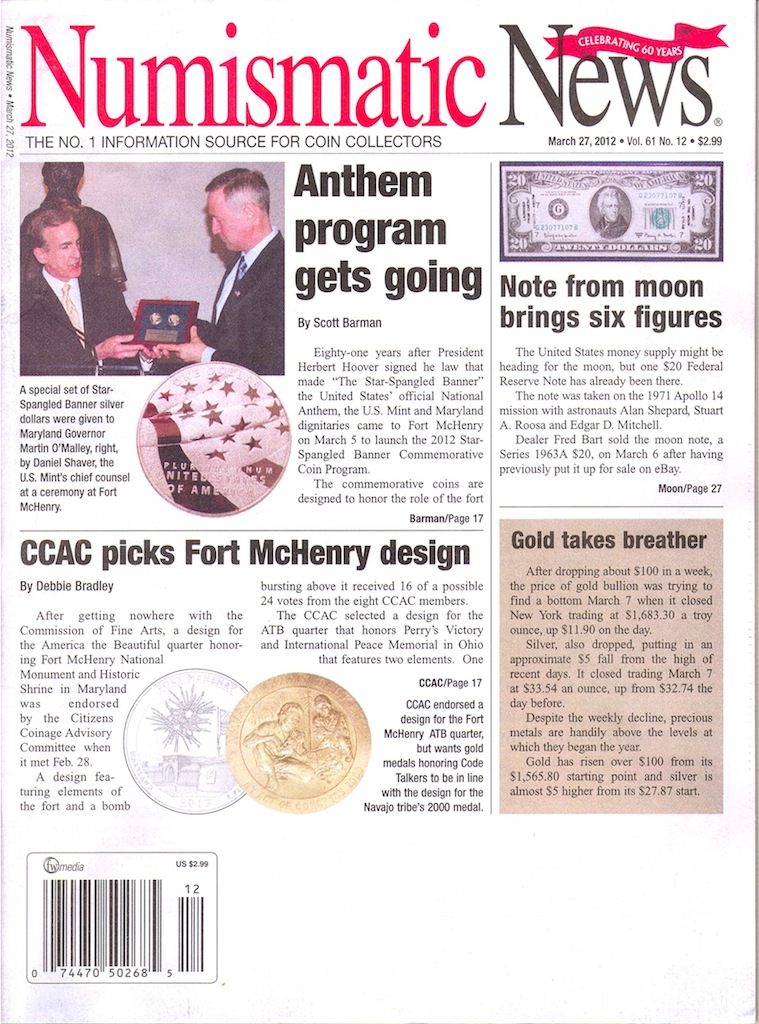 Please excuse me while I allow my ego to write this post!
If you are subscriber to Numismatic News and received your copy of the March 27, 2012 edition, there is a story with an interesting by-line featured on front page. Yes, this is the article about the 2012 Star-Spangled Banner Commemorative Coin launch that was written by your favorite blog host!
I had a lot of fun covering the launch event. I will be covering other numismatic-related happenings in the Washington, D.C.-area so that I can report about them here on the blog and, hopefully, in a fine publication like Numismatic News.
Support the Coin Collectors Blog
 Buy me a coffee
Thank you for your support!
Let Me Know What You Think
Are you going to the World's Fair of Money
Total Voters: 17
 Loading ...