
SCAM ALERT: Beware of Cheap Silver Eagles

If a deal is too good to be true, it probably is.

Device that could metallic analysis of a coin below the surface
The company is named LIACOO. Please note the two “ohs” because there is a legitimate company spelled with a single “oh.” LIACOO appears to be selling knock-off products made in China and representing them as genuine for less than market value.
A reader purchased five of these coins. After they arrived, this person said that something looked wrong and asked for help. The images that were sent makes the coins appear to be cast copies of American Silver Eagle coins. COUNTERFEITS!
First, you will NEVER find a legitimate seller sell American Silver Eagle for less than the wholesale price. You may be able to find someone who will round down your cost to the nearest dollar as a loss leader, but the price will never be more than 1-2% less than the spot price. The current spot price of silver is $17.84. If you find someone selling legitimate American Silver Eagle for $17.00-17.50, they will probably sell the coins to convince you to do further business with them. Otherwise, you may want to check the company further.
In this case, an examination of their website has no information about who they are.
- There was no physical address.
- There was no telephone number listed.
- The site did not have a privacy policy required to do business with most of the world.
- The site did not have any policies for shipping, returns, or customer service.
- The pictures of legitimate monster boxes and roll containers were “borrowed” from another site.
There are two places where they provide contact information. On their FAQ page is an email address that uses a different domain. Contact information for the company’s domain name appears on one page that listed an email address, and that customer service was available between 9a and 5p HKT. HKT is the time zone abbreviation for Hong Kong Time.
If that was not enough to convince you that this deal is too good to be true, further research went into their Internet presence.
Their domain name registration shows that the name was purchased from a company in Guangdong, China, that appears to service small businesses. This service provider is reselling the services offered by Baidu. Baidu is a Chinese state-controlled search engine, sometimes called the Google of China. The Chinese government heavily regulates Baidu.
The website is hosted on servers owned by Alibaba. Alibaba is a China-based e-commerce conglomerate whose ties with the Chinese government is uncertain. Although founder Jack Ma has claimed to have no government ties, it is essential to remember that the Chinese government regulates everything and censor Internet traffic inside its borders.
Everything regarding their Internet presence confirms that they are a China-based company. Remember, many of the worst counterfeit coins have origins in China.
I provided the details of the clues I was looking for to help you understand how to spot a scammer. I went further by looking into their Internet presence since I have the background to understand the under-the-hood workings of the Internet. However, my examination of the website was enough to convince me not to buy the coins.
If anything about the offer makes you uneasy, then do not buy the coins. If you want me to look at the site, leave a message in the comment section below, or send me a note. “Let’s be careful out there.”
Dear ANA Board: SHUT UP!
Late Thursday afternoon, the American Numismatic Association Board of Directors issued a statement in response to Larry Shepherd’s statement on his employment situation.
The problem is that the statement does not say anything of substance. It did say that Shepherd hired legal counsel who suggested that Shepherd was defamed. In response to that, the Board said that they made “an effort to avoid a rancorous, public discussion on personnel matters which are normally best left private.” If so, then why issue a statement?
The statement says that the Board “ended” their employment relationship with Shepherd yet seems to be concerned that Harlan Berk’s statement said Shepherd was fired. However, a person does not have to be a rocket scientist to know that after it was announced Shepherd was put on leave during an investigation and then his employment was “ended” to put the two events together to guess he was fired. In fact, my post on that day was “ANA Fires Shepherd.”
Again, this statement does not say anything of substance. But it appears that the Board feels they have to defend themselves. If the Board did not do anything wrong, what are they defending? Then to have Cliff Mishler, past president and current governor, make a statement, it makes them appear like they are trying to hide something.
What are the ANA Board of Governors hiding?
The ANA released their statement, Harlan Berk had his say, then Shepherd responded. Everyone vented and that should be enough. Why did the Board of Directors have to respond? What are they hiding?
The Board’s statement concludes:
If you do not want to “dwell on past mistakes,” then just SHUT UP!
The Passing of a Legend
 Last night saw the passing of Steve Jobs, a computer industry pioneer who revolutionized more than the computing industry. Jobs revolutionized how technology influences our lives and culture. That technology has even had an effect on this blog.
I bought my first Mac in 2002. I had heard about the new Mac operating system MacOS X and I wanted to learn more, so I decided to find a used Mac to play with. At the time, my company was holding a surplus auction where they would auction computers and peripherals that were beyond their life cycle. That year, the company decided that they would standardize on Windows and those with Macs would have to give up their machines. I bid on a PowerBook G3 that was code named “Wall Street” and won. I bought a copy of MacOS X Jaguar (10.2), more memory and started learning the Mac.
This was the time of the “switcher” commercials. One commercial was a woman who talked about how she was able to recover pictures from her digital camera to save Christmas. It was not Christmas time, but I was sitting with a cheap digital camera I bought to try out digital photography and having a difficult time getting the drivers loaded under Windows 2000 (remember, this was in 2002). I opened the PowerBook to try that computer. I plugged in the camera and was searching for the camera’s instructions when I noticed that not only did iPhoto start, but recognized the camera and asked if I wanted to import the photos.
To say I was blown away would be an understatement. It was easy and ordering prints online from Apple were easy and not expensive. I was hooked. I transitioned everything from the Windows machine to the Mac and never looked back. Today, I am using my third Mac. I write and manage this blog using a 27-inch iMac (late 2009). Sweet machine!
That ease of use runs through Apple’s product line and was Steve Jobs’s vision. Digital music players existed before the iPod, but Jobs lead his team to do better. From the iPod to the online digital music store, iTunes, Jobs and Apple revolutionized the electronic music business like nobody has. This portable player also lead to the revolution that are podcasts that expanded our access to information. As I look down on my desk, there is my 6th generation iPod Nano that I will clip to my shirt to listen to podcast on the go.
There were smart phones before the iPhone, but after Jobs rejected two prototypes, he gave his most exciting keynote address (called a “Stevenote”) where he introduced a single device to surf the web, listen to music, and a cellular phone—no stylus required. Then, Apple adapted the concept of programming the phone (other than by web pages) and the app store was born. In the app store, we find a number of apps that have been reviewed here including The Numismatist reading app.
The last coin show I went to, I saw a few dealers taking payments with their iPhone. Using a device called Square attached to the earphone port, dealers could swipe credit cards and get approved for payments via their iPhone. With low swipe fees (2.75% per swipe), dealers can now accept credit cards and expand their business. This would not be possible without the technology behind the iPhone.
Yes, I will pre-order an iPhone 4S tomorrow.
Never satisfied to stand still, Jobs pushed his team to build the iPad. Rather than accept what was “normal” for tablet computers, Jobs took the lessons learned from the iPhone and created another drool-worthy device that others are trying to imitate. I drooled over the iPad for over a year until the iPad 2 came out—I never buy the first version of anything. It was the reason that earlier this year, I wrote asking about electronic numismatic books which was noticed by the hobby’s two largest publishers. I have since downloaded a few numismatic books to read on the iPad. I also use the iPad to post links to numismatic stories on Twitter (see @CoinsBlog).
Even if you do not have these devices, the improvements elsewhere are because Apple pushed the envelope in that direction. Android-based phones and tablets came after Apple introduced the iPhone and iOS. Microsoft changed their Windows interface to compete with the MacOS interface. And nobody has really come up with an answer to the iPod, which remains the best selling music player in the market and iTunes is continues to sell the most downloadable music than any other vendor.
Regardless of the industry we are in and regardless of how we interact with technology, Steve Jobs and Apple has influenced all our lives that should live on.
Thank you Steve for being the influence that makes all of this possible. Rest in peace.
Shepherd Responds
The former American Numismatic Association Executive Director Larry Shepherd issue a statement regarding his dismissal from the ANA. In that statement, Shepherd emphasized,
Including this in the statement was curious. It is implying that Shepherd was alleged to have said something inappropriate, as I speculated in a previous post. But this allegation may be something that was used as part of someone’s agenda. This is reinforced when Shepherd followed up the above paragraph with:
This is the first act of newly inaugurated ANA President Tom Hallenbeck. Hallenbeck, who was previously ANA Vice President, may have not had a good relationship with Shepherd and wanted to find cause to terminate his contract. When reading between the lines, it is clear that Hallenbeck and allies on the Board was looking for a reason to fire Shepherd rather than try to work with him.
Welcome to the old ANA where it appears that the Board wants to micromanage the operations in Colorado Springs rather than being a body that sets the agenda and allowing the Executive Director to manage the day-to-day operations. It is a big strike against the Board whose two year term has just begun.
Finally, the Coin Collector’s Blog wishes Larry Shepherd well with his new job at Harlan J. Berk, Ltd. Berk’s gain is the ANA’s loss.
What Is My Coin Worth?
One of the most common questions I receive is “what is my coin worth?” Which is then followed by, “why is this coin not worth more?” Both are good questions that cannot be answered in a quick email since price is determined on market value which is heavily influenced by the coin’s condition. Let me explain…
First misconception is that the older the coin, the more it is worth. While some of this is true, there are exception. Copper coin enthusiasts will tell you that the 1910’s Lincoln Cents are worth more on avert than the 1900’s Indian Head Cents, rarities not withstanding. But those rarities are represented of one of the significant drivers in the cost of a coin: supply and demand. Simply, if there is a lower supply for the coin and a high demand, then the prices will be higher. For example, there were only 484,000 1909-S VDB Lincoln Cents struck before the U.S. Mint stopped production of the coins to remove the “V.D.B” initials on the reverse. Although nobody is certain how many have survived, it is difficult to find a collector who does not want one in their collection. Low supply, high demand means high price.
Many of what collectors call “key date” coins are those that are in low supply. But not all of those coins have the same demand. One example is the 1909-S Indian Head Cent with a mintage of 309,000. Even though the supply is lower than the 1909-S VDB Lincoln Cent, its demand is not as high. With the lower demand, the average price of the 1909-S Indian Head Cent is lower than the 1909-S VDB. But if you looked at the price of the 1909-S Indian Head Cent at higher grades, the Indian Head Cent is more expensive. This is because the first year Lincoln Cent was save in greater numbers and there are a few more higher grade examples available. Fewer of the 1909-S Indian Head Cents were saved leaving a lower supply making the coin more expensive for those demanding a higher grade coin.
That brings up the second factor of price: the condition of the coin. The better the condition the more expensive the coin. Using the 1909-S VDB Lincoln Cent for an example, the “book price” of a brown cent (BN) in the average grade of Extra Fine (XF-40) is $1,300. If it was at the low end of being Uncirculated (MS-60), the coin is worth $1,680. A coin that has some mint red luster that can be classified as red-brown (RB) makes the coin worth $1,720. In higher grades, such as MS-65, the difference between having a 1909-S VDB in BN ($3,060) differs significantly from a RB cent ($4,230) which is less than if it was a full blazing red cent ($6,440).
Condition is a key factor. Even if you were to look up the price of a coin in almost any reference, you will find that the price is different for each grade. It is important that you know the grade of the coin. For U.S. coins, one of the best online resources for helping grade coins is PCGS Photograde Online. PCGS Photograde Online contains high quality images of pre-1964 coins in all grades so that you can compare your coin with the online images. If you have an Apple iPhone or iPad, you can download the app from the iTunes App Store (Photograde app was previously reviewed here).
Even with knowing the condition and rarity of the coin, pricing is more of an art than a science. Publishers of price guides look at market condition, reports of how coins are selling, auctions, and other factors to determine what they think a coin should be worth. Just remember, these guides are just guidelines. They are not definitive prices. Individual dealers set their prices based on how much they purchased the coin for, consignment agreements, what the price guides suggest, along with extra to make a profit. Depending on the dealer, coin, and circumstances, these prices are not firm and can be negotiated. However, if you are negotiating for a coin, you should know what the fair market value is of the coin. Otherwise, you will make the dealer upset and might not sell you the coin regardless of the price.
Negotiating tips will be the topic of another post in the near future.
A good place that I have found to determine what the fair market value is the NumisMedia Fair Market Value Price Guide. NumisMedia allows all web visitors to view the fair market values of the coins in all grades. For those at shows or visiting a coin shop doing quick research on their smartphone, NumisMedia offers a mobile version of their fair market value website at m.numismedia.com.
If you collect foreign coins, there are few, if any, online resources. Since I have an interest in Canadian coins, the best single reference is the Charlton Standard Catalogue, Canadian Coins. Now in its 66th edition, it is the definitive reference on everything minted by the Royal Canadian Mint and those issued by the provinces before the union. One minor drawback is that the images are in black and white. Also, the book is not available as an e-book, which would benefit mobile users.
The ultimate reference guide for world coins is the Standard Catalog of World Coins from Krause Publications. Not only are there volumes for the 18th, 19th, 20th, and 21st century, but all four volumes are available as PDF files on DVDs. Once the files are copied to your system, they can be downloaded to your e-reader or mobile device for taking on the road. The files are searchable and can help price your world coins. If you do not want the full catalog but want a few countries or regions of interest, Krause offers their “Coins of the World” for downloading. This will allow you to download on the section of the Standard Catalog that you are interested in.
Krause also offers sections of their U.S. Coin Digest for each coin type for download. This is a good service for those interested in just one type. For obsolete bank note collectors, Krause also offers sections of the multi-volume Standard Catalog of United States Obsolete Bank Notes by James A. Haxby as a per state download.
Other references you might consider are Whitman’s A Guide Book of United States Coins, also known as the “Red Book,” and Krause’s U.S. Coin Digest. Both traditional references are available for your favorite e-reader making them easily searchable and portable.
Using these references should help you understand what your coin is worth and why. Now go forth and build your collection!
Playing Tooth Fairy Numismatically
 Are you a tooth fairy looking for something different to give leave that little loved under the pillow? Then the Royal Canadian Mint has an answer for you, especially if the toothless child is into coin collecting. Rather than leaving money, the RCM has produced a Tooth Fairy Gift Card with a special 25-cents Tooth Fairy coin.
Tooth Fairy legends started in Europe where it became a tradition to bury baby teeth as they fell out. Later, it became tradition to place the tooth under the pillow where the Tooth Fairy would collect the teeth, leave the children money, and give the teeth to the parents as a keepsake of their child’s growth. Whatever the tradition, the bottom line is the giving of money for the tooth. Why not make it memorable?
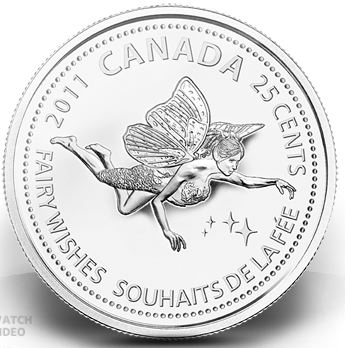 The card from the RCM also includes an envelop so that you can include more money than a quarter. For children in the United States, you can include other world coins if the child is a beginning collector or you can just leave some modern, legal tender alternatives. On either side of the border, an idea is to include the current Presidential $1 Coin or a few National Parks quarters. In Canada, the RCM has a animal and flower coins that would satisfy any child along with having the tooth fairy card.
Some traditions mark the sixth tooth as being special because it represents the strength in the child’s growth. For those, why not look at a large silver coin. the American Silver Eagle is a nice choice for U.S. children. In Canada, the 2011 Maple Leaf Forever silver coin with the three maple leaves is a symbol of Canada like no others.
I remember after the first few teeth how monotonous losing teeth became. This card could help a child along having those feelings.
This card is such a good idea, I wish I was playing tooth fairy for someone who could enjoy a card like this.
Images courtesy of the Royal Canadian Mint.
Support the Coin Collectors Blog
 Buy me a coffee
Thank you for your support!
Let Me Know What You Think
Are you going to the World's Fair of Money
Total Voters: 17
 Loading ...