
Weekly World Numismatic News for March 15, 2020
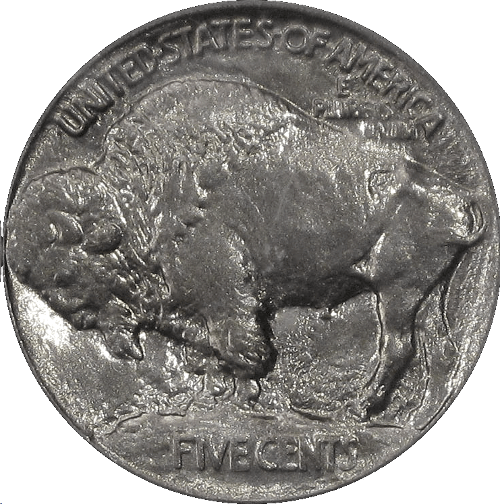
Following Saturday’s article, an article appeared in my newsfeed with tips on how to start building a collection of Buffalo Nickels.
CNN interviewed noted numismatist Charles Morgan. The article is a good synopsis of collecting Buffalo Nickels.
Buffalo nickels are a favorite of a lot of people. Designed by James Earle Fraser, the Buffalo Nickel was struck by the U.S. Mint from 1913 to 1987. The obverse of the coin features a Native American that Fraser said was a composite design of three chiefs, and the reverse is a buffalo that Fraser said was modeled after Black Diamond, an American bison he found at the Bronx Zoo. Both claims by Fraser have been controversial since several American Indian Chiefs claimed to have been Fraser’s model, and Black Diamond lived at the Central Park Zoo. In either case, it is a beautiful coin and an excellent entry to collecting.
Buffalo nickels are very available coins with a few exceptions. Beautiful examples with full dates and at least three-quarters of the buffalo’s horn still visible are available at reasonable prices.
For someone starting a Buffalo nickel collection, you might want to consider starting with a date and type set. Going this route would spare the beginning collector from trying to find the Type 2 1913-D and 1913-S coins, which can be expensive.
If you complete the goal of the date and type set, then try to fill in the rest of the coins to create the full date and mintmark set.
Another idea is to use the Buffalo nickel as the basis to collect other coins with buffaloes as part of the design. In 2011, I presented a Herd of Buffaloes type collection. Maybe it can be something to do while riding out the current situation.
Maybe, if we can attract new collectors using an article from CNN, we can encourage them to write more.
And now the news…
 March 6, 2020
 → Read more at gulfnews.com
March 10, 2020 → Read more at meadvilletribune.com
March 11, 2020 → Read more at theunionjournal.com
March 14, 2020 → Read more at cnn.com
→ Read more at gulfnews.com
March 10, 2020 → Read more at meadvilletribune.com
March 11, 2020 → Read more at theunionjournal.com
March 14, 2020 → Read more at cnn.com
U.S. Mint’s New Branding
Back when I wrote about the U.S. Mint joining the electronic communities of Facebook and Twitter. I also noted that the U.S. Mint was showing off a new logo. Almost a week later, the branding consulting firm Siegel+Gale issued a press release announcing new branding for the U.S. Mint they are calling Connecting America Through Coins.
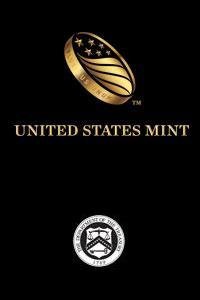
The logo features a golden colored flipping coin that will be used as part of product marketing throughout the U.S. Mint product line. As previously noted, the new logo appears on the U.S. Mint’s new Facebook and Twitter pages as well as the “microsite” for the America the Beautiful Quarters Program. No other U.S. Mint asset uses the new logo. Images of the new products in the U.S. Mint&rsuqo;s online catalog show either the use of the old logo or the official U.S. Mint seal.
According to Siegel+Gale, the U.S. Mint felt there was a “general lack of understanding of its breadth of additional offerings” and “aspired to increase sales of collectable coins, increase the uptake and use of dollar coins, and develop increased public awareness of the United States Mint as the only legal manufacturer of all American coins.”
If the U.S. Mint’s issues were about branding and understanding who they are, then this is a good move. But those of us who watch the U.S. Mint knows that their problems run deeper than their branding and logo. From lackluster designs, questionable customer service, to questionable management, U.S. Mint needs more than branding to help their image. Unfortunately, if we look at the how the U.S. Mint has performed, the axiom “a fish rots from the head&rdquo becomes very profound in describing the state of the U.S. Mint.
Finding a Modern Love Token
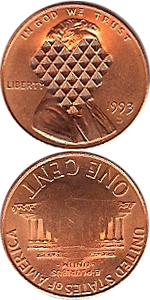 As I was going through my email and found a note from a reader who sent images of a 1993-D Lincoln cent where it looks like someone used a punch to create a heart design in the center of the coin (see image to the right). The reader asked if this may have been the result of the U.S. Mint trying to deface the coin and why it was placed into circulation. I was also asked if the coin had value—which is a natural question.
As the reader suggested, the markings are post minting but they were not made by the U.S. Mint. When the Mint cancels a coin they will run it through a machine that creates a waffle-like impression in the coin. Up until 2003, when the quality control officers at the U.S. Mint would remove coins from being circulated, they were separately bagged and placed under heavy guard between the Mint and the recycling center. 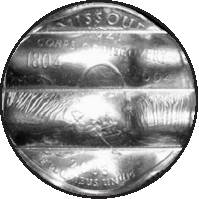 The security for coins that would never be circulated was costly. In mid-2003, the U.S. Mint purchased machines that will make the waffle-like impression as a way of defacing the coins to cancel them. These coins are called waffle cancelled. Later that year, the Mint sold these coins to a dealer who encapsulated them and sold them for a premium.
My first impression was that the person who stamped the design on this coin was a modern day love token. Love Tokens are not as popular as they were in the 19th century. Love tokens are circulated coins that were smoothed by sanding or polishing on one or both sides of the coin and then a design hand engraved into the coin. They were called love tokens because they were used as gifts to show love or affection for the person. Love tokens were popular in Great Britain in the early part of the 19th century and their popularity in the United States occurred after the Civil War through the end of the century.
Love tokens were engraved on any coin found in pocket change. Depending on the financial status of the engraver, smaller denominations coins were very popular. When wages were averaging 10 to 15-cents per day, it was difficult to justify higher denomination coins to engrave.
It is typical for love tokens to have a hole punched in the top of the design to be work around the neck. More “expensive” love tokens may have a loop or bezel attached to the top so that the design stands out from the chain. Others who could afford larger, higher denomination coin and could afford to add a pin to the back to wear on a lapel. Love tokens were also made into chains and bracelets. Mothers sometimes had bracelets that had love tokens with the initials of their children.
Each love token is a personal story of a gift given in love. It is rare that these coins have a documented provenance leaving collectors to speculate the meaning behind the fascinating designs. If you are interested in love tokens, you may want to check out the website for the Love Token Society.
Like love tokens, we can only speculate as to why someone punched the heart into the coin and why it ended up in circulation. I hope its appearance in circulation does not represent a rejection of an interesting gift.
Waffle cancelled Missouri Quarter from The Columbus Dispatch.
OMG! US Mint Tweets and is on Facebook
The U.S. Mint has joined the 21st century and is now on Facebook and Twitter. Judging by the dates of their first messages, they have been using these messaging services since the end of July. Both accounts appear to be used by their public information service to announce various programs and other news of the U.S. Mint.
While comparing the two sites, it appears that the same messages are being posted on both services.
 Another change that appears on both services is a new logo. Rather than using the logo that was based on the U.S. Mint seal with a red, white, and blue banner flying to the right (see image to the left),
  the new logo (right) uses a medal-like device with a flag impression that also has edge lettering that say “US Mint” placed over capital letters reading, “United States Mint” in a serif font. The new logo has appeared in email and on their “microsite” for the America the Beautiful Quarters Program. However, no change has been made to their main website and the online catalog replace the old banner logo with a black-and-white seal.
While the microsite is nicely designed, appealing, and informative, the rest of the U.S. Mint online infrastructure is in dire need of a refresh. It would be nice if they could extend the design used for the America the Beautiful Quarters Program. But it seems the U.S. Mint progresses in baby steps and this may be a small preview of what is to come—sometime in 2012 I figure.
In the mean time, if the U.S. Mint make their Twitter page (see @usmint) and Facebook wall a resource for all collectors, it will be a welcome change from how they have treated the collecting public.
U.S. Mint logo images courtesy of the U.S. Mint.
RIP DGS
Dominion Grading Service is now closed. After David Lawrence Rare Coins purchased the remnants of PCI from a bankruptcy auction, relocated the service to Virginia Beach, and began to accept grading submissions in May 2008. DGS offered two new services to collectors: AuthtiVIEW, a free imaging service for coins valued over $100; and the Visual Population Report. Both services made use of technology to bring new services to their customers.
But this was not enough. Over the last two years, DGS has stagnated. There have been no new services, no new innovations, and nothing to excite their potential customers. At shows, while DLRC’s booth is a bit sedate compared to other auction companies, DLRC did little to improve and promote DGS. DGS acknowledge their stagnation noting that “both PCGS and NGC have made great strides and improvements to their grading technologies and practices and we no longer feel that our services are needed.”
In a previous post, I discussed that the long term health and existence of other grading services matter. It is important for other grading services to exist because competition is good. Competition makes every service better. Competition forces grading services to innovate to try to distinguish themselves from the others in their field. This is good for the consumer who will get a better value for their fees.
There was a lot DGS could have done to distinguish themselves from the other services with only expenses in technology. Yes, I know the economy is not doing well. I also know that most MBA programs teach that building the infrastructure will pay dividends in the future. It takes a little imagination and marketing to break through the crowd and distinguish themselves from other serves. John Feigenbaum, president of DLRC and DGS whose biography says that he earned a Bachelor of Science degree in Marketing Management from Virginia Tech (not a slouch school!), should have known better rather than let the service stagnate until it withered away almost unnoticed.
Yosemite Quarter Launch
 On July 29, 2010, US Mint director Ed Moy introduced the Yosemite National Park Quarter at the park in California. The coin fathers the image of El Capitan, the 3,000-foot vertical rock formation that is prominent formation that looms over Yosemite Valley.
Prior to being discovered by European-Americans in 1833, the Ahwahneechee people inhabited Yosemite Valley. As the gold-rush expanded the non-native population, U.S. troops burned Ahwahneechee villages in 1851, eventually driving them out of the valley. Within a few years, the lack of gold lead to entrepreneurs to use early photographs of the area to turn the area into a tourist destination.
By 1864, the commercial use of the area became a concern. Prominent citizens lobbied congress to pass a bill to declare the area a national park. The bill creating the Yosemite Grand was signed by President Abraham Lincoln on June 30, 1864. Yosemite Grant was managed by the Army until the National Park Service was created in 1916.
A coin exchange and roll sale followed the launch ceremony.
The following video of the launch ceremony was released by the U.S. Mint:
You can find the B-Roll package at NewsInfusion.com.
Coin image courtesy of the U.S. Mint.
Support the Coin Collectors Blog
 Buy me a coffee
Thank you for your support!
Let Me Know What You Think
Are you going to the World's Fair of Money
Total Voters: 17
 Loading ...