
Numismatic Legislation Review
 I did not realize that it has been a few months since I did a Numismatic Legislation Review. It is time to look back at the past months of Congress meddling with coin designs.
December 2019 Numismatic Legislation Review
The first piece of legislation is a lesson in why watching Congress is not for the faint of heart!
H.R 1865, sponsored by Rep. Bill Pascrell (D-NJ), started as the National Law Enforcement Museum Commemorative Coin Act. Its original purpose was to create a three-coin commemorative coin program for the National Law Enforcement Museum in the District of Columbia in 2021. From the time it was submitted until passage by the Senate on November 12, 2019, it was just another commemorative coin bill.
Then the sausage-making process began.
It starts with the necessity to fund the government. With time running out, the House of Representatives sends a message to the Senate that they have a resolution to start the funding process. The Senate objects to the House’s actions and looks around for something so they can add funding amendments.
Although H.R. 1865 passed in the Senate, the bill did not go to a conference committee to resolve differences. It became a convenient vehicle for the two chambers to negotiate a budget.
By the time the bill passed Congress, it was renamed to the Further Consolidated Appropriations Act, 2020, and the provisions for the National Law Enforcement Museum Commemorative Coin Act became “Division K” of the signed law.
The following is the unedited status of what is now Public Law No. 116-94 (there is more below this section):
H.R. 1865: Further Consolidated Appropriations Act, 2020
- the Departments of Labor, Health and Human Services, and Education, and Related Agencies Appropriations Act, 2020;
- the Agriculture, Rural Development, Food and Drug Administration, and Related Agencies Appropriations Act, 2020;
- the Energy and Water Development and Related Agencies Appropriations Act, 2020;
- the Department of the Interior, Environment, and Related Agencies Appropriations Act, 2020;
- the Legislative Branch Appropriations Act, 2020;
- the Military Construction, Veterans Affairs, and Related Agencies Appropriations Act, 2020;
- the Department of State, Foreign Operations, and Related Programs Appropriations Act, 2020; and
- the Transportation, Housing and Urban Development, and Related Agencies Appropriations Act, 2020.
In addition to providing appropriations, the bill includes legislation that extends several expiring programs and addresses a wide range of policy issues throughout the federal government.
For good measure, Rep. Steve Watkins (R-KS) introduced the Conan Commemorative Coin Act to honor Conan, a Belgian Malinois who has worked with the United States Special Operations Forces in the Middle East. If passed, the money will be given to the Department of Veterans Affairs to support vetinary care for service animals.
H.R. 5537: Conan Commemorative Coin Act
January 2020 Numismatic Legislation Review
In January, Congress passed the President George H.W. Bush and First Spouse Barbara Bush Coin Act to extend the Presidential Dollar and First Spouse Gold coin programs to include the late President and First Lady. The law requires the coin to be issued in 2020.
S. 457: President George H.W. Bush and First Spouse Barbara Bush Coin Act
This bill requires the issuance of
- $1 coins bearing the image of President George H.W. Bush for a one-year period beginning on January 1, 2019, and
- bullion coins bearing the image of Barbara Bush during that same period.
February 2020 Numismatic Legislation Review
Finally, in February, Rep. Gregory Meeks (D-NY) introduced the Harriet Tubman Bicentennial Commemorative Coin Act. Even though Tubman was born in 1820, the bill calls for a three-coin commemorative program in 2022 to celebrate 200 years since her birth. If passed, the money raised from this program will be paid to the Project Legacy of Brooklyn, NY, to advance its mission.
H.R. 5873: Harriet Tubman Bicentennial Commemorative Coin Act
And with that, we are all caught up!
Skipping 2009 in Dimes
While searching through my change this evening, I found two 2010 Roosevelt dimes! Considering I have yet to find 2009 nickels or dimes in pocket change, finding a 2010 dime in June of 2010 is very interesting. Could this be the economy turning around or a case of last-in/first-out from the Federal Reserve money rooms with the 2009 coins buried in the back of the room?
Yellowstone Quarter Launch
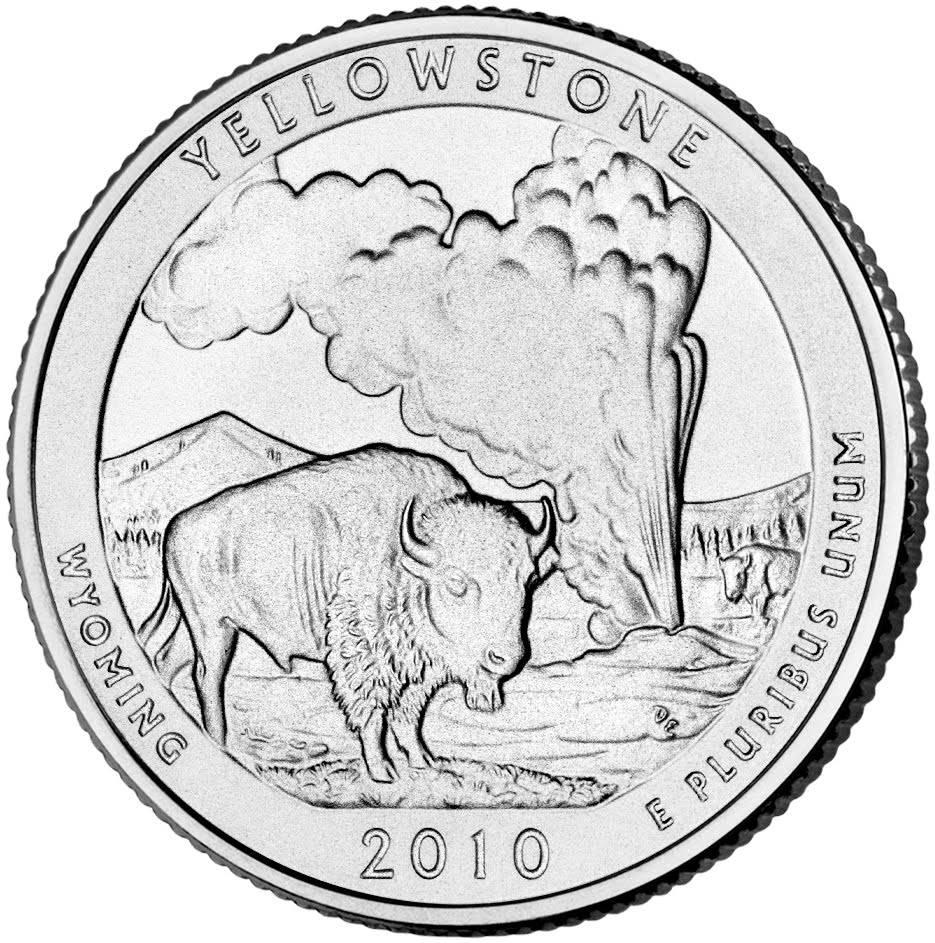 While the U.S. Mint fights trademark issues over the name of their program, Director and professional politician Ed Moy travelled to Yellowstone National Park in Wyoming today to launch the Yellowstone National Park Quarter. Moy was joined by Suzanne Lewis, Superintendent of Yellowstone National Park.
Yellowstone National Park was established by an act of congress on March 1, 1872. Its 2.2 million acres is home to grizzly bears, elk, wolves, and bison. Along with the Old Faithful Geyser are a collection of an extraordinary group of geysers that do not receive the same press as Old Faithful.
The reverse of the coin features Old Faithful Geyser and a bison, both excellent representatives of the nation’s second National Park.
Here is the B-roll video from the U.S. Mint and the launch ceremony:
Quarter image Courtesy of the U.S. Mint
Update on Opposing Import Restrictions on Ancient Coins
According to the Ancient Coin Collectors Guild (ACCG) noted that 1,934 discrete addresses used their fax service to send notes opposing import restrictions on ancient coins from Italy. I would like to thank my readers who were amongst those who sent faxes to the U.S State Department’s Cultural Property Advisory Committee (CPAC).
ACCG Executive Director Wayne Sayles attended the meeting and wrote about the meeting from his perspective. ACCG Board member Peter Tompa wrote a full report about the meeting. Both are worth reading.
The Washington Post also sent a reporter who filed this story.
CPAC has not yet resolved the issue. I hope our efforts writing to the CPAC in conjunction with the ACCG prevents the Memoranda of Understanding with Italy from being modified to include ancient coins.
"America The Beautiful" Trademark Owned by the US Mint?
According to the lawyers at the U.S. Mint, the term “America the Beautiful” cannot be used when referring to the quarter series without noting that it is a trademark.
Coin World is reporting that Numismatic Guarantee Corporation will change the labels they use on certified 2010 quarters to remove “America The Beautiful” from across the top because the lawyers at the U.S. Mint complained.
According to registered trademark number 77823874, the trademark is for the term America the Beautiful Quarter™ with the disclaimer “No claim is made to the exclusive right to use America or Quarters apart from the mark as shown.”
Although NGC said that they would not fight the request, NGC’s original label did not use the word “Quarter” and is well within the spirit of what was written in the trademark application.
Prior to the quarters program, many of us knew America the Beautiful as the patriotic song based on the poem by Katharine Lee Bates and music by Samuel A. Ward. We also knew the phenomenal rendition by the late Ray Charles. Does the U.S. Mint’s actions mean that Charles’s estate can issue a cease and desist order against the U.S. Mint?
But did you know there was a documentary titled America the Beautiful asking whether is America obsessed with beauty? The film had a limited release in 2008. Does this mean that the U.S. Mint is infringing on the filmmakers copyright?
Will the U.S. Mint and the United States Geologic Survey become entangled in an inter-Executive Branch tussle over the name? The USGS sells the “America The Beautiful – The National Parks and Federal Recreational Lands Annual Pass.” that allows the holder to use these lands without paying an additional fee. Will this be the case of prior usage when the Department of the Treasury fights it out with the Department of the Interior? DoI may not be in a good mood given their involvement with the current disaster in the Gulf of Mexico.
This is an overzealous prosecution by the U.S. Mint’s Office of Chief Counsel (OCC). It appears that the U.S. Mint is taking a common phrase out of the American lexicon and claiming it as their exclusive rights. In the process, OCC is using legal antagonism against the secondary market that serves the collecting community who is being asked to buy these coins.
Considering the reduction in sales caused by the “Great Recession” and collector fatigue over yet another series, it is not in the U.S. Mint’s interest to alienate the collecting community. I urge the U.S. Mint to reread Bates’s historic poem and reconsider its actions regarding a name.
Not a trademark but a sentiment.
PCGS Sues Alleged Coin Doctors
Late Friday afternoon, Collectors Universe, the parent company of PCGS, announced that they are suing six defendant and 10 “Does” (unknown people) in U.S. District Court for the Central District of California for allegedly doctoring coins. The named defendants are:
- Al Rossman of Nevada
- Eric Steinberg, a PNG member and owner of Broward County Coins in Plantation, Florida
- Rick Wesslink of Mission Viejo, California (it is possible this name is misspelled in the complaint)
- Silvano DiGenova, a PNG member and owner of Tangible Investments in Laguna Beach, California
- Greg Krill, a PNG member and co-owner of North Bay Rare Coin & Jewelry of St. Helena, California
- Robert Lehmann a coin shop owner in Cumberland, Maryland
The complaint alleges that the defendants conspired to doctor coins using “techniques [that] are designed and intended to avoid detection by [PCGS] and the coins’ owners for many years.” Amongst the method allegedly used are chemicals that would show up over time and laser alteration to fix or enhance coins. Owners of doctored coins later received compensation from Collectors Universe under the PCGS Guarantee.
Twelve examples of coin doctoring dating back to 2001 were listed as examples in the complaint.
CU alleges that the defendants are in violation of the Lanham Act (Trademark law) by allegedly misrepresenting the details of the coin; the Racketeer Influenced and Corrupt Organizations Act (RICO) alleging that they knowingly acted as an “enterprise” to defraud CU and PCGS; that the “Defendants acted willfully, fraudulently, maliciously, and in wanton disregard of CU’s rights;” and violated the California Unfair Competition Law.
As part of the complaint, it says that “PCGS is a leading coin authentication and grading service in the world,” and spends several paragraphs describing their work and guarantee. This is followed by the complaint that the defendants doctored coins. However, if PCGS is a professional service, how could they allow these defendants to allegedly submit and they encapsulate coins for over nine years without prior action?
There have been informal discussions in various forums as to whether the third party grading services may becoming overwhelmed with submission and questioning the results of their services. Along with the grading of classic coins, the third party grading services grade many modern coins, some directly from the packaging as shipped to dealers from the US Mint. Could coin doctors use this to try to hide their patterns over the years?
One solution was the formation of a service that verifies the grading of the third party graders. After a very public “spat” between the top grading services and notable dealers, some came together to form the Certified Acceptance Corporation (CAC), an authentication service that verifies the grading of the third party graders. While this may have slowed the coin doctors, it has not eliminated the problem.
In the mean time, PCGS reports that they have paid over $7 million under their guarantee over 24 years. While PCGS should pursue those that attempt to defraud them and the collecting community, PCGS may need to examine its own grading practices to understand how these coins passed their scrutiny.
Support the Coin Collectors Blog
 Buy me a coffee
Thank you for your support!
Let Me Know What You Think
Are you going to the World's Fair of Money
Total Voters: 17
 Loading ...