
October 2019 Numismatic Legislation Review
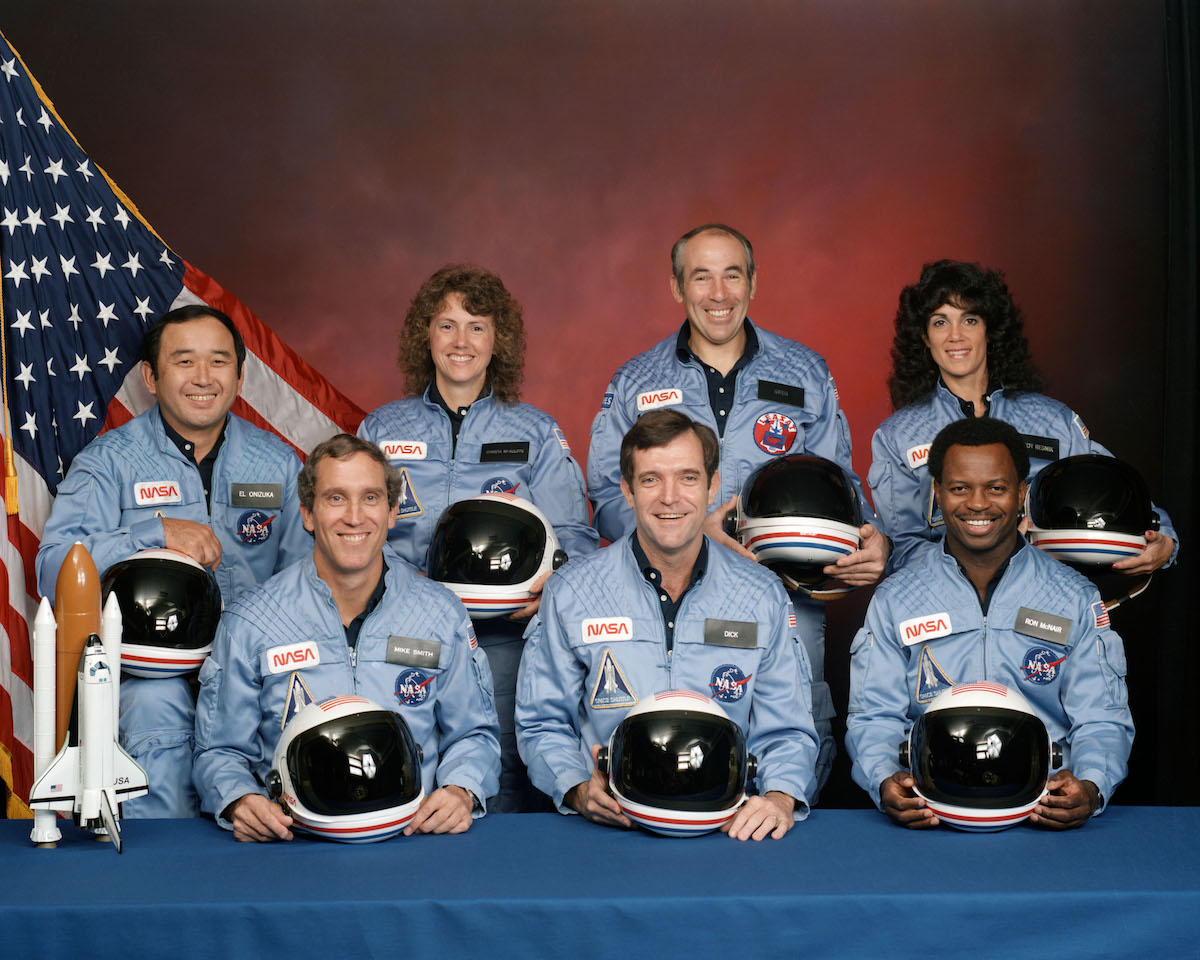
The STS-51L crewmembers are: in the back row from left to right: Mission Specialist, Ellison S. Onizuka, Teacher in Space Participant Sharon Christa McAuliffe, Payload Specialist, Greg Jarvis and Mission Specialist, Judy Resnik. In the front row from left to right: Pilot Mike Smith, Commander, Dick Scobee and Mission Specialist, Ron McNair. (Wikipedia)
For those who do not remember or were not born at the time, McAuliffe was selected as the first civilian teacher to fly into space as part of the Space Shuttle program. On January 28, 1986, she boarded the Space Shuttle Challenger along with Francis R. Scobee, Michael J. Smith, Ronald McNair, Ellison Onizuka, Judith Resnik, and Gregory Jarvis for mission STS-51-L. Challenger lifted off from Cape Canaveral at 11:39 AM.
It was an unusually cold morning, even for Florida. The cold and deterioration of the O-Rings that sealed the joints of the solid rocket boosters failed. The firey escape of fuel caused the external fuel tank to explode 73 seconds into the flight. Challenger disintegrated, taking the lives of the seven-member crew.
The surcharge of $10 per coin sold in 2021 will be paid to the For Inspiration and Recognition of Science and Technology (FIRST) robotics program “for the purpose of engaging and inspiring young people, through mentor-based programs, to become leaders in the fields of science, technology, engineering, and mathematics.”
S. 239: Christa McAuliffe Commemorative Coin Act of 2019
The House also passed the Women’s Suffrage Centennial Commemorative Coin Act (H.R. 2423) for 2020 and the National Law Enforcement Museum Commemorative Coin Act (H.R. 1865) for 2021. Both bills head to the Senate for their consideration.
H.R. 1865: National Law Enforcement Museum Commemorative Coin Act
H.R. 2423: Women’s Suffrage Centennial Commemorative Coin Act
Two additional commemorative coin bills were introduced in the House of Representatives. One is so new that the Government Printing Office has yet to release the official text.
H.R. 4681: National World War II Memorial Commemorative Coin Act
H.R. 4940: To require the Secretary of the Treasury to mint coins in commemoration of the 200th anniversary of the establishment of the Nation’s first statewide investigative law enforcement agency, the Ranger Division of the Texas Department of Public Safety.
ANA Rescinds Cipoletti’s Presidential Award
Dave Harper, editor of Numismatic News, wrote a blog entry reporting that the American Numismatic Association Board of Governors unanimously voted to rescind the Presidential Award presented to former Executive Director Christopher Cipoletti. Cipoletti was given the award by then outgoing President Bill Horton in 2007 at the banquet held during the World’s Fair of Money in Milwaukee.
Harper reports that the request was made by Horton and brought up by President Barry Stuppler during the Board Meeting held at the National Money Show in Portland, Oregon. Former ANA President Bob Campbell told the Board that he thought this was a bad idea. Harper further said:
Legal Counsel Ron Sirna said the motion was in order after remarking that Cipoletti had cost the organization $2 million to $3 million in litigation. “There is a substantial basis for Mr. Horton’s request,” Sirna said.
With all due respect to Ron Sirna, while there might be a legal basis for the action is it really the right thing to do?
I would be hard pressed to find many ANA members who believes that Cipoletti did a good job. But what I find disturbing is that Horton is asking for the proverbial “do over” for his bad decision he made. Horton ignored the undercurrent of complaints about Cipoletti that were part of the 2007 Board of Trustees elections. Or Horton ignored what was being said. But even with the griping that was gripping the pages of the numismatic publications, Horton found time to defend the Board, himself, and Cipoletti in published letters.
Horton created this situation while he was ANA President by turning a deaf ear to the voices of discontent and defied his constituents to give the Presidential Award to Cipoletti. Now, the current Board of Governors wants to rescind the award because the legal bill for litigating Cipoletti’s dismissal cost too much. Apparently, this Board has not learned that you can’t put the toothpaste back in the tube.
Former ANA President Bob Campbell was right when he said it was a bad idea. It looks like sour grapes. This is just a bad idea. Regardless of what happened subsequent to the award, what’s done is done. The ANA should drop this issue and just move forward.
Getting A Round Tuit In Baltimore
If it was Saturday at the end of March, it was time to drive to Baltimore for the Whitman Baltimore Coin and Currency Expo. This show is a three-times-a-year ritual for the numismatic community centrally located on the eastern seaboard. For the last few years, the show has expanded to three large halls in the Baltimore Convention Center and made into a real numismatic happening by the people at Whitman. Whitman has done a good with the show and I hope their new venture into Philadelphia is successful. If there is one complaint, I wish they would use chairs without arms. Those of us with wide bottoms would appreciate this.
After completing errands, I left home at 11:30 and drove to Baltimore. Depending on traffic, the trip from home to parking near the Baltimore Convention Center can take an hour. I park near the convention center in the parking lot at the Sheraton Inner Harbor. I overpaid for parking and walked to the Convention Center.
Registration booths are expertly tended to by members of the Baltimore Coin Club. Sine many of the members are also members of the Maryland State Numismatic Association, it was nice to see friendly faces.
Once inside I started with my regulars. I wanted to talk with them to see how the show was going. The responses were mixed, but in the extremes. Some dealers said that they would not make the money they paid in fees and expenses for the weekend. Others said that the weekend could not be better.
Gold and silver seemed to be very hot. It was difficult to find 2009 Silver Eagles. I was able to find one from a dealer with three singles and two rolls left. Good date Morgan dollars were also selling well. One dealer said that early 20th Century commemoratives were also selling well.
There was a lot of gold. Gold was everywhere. Some dealers were advertising that they would buy scrap gold. I watched as a dealer bought scrap gold at spot less 5-percent. I also saw a dealer with one ounce gold eagles fanned across his case when I entered the hall and the pile was half the size two hours later.
At the show I met Sharon, a dealer from New York who travels with her husband nearly every weekend to shows. She was a fun person who convinced me to buy something I originally was not going to buy. Sharon mostly sells currency and said that the show was a disaster for her. Although she had some very nice National Banknotes, there seemed to be little interest in currency at this show. Sharon and her husband will be at the Dulles Coin & Currency Expo at the end of April. This year is the third annual show at Dulles. I will have to drop by.
Other currency dealers also said it was slow. I do not collect currency because of the costs involved, but I will browse their tables to look at the artwork of these wonderful notes. Currency dealers also love to talk about their products and I have learned a lot about economic history from their discussion of the notes. Nearly every currency dealer said that their sales were slow. Only one dealer gave me a shrug and said that it was “OK.”

 Although I did not buy much, I continued my tradition to try to find something I consider “neat.” This show’s neat find did not cost anything. I was walking down the aisle and walked by the table for Abbott’s Coins. I forgot to ask who the dealer at the table was, he was not John Abbott, but he was handing out these copper-looking tokens. Looking at the token, there were the big letters “TUIT” on the front. I looked at the dealer and said, “I can’t take this. It means that I would have to get things done!” But it was so compelling, I had to take one.
Now that I have a “Round TUIT” I cannot complain that I will get things done when I get a Round TUIT. I have one. I guess it’s time time to get things done!
The June show will be bigger and will have a Sunday session. There will be speakers, club meetings, and more activities. It will be a real happening along with the usually buying and selling. If you are in the area, you have to attend this show. When you are done, remember that the Inner Harbor is right next door with shops and plenty of restaurants. If you want to bring your family and they are not interested in coins, send them to the National Aquarium while you check out the coins.
A Readable Commemorative
 In a ceremony earlier today at the National Foundation for the Blind headquarters in Baltimore, US Mint Director Ed Moy and NFB President Marc Maurer introduced the nation’s first coin with readable braille. the 2009 Louis Braille Bicentennial Silver Dollar.
“For the first time in history, the United States has a coin with readable Braille,” Director Moy told the audience. “The 2009 Louis Braille Bicentennial Silver Dollar honors the developer of Braille, a tactile code that has been instrumental in the literacy and independence of the world’s blind people.”
 Authorized by Public Law 109-247 (GPO: [Text] [PDF]), the Mint is limited to issuing 400,000 coins. The $10 surcharge, a maximum of $4 million, will be paid to the NFB to promote braille literacy. The NFB reports that the money will be used in its Jernigan Institute and Braille Literacy Campaign to double the number of school-age children reading braille by 2015.
According the the NFB:
An astounding 90 percent of blind people today are Braille illiterate. This would be viewed as a national outrage if the same crisis faced sighted individuals, and yet blind people continue to be deprived of the Braille education and resources they need to obtain jobs, pursue stimulating careers, and enjoy the same opportunities as sighted individuals. Further, Braille illiteracy is the leading contributor to a shocking 70 percent unemployment rate among 1.3 million blind Americans and it’s only going to get worse—70,000 people are losing their sight each year.
To help fund Braille literacy programs, the NFB has teamed with the U.S. Mint to issue the first coin ever to feature readable Braille. The Louis Braille Bicentennial Silver Dollar will be launched this Thursday, March 26, 2009 at the NFB’s headquarters in Baltimore, MD, after which the coin will be available for purchase…. Every coin sold will support Braille education nationwide and ensure that every blind American enjoys the same opportunities for success as sighted individuals.
The National Federation of the Blind is also publishing a report to the nation, titled “THE BRAILLE LITERACY CRISIS IN AMERICA: Facing the Truth, Reversing the Trend, Empowering the Blind.” The report, a comprehensive overview of the crisis and proposed solutions to reverse it, is currently under embargo until the launch day on March 26, when it will be posted online at www.nfb.org and www.braille.org.
I believe in supporting a good cause. If support also comes with a cool collectible, then it makes sense to buy. I hope this commemorative sells out!
A New Gold Rush
With the price of gold rising and the economy falling, there is a new gold rush. Reports from California said that panning for gold is becoming popular for people looking to make money.
The story from KTLA in Los Angeles says geologist estimates that only 20-percent of the gold was found during the 1849 gold rush. Today, the new gold rush is occurring within an hour of downtown Los Angeles. This is the story from KTLA:
Could there be gold in other places? Before the 1849 California Gold rush, the news of the Carolina Gold Rush followed the 1799 discovery of gold by Conrad Reed outside of Charlotte in Cabarrus County, North Carolina. In 1829, gold was discovered in Lumpkin County, Georgia near Dahlonaga. By 1837, Congress authorized the building of the Charlotte and Dahlonaga Branch Mints for the minting of gold coins.
But these areas are not open to general exploration. The Reed Gold Mine is a State Historic Site with restrictions on where visitors can explore. In Dahlonega, Consolidated Gold Mines, Inc. own the area of the Georgia gold discovery. Panning and searching for gold in those areas are limited to their pre-determined “experience.”
During my teen years growing up in Charlotte, there were rumors of gold under the buildings of downtown Charlotte. It was said that the small amount of gold under the streets and the effort it would take to get to it through the hard clay soil made it economically infeasible. Could the economics have changed enough to try to mine under the streets of Charlotte?
Are there other areas where gold may be found? Gold was found in southeast Alaska in 1872, near Juneau in 1880, and the Klondike Gold Rush in 1898. Could Alaska be another place for modern day gold prospectors?
Could there be an undiscovered area prime for a modern day gold rush?
Own Your Own Spy Coin
In January, 2007, there was a story about Department of Defense contractors inadvertently carrying a hollowed out Canadian dollar that contained Radio Frequency Identification (RFID) transmitters that could be used to track their movement. Allegedly, the coin was given to them in change by a third party. Later, Defense Security Services (DSS) issued a press release stating that the story was not true.
I thought it would be fun to find a spy coin and see what could be done with it.
 Earlier on Monday, a friend sent a link to Think Geek, an online merchant that sells technology-related items specifically to the technologist market. While looking through the items I found a listing for Hollow Spy Coins. The coins are hollowed out quarters or half-dollars with enough room for a very small memory card. The coins are advertised to come with an unlocking ring and are “indistinguishable from regular coins when closed.”
Think Geek is selling the spy quarter for $20.99 and the half-dollar for $24.99.
If these coin are indistinguishable from regular coins, I would be afraid to carry the quarter for fear of accidentally spending it. But keeping the half-dollar as a pocket piece with some “secret” inside could be fun. I might buy one!
Image courtesy of ThinkGeek.com.
Support the Coin Collectors Blog
 Buy me a coffee
Thank you for your support!
Let Me Know What You Think
Are you going to the World's Fair of Money
Total Voters: 17
 Loading ...