
Weekly World Numismatic Newsletter for November 3, 2019
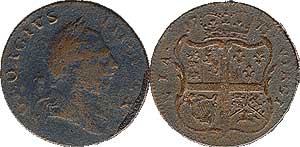
A 1773 Virginia Halfpenny from the Colonial Williamsburg Collection (not my friend’s coin because I forgot to take pictures) (Image courtesy of Colonial Williamsburg)
He was in an area not far from Jamestown. The metal detector community in the area knows that it is possible to find small items dating back to colonial times. Most of the time, people find bullets and buttons from the Civil War era. They dream of finding something special.
On this day, my friend comes in excited. He finds what he thinks are colonial coins. If he is right, he could have hit the local jackpot. I asked to see the coins.
Upon pulling out the coins wrapped in cheesecloth, the first thing I noticed that the coins were round. But Scott, you say, coins are supposed to be round. I say that you are correct, but at a time when minting coins required striking dies with a hammer, the result is not perfectly round.
While laying the open cloth on my desk, the sound the coins made was suspicious. Anyone who has handled large copper coins knows the sound made by a dropped coin.
Picking up my trusty 16x loupe, I went to examine the coins when I picked them up and felt they were lighter than expected. A quick drop on the hard floor confirmed that they were aluminum.
My friend found souvenir coins from Colonial Williamsburg used as part of the experience of living in the 16th century. A tourist would pay for the coins then use them in the shops or to purchase dinner in the village. Quick online research suggested they were used in the 1980s.
We think some kids buried the coins while playing and forgot about them. Or someone was trying to fool a metal detectorist, like my friend.
Even though he had dreams of being in one of the stories I add to the weekly news digest, we had a good time hanging out and talking. After all, what is the point of collecting if you do not have fun!
And now the news…
 October 29, 2019
 → Read more at siouxcityjournal.com
October 31, 2019 → Read more at fluxmagazine.com
October 31, 2019 → Read more at dailymail.co.uk
November 1, 2019 → Read more at dailymail.co.uk
November 1, 2019 → Read more at coinspeaker.com
→ Read more at siouxcityjournal.com
October 31, 2019 → Read more at fluxmagazine.com
October 31, 2019 → Read more at dailymail.co.uk
November 1, 2019 → Read more at dailymail.co.uk
November 1, 2019 → Read more at coinspeaker.com
Meet Her At the Money Museum
A while ago, I heard from Donna Guthrie, teacher and children’s book author, who created a new website called Meet Me At the Corner. Meet Me At the Corner hosts kid-friendly videos about many topics of interest to kids. Kids are encouraged to produce a video about a topic of interest and submit them for the world to see. For those who need assistance, there is a video to explain how to make videos.
Donna wrote to me around Presidents Day to alert me about the new video about one kid’s visit to the Edward C. Rochette Money Museum located at the American Numismatic Association headquarters in Colorado Springs.
The video by Amanda tours the museum with and interviews ANA educator Rod Gillis. Amanda asks about coins, collecting, and the new Lincoln Cent issues. Amongst the tour during the video, Amanda is shown the two examples of the 1913 Liberty Head Nickel the ANA holds. Rod tells Amanda that one of the five known coins was sold last year for $4 million. Amanda does a great interview and probably does better than most adults!
Go to the site and watch the video. It is worth the time. When you are done, pass it along to a young numismatist for their enjoyment.
Take That 50,000 Times
I had to share this before retiring for the evening since it’s marginally coin-related. We’ve seen these stories before and they are just as amusing each time. A Romanian man was angry after being fined 500 lei for allegedly employing children to tend his goats. Angelo Rujinaru, 39, objected to the fine saying that a neighbor’s child was playing with his goats. Rujinaru said that the police refused his right under the law to pay half of the fine within 48 hours, which lead to his protest: Rujinaru paid his 500 lei fine with 50,000 one ban coins (100 ban is equal to one lei).
Rujinaru carried his coins in a backpack and two buckets to the community cashier, who is required to accept the coins in payment for the fine. Because Romanian law requires cash payments to be counted by hand, the clerk and two colleagues were able to count 15,000 coins. Rujinaru was quoted saying, “I’m sorry for the cashier lady, but this is my way to protest this unjust act. If they count one penny per second, they should be done in about two days.”
Here is how it was reported on MSNBC:
Visit msnbc.com for Breaking News, World News, and News about the Economy
I am sure he is now the talk of the town… and maybe the police, as well!
ICG Moves to Florida, Does it Matter?
In case you had not noticed, and judging by the numismatic press you probably have not, the Independent Coin Grading Company (ICG) moved from Englewood, Colorado to Tampa, Florida on December 8, 2008. I found this out when I visited the ICG web page while checking the links in my last post.
Does it matter?
Since the take over of ANACS by principals at ICG, the swapping of personnel, the difficult move of ANACS to within a few miles of ICG’s headquarters, and the turmoil that resulted, there has been little good news out of either of these services. Other than bloggers and numismatic forum users have decried the rush of ANACS holders on the late night shopping networks, there has been little news out of Englewood.
But does it matter?
In my experience selling coins on online auction sites or to dealers, coins in ICG and ANACS holders are not being taken as seriously as in NGC or PCGS holder. If you do not mind the ICG or ANACS holders, I have a few coins for sale that may be of interest. These coins were graded by ICG and ANACS before the turmoil.
Yea, but does it really matter?
Over the last year, we have seen the rise of the Dominion Grading Service as a credible service. DGS was born out of the ashes out of PCI after its assets were purchased by David Lawrence Rare Coins. As I noted last year, DGS seems to be making progress in quality and acceptability. While DGS may not be thought of as a top tier service because of their lack of longevity in the market, coins in their holders appear to be selling well.
You have not answered my question, does it matter?
In the market of third party grading services, it seems to be a two horse race with PCGS and NGC fighting to expand into more markets and improve encapsulation of modern coins as the supply of rare coins not slabbed may be dwindling. Even with the emergence of Certified Acceptance Corporation as a fourth-party verification service that verifies coins graded only by PCGS and NGC, one can wonder if there is a market for more grading services. Although DGS is making strides to acceptance, it is almost as if they are 20 furlongs behind heading in the clubhouse turn.
Why are you avoiding the question?
I am avoiding the question because there is no good answer. On one hand, competition is good. Competition works to the benefit of the collector who only wants value and accuracy in these services. On the other hand, ANACS and ICG appears to have damaged their reputation to the point of having the market mistrust their holder. In a market where trust in the accuracy and integrity of the service is a key value, ANACS and ICG appears to have done little in repairing their images after the turmoil that began at the end of 2007.
There are a number of books and magazine articles that recommend those new to the coin market to look for PCGS and NCG encapsulated coins, boosting the reputation of these grading services. As these collectors get used to buying PCGS and NGC graded coins and listen while more experience collectors remind them to “stay with the best.” This has caused coins in these other holders to lose value, even though they may grade the same as if they were in PCGS or NGC holder.
It is difficult to surf past the home shopping cable channels and see what appears to be over graded, modern coins in “special” ANACS holders and continue to take ANACS seriously. Although the capitalist side of me says that ANACS has the right to try to make money, the numismatist side of me wonders at what cost? Unfortunately, this is hurting the reputation of ICG because of the concept of “guilt by association,” or in this case, guilt through diassociation.
The survival of ICG and ANACS should matter to the numismatic community. Over the years, both services have proven resilient and have had good successes. But it is difficult to acknowledge their current place in the market when they are not doing much to distinguish themselves and repair their damaged images.
Baltimore Show Next Week
This week I received a postcard in the mail announcing that the Whitman Baltimore Coin and Collectibles Expo will be held at the Baltimore Convention Center, March 26-28. The card announces that the official auction will be conducted by Bowers and Merena Auctions as well as on-site grading services by DGS, ICG, NCG, and PCGS.
The Bureau of Engraving and Printing will be at the show with its Billion Dollar Exhibit and the antique Spider Press. BEP will be selling the second print in the Lincoln Bicentennial Intaglio Print Series. If the past is any indication, BEP will be selling special versions of the print that was printed at the show on the Spider Press. The limited edition will be noted on the print and sold by daily lottery. You will have to be present to win.
In addition to the coins and currency will be able to Meet Mr. Lincoln presented by Lincoln re-enactor, Dennis Boggs. Boggs presents “presents an enlightening, informative, and educational look at the life of the 16th President as it might have been told by Abraham Lincoln himself.” Souvenir photos with Mr. Lincoln will be taken.
I will be there on Saturday. I will enter my thoughts via Twitter and can be read on this page or through my Twitter timeline.
ANA Raises and Lowers Dues
Tonight, I received an email letter from the American Numismatic Association announcing a new dues structure. The new fee structure will introduce a Basic membership tier that will include online-only delivery of The Numismatist for $28 per year—a reduction of $8 from the current membership fee. The Regular membership tier will be $46 per year, an increase of $10, will include having The Numismatist mailed. According to the ANA, “Members in both tiers will otherwise receive the same ANA benefits including the privilege of submitting coins and paper money directly for grading and conservation services to Numismatic Guaranty Corp., Paper Money Guaranty and Numismatic Conservation Services and full use of the Dwight N. Manley Numismatic Library.”
In addition to the membership changes, non-members will be charged for admission to the Edward C. Rochette Money Museum and Dwight N. Manley Library at the ANA Headquarters in Colorado Springs as well as admission fees to attend both the National Money Show and the World’s Fair of Money. Members will continue to receive free admission.
The following is the new dues structure included in the note:
Basic Membership with online version of The Numismatist only
| 1 Year | 2 Year | 3 year | 5 year | |
|---|---|---|---|---|
| Basic Regular | $28 | $53 | $78 | $128 |
| Basic Junior (17 and younger) | $14 | $26 | $39 | $64 |
| Associate | $14 | $26 | $39 | $64 |
Regular Membership with The Numismatist delivered to your door
| 1 Year | 2 Year | 3 year | |
| Regular | $46 | $88 | $130 |
| Senior (65 and older) | $41 | $78 | $115 |
| Junior (17 and younger) | $26 | $50 | $74 |
Life Membership (Option for Basic or Regular)
| Under 55 | 55 & Over | |
| Basic (Online version of The Numismatist) | $800 | $600 |
| Regular (The Numismatist delivered to your door) | $1,200 | $900 |
| Club (Regular option only) | $1,750 | *25 years |
Club Membership (Regular option only)
| 1 Year | 2 Year | 3 year | 5 year |
| $75 | $145 | $215 | $355 |
Add $36 a year for magazine delivery outside the U.S
The new fee structure begins on April 1 for non-members and June 1 for members. No information was provided for those of us who prepaid through this year and beyond.
Support the Coin Collectors Blog
 Buy me a coffee
Thank you for your support!
Let Me Know What You Think
Are you going to the World's Fair of Money
Total Voters: 17
 Loading ...