
Memorial Day 2019
 The first recorded organized public recognition of the war dead occurred on May 1, 1865, in Charleston, South Carolina. On that day, Freedmen (freed southern slaves) celebrated the service of the 257 Union soldiers buried at the Washington Race Course (now Hampton Park). They labeled the gravesite “Martyrs of the Race Course.” African Americans continued that tradition and named the celebration Decoration Day.
Memorial Day took on national significance following World War I when the nation began to recognize all those who gave the ultimate sacrifice during all conflicts. By the end of World War II, most of the celebrations were renamed to Memorial Day. Memorial Day did not become an official holiday until 1967 with the passage of the Uniform Holidays Act (sometimes referred to as the Monday Holiday Bill). Under the law, Memorial Day was set to the last Monday in May, changing it from the traditional May 30th.
The modern Memorial Day is a holiday celebrating the lives of those sacrificed in defense of the United States and its ideals at home and abroad. Today, we honor the memories of those who paid the ultimate sacrifice, from the days of the revolution to the conflicts in around the world, so that I have the freedom to write this blog and you can read and share it amongst your friends.
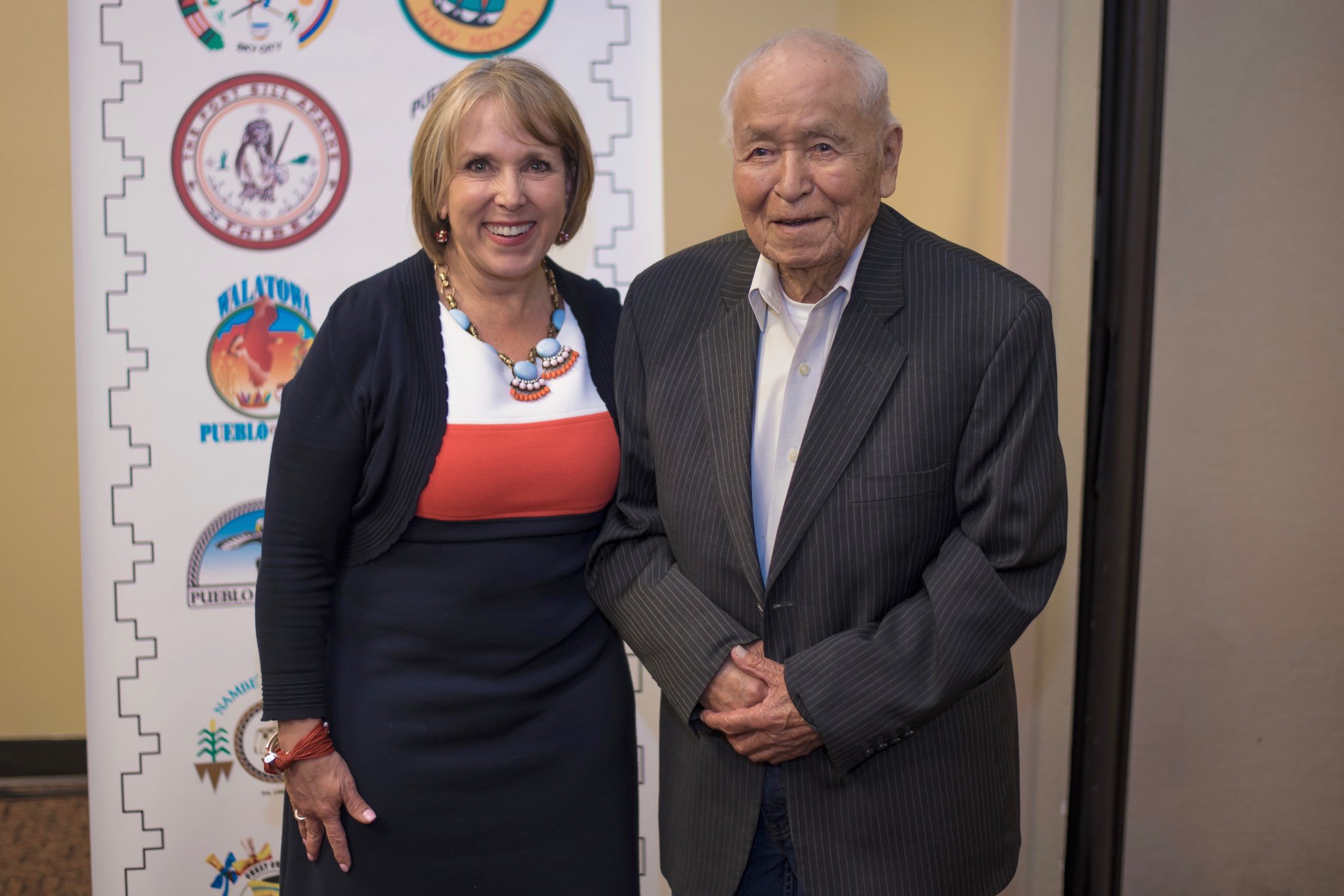
SPECIAL REMEMBRANCE: New Mexico Sen. John D. Pinto, a former World War II Navajo Code Talker, died on Friday, May 24, 2019. Pinto was one of the 400 native Navajo people who learned the code based on the Navajo language. It was used to communicate among the troops in the Pacific Theater during World War II. After the war, Pinto became a teacher and then a state senator in 1977. He was 94.
IMAGE: New Mexico Gov. Michelle Lujan Grisham and Sen. John D. Pinto (via Twitter)
Weekend Coin Finds Part II
 Although I had this token for a while, I was about to put it into an AirTite holder for storage. Since it was already imaged, I thought I would share it here. This is a token from the Trioboro Bridge and Tunnel Authority. The TBTA (now part of the Metropolitan Transportation Authority) is responsible for managing the bridges and tunnels that connect different areas of New York City. At one point in my life, I lived in New York and worked in New Jersey. To make the commute easier, I used to buy these token for $20 per roll to use in the exact change lanes. That lasted a week for crossing the Verrazano-Narrows Bridge into Staten Island.
With the introduction of EZ-Pass, tokens are no longer used. It is a relic of a bygone era of not so long ago when I commuted in and around New York City.
Let’s see if I can find more.
Weekend Coin Finds Part I
I know there has been a lot of news on the numismatic front. I know the spot price of gold closed at over $800 per ounce. But it is the weekend and it is time for some fun. Since this is my blog, I want to show off some recent finds—especially since I have not done that in a while.
In a previous post, I discussed competitive collecting 1976 coinage. These are the Washington Quarters, Kennedy Halves, and Eisenhower Dollars with the special reverse to commemorate the American Revolution Bicentennial. These coins are of great interest because they are the first change in coinage following my interest in collecting. In fact, I continue to search change looking for the Jack Ahr Drummer Boy design on the reverse of the Washington Quarter. Not including commemorative coinage, the change in location of mint marks, or a change in alloys, this was the first temporary change in coin design on a continuing series.
 Aside from competitive collecting, I would like to put together a competitive exhibit for an ANA convention about the 1976 coinage. In order to do that, I need a few “wow” items. Sure, I have the history—including copies of the laws that authorized that various coins—but there has to be a real eye catcher. I think I found it. How about three PCGS slabbed, gem proof coins with the labels autographed by the artists who designed the reverses!
These are three beautiful coins with very deep cameos placed in the slabs with the reverse facing the front and the autograph of the artists on the label. After winning the quarter and half-dollar very easily in a Teletrade online auction, it had taken another three months to win the Dennis Williams designed dollar. But looking at this set, it was worth the wait!
This is the first coin find posts of this weekend. Have a good weekend and stay tuned for a few other items that fit my “oh neat” criteria.
CCAC To Review Lincoln Commem Design
The US Mint announced that the Citizens Coinage Advisory Committee (CCAC) will hold a public meeting on November 13 at 9:00 AM (ET). CCAC Meetings are held at United States Mint Headquarters, 801 9th Street NW, Washington, DC. The agenda will include the presentation of new design candidates for the 2009 Abraham Lincoln $1 Silver Commemorative Coin.
Anyone interested in participating in the meeting should call 202-354-7502 for updated information on meeting time and location. Members of the news media are welcome. I wonder if bloggers count as news media?
Heritage Sells Stolen Pulitzer Medals
Newsday was alerted earlier this month that a Pulitzer Prize gold medal won by the newspaper appeared for sale on the eBay auction site. Although that medal turned out to be a replica, reporters found listing for three gold Pulitzer Prize Medals for auction at Heritage Auction Galleries.
Officials from Heritage Auctions listed the 1953, 1970, and 1974 medals that were awarded to Newsday which Heritage deemed as genuine gold award medals. These were the first three of 19 Pulitzer Prizes won by the newspaper. Heritage President Jim Halprin alleges that the medals were consigned from a Long Island coin dealer who claims to have purchased them from an estate sale. The coin dealer has hired an attorney and has not commented.
Newsday executives believed the original medals were stored in a safe in the newspaper’s Melville (Long Island) corporate offices while authorized replicas are on display at in their New York City offices. Executives opened the safe where they thought the medals were stored and found a locked box. When a key could not be located, Newsday hired a locksmith to drill the lock open. The box was empty.
Company officials contacted the FBI to report the theft. The FBI recovered two of the medals that were sold to someone in Florida who is cooperating with the investigation. The other medal will be returned from Heritage Galleries’ offices in Dallas, Texas. All three medals will undergo authentication by the Medallic Art Company, who created the medals for the Pulitzer Foundation.
Halprin defended the auctions claiming that it is Heritage’s policy to verify consignments, especially when they are from someone they have not done business with in the past. He noted that their procedures have been in place since 2001 after previous problems. Halprin did not comment further on this consignment except to say that Heritage will perform an internal investigation into this transaction.
Acquiring an original Pulitzer Gold Medal that was awarded to a newspaper still in existence should be suspicious. One would expect a firm like Heritage would scrutinize the attempt to consign such a prestigious award. Investigating the pedigree of this medal be easy. Since the name of the newspaper is engraved on the medal, the first first act would be to call Newsday to verify the medal’s pedigree. Heritage was probably so ecstatic to obtain such a prize that their eyes probably glazed over and rushed it to auction without doing their due diligence—at least this is how it appears!
Boxing the Three Lenses
Yesterday, I asked if anyone knew what a “Three Lens” was because it appeared in the Product Schedule page of the US Mint’s online catalog. User Mint News Blog said that the boxes the Mint sells to store proof coins sets to accommodate the three cases used in the 2007 proof sets with 14 coins. Today, the Mint made this box available on their website.
I learned that the Mint calls the cases for proof sets “lenses.”
Support the Coin Collectors Blog
 Buy me a coffee
Thank you for your support!
Let Me Know What You Think
Are you going to the World's Fair of Money
Total Voters: 17
 Loading ...