
Finally, a Cash Register Find
It has been eight months since I opened my shop of treasures. While I have had fun most of the time one thing that has not happened is a good cash draw find. That is until recently.
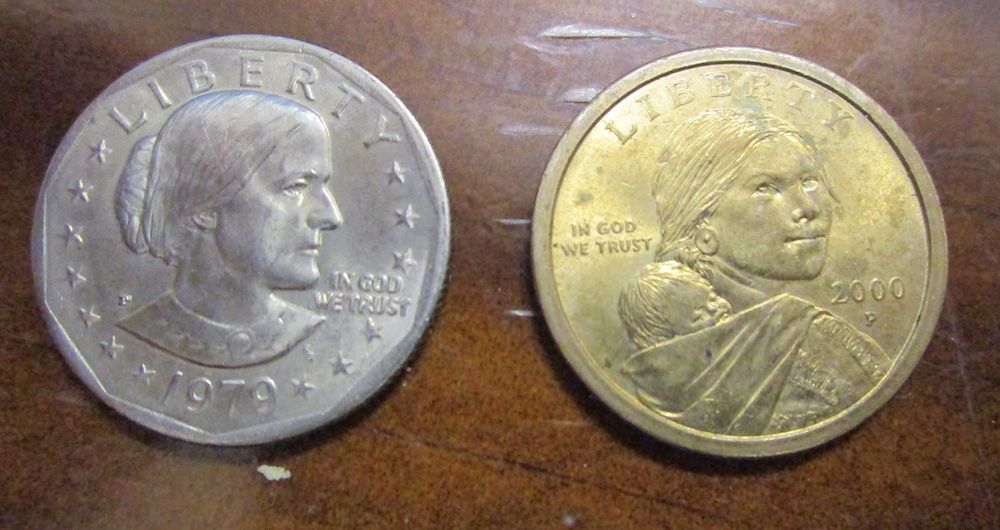
1979-P Susan B Anthony Dollar and 2000-P Sacagawea Dollar found in the cash draw
I think the patron was surprised I took the coins without question. I threw the coins in the far left slot and counted out his change. With a quick tear of the receipt and a nod, I thanked the customer for his business and he left.
Later, I was telling someone about the transaction and was told the customer was testing me. Apparently, some people use dollar coins, half dollars and two dollars bills to test the store to see if the store knows enough to take the coins. I was told that the “pass rate” for this test is under 20-percent. I guess I passed!
Earlier today, I passed one of the Sacagawea dollars out for change.

2013 British 10p coin. It looks better in hand!
It’s a cool find and worth 13-cents, but what is it doing in my cash drawer?
I cannot blame anyone because my assistant was not in and I was the only one operating the cash register. I didn’t open a roll taking the blame off the bank. No, this is my fault and I lost 12-cents on the transaction!
I thought I would find a loose Canadian cent or a Jamaican penny mixed in with the copper. Nope! Apparently, I didn’t pay enough attention and was handed 10 pence.
After counting the coins, I replaced the British coin with a U.S. quarter that was in my pocket. My drawer balances but now I have my own lesson to pay attention!
Fun With Coins: Coin Dominoes
As part of a promotion for Vodaphone and Sky in Great Brittan, someone laid down 10,000 £1 coins in a domino-like chain and set the chain in motion. It has the same fascination of dominoes, but these are £1 coins, which should appeal to us collectors. Playing with your money can be as much fun as collecting!
Sometimes Bigger Is Not Necessarily Better
Baltimore Coin and Currency Convention has seen tremendous growth since I have been attending the show during this decade. With greater interest in coins by hobbyists and investors, the gentlemen who operate the Baltimore show has allowed it to grow with this interest. To capitalize on the interest, the promoters added Hall C of the Baltimore Convention Center to the bourse space available. After two shows, Hall C was full for this past convention making it Baltimore’s largest numismatic show.
Realizing that this growth was inevitable, I went earlier than usual. Driving just over an hour from my suburban DC home, I arrived around 10:30 AM and met Zach (zrlevin from the Collectors Society’s Message Boards) and his mom in the lobby. They drove down from New Jersey to attend. Both are wonderful people and appears to have had a wonderful experience. Zach, being younger than I expected, is really into his collection. This is good since the hobby does need some fresh faces to carry on the traditions.
Since I have attended these shows before, I knew what to expect when I walked in. From the entrance, you see the rows of tables in Halls A and B. Hall C is to the right making the floor and “L” shape. As I expected, many regular dealers were in their usual position which allowed me to talk with and purchase from a number of acquaintances. Being a regular has the advantage of making better deals.
After a few years of doing some broad collecting, I am now focusing on a few items. One area of interest are early red Lincoln cents. Uncirculated Lincoln cents in red-brown and brown are relatively easy to find. But nice red cents prior to 1930 are difficult. And they are getting more difficult to find raw, meaning not slabbed. I would buy one or two coins at a time because of budget constraints, but I was able to find a good supply. However this and the last few shows have shown a drop in the number of red Lincoln cents available—even slabbed coins. Many dealers apologized and said that they have not had a high demand for early red Lincoln cents, which is why they had few. It is disappointing, but I am determined to find those to complete my collection.
One thing I noticed was a reduction of raw coins available for just about anything older than the clad-coinage era. There were very few vendors selling raw, uncirculated Morgan and Peace dollars as well as early Buffalo Nickels and Mercury Dimes. With few exceptions, there was a glut of slabbed coins. Since I am not a fan of slabbing (more on that at another time), I felt that the selection available to me was more limited than usual. I was able to purchase a number of items that I will resell on eBay, but I was unable to find the few coins I was looking for to fill my albums.
That is not to say I do not purchase slabbed coins. I purchased a nice 1986 American Silver Eagle graded MS-69 for a Registry Set I am putting together (more on that at another time). I also purchased a few MS-65 Eisenhower Dollars for another Registry Set. And I also dropped off a number of other modern dollar coins with NGC for grading that will be for Registry sets. Otherwise, I was looking for raw coins for my regular collection.
Another area that I like but seems to be reduced were the number of “junk boxes” on the floor. Junk boxes are either lower grade coins or coins that the dealer could not sell otherwise. Sometimes, I can search the junk boxes and find Barber Coinage that are considered very good (approximately VG-8) in grade. Or I can find coins that I know I could turn over on eBay. I noticed that the number of junk boxes were fewer and the quality of the coins were less than in past days. I also did not see many junk boxes with foreign coins. Since I have been working on a few lower denomination Canadian coins for fun, the junk boxes have a treasure trove of fillers for my albums. I was only able to pick up four nickels and two quarters for my Canadian collection.
In an interesting twist, there were more tables with non-numismatic items than in the past. Although many of these tables had jewelry, there were some antiques, memorabilia, and even a vendor for an item that keeps leaves out of gutters. It was an interesting discovery within a numismatic show.
In the past, I wondered if “the market for key coins going to shut out those of us who have to stick to a budget?” Considering the increased occurrence of slabbing and the difficulty in finding some of the key coins (e.g., 1921-PDS Walking Liberty Half Dollars), I wonder if I have to consider refocusing my collection goals. While all coins are increasing in value at a rate greater than inflation, slabbed coins are climbing even higher. I do not know if this is an issue caused by a lower supply and greater demand or the perception of prices as the spot price of silver increases, but I am concerned about being priced out of the market.
Although I was a little disappointed for this show, I still had fun and am looking forward to the next one in March. If you have not had a chance to come to this show, come to Bal’more and visit. Charm City is a wonderful place to visit especially with the Convention Center being next to the Inner Harbor. Come by and enjoy the show.
Numismatic Look at the New Congress
Now that the election is over and all that is left is the counting in two key senate races, it is time to consider what this will do for numismatic-related legislation. The 109th congress was very busy over the last two years. However, with a lame duck session of congress beginning next week with no passed budget, numismatic-related bills are finished for this year.
By rule, all legislation not enacted into law does not carry over into the next congress. So any bill that is active in the 109th congress, they would have to be re-introduced during the 110th congress for consideration. While some of these bills were originally introduced by representatives looking to curry favor with their voters back home, there are a few that have a chance in the next congress.
When the ten 1933 Saint-Gaudens Double Eagles that once belonged to Israel Switt were confiscated from one of his decedents, there was a move by congress to try to create a law that would define what was legal tender and what was not. Rep. Frank Lewis (R-OK) introduced the Numismatic Rarities Certainty Act of 2006 (H.R. 5077) to help determine the legality of other coins and patterns not “officially” considered US Government property, even though the Mint has not pursued those coins. Although the bill is still in committee, there is no reason to think that this will not be brought up again.
Rep. Jim Kolbe (R-AZ) introduced the Currency Overhaul for an Industrious Nation (COIN) Act (H.R. 5818) late in the second session. It is a sweeping piece of legislation that seeks to stop circulating cents by codifying rounding for cash transactions, eliminates the one-dollar paper currency in favor of coinage, re-introduces the $2 for circulation, along with other changes. Since the bill was introduced in August, there is no chance of this being resolved in this congress. There are some provision that are promising and will be brought again.
Two commemoratives that passed where they were introduced are certain to be re-introduced. The NASA and JPL 50th Anniversary Commemorative Coin Act (H.R. 68) will celebrate the 50th anniversary of these institutions with a $50 gold and $1 silver coins in 2008 was passed in the House. Also, the American Veterans Disabled for Life Commemorative Coin Act (S. 633) was passed in the Senate and specifies the issuing of two $1 silver commemorative dollars with the proceeds helping fund the construction of the American Veterans Disabled for Life Memorial.
One more bill I would like to mention that did pass in the Senate but probably has little chance of being re-introduced in 2007. The Theodore Roosevelt Commemorative Coin Act (S. 863) was to honor the 100th anniversary of our 26th President being the first sitting president to win the Nobel Peace Prize in 1906. Although it passed the senate, the current state of politics in this country and that this year was the century anniversary makes this bill a long shot.
Congratulations to all of the winners and I hope you do what is right for the nation as well for all of us interested in numismatics.
CCAC Meeting Rescheduled for November 14
The Citizens Coinage Advisory Committee (CCAC) meeting that I previously reported would meet on November 2 is now scheduled to meet on November 14. The primary agenda continues to be to review the designs for the obverse for the 2008 Presidential $1 coins and discussion of the CCAC Annual Report.
CCAC meetings are open to the public. Meetings are held at the US Mint Headquarters, 801 9th Street NW, Washington, DC, in Conference Room A on the 2nd Floor.
Mint Strikes SF Commems
The US Mint announced on October 27 that they have begun striking San Francisco Commemorative silver proof coins at the San Francisco branch mint. Representative Nancy Pelosi and Senator Dianne Feinstein joined members of the San Francisco Museum and Historical Society to witness the striking ceremony.
Authorized by Public Law 109-230 [GPO: text/pdf], San Francisco Old Mint Commemorative Coin Act “require[s] the Secretary of the Treasury to mint coins in commemoration of the Old Mint at San Francisco, otherwise known as the ‘Granite Lady’.” Sales of the commemoratives will include a $35 surcharge for the gold coin and $10 for each silver coin. Proceeds will be distributed to the San Francisco Museum and Historical Society to rehabilitate “the Historic Old Mint in San Francisco as a city museum and an American Coin and Gold Rush Museum.” It has a potential to raise $8.5 million for the project.
The silver commemorative will be minted in a 90-percent silver and 10-percent copper alloy with the obverse design based on the San Francisco Mint Medal by Sherl J. Winter. The reverse will use the reverse design of the 1904 Morgan Dollar design by George T. Morgan.
Four months from passage of the law to first striking is the government and coin process mechanisms moving at light speed. Let’s hope that the coin will be as impressive as it sounds and produced in a similarly impressive manner.
Support the Coin Collectors Blog
 Buy me a coffee
Thank you for your support!
Let Me Know What You Think
Are you going to the World's Fair of Money
Total Voters: 17
 Loading ...