
January 2019 Numismatic Legislation Review – Welcome to the 116th Congress
 At noon on January 3, 2018, the 116th Congress gaveled into session. The first day of a new congressional session is mostly ceremonial and procedural. Leaders are chosen. Rules are established. Committees are formed. And the House of Representatives gets to work on a new budget.
Usually, the budget the House starts with is for the next fiscal year. This year, the 115th Congress did not finish their work and left the government unfunded. It does not matter whose side you are on or what animal you worship, the bottom line is that 800,000 federal employees, many more contractors, and the businesses that rely on their patronage were hurt. Sure, the federal employees will earn back pay but the contractors who were furloughed will not. The businesses that serve these people will also not be made whole.
But that did not stop members of Congress from submitting bills for consideration. As I write this, there have been 842 bills submitted in the House of Representatives and 268 in the Senate. Of those bills, only four have numismatic significance. All four bills were also submitted in the 115th Congress but had died in committee when that Congress adjourned for the final time.
As of now, the Financial Services Committee, chaired by Rep. Maxine Waters (D-CA), has not posted the rules as to what it will take for numismatic-relation legislation to move forward. Since the 112th Congress, the committee required a numismatic bill to have 250 co-sponsors. But since the control of the committee has changed parties, we will have to wait until the committee publishes their rules.
Here are the first four numismatic-related bills submitted in the 116th Congress:
H.R. 61: Carson City Mint 150th Anniversary Commemorative Coin Act of 2019
H.R. 500: Christa McAuliffe Commemorative Coin Act of 2019
H.R. 636: To require the Secretary of the Treasury to mint coins in commemoration of Muhammad Ali.
S. 239: A bill to require the Secretary of the Treasury to mint coins in recognition of Christa McAuliffe.
Buffalo Strikes Gold
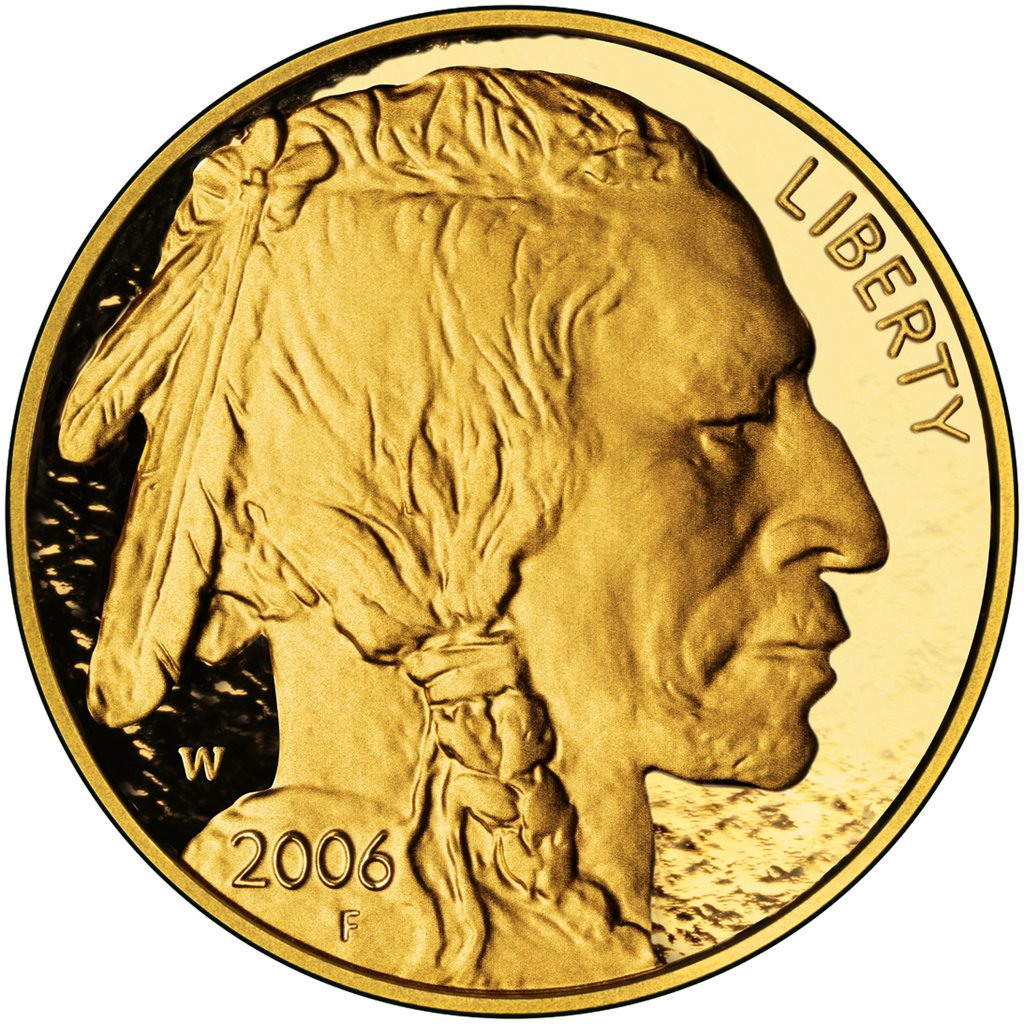 With the push of the button, James Earle Fraser’s Type 1 Buffalo design is now preserved in 24-karat gold as part of the American Buffalo Gold Coin program. During the ceremonial striking ceremony, the Mint’s Deputy Director David A. Lebryk said the design “which have been American favorites since they were first used in 1913, recall a golden age of coin artistry.” The one ounce coin will be produced in uncirculated and proof versions. The accompanying pictures of the coins are from the US Mint Image Library (click the images to enlarge).
 With the issue of the $50 American Buffalo Gold Coin, the Fraser Buffalo design joins Augustus Saint-Gaudens’ Liberty Double Eagle and Adolph A. Weinman’s Walking Liberty as classic coin designs that grace US bullion coins. Both Weinman and Fraser studied and worked with Saint-Gaudens. Their coin designs are the result of President Theodore Roosevelt’s push to update US coinage to be the most beautiful in the world. Roosevelt commissioned Saint-Gaudens to produce classic, yet modern designs. Saint-Gaudens responded with the famous Liberty design used on the $20 double eagle and the Indian $10 eagle coins prior to his death.
Roosevelt was also instrumental in pursuing the Victor David Brenner designed Lincoln Cent to honor the 100th birthday of Abraham Lincoln. We will celebrate the Lincoln’s 200th birthday and the cent’s 100th anniversary in 2009 with four coins to commemorate the the life our 16th President.
That “golden age of coin artistry” continues is a tribute to the vision of Theodore Roosevelt and the love he felt for this nation. BULLY!
San Francisco Old Mint Commemorative Coin Act is Law
On Thursday, June 15, 2006, the White House announced that President George Bush signed H.R.1953, San Francisco Old Mint Commemorative Coin Act, into law. Now as Public Law 109-230, [GPO: text/pdf] the US Mint has until the end of this year to design, strike, and sell these commemoratives. This will be a real test for the Mint and the Citizens Coinage Advisory Committee (CCAC) and Commission of Fine Arts (CFA) bureaucracies.
The American Gold Buffaloes
On June 14, the US Mint issued a press release inviting the media “to get a rare glimpse inside the United States Mint at West Point, New York, on Tuesday, June 20, 2006, to see the Nation’s first 24-karat, pure gold (.9999% fineness) one-ounce coin, the American Buffalo, being minted in both investor bullion and collectible proof versions at an official strike ceremony. A tour of the United States Mint, which will include its store of gold bars, will follow the ceremony.”
The American Buffalo 24-Karat Gold Coin program was authorized under Public Law 109-145 [GPO: text/pdf] that required the Mint to use the James Earle Fraser Type 1 Buffalo Nickel design to produce a coin containing one ounce of .9999 fine gold purchased from US sources. The law requires the Mint to strike and issue the coins within six months of enacting the law. The press release says that the sale of these coins will being at noon on June 22, 2006.
As with the American Eagle Bullion program, the Mint will sell uncirculated coins through pre-approved Authorized Purchasers. Uncirculated coins will be priced according to the current spot price of gold plus a small premium. Collectors will be able to purchase proof coins directly from the Mint and will be priced at $875.
This is one time I wish I was a member of the media since they will be allowed into the West Point branch mint that is usually closed to the public. Nicknamed “The Fort Knox of Silver,&rdquo it should make for a very interesting tour. I hope the numismatic media takes and publishes many pictures of their tour so they can share the experience!
Of Persians and Hoboes
If you have not attended a meeting of your local coin club, you should find the time and go. Not only will you meet fellow collectors, but you might learn something that can inspire you in your collecting endeavors. One of the reasons I try to ensure I make it to the monthly meeting of the Montgomery County Coin Club is because I always go away with an appreciation for something different about the hobby.
At these monthly meetings, members are encouraged to bring in their monthly finds. After the brief business portion of the meeting, members make a short presentation on their finds. This week, Jerry Grzenda, a collector of world coins, brought in coins representing the last century of Iran. Jerry’s presentation included a history of Iran as seen through its coinage. It was a great learning experience and the coins were beautiful.
Another highlight of the meeting was the presentation by Ron Brais about Hobo Nickels. While I have heard about Hobo Nickels, all I knew about them was what I learned in passing. In listening to Ron talk, I learned that the original Hobo Nickels were created between 1913 and 1935 using only Buffalo Nickels because the design had large figures on both sides that could be used as the basis of the design. These elements allowed the carver to make just about any design, and usually did. Designs were as varied as the artists who carved them. Hoboes would use the carved nickels to trade for food, shelter, or other favors during their travels.
The most famous Hobo Nickel artist was George Washington “Bo” Hughes. Bo ran away from home at a young age and was befriended by a hobo identified as Bert. After a train yard scuffle, Bert took Bo under his wings, protected him from the tramps and bums and taught Bo how to carve realistic images into the Buffalo nickel. For many years, Bo would ride the rails and carve nickels living the life of the hobo as he looked for work to survive. Bo’s work on Hobo Nickels allowed him to eventually get a job as a craftsman. It lasted until 1957 when he cut his left hand while carving a nickel. At that time Hobo Nickels were no longer popular and Bo just faded away. He died in 1982.
The life and history of George Washington “Bo” Hughes has been immortalized in the book Hobo Nickels by Delma K. Romines (out of print).
Today, the Original Hobo Nickel Society has a number of artist members that are carving images into Buffalo and Jefferson nickels to keep the art alive. Some of the designs are ingenious and beautiful while others are copies of carving on older coins. Modern nickels are made using modern tools that allows the carving to look much cleaner than their older examples. The old methods and tools were not able to make clean lines but it gave them a character that cannot be matched.
The example of a Bo Hughes carved nickel Ron showed us was beautiful in its design and execution. The care and craftsmanship that went into carving that coin was evident. Hobo Nickels can sell from $200-$1500 depending on condition and the artist. Coins by Bo Hughes are worth more than others. I may have to add one to my collection.
The Granite Lady Gets Her Commem
I was updating the Bloglinks (see Numismatic Links in the sidebar) when I clicked on the link for H.R.1953, San Francisco Old Mint Commemorative Coin Act, and found that it has been enrolled after being passed by both the House of Representatives and Senate. Once a bill has been enrolled, it is sent to the President for action. This bill is likely to be signed by President Bush.
The Act “require[s] the Secretary of the Treasury to mint coins in commemoration of the Old Mint at San Francisco, otherwise known as the ‘Granite Lady’.” The bill specifies that the design will represent the San Francisco Old Mint Building and its role in rebuilding San Francisco after the 1906 San Francisco Earthquake. The bill calls for 100,000 $5 coins be minted using a 90-percent gold alloy along with 500,000 $1 coins be made from a 90-percent silver alloy. Coins will be offered in proof and uncirculated qualities and requests that the coins be struck “at the San Francisco Mint to the greatest extent possible.”
Sales of the commemoratives will include a $35 surcharge for the gold coin and $10 for each silver coin. Proceeds will be distributed to the San Francisco Museum and Historical Society to rehabilitate “the Historic Old Mint in San Francisco as a city museum and an American Coin and Gold Rush Museum.” It has a potential to raise $8.5 million for the project.
This bill is going to put the system to a real test. Unless the US Mint has been preparing for this bill’s passage, the bill says that the coins can be issued “only during the 1-year period beginning on January 1, 2006.” Not only does the Mint have to make at least one design, but the design must be approved by the Citizens Coinage Advisory Committee (CCAC) and the Commission of Fine Arts (CFA). It appears that both groups meet during the third week of the month. It may take as little as three months for the design to be approved before die making and production begins.
With such a short time period to move the bureaucracy, the numismatic community should be prepared for the varieties and errors as the Mint rushes to have these coins minted and sold by the end of this year.
Support the Coin Collectors Blog
 Buy me a coffee
Thank you for your support!
Let Me Know What You Think
Are you going to the World's Fair of Money
Total Voters: 17
 Loading ...