
It was for the wurst

Staatliche Münze Berlin
(photo courtesy of Wikimedia Commons)
While the story about the currywurst commemorative coin seemed like something to poke fun at, I was reminded that Staatliche Münze Berlin, the Berlin State Mint (www.muenze-berlin.de), is not an official government mint. It is a private mint that has been contracted by the German government to assist in producing coins. Their website reports that they produce one-fifth (20-percent) of all German coins.
Reports suggest that the Staatliche Münze Berlin has been under contract to Latvia to produce legal tender coins since 2014.
It appears that Staatliche Münze Berlin would be to Germany as the Pobjoy Mint is to the United Kingdom. Both a private mints that are contracted to strict legal tender coins that create their own commemorative.
This might mean we are safe from coins commemorating poutine and haggis. However, the idea of mixing curry with ketchup may be worth a try!
Evolution of the $20 Bill
Money has always been a fascination because of their design and the history they reveal. It is interesting to look at a series of the same denomination and learn the history behind the designs. I had the chance to do that when my bank’s ATM gave me three generations of $20 Federal Reserve Notes (FRN). Although I am not a bank note collector, I find their images and devices interesting.
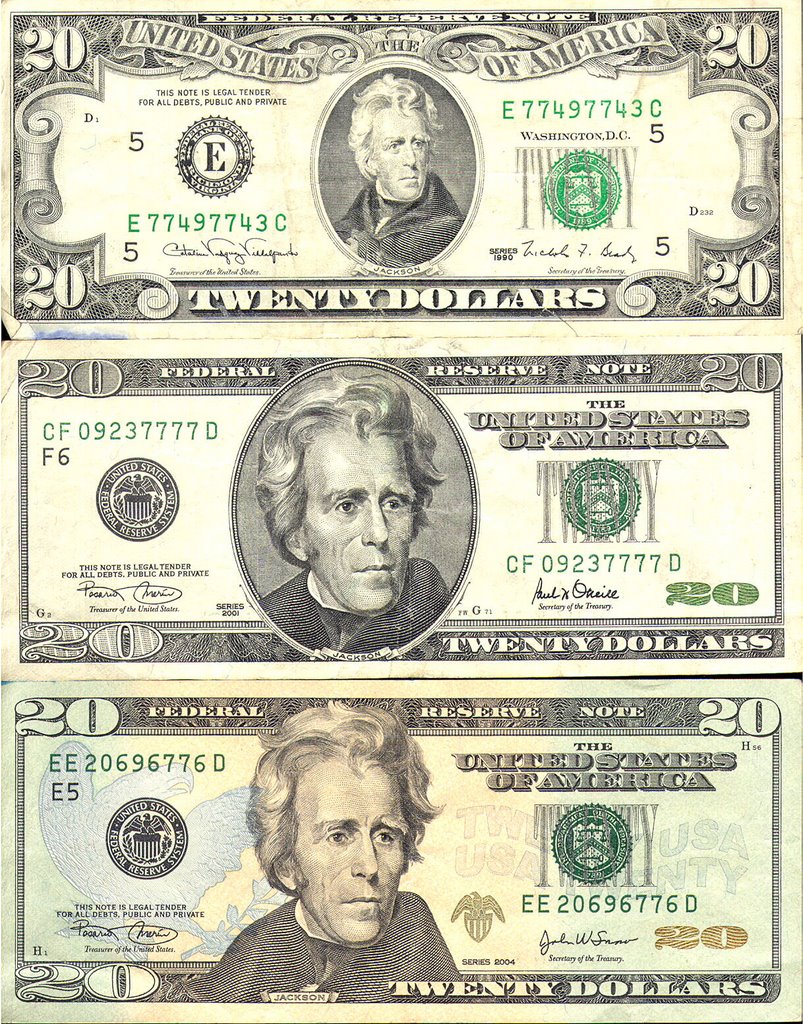 First, I found is the Series 1990 note with the signature of Treasury Secretary Nicholas F. Brady and Catalina Vasquez Villalpando, the Treasurer of the United States. Both Brady and Villalpando were appointed by President George H. W. Bush and served until the end of his term. Brady also served for six months under President Ronald W. Reagan.
The second is a Series 2001 note with the signatures of Treasury Secretary Paul M. O’Neill and Treasurer Rosario Marin. They were appointed by President George W. Bush during his first term. The third note is from Series 2004 with Marin’s signature along with Treasury Secretary John W. Snow, who succeeded O’Neill.
 My first impression was the differences in design. The $20 FRN was first designed in the 1920s and was an evolution of earlier designs. It has ornate and fine engraving with a green hue. The fine engraving has been a staple of bank notes since their inception as a means to prevent counterfeiting. The “green back” was used to prevent copying using new photographic technologies which had a difficult time reproducing the green color. Today, the green color remains out of tradition considering modern imaging capabilities.
The newer notes do not have a lot of fine engraving. The same portrait of President Andrew Jackson is used but was enlarged on the newer notes with the border around the portrait removed on the Series 2004 notes. Another difference is the addition of color with a darker green hue and peach on the front adds a new dimension I am not sure I like.
Although an engraving of the White House remain on the reverse, the older note uses an image taking from the south lawn from the ellipse. The new notes show the White House from the north lawn that could be seen from Pennsylvania Avenue more centered rather than filling the entire reverse. As part of the Bureau Engraving and Printing’s (BEP) program to include better security features, they have left the sides blank so the watermark image and security thread can be easily seen.
I like the front of the latest note, but I don’t like the color. I also miss the indication of the Federal Reserve System Bank for which the notes were printed. It is like the mint mark for the FRN. I always found it interesting finding notes from different areas. I like the south lawn portrait better than the one from the north lawn. I am disappointed with the starkness of the reverse. I am not sure that BEP can change this given the nature of the security features.
Finally, the attempt to colorize the notes is not working. It looks cheesy. If BEP colorizes the note, it should be more than just a gradient on the background. Many countries use color in their bank notes as part of the devices, not just to splash some color around to say “look at the color.” I think BEP can do better.
I Am Still Here!
After a few days of nice finds, real life set in leaving me very busy with my day job and trying to complete my taxes. Tax season is not one of my favorite times and I am sure it does not rank high on your list.
Since the postings of my finds, I withdrew money from my bank’s ATM and found the last three types of $20 Federal Reserve notes. I will write more about this over the weekend, but seeing the transition of the design is very interesting.
Other future entries will include a word or two about two new purchases: silver Chinese Pandas and the Breast Cancer 25-cent circulating commemorative from the Royal Canadian Mint. The Pandas are very interesting and worthy of a look. As for the Breast Cancer Commemorative, I am an advocate for any program that raises money and awareness for cancer research. Stay tuned!
New Find Leaves Me 7½ Cents Short
While searching through my change to feed the soft drink machine, I was picking through my quarters and found something that looked quite a bit different. The obverse had the image of Her Majesty Queen Elizabeth II. Thinking that it was a Canadian coin, I returned it to my pocket and selected a quarter to quench my thirst.
When I returned to my desk I decided to examine the coin further to find only the words “Ten Pence&rdquo” on the reverse. Since it did not have Canada or the name of any other Commonwealth Realm, it had to be British coinage. A quick search revealed that it is a 1992 10 Pence coin. The 1992 10p coin is a resized, smaller version of the decimalization coins.
Aside from being the second interesting find in as many days, someone still owes me 7½ cents since the coin is worth 17½ cents at the current exchange rates!
Catching A Buffalo
I was standing at the cash register at a local convienence store to purchase a diet soft drink sifting through change to pay my tab. As I picked quarters and nickels to give to the cashier, I saw a nickel that looked different. I pushed it aside to provide payment for my libation.
Outside of the establishment, I reached back into my pocket and removed the coins to find a 1927 Buffalo Nickel! The rim and high-points are flat, the buffalo’s horn cannot be seen, but the date is visible. Even though the 1927 coin is a common date and the find is in good (G-4) condition, it was nice to find. Regardless of the condition, the James Earle Frasier-designed coin remains one of my favorites.
An Open Letter to the ANA Board of Governors and Members
The following is an open letter to the American Numismatic Association Board of Governors with copies being provided to Numismatic News and the Numismatist for publication to the ANA membership. The note refers to most recent articles that appeared in Numismatic News as wells as previous news reports regarding the actions of the Board. Permission is granted to all news publications to reproduce this note in whole or part as long as proper attribution is included.
There are so many good things to write about in numismatics. Aside from my own successes in finding interesting items, the interest in collecting has risen significantly. Regardless of whether the reasons can be tied to the 50 State Quarters program, the new currency, the fascination with the skyrocketing values of rare coins, or the rise in the precious metals markets, the interest in numismatics seem more sustainable than the overheated market of 1979-1980. Even with my late arrival for the Baltimore Coin Convention, I saw remnants of a very strong weekend. Then I opened the March 28, 2006 edition of Numismatic News to pages 34-36 and wondered if American Numismatic Association is in step with its members.
ANA President William H. Horton, Jr. asked Numismatic News to reproduced a guest editorial by ousted Governor Walter Ostromecki, Jr. that originally appeared in Coin World. The article appeared with a previously unpublished rebuttal written by Mr. Horton. If you are a member of the ANA, I urge you read these tomes. They should disturb you as much as they disturbed me.
The articles makes it appear that a person who is naive in the political innards of the ANA was caught up in the ANA Board of Governors’ attempt at propaganda. It has the appearance that the Board is covering up its action. For Mr. Ostromecki and the ANA Board, please remember that the operative words are “appear” and “appearance.” These new statements and previous articles on the matter leaves a lot of questions as to whether the current Board can regain and maintain the trust of the membership.
Was there a problem with Mr. Ostromecki’s credibility? It is possible one could assert this accusation from his own written explanation. One of his arguments was that copies of the policies and procedures were not provided in a timely manner. But as an ANA member, Mr. Ostromecki should know that the Association has a charter and bylaws that does explain how he should conduct himself. This is discussed in the Article “Board Member Code of Ethics.” By Mr. Ostromecki’s own admissions, it appears that he violated Section 8 of that Article regarding confidentiality of Board proceedings on more than one occasion.
Mr. Horton’s response said that the board was concerned that there may have been a violation of Section 11 which prevents board members from making “any promises or commitments on behalf of the Association unless authorized to do so….” This may be the one issue that would truly justify the board’s actions. But the attack laid by Mr. Horton that used 18 paragraphs and almost three full columns of print before addressing this issue leaves the impression that there was a vendetta against Mr. Ostromecki.
In the ANA Bylaws Article “Board Member Code of Ethics,” Section 13 says, “A Board member shall maintain the highest standard of personal conduct.” An open article in a numismatic publication that uses the word “lies” without full disclosure of the evidence is not only bad judgment but does not meet any high standard of personal conduct. As ANA President, Mr. Horton should be above name-calling and be the one to set the example in this matter. In short, Mr. Horton should examine his own judgment and motives before accusing Mr. Ostromecki of showing bad judgment.
As a professional in the area of information security and public policy, it appears that the ANA has a serious business risk in the way its board conducts the Association’s business. Aging bylaws have not been amended to reflect the changing needs of the organization. As a result, the board appears to be enforcing de facto operating procedures without appropriate policies in place. For example, there are provisions in the bylaws where the Association’s counsel and executive director are required for decisions, yet the same person holds these offices. If Chris Cipoletti is still acting as executive director and of counsel to the Association he should be asked to resign one of these positions. Not only does this suggest a conflict of interest that is dangerous to any organization but an outsider can question the ethics of an attorney that would legally advise an entity which he has a personal stake. This situation should be resolved immediately.
Another de facto standard without appropriate policy of the use of email to conduct Association business. Email is not covered in Section 10 of Article IV of the ANA bylaws. If the board is that interested in confidentiality, they should know that sending email is the electronic equivalent of mailing a postcard. Policies of known services like AOL and Google say that they reserve the right to scan your email for violations of their policies. Making this practice more incredible is that there have been accusations against AOL and Yahoo! for misuse by their employees. If there is a lawsuit against the ANA for items sent in email, the ANA will have a difficult time proving the chain of custody of their messages. The potential outcome of such litigation should worry every ANA member, especially that some of the Board members have accounts with these services. The Board is urged to consider proposals to improve on the bylaws so that it reflects the Association’s current operating environment by addressing the risks with mitigations that will improve operations, like supplying secure, archival email access on ANA controlled servers.
Many people will agree with Mr. Ostromecki’s comment that the actions of the board lack transparency. As a member driven organization, the Board should be accountable to the membership. By not disclosing policies, procedures, and the essentials of decisions made by the Board, ANA members left to question the motivations of the decisions made by the Board of Governors. The privilege of serving on the Board of Governors in a organization where membership is a privilege should include a responsibility to be accountable to those who have entrusted you with the organization’s present and future. The Board members must demonstrate that they are deserving of this privilege by making as much transparent to the membership as legally and practicably possible.
In the time since the election of the Board of Governors, there have been letters printed in numismatic publications that indicate that members and non-members are losing trust in the Association. If the current course continues, the potential is there to put the ANA charter in jeopardy. No ANA member wants to see the Association fall into this type of disarray. Therefore, the Board of Governors is urged to consider these suggestions to strengthen the ANA for today and the future.
For the record, I am and will remain an ANA member.
Support the Coin Collectors Blog
 Buy me a coffee
Thank you for your support!
Let Me Know What You Think
Are you going to the World's Fair of Money
Total Voters: 17
 Loading ...