Nov 18, 2015 | BEP, cents, coins, commentary, currency, dollar, economy, Federal Reserve, US Mint
 Over the summer, a Harris Poll was conducted to understand how Americans feel about abolishing the one-cent coin and the paper dollar note. Even though there are pundits calling for these changes and even the end of physical currency, Harris found that those wanting to keep the lowly one-cent coin continue to hold the majority opinion.
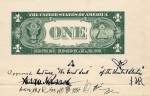
Series 1935 $1 FRN Reverse Early Design
Every so often an article is written, usually by the political elite, about ending lower denomination coins for many reasons including the high cost of mintage or the inconvenience of their existence. Others point to rise of non-cash transactions and the rise of digitally created currencies as the future.
Those of us who work in areas outside the larger commercial world has experience with a cash economy that is not tied to economic status. One of those is the numismatics industry. While many dealers will take credit cards, and will pass along the fees along to the customer, many dealers have said that most of their off-line business is a cash-based business. While larger purchases are done using checks, most will leave shows with more hard currency than other types of payments.
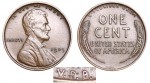
1909-VDB Lincoln Cent
There are people who are leery of using credit and debit cards for every transaction. We use cash to limit our exposure. In this connected world, the credit and debit card leaves a digital breadcrumb that is available to be hacked. I cannot tell you how many times I watched people in local convenience stores punch in their codes in a matter I could see them and then leave their receipts behind. This could be used to steal your money and your debit cards are not covered the same as credit cards. But the public does not see this.
A week does not go by without a report of the hacking of personal information that should not be made public. Unfortunately, it is getting to be like rain on the hot-tin roof, after a while the sound blends into the background.
According to the Federal Reserve, there was approximately $1.39 trillion in circulation as of September 30, 2015, of which $1.34 trillion was in Federal Reserve notes. That represents a lot of money that would have to be accounted for if we were to go into a cashless society. It would take a significant effort that would not make for good public policy.
The calls to make changes to change are beginning to drone on as background noise like rain on a hot-tin roof.
Nov 13, 2015 | coins, commentary, counterfeit, news
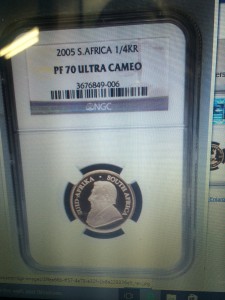
The counterfeit quarter-ounce Krugerrand in a counterfeit NGC holder that was purchased in Fullerton, California.
The biggest threat to the numismatics industry is not the lack of participation by younger people, women, or people of color, all of which are problems, the threat that counterfeits pose will drive away potential collector and investors. Anyone that collects scarce or rare coins should be very concerned about counterfeits.
Industry heavyweight Dwight Manley issued a statement after his company was fooled by a counterfeit Krugerrand in a counterfeit third-party grading service holder. Here is the statement:
Beware of Frighteningly Deceptive Counterfeits
Statement By Dwight Manley
Prominent rare coin dealer and collector Dwight Manley, owner of Fullerton Coins & Stamps in Fullerton, California and Managing Partner of the California Gold Marketing Group, who assisted a quarter-century ago in breaking up a counterfeit coin and counterfeit holder scheme, has issued the following statement.
“A frighteningly deceptive counterfeit has been encountered, and the world needs to be told about it. We recently realized that a 2005-dated quarter-ounce South African Krugerrand labeled NGC Proof 70 is not only a counterfeit coin, it is housed in a counterfeit Numismatic Guaranty Corporation holder that has the same certification number on the label as a genuine 2005 PF 70 one-quarter ounce Krugerrand listed in the NGC data base.”
“The fake was purchased on October 23, 2015 by a knowledgeable employee of Fullerton Coins & Stamps over the counter from a semi-regular customer. Before making the purchase, the employee checked the NGC website to see if the certification number and coin description matched. They did: cert number 3676849-006.”
“I recently examined the coin, and it just didn’t look quite right. I did a side-by-side, inch-by-inch comparison between the encapsulated coin the store purchased and the obverse and reverse photos on the NGC website. The reproduction of the NGC hologram on the fake is almost dead on the same; however, there is one distinct difference between fake and genuine on the left side of the front insert label. On the fake coin, the circle in the NGC logo (an encircled balance scale) goes almost entirely around the P in the grade PF 70. On the genuine coin’s label, the P is outside the logo circle.”
“An amazing amount of effort obviously went into creating a fake coin and a fake holder with a cert number and description that match a genuine coin. I’ve notified NGC, but in the meantime, I caution collectors and dealers to watch out for any similar, deceitful and dangerous counterfeits.”
Nov 5, 2015 | coins, commemorative, legislative, policy, US Mint
 Those who follow politics has watched the machinations that the House of Representatives went through before picking Rep. Paul Ryan (R-WI) as the 54th Speaker of the House of Representatives. During that time, not much else happened outside of the requisite budget battles. But there was one bill introduced that may be of interest:
S. 2185: Breast Cancer Awareness Commemorative Coin Act
Sponsor: Sen. Heidi Heitkamp (D-ND)
• Introduced: October 20, 2015
• Referred to the Senate Banking, Housing, and Urban Affairs Committee
• Summary:
- 2018 Commemorative program
- 50,000 $5 “pink gold” coins with $35 surcharge
- 400,000 silver $1 coins with $10 surcharge
- 750,000 clad half-dollars with $5 surcharge
- Surcharge paid to Breast Cancer Research Foundation for the purpose of furthering breast cancer research
Track this bill at https://www.govtrack.us/congress/bills/114/s2185

iPhone 6S in Rose Gold
If you think that this bill looks very much like H.R. 2722, you are a very perceptive person. The only difference between this bill and H.R. 2722 is the specification to use “pink gold.” Pink gold is actually “rose gold,” which has a pinkish hue. For the record, Apple’s new iPhone 6S comes in rose gold that looks more pink that “rose.”
Speaking of budget bills, one of those bills, S. 2132, has been reported out of committee and waiting for a Senate vote. What is significant about the bill is that it outlines how much money the U.S. Mint can withdraw from the Public Enterprise Fund, the account where the seigniorage from all coin sales is deposited. The bill states:
United States Mint – United States Mint Public Enterprise Fund
Pursuant to section 5136 of title 31, United States Code, the United States Mint is provided funding through the United States Mint Public Enterprise Fund for costs associated with the production of circulating coins, numismatic coins, and protective services, including both operating expenses and capital investments: Provided, That the aggregate amount of new liabilities and obligations incurred during fiscal year 2016 under such section 5136 for circulating coinage and protective service capital investments of the United States Mint shall not exceed $20,000,000.
iPhone image courtesy of Apple.
Oct 29, 2015 | administrative, coins, fun, news, personal
 Sometime in 2005 I began to search the Internet for information about coins. The two major publications, Coin World and Numismatic News, were not quite fully engaged online at that time. There were other online services but there was not something that would be the voice of a collector. Chat boards are nice but they are fractured. I wanted to have a conversation with the community.
Although I have a technical background, I did not know how to create and run a blog. After doing some research I discovered Blogger, Google’s blogging platform. After playing with the administration and learning how to create a blog post, I wrote my first post on October 29, 2005.
In my first post, I said that the coins I like include “Adolph A. Weinman’s Walking Liberty Half-Dollar and Liberty Head “Mercury” Dime, James Earl Fraser’s Buffalo Nickel, Augustus Saint-Gaudens’ $20 Double Eagle, and Bela Lyon Pratt $5 Half-Eagle.” Not much has changed except for my interest in exonumia, especially those pieces with ties to New York City, and the addition of Canadian coins to my collection
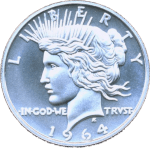
The blog has changed, or I would like to think it has evolved over the years. The biggest change was moving away from Blogger to my own domain. As part of the move I decided to create a logo using the allegedly non-existent 1964-D Peace Dollar, and I now participate social media specifically Twitter and Pinterest. What has not changed is the amazed and humbling experience I feel when I look at the server logs to see that more than 1,000 people read my posts—even with the recent slowdown in writing.
To all my readers, past, present and future, THANK YOU for being part of my numismatic adventure!
Stay tune… more to come!
Oct 27, 2015 | Britain, bullion, coins, nclt, video
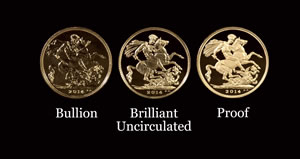
Royal Mint Striking Standards
As part of the article and video they discuss the differences between the three types of uncirculated commemorative coin finish: Proof, Brilliant Uncirculated, and Bullion. For the Royal Mint, proof are the highest standards followed by brilliant uncirculated then bullion.
While this may be intuitive to experienced collectors, novice and new collectors may be confused by the difference. The Royal Mint does a very good job at explaining the difference in a short, well produced video. It should be interesting to the beginning and expert collector to see how another mint does their work.
Image and video courtesy of the Royal Mint.
Oct 22, 2015 | coins, markets, news, values
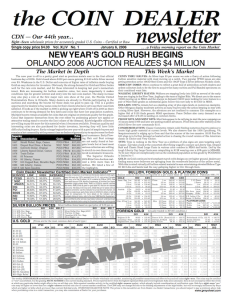 Earlier this year, Shane Downing, editor and publisher of the Coin Dealer Newsletter, better known and “The Greysheet” died of colon cancer on Jun 18, 2015. Shane became publisher following the death of his father, Ron Downing, in 1997.
The Downings have been running The Greysheet since 1884 when Ron and Shane’s grandmother Pauline Miladin purchase the publication from its original owners.
The Downings expanded the publication to include quarterly supplements, The Currency Dealer Newsletter (Greensheet) for currency, Certified Coin Dealer Newsletter (Bluesheet) for certified coins, and special monthly supplements highlighting specific coins. In recent years, CDN has been available online as a PDF file in a program they call CDNi.
Early last month it was announced that an ownership group led by John Fiegenbaum, formerly president of David Lawrence Rare Coins (DLRC), has purchased CDN Publishing. The ownership group includes Steve Halprin and Steve Ivy, co-founders of Heritage Auctions; Mark Salzberg, Chairman of Numismatic Guaranty Corporation; Steve Eichenbaum, CEO of the Certified Collectibles Group, the parent company of NGC. Fiegenbaum has retired from DLRC to dedicate his time to running CDN with the assurance that CDN will remain an independent entity. The other owners will remain in their current positions.
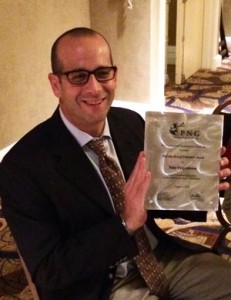
John Feigenbaum receives 2014 Abe Kosoff Founder’s Award from the Professional Numismatic Guild
CDN will be moving from California to the east coast. Although the press release does not specify the location, it is likely that CDN will be located in Virginia Beach, Virginia where Fiegenbaum has been running DLRC for over 30 years.
One of the benefits of Fiegenbaum running CDN would be to improve online access to their publications. Under Fiegenbaum, DLRC has moved from mail and phone bid auctions to a successful online auction system. Their auction website is very user friendly and getting better as they receive feedback from users. DLRC’s website rivals that of Heritage Auctions, led by Halprin and Ivy, for ease of use and accessibility to the auction items. This is a powerful backing for better electronic access.
Using the resources of NGC and Heritage Auctions, CDN could produce an online almanac of coinage including history and prices that would rival anything currently available. Making it accessible to collectors and dealers on both a free and paid basis could keep CDN viable for many years to come. Such a service could even surpass the every-ten-year effort by CoinWorld and the multi-volume effort by Whitman Publishing.
While running DLRC, Feigenbaum has shown how embracing the Internet could benefit his company and the collecting community. If he can embrace electronic publishing by bringing existing resources to the Internet and look for expansion with specialty collectors, CDN could become the go-to resource for people interested in learning all about their collections by making it more accessible to the emerging market of Gen X’ers and Millennials. That would benefit the numismatic community more than phonebook sized volumes of dead trees or glossy pages with pretty red covers.
Image of The Greysheet cover courtesy of CDN Publications.
Image of John Feigenbaum courtesy of David Lawrence Rare Coins.
Oct 21, 2015 | bullion, Canada, coins, commemorative, silver
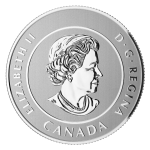
Obverse of the Royal Canadian Mint $20 for $20 silver coins
The advantage to directly buying coins from the RCM is that the exchange rate is very favorable for us Yanks. At the time of writing, C$1 is worth about 77-cents in U.S. currency making a C$20 purchase about $15.41 in the U.S. Another advantage of purchasing coins from the RCM than a dealer is avoiding the dealer markup. One U.S.-based dealer is selling the current $20 Bugs Bunny silver coin for $19.95 in U.S. currency.
For U.S. buyers who use credit cards to purchase coins on the RCM website, while your credit card will be charged in Canadian funds, your bank will charge you a conversion fee. Conversion fees are different between financial institutions and you should consult them for their rates.
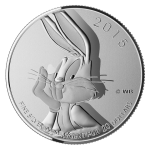
Reverse of the Royal Canadian Mint $20 for $20 silver coin featuring Bugs Bunny
RCM’s $20 for $20 coins struck using 7.96 grams of silver. At 27 millimeters, it is comparable in size to the Canadian half-dollar (27.13 millimeters) and smaller than the U.S. half-dollar (30.61 millimeters). While a nice size, a coin containing 7.96 grams of silver is a little more than one-quarter of a troy ounce of the metal. With the cost of silver $15.92 per troy ounce (and the time of writing), the coin only contains $4.07 worth of silver ($5.25 in Canadian funds).
To put it another way, the silver value of the coin is 75-percent of its cost or 400-percent over its melt value!
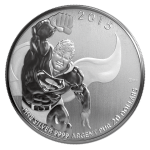
Reverse of the Royal Canadian Mint $20 for $20 coin featuring “The Man of Steel”
Questioning the program’s worth aside, both the Bugs Bunny and Superman coins are very cool designs. Aside from being engraved coins (not colored pictures) and struck as specimen coins (similar to the U.S. Mint’s enhanced uncirculated strikes), it is just plain fun to have coins with the image of childhood interests.
For a little more than $30 including fees and shipping, I can get two silver coins with iconic designs. It is not about collecting for value. It is collecting for fun!
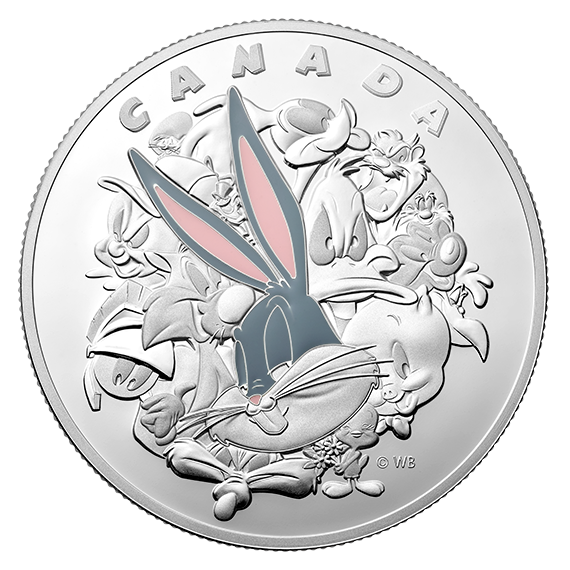
Weighing in at 1 kilogram of fine .999 silver, this enameled proof coin is does not cost $20! With a $250 face value, the Royal Canadian Mint is selling this coin for $2,350.95
($1,810.80 in the U.S. at the current exchange rate)
All images courtesy of the Royal Canadian Mint.
Oct 20, 2015 | Canada, cents, coins, other, varieties
It has been a very interesting few weeks since my last post. During that time there was a lot of business activity that I hope will allow be to have more time to do some of the things I would rather be doing, like write. Aside from the blog, I have 95-percent of a collecting-related ebook completed and 80-percent of a different sort of book completed. In between business meetings, I was able to start a book I am tentatively calling “Why did the Mint do that?” which may include information about why the Bureau of Engraving and Printing does what it does including a section on the history of counterfeit detection in the United States.
In the mean time, I have started several posts in the same style that I have been writing for the last few years. Until I can make more time, some long-form tomes will have to wait. Instead of taking the time to write longer items, I will look to write shorter posts including in multiple parts, depending on the topic. This way, I can clear the list of ideas I have been saving.
One more bit of housekeeping before I talk about my new collection: you might see a page that says that I am working on an update. I decided that the blog needs a new look and that periodically, I will work on a theme change. Hopefully, I can finish by the end of the month, but you never know!
That being said, I also had taken the time to start a new collection. While I wanted to start something new for a while and had an idea for a direction, I did not have the opportunity until now.
Earlier this month I attended a local coin show in Westminster, Maryland. Westminster could be considered a distant suburb of Baltimore with a big firehall that housed this show. Although I was there to man the front table representing the Maryland State Numismatic Association as its president greeting people, I was able to slip inside to look around. One of the tables had binders with foreign coins and I started to look.
Grabbing the one for Canada, I remembered that the first official coinage of the Province of Canada. In 1840, the British Parliament passed the Act of Union that merged the upper and lower colonies of Canada into the single Province of Canada. As a province, Canada was able to form a more independent government, even though it was answerable to the Crown. Answering to political dissension that was building in the province, Queen Victoria named Ottawa as the province’s capital. Although the province government met in Ottawa anyway, this was a symbolic move.
One of the problems was the lack of circulating currency. Even though the monarchs loosened the rules on circulating coinage in Canada, there was a need for a larger supply. Even though the Province of Canada’s parliament passed legislation to adopt a decimal coinage, Queen Victoria finally recognized the request. As part of trying to maintain order in the province, Victoria ordered the Royal Mint to produce coinage for Canada starting in 1858.
Canadian large cents with the effigy of Queen Victoria are affectionately called Vickie Cents. With the recent elimination of the one cent coin, looking back at the Canadian cent through its history has become popular with Canadian coin collectors. The key date for Vickie Cents is the first year, 1858 coin.
At mid-grade the 1858 Vickie cent is not that expensive. Although they are harder to find, the demand keeps the price reasonable for the average collector. Although I have been thinking about starting a Vickie cent collection for a while but when I found one in this dealer’s binder, I could not resist!Based on the description in the Charlton Standard Catalog of Canadian Coins, the coin would be graded around F-12. But since it is the first year of issue and the general rule is to buy the best you can afford, this was how I was going to make my start with Vickie cents.
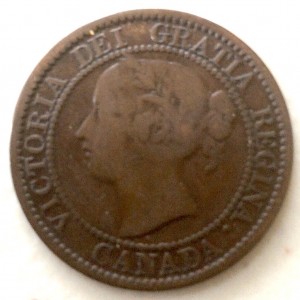
1858 Province of Canada Large Cent (Vickie Cent) obverse
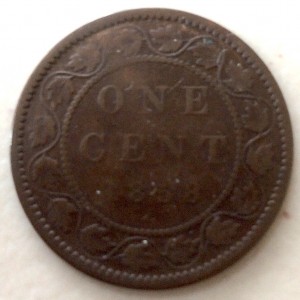
1858 Province of Canada Large Cent (Vickie Cent) reverse
Since I was there I decided that even though it was not the first year of issue, I would pick up the last year of issue. Since Queen Victoria died in January 1901, that was the last year her image appeared on coins in the British Commonwealth. I picked out a nice extra fine example to mark the beginning and end of the series.
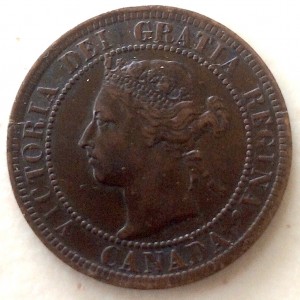
1901 Dominion of Canada Large Cent obverse (Last year of Victoria Cent)
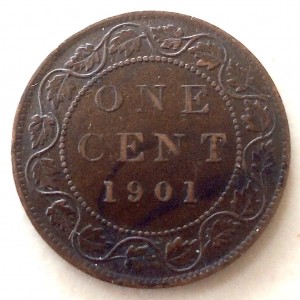
1901 Dominion of Canada Large Cent reverse (Last year of Victoria Cent)
Vickie cents were produced in 1858 and 1859 with a few distinguished varieties. One notable variety is the 1858 coin-aligned reverse. At the time it was the Royal Mint’s practice to have coins aligned in what we call today “medal alignment” where the top of the obverse and reverse point in the same direction. An error at the mint created a rarer coin-aligned (tops on opposite ends) coin. In 1859 there were overstrikes, doubled numbers, alignment differences, and composition differences. If I were to look for all of the known varieties, the cost of the 1859 with a Narrow 9 made of brass (not bronze) would cost about as much as a 1914-D Lincoln cent and be much more difficult to find.
The cents of 1858-1859 were minted in enough quantity to keep the Canada stocked with cent until 1876. New portrait, and varieties, were introduced as well as a striking at the Birmingham Mint, also known as the Heaton Mint, along side the British halfpenny, which used the same planchet. Coins struck at the Heaton Mint were given the “H” mint mark.
Foreign coin collecting can be an adventure that may not be as expensive as their U.S. counterparts. If you are collecting for fun, as I am, pick a country, learn a little about the history, and pick a series to collect. I picked Canada because my wife’s family is from the Province of Québec. Not only will you find it a challenge, but the lower demand may make your endeavor more affordable.
Stay tuned for more!
Oct 7, 2015 | coins, dollar, US Mint
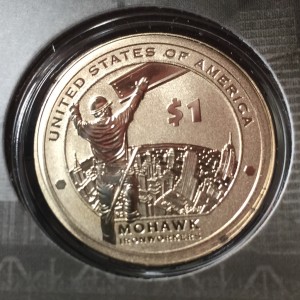
2015-W Native American Dollar Reverse celebrating the Mohawk Iron Workers
Through 2008, the reverse featured a soaring eagle by U.S. Mint sculptor-engraver Thomas D. Rogers. Starting in 2009, the reverse was changed as part of the Native American $1 Coin Act (Pub.L. 100-82) signed into law by President George W. Bush. Under the law, the reverse of the one dollar coin “shall depict images celebrating the important contributions made by Indian tribes and individual Native Americans to the development of the United States and the history of the United States.”
The act also moved the E PLURIBUS UNUM and the date to the edge of the coin.
While dollar coins have not been popular and even have undergone unneccesary scorn, the images and artwork going into these coins are amongst the best produced by the U.S. Mint. In 2009, the subject was the Three Sisters of Agriculture depicting a Native American woman planting seeds in a field populated with corn, beans and squash. It shows how the Native Americans understood the concept of crop rotation long before the Europeans did. But the design by U.S. Mint sculptor-engraver Norman E. Nemeth is nothing less than fine art on a coin.
For 2015, the reverse commemorates the Kahnawake and Akwesane Mohawk ironworkers who contributed to the building of New York City skyscrapers. The deisgn by artist Ronald D. Sanders and engraved by U.S. Mint sculptor-engraver Phoebe Hemphill is nothing less than fine art touting the talents of both artists.
This year, the U.S. Mint issued the American $1 Coin and Currency Set containing a $1 Federal Reserve Note from the Federal Reserve Bank of New York with a serial number beginning with “911” and an Enhanced Uncirculated 2015-W Native American dollar coin with the Mohawk Ironworker’s reverse. Originally, I bought this set for the dollar note because of its tie to New York but the enhanced uncirculated dollar coin makes this a fantastic collectible.
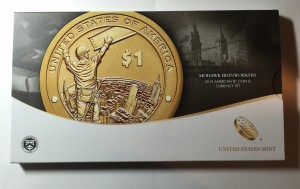
Outer packaging of the 2015 American $1 Coin and Currency Set
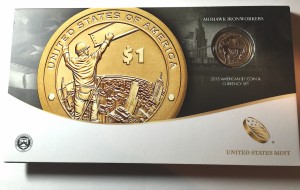
Front of the folder for the American $1 Coin and Currency Set
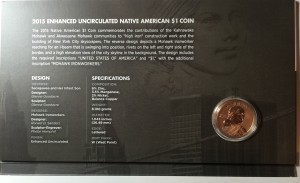
Back of the folder for the 2015 American $1 Coin and Currency Set
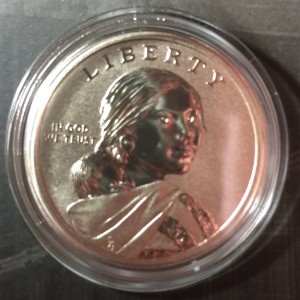
Obverse of the 2015-W Enhanced Uncirculated Native American Dollar
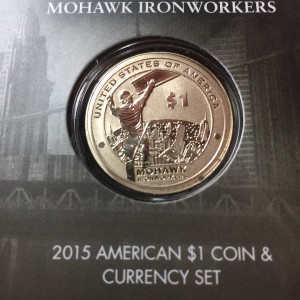
Reverse of the 2015-W Enhanced Uncirculated Native American Dollar
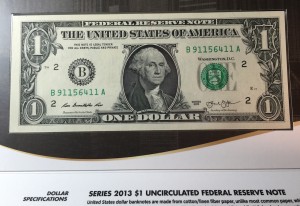
Series 2013 Uncirculated $1 Federal Reserve Note from the Federal Reserve Bank of New York
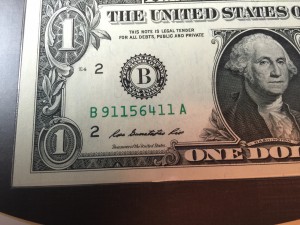
Close up of the Series 2013 $1 FRN. Note that the serial number begins with “911”
There are some great designs that the U.S. Mint has issued as “Enhanced Uncirculated.” To add the textures to the coins, the dies are polished and enhanced with lasers and wire brushes. In my opinion, these are better than the colored coins because they are part of the design and not the printing of pictures on the coin. I will have more thoughts on the enhanced uncirculated coins at another time.
Sep 29, 2015 | CCAC, coins, commemorative, job, US Mint
 Are you a numismatist with training, education or experience? Do you want to be part of the decisions making process in the design of new coins and medals? Can you do this with no compensation, minimal reimbursement, and make decisions with people looking and criticizing your decisions? Then do I have a job for you!
The Citizens Coinage Advisory Committee is looking for a member who is specially qualified in numismatics to fill one of its 11 seats. As one of the 11 members, you will provide one of the many inputs on themes and designs for circulating and bullion coinage, commemorative coins, Congressional Gold Medals, and other medals produced by the U.S. Mint. The other inputs will be the Commission of Fine Arts and the special interest organizations that has the ear of the decision makers including whomever is running the U.S. Mint and the Secretary of the Treasury.
Appointments to the CCAC are for four-year term and are classified as Special Government Employees who are subject to conflict of interest laws and ethics regulations. At the end of the four-year term you can be re-appointed as long as your application is approved.
If you want to be considered to be part of this sausage making process, should submit a resume, along with a cover letter, detailing specific educational credentials, skills, talents, and experience. Applications may be submitted by email to info@ccac.gov, by fax to 202-756-6525, or by snail mail to: United States Mint, 801 9th Street NW, Washington, DC 20220, Attn: Greg Weinman. Submissions must be postmarked no later than Friday, October 9, 2015.


 Loading ...