Sep 26, 2011 | coins, museum
As collectors progress in their collecting pursuits, we begin to think about the great collections and how we compare. To give you an idea of what some of the most famous and extensive collections are like, the following is a list of current, past, and two special government collections.
National Numismatic Collection at the Smithsonian Institute
The only way to start this list is with the National Numismatic Collection at the Smithsonian Institute, the world’s largest numismatic collection. With over 1.6 million coins, tokens, medals, and other numismatic objects, the collection includes United States, world, and ancient coins. The collection contains rare coins and patterns not seen anywhere else in the world. Amongst its holdings are famous rarities include all varieties of the 1804 Draped Bust Silver Dollar, a 1913 Liberty Head Nickel, and two 1933 Saint Gaudens $20 Double Eagle coins. Also in the collection is a Brasher Doubloon, sometimes called the United State’s first gold coin, and a 1974 aluminum Lincoln Cent created by the U.S Mint to try to convince congress to allow for its production.
Unfortunately, the Smithsonian Institute has taken the National Numismatic Collection off display. Curators are incorporating the coins into other displays and creating travel exhibitions that have appeared in other museums and at large coin shows. You can visit the Smithsonian’s online virtual coin exhibits and read more about the collection online.
Edward C. Rochette Money Museum
The Edward C. Rochette Money Museum at the American Numismatic Association headquarters in Colorado Springs is the largest museum dedicated to the study of United States coins and currency that also covers the history of numismatics. With over 250,000 pieces, the collections contains famous rare coins including the George O. Walton specimen 1913 Liberty Head Nickel, an 1804 Draped Bust Silver Dollar, and one of the three known 1866 No Motto Seated Liberty Silver Dollars.
The Rochette Money Museum is the home of the Harry W. Bass, Jr. Collection. Bass was interested in United States gold coins and had built the most complete collection ever assembled, including many one-of-a-kind specimens, of gold coins from 1795 through 1933. Bass’s collection includes the only complete set of $3 gold pieces including the rare 1870-S, complete set of gold coins and patters from 1834-1933, and a set of 1896 “Educational Series” silver certificates including test printings and uncut sheets.
Read more about the Rochette Money Museum and all of their collection on the ANA’s website.
Coin and Currency Collections at the University of Notre Dame
University of Notre Dame Libraries Department of Special Collections boasts one of the largest collections of colonial coins and currencies in the United States. The coin collection includes an Oak Tree one-shilling coin, a Continental dollar, and a 1792 half disme—the first coin-type struck by the newly established United States Mint. The colonial currency collection includes samples from nearly every emission (issue) from all thirteen colonies and lottery tickets that were used to raise money to pay the costs of the Revolutionary War.
The collection also includes Washington Tokens and Confederate Currency and our Nineteenth Century American tokens. You can visit the colonial collection on line at www.coins.nd.edu.
Penn Museum Archaeology and Anthropology Coin Collection
The University of Pennsylvania Museum of Archaeology and Anthropology has one of the most complete collections of ancient coins. But rather than display them as a coin collection, the curators at the museum keep the coins with the various sections. Visit the ancient Roman section, and you can see the coins that defined the rule of the Roman Empire and the ancient Greek collection is very impressive. All coins were found during archaeological visits to the regions of ancient civilizations. You can read more about the Penn Museum at www.penn.museum.
The Fitzwilliam Museum Coin Collection
The Fitzwilliam Museum in Cambridge, England has a nearly complete collection of ancient Roman coins issued after the murder of Nero. Amongst it collections are British and other Campaign and Gallantry Medals, European Renaissance medals, unique copper tokens handed out by the Cambridge chandler in 1668, and coins found casually and archaeological discoveries throughout England. The Fitzwilliam boasts of ongoing research into areas such as Indian and Islamic coinage. If you cannot visit The Fitzwilliam in Cambridge, you can see parts of their collection on line.
Staatliche Museen zu Berlin
The collection at the Staatliche Museen zu Berlin (National Museums in Berlin) is well known as being very comprehensive and diverse covering the beginnings of coinage through the coins of today. With over 500,000, it is one of the largest collections in Europe. Staatliche Museen boasts large collections of Greek, Roman, and European coins from the Middle Ages to today. They also have an extensive collection of art medals dating from 1400.
In addition to the coins and medals, the collection also contains an extensive collection of paper currency primarily from Europe and items used as money from all over the world. The non-coin collection includes tools and dies that were used to strike coins in Berlin since the 17th century. The Staatliche Museen online English version of their online catalog can be found here.
Numismatic Museum, Athens
One of Greece’s oldest museums, the Numismatic Museum located in the Heinrich Schliemann mansion in downtown Athens, Greece. The Numismatic Museum collections has over 500.000 pieces of mostly coins but includes medals, lead seals, gems, weights, and minting objects dating from the 14th century BC until today. The collection includes a remarkable display of Greek coinages from Athens, Macedonia and Alexandria, Magna Graecia, and other Greek leagues and alliances. Modern coin galleries include coins from the Ottoman Empire through Greece joining the European Union. Read about their collection online at www.nma.gr.
State Hermitage Museum
Located in Saint Petersburg, Russia, the collection at the Sate Hermitage Museum is one of the most popular coin exhibits in Europe. With over 1.2 million pieces, it is the largest collection known outside of the United States. The largest segment of their collection tracks this history of money in Russia from the ninth century through today.
The Hermitage Museums’ Oriental collection boasts of coins, money ingots, dies, coin-shaped amulets and primitive currency of Asia, Africa, and neighboring Atlantic and Pacific islands. The collection includes a collection of very rate Sassanian coins and the 19th century Chinese silver money ingots that are considered amongst the finest collection in the world.
The Coin Room is in the main museum building at Palace Square in Saint Petersburg, which is closed on Mondays. Discover more about their collection on their website at www.hermitagemuseum.org.
Louis E. Eliasberg, Sr. Collection
One of the most famous coin in United States numismatic history belonged to Louis E. Eliasberg. Eliasberg was a Baltimore financier who is the only person ever to build a complete set of United States coins. In 1950, he achieved his goal of building a collection of regular issue United States coins comprising all then-known dates and mintmarks when he purchased the last US gold coin and silver dime missing in his collection.
Eliasberg continued to collect turning his attention to rare world coins and medals. When he died in 1976, his collection was divided between his two children. The coins were sold in three auctions in 1982, 1996, and 1997 realizing nearly $44.9 million. Recently, the Eliasberg Collection of World Coins and Medals was auctioned in 2005 for more than $10.1 million.
The John J. Ford, Jr. Collection
John J. Ford, Jr. was a controversial figure in the world of numismatics, but his collection was legendary. Ford’s collection include colonial coins and currency from all 13 colonies, rare confederate pennies, and one of a kind tokens from the earliest days of colonial North America through the Great Depression. As a partner in the New Netherlands Coin Company, the auction catalogs Ford wrote became industry references.
Ford began selling his collection via auction in 2003. It was fitting that Stack’s of New York City handled the auction since Ford started his numismatic career as a youngster delivering coins for the famed company. Ford’s collection was sold in 10,855 lots during 21 auctions over five years bringing in over $56 million in sales. The auction catalogs were so meticulously written using Ford’s previous writings that they have become references.
John J. Ford, Jr. died in 2006 at the age of 81 leaving a numismatic legacy befitting a great collection, but leaving questions as to whether there were other pieces and writings hidden somewhere.
King Farouk I of Egypt
Saying that King Farouk I of Egypt lived in excess would be an understatement. From the time he took the throne in 1936 until his overthrow in 1952, Farouk used the Egyptian treasury to acquire rare works of art, gold, and a phenomenal coin collection. Farouk regularly worked with dealers in the United States and Great Britain to buy the best of the best from around the world.
After his overthrow in 1952, the new military government worked with Sotheby’s of London to sell Farouk’s collections. Farouk had accumulated the finest gold coins and many rarities from around the world. Notably, the collection included 8,500 gold United States coins including the only known complete set of Saint Gaudens $20 Double Eagle coins.
The auction caught the eye of the United States government who noticed that Lot 333 contained a 1933 Double Eagle that was considered illegal to own. The government convinced Egyptian authorities to remove the coin from the auction but it was never returned to the United States government as requested. The entire auction of King Farouk’s items sold for over $150 million.
The 1933 Saint Gaudens Double Eagle turned up again in 1996 when British coin dealer Stephen Fenton tried to sell the coin at the Waldorf Astoria Hotel in New York to an American dealer. Fenton was arrested. This set off a legal battle for the next five years over the coin. The case was settled in 2001 and the coin was removed from its holding place in the World Trade Center, a few weeks before the attack.
In an astonishing one-lot auction on July 30, 2002, Sotheby’s sold what is now called the Farouk-Fenton Specimen for $7.59 million to an anonymous bidder. The auction price was increased by $20 that was paid to the United State Treasury since it issued the coin and had to ensure their books are balanced. To date, that is the highest price spent on one coin.
The United States Mint
Little is publically known about the collection at the United State Mint since the collection is not on display to the public. We do know that each of the U.S. Mint’s branches has a collection of material used at the branch and that this material contains trial pieces, dies, galvanos (artists proofs of coin designs), and medals. In a video recently released by the U.S. Mint, viewers are shown a collection of assay medals. These medals were created for the Assay Commission that used to verify that the coins struck by the U.S. Mint contained the proper metal content.
The U.S. Mint has rarely displayed their collection. At times, parts have been on display in the lobby of the U.S. Mint branches and at national coin shows, but only the employees at the U.S. Mint know the extent of this collection.
The Bureau of Engraving and Printing
Unlike the their counterparts at the U.S. Mint, the Bureau of Engraving and Printing (BEP), the agency responsible for printing our currency, regularly displays parts of their collection when they can. Pieces can be seen in the tour areas of the BEP facility in Washington, DC and at major coin shows. In recent years, BEP has brought its “Billion Dollar Exhibit” to many shows. The exhibit features more than $1 billion of rare U.S. paper currency that includes sheets of $100,000 notes, Treasury bonds and Gold and Silver Certificates.
The BEP collection dates back to the founding of the bureau in 1862. The collection reportedly contains notes, sheets, vignettes, test printings, and printing plates of every note and stamp every printed by the BEP. It is an extraordinary collection that very few have seen.
Aug 20, 2011 | coins, Euro, video
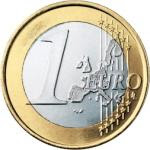 One of the reason I collect coins and write this blog is that I find coins interesting, regardless of whether they are modern or otherwise. I do not have to collect a particular coin type to be fascinated by them. Although I do not collect Euro coins, I am fascinated by the bi-metallic 1 and 2 Euro coins.
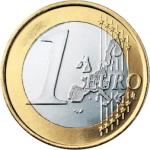
As with all Euro coins, the common reverse side shows its value and depicts a map of Europe representing the entire Eurozone. The obverse has what is called the “national side,” the side each member nation customizes to represent their unique place in the world. Some countries, like Belgium, uses the same design on all of their coins while others use different designs.
While all Euro coins are made of base metals, the 1 and 2 Euro coins are bi-metallic. For the 1 Euro coin, the inner part is made of copper-nickel with a silvery color while the outer part is made of a nickel brass and has a golden-like color. The composition is reversed for the 2 Euro coin.
 The edge of the 1 Euro coin consist of alternating segments, three smooth, three finely ribbed.
 The edge of the 2 Euro coin is finely milled with lettering that varies by nation, the same as the obverse.
What I find fascinating is that both metals are made separately but when they are struck, the design overlaps both metals and the striking process fuses the metals together. It was fascinating since I never thought about how the one and two Euro coins were until I came across a video show how the 2 Euro coins are made.
This video is from the National Geographic Channel. I am not sure what show it is from, but it shows how the 2 Euro coin is made:
All images courtesy of Wikimedia.
Aug 16, 2011 | coins, commentary, currency, dollar
When congress comes back to Washington to (hopefully) represent their constituency to carry out the nation’s legislative interests, a twelve-member bipartisan commission (a “super congress” as the press is calling them) must find a way to deal with the government’s debt and deficit by Thanksgiving or the law requires an additional $1.5 trillion in cuts, mostly to defense.
Followers of the debate have found that there are fundamental differences between both sides of the aisle as to how to manage the affairs of government. Rather than look for common ground and try to negotiate about the differences, their actions are reminiscent of a smoker who quits their habit but uses food to make up for the cigarettes trading one condition (cancer risk) for another (obesity). In an attempt to get them started, I have a proposal:
End production of the one-dollar Federal Reserve Note!
According to the most recent report from the Government Accountability Office, the independent, nonpartisan legislative branch agency that investigates how the federal government spends taxpayer dollar, the government could realize a savings of $5.5 billion dollars over 30 years by eliminating the paper dollar for coins.
By eliminating the one-dollar Federal Reserve Note, congress can begin show that they are willing make “difficult decisions” to help the economy while not stepping on either side’s political hot buttons. Also, if congress votes to eliminate the paper dollar, the approximately $1.1 billion of dollar coins sitting the Federal Reserve’s coin vaults will start to circulate in the economy. This is $1.1 billion dollars of money not doing anything but sitting. It would be a $1.1 billion stimulus to the economy that will not add any money to the deficit because the coins are already paid for.
If you add the $1.1 billion of existing money to a $5.5 billion in long term savings, that is a total of $6.6 billion of economic immediate economic stimulus that does not cost the government anything. Further, once the $1.1 billion is circulated in the economy, the money spent will generate additional revenues from the taxes collected by the economic activity, something both parties said they want to encourage.
But this is such a small amount compared to the total debt, why do it?
Using the correct form of the Lao-tzu quote: “The journey of a thousand miles begins beneath one’s feet.” Lao-tzu believed action naturally arises from stillness. This country has been still on its money production policies, it is a natural move to eliminate the one-dollar note. Or to use the more colloquial version: “A journey of a thousand miles begins with a single step.”
Borrowing an anonymous response to a previous post:
You people need to get over yourselves – put it to a vote and the public does not want or need dollar coins! / Just because coin collectors want coins doesn’t mean the rest of us need to suffer. / If it’s dollar coins versus dollar bills… bye bye dollar coins.
It looks like saying that countries like Australia, Canada, France, Japan, the Netherlands, New Zealand, Russia, and the United Kingdom eliminated their unit currency in favor of coins is not a good argument for some. Or that the European Union started this century with producing only a coin for the 1-Euro denomination will not work either. How about this:
Supporting the elimination of the paper dollar is the patriotic thing to do!
Is it patriotic to continue to waste money? Or is it our patriotic duty to do what is in the best interest of the country even it means making a few minor sacrifices for the common good? True patriots will make the adjustments and do what is right by the country!
Sacrificing for your country is the patriotic thing to do!
Aug 15, 2011 | coins, commemorative, legislative
Every week I check the progress of coin bills in winding its way through congress. As there are new bills or updates, I make sure the Coin Bills in the 112th Congress page is updated. Having not done so since congress went on their summer vacation, I decided to see if there was anyto change prior to their leaving Washington.
As opposed to previous congresses, the 112th congress has been pretty dull when it comes to coin legislation. Not only have fewer bills been introduced, but the bills that have been introduced have been sitting in committee going nowhere. That is until now.
According to the record, the National Baseball Hall of Fame Commemorative Coin Act (H.R. 2527) was voted out of the House Financial Services Committee by voice vote on July 20 and ordered to be reported to the House Floor for consideration. Although the bill was also referred to the House Budget Committee, House rules allow Speaker of the House John Boehner to schedule it for debate and vote on the House floor without consent of the Budget Committee.
Of all the coin-related bills introduced in the 112th congress, this is the only one that has had any action following introduction.
Other than directing the U.S. Mint to strike $5 gold coins, silver dollars, and clad half-dollars in recognition of the National Baseball Hall of Fame during 2015, H.R. 2527 requires the coin to be concave/convex to depict a baseball on the reverse and have a competition for the obverse. Read my prior post, “A Commem to Take Out to the Ball Game” for more on this bill.
Given the toxic nature of how both sides of the aisle has done business, it is good to see at least one committee can come together for at least one bill!
Aug 14, 2011 | advice, coins, fun
After writing Collecting a Herd of Buffaloes, a reader and I have been discussing creating another type collection that would best represent the Lincoln Cent. The thought was that since the Lincoln Cent is over 100 years old with so many key (1909-S VDB, 1914-D, and 1931-S) and semi-key dates (1910-1915 S mint coins, 1924-D, and 1926-S) with some very interesting errors and varieties (1955 DDO, 1922 No/Weak D, and various small and large dates), that collecting the series may be too challenging for someone just starting collecting.
How does someone represent a series that spans over 100 years? First, looking at the basic type-set there are a lot of holes in the series. For example, after collecting the Type 1 Lincoln Cent (VDB on the reverse), the wheat-back design continues until 1958 with the only “change” being the zinc-coated steel cents struck in 1943. Aside from being uninteresting, it did not represent the history that the Lincoln Cent has seen through its first 50 years.
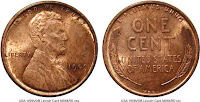 If we look at 20th century history, there seems to be a pattern of history being recorded every decade, or so. It is not a perfect cycle, but close enough to look at putting together a series by decade accounting for history, type changes, another of other factors to make the collection interesting. The first coin of this set is the 1909 VDB. With more than 27 million coins struck in Philadelphia, it is possible to get a fair price on a nice uncirculated red example. Since the Lincoln Cent was first struck in Philadelphia, it is appropriate to start a collection with the first coin produced for the series.
There was a lot of history in the 1910s. For collectors, much of the coins of the first half of the decade are expansive to find in higher grades. The only year that is affordable in higher grades is 1919. In 1919, the Treaty of Versailles officially ended the “War to End All Wars” (World War I) and the economy in the United States was still producing goods not only to rebuild the military but to sell to war-torn Europe. The high demand for cents made 1919 the year with the highest production making it more likely to find good examples in high grades.
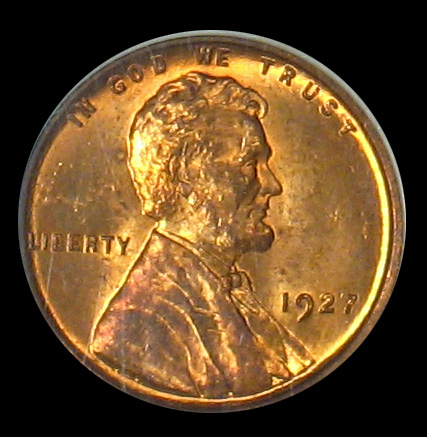
 The Roaring Twenties was known for its sustained economic stability, industrial growth, new inventions, art deco, women’s suffrage, and the wide acceptance of jazz music. It was also the decade that saw the growth of the organized crime controlling the illegal flow of alcohol and speakeasies. The demand for coins were great, especially in the second half of the decade. Almost any Lincoln Cent from 1926 through 1929 can be affordably purchased in uncirculated grades so we decided on 1927 to be a good representation of the era.
All went well until October 29, 1929, Black Tuesday. Subsequent years marked a great panic that included bank runs and high unemployment. Things became worse when Secretary of the Treasury Andrew Mellon insisted on draconian measures that would close what he considered weak banks and transfer assets to larger banks at pennies on the dollar that wiped out many people’s savings. Rather than trying to infuse cash into circulation to try to spur the economy, Mellon advocated deep federal spending cuts to balance the federal budget and opposed economic stimulus measures. His plan did not help the economy and plunged the country deeper into the Great Depression. Mellon was accused purposely sabotaging the economy and colluding with bankers and industrialists to profit from the crisis. Just before a vote on the whether articles of impeachment would be sent to the full House from the House Judiciary Committee, Mellon was appointed Ambassador to the Court of St. James (United Kingdom) and resigned as Treasury Secretary.
 When Franklin D. Roosevelt was inaugurated, he appointed William Woodin as Secretary of the Treasury. Working with his predecessor, Ogden Mills, these men came up with a plan to try bring the country out o the depression. Part of the plan was to have FDR order gold withdrawn from private hands. Since Woodin was a coin collector, he made certain that the order include an exception for “rare and unusual coin types.” To honor Woodin and to have the collection represent the era, this Lincoln Cent collection will include a nice 1933 cent.
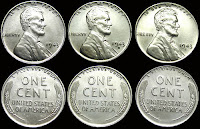 It is generally accepted that World War II began on September 1, 1939 when German invaded Poland although Japan invaded China in 1936. With Germany and Italy trying to conquer Europe and Japan attacking China and Russia from the Far East, there was a passivist movement in the United States. The problem was “over there” and had nothing to do with us. That changed on December 7, 1941 when the Japanese Navy attacked the U.S. Naval Base at Pearl Harbor. A Declaration of War on Japan was passed on December 8 and on Germany and Italy on December 11. Since copper was necessary for the manufacture of ammunition and other armaments, laws were passed that changed the composition of the Lincoln Cent from bronze (copper-zinc) to zinc-coated steel. When the U.S. Mint struck the steel cents in 1943, it marked the only time in the country’s history that a circulating coin was struck without any copper. Finding high grades of steel cents are relatively easy and inexpensive because so many were minted. Thus, our collection will have one steel cent from each branch Mint.
From 1944-1946, spent shells from military training grounds were collected and melted to use for striking coins. Using those shells, the bronze composition returned and copper cents began to circulate driving the unpopular steel cents out of circulation. As a type, these coins are known as “Shotgun Cents” because of the use of the shell casings. Since both V-E Day and V-J Day both happened in 1945, this set will include a 1945 Lincoln Cent.
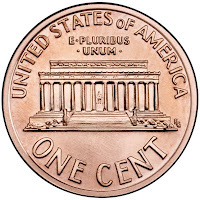 Following 1946, the composition of the cent changed slightly to a bronze that included copper (.950), zinc and tin (.050). This would remain the composition until 1982. Before then, the reverse design would change to the Memorial Reverse in 1959. First, we need a coin for this new composition. For this we decided on a 1955 cent. Aside from being plentiful and inexpensive in uncirculated red grades, it was the year that the Brooklyn Dodgers finally won the World Series—a fitting tribute for the decade. Then, add a 1959 first-year Memorial Cent to the collection to complement the first issue wheat-back cents.
Finding uncirculated red Memorial Cents are very easy. Many were struck in the billions and many were saved in collections and rolls making them highly available and very affordable. Choosing Memorial Cents is a matter of trying to match the dates with historical significance. For example, after the coin shortages of the early 1960s, the U.S. Mint stopped producing coins with mint marks. By omitting the mint marks, it was felt that collectors, who were initially blamed for the shortage, would not hoard coins. Once it was determined that collectors were not the cause of the shortage, mint marks returned to the Lincoln Cent in 1968. So let’s add a 1968-D cent to the collection to include the first coins struck with a mint mark after their removal in 1965.
The 1970s was an interesting decade that included the resignation of Richard Nixon, the American Revolution Bicentennial Celebration in 1976, and my high school graduation. But for the Lincoln Cent, this collection will have a 1974-S to represent the last S mint marked coin struck for circulation in San Francisco. Although some cents were struck in San Francisco in the 1980s, they were struck without mint marks and cannot be differentiated from coins struck in Philadelphia.
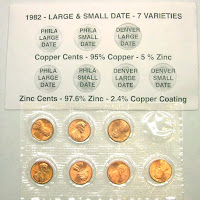 One more change in composition came in 1982 when the Lincoln Cent went from bronze to copper-coated zinc. Also in 1982, there was a change in the dies that caused both large and small dates to appear on both compositions. To mark this transition, the collection will include a set of all seven varieties that includes coins from both Philadelphia and Denver. Rather than buying these coins individually, the collection can include a pre-packaged set that can be bought from any dealer, at a coin show, or online for under $25. It is a perfect way to mark the transition.
For the Lincoln Cent, history there after was bland. But the collection needs a representative from the copper-coated zinc era to end the 20th century. We chose a 1999 Lincoln Cent for no other reason that while thinking about it, the song “1999” by Prince came up in the discussion. Since the song was release in 1982 on the album titled “1999,” it seemed a fitting tie in for the collection.

Next is a 2001 cent to celebrate the start of a new century/millennium (we count years from one, not zero!) and one from 2008 as the last Memorial Cent of the series. Of course the set will include the four types from the Lincoln Bicentennial and Cent Centennial celebration. However, since the bronze (copper-zinc) versions are available from the sets sold by the U.S. Mint, the set will include those instead of the copper-coated zinc coins that were circulated.
Finally, this collection ends (for now) with a 2010 Shield Reverse Cent so that we continue with the pattern with including an example from the first issues.
<UPDATE>
One of the reason I love my readers is that they can pick up on something I miss. One reader reminded me that a type set should include a Lincoln Cent with no designer initials. After the U.S. Mint removed the “V.D.B” on the reverse of the early 1909 cents, Victor D. Brenner’s initials did not reappear on the coin until 1918. So that the set is complete, a first-issue without initials 1909 is an affordable option.
</UPDATE>
When complete, our Lincoln Cent representative collection looks like:
- 1909 VDB, first issues
- 1909, for the first year of no “VDB” initials
- 1919, end of World War I
- 1927, the Roaring Twenties
- 1933, the Great Depression
- 1943 P-D-S Steel Cents
- 1944 Shotgun Shell Cents
- 1955, the 50s
- 1959 first issues of the Memorial Reverse Cents
- 1968-D, return of mint marks
- 1974-S, last year of S-mint circulated coins
- 1982 7-coin copper/zinc cents
- 1999, copper-coated zinc cents
- 2001, the new millennium
- 2009, 4-coin copper set
- 2010, first issues of the Shield Reverse
This collection is 26 27 coins making it more manageable and affordable than collecting the entire set. Dates can be changed or added to represent significant family events, such as the birth of family members. Youngsters can enhance their collection by writing a paragraph or two about each of the coins.
Jul 21, 2011 | coins, commentary, dollar, legislative
On July 19, 2011, Sen. David Vitter (R-LA) and Sen. Jim DeMint (R-SC) introduced S. 1385, To terminate the $1 presidential coin program. Simply, the bill removes subsection n of Section 5112 of title 31 United States Code (31 U.S.C. § 5112), which is the law authorizing for the Presidential $1 Coin Program.
The bill reads as follows:
S 1385 IS
112th CONGRESS
1st Session
S. 1385
To terminate the $1 presidential coin program.
IN THE SENATE OF THE UNITED STATES
July 19, 2011
Mr. VITTER (for himself and Mr. DEMINT) introduced the following bill; which was read twice and referred to the Committee on Banking, Housing, and Urban Affairs
A BILL
To terminate the $1 presidential coin program.
Be it enacted by the Senate and House of Representatives of the United States of America in Congress assembled,
SECTION 1. TERMINATION OF PRESIDENTIAL $1 COIN PROGRAM.
Section 5112 of title 31 United States Code, is amended by striking subsection (n) and inserting the following:
`(n) [Reserved.]’.
This is clearly an over reaction to the slanted report by NPR that suggests this is a taxpayer issue and not an issue of the broken monetary system in the United States. Rather than figure if this bill will properly achieve their purpose, Messrs. Vitter and DeMint wrote the most expedient bill regardless of its ramifications.
First, if this bill is passed, it will not do anything to relieve the oversupply of dollars being held by the Federal Reserve. All it will do is not increase the current supply leaving about $1 billion of coins in the Fed’s coin vaults and not circulating in the economy.
Another problem with the bill is that it leaves the First Spouse Gold Coin program in place. A closer look at the law shows that the First Spouse Program is codified in 31 U.S.C. § 5112(p). In order to stop the entire program, the bill would have to remove both subsections “n” and “p.”
Further, 31 U.S.C. § 5112(q) (subsection “q”) requires the U.S. Mint to promote the Presidential Dollar program and includes the requirements about the government and commercial acceptance of the coins. If the bill passes by removing subsection “n,” both the U.S. Mint and Federal Reserve will have difficulty complying with this law.
For numismatists who have been collecting Presidential Dollars, this bill’s passage will end the program early leaving us with a partial series. Teachers who use the coins and the good materials produced by the U.S. Mint to help teach history will have to find different tangible aids than coins. Coins would be a better teaching aid since it is tangible and money gets everyone’s attention.
The ONLY way to reduce the oversupply of dollars being held in the Federal Reserve coin vaults is to eliminate the $1 Federal Reserve Note. With out the paper, coins become the currency of the realm and will start to circulate.
I am sure that within a day someone will send a comment saying that Americans like paper and do not like coins. While there are segments of the population that will complain, Americans are resilient and will adapt. We can adapt to anything that the government can do and be successful. We can adapt to anything that market forces place on us and bees successful. We went from an all cash society to adding credit cards; cell phones are now everywhere as compared to 10 years ago; we have survived many changes in the economy; we went from leaded gas to unleaded; transit tokens to electronic metro passes; and now many cities are moving to paying for parking electronically rather than feeding quarters into meters. Americans adapt to change all of the time. Now it is time for all Americans to dig into their souls and change their currency habits for the good of the country.
Jul 21, 2011 | coins, commentary, legal, US Mint
“People of the United States of America have been vindicated.”
This utterance came from Assistant U.S. Attorney Jacqueline Romero, the government’s lead attorney in the case Langbord v. United States after the jury deliberation said that the ten 1933 Saint-Gaudens Double Eagle coins found by Joan Langbord is government property.
For years, the government has wasted taxpayer dollars on attorneys, staff, investigators, and expert witnesses (the government paid David Tripp $300 per hour) to deny the numismatic world the coins of legend. For what purpose? As a result, the jury set a precedence by saying that these coins “left the Mint illegally and were concealed.” It is an argument that can be used to confiscate any coin or pattern that has left the U.S. Mint.
What does this verdict say about the five 1913 Liberty Head Nickels? While the 1933 Saint-Gaudens Double Eagles were legally struck before the order to cease their distribution and melt the coins, the five 1913 Liberty Head Nickels were not supposed to exist. The U.S. Mint was supposed to start striking Buffalo Nickels for circulation, yet someone at the Mint struck five coins using Charles Barber’s Liberty Head design and they left the Mint without any record of their existence.
What does this verdict say about the pattern coins that are in collector hands. None of these patters were supposed to leave the U.S. Mint. Yet there are records of patterns being given out as favors to “important people” to curry favor. Aside from being Secretary of the Treasury at the beginning of the first Franklin D. Roosevelt administration, William H. Woodin was a collector of coins and patterns he collected mostly while director of the New York Federal Reserve Bank. Are those pattern now illegal since they left the Mint illegally and were concealed?
What does this verdict say about the 1974 Aluminum Cent? The U.S. Mint struck these patterns to show to try to convince congress to change the composition of the cent to save money. After they were distributed to congress as “demonstrations,” the U.S. Mint asked for their return. Not all of the congress members returned the coins and some ended up in collectors hands. Are these aluminum coins illegal since they were not legally issued coins?
With all due respect to Assistant U.S. Attorney Romero, I do not feel vindicated. I feel cheated!
Jul 17, 2011 | coins, commemorative, legislative, US Mint
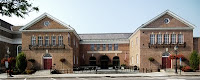 In a very rare show of bipartisan ship in the House of Representatives, Rep. Richard Hanna (R-NY24) introduced H.R. 2527, National Baseball Hall of Fame Commemorative Coin Act. Hanna, whose district includes Cooperstown, submitted the bill with 293 sponsors, including the entire New York delegation from both parties. This might be the first coin-related legislation to see action in the 112th congress.
The National Baseball Hall of Fame and Museum opened in Cooperstown, New York on June 12, 1939. Its first inductees class include five payers who many consider amongst the greatest who have ever played professional baseball. These inductees were (in alphabetical order):
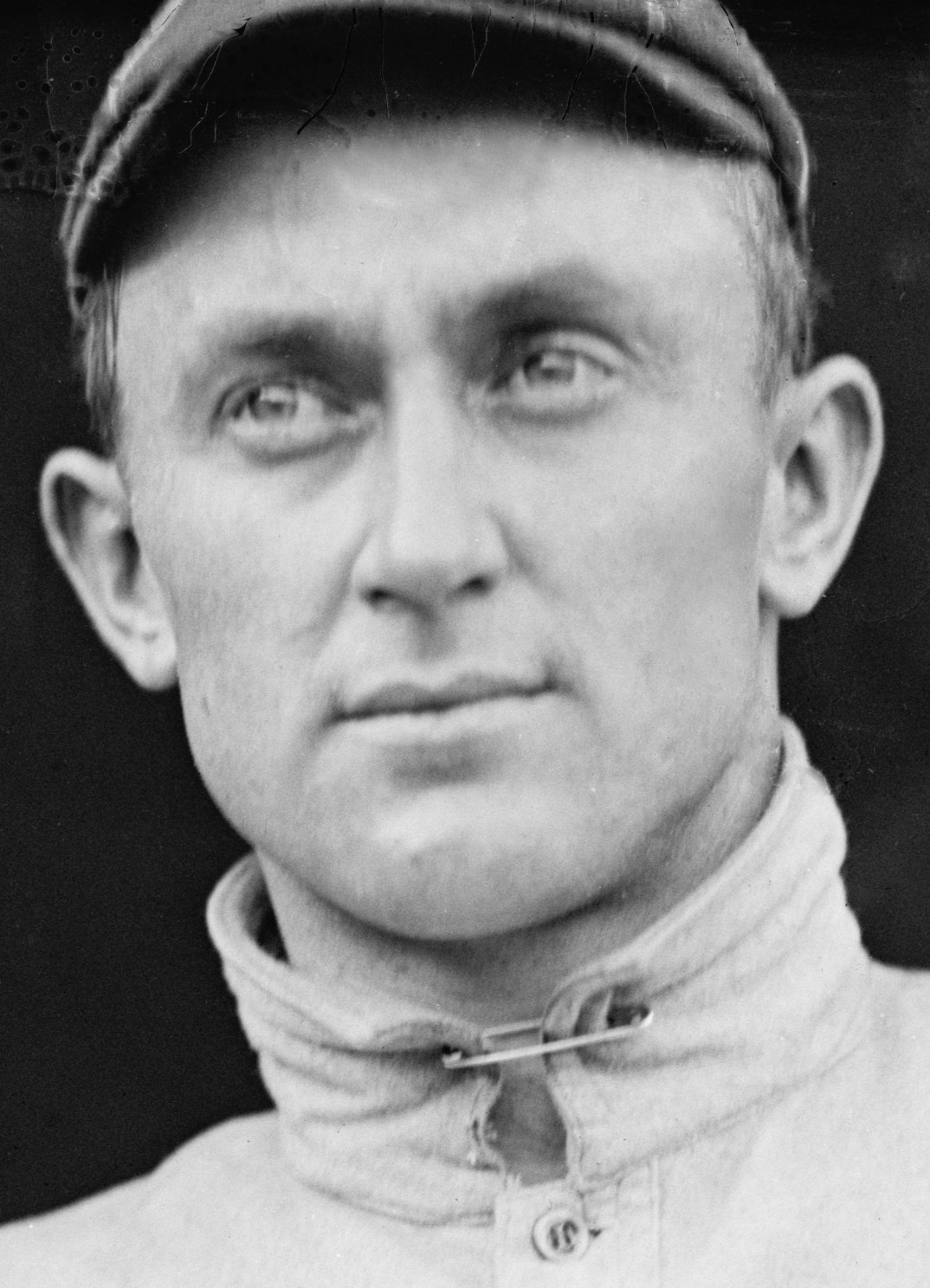
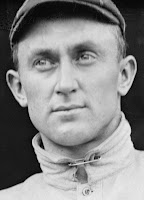 Tyrus Raymond “Ty” Cobb, also known as “The Georgia Peach,” set 90 Major League Baseball Records including highest career batting average (.367) and most career batting titles (12) which he still holds today. His 24-year career was also memorable for his surly temperament and aggressive playing style. When he was voted in to National Baseball Hall of Fame on its inaugural ballot in 1936, he received 222 out of a possible 226 votes, the most of this entry class. The other four votes were probably from sportswriters Cobb made upset during the course of his career.
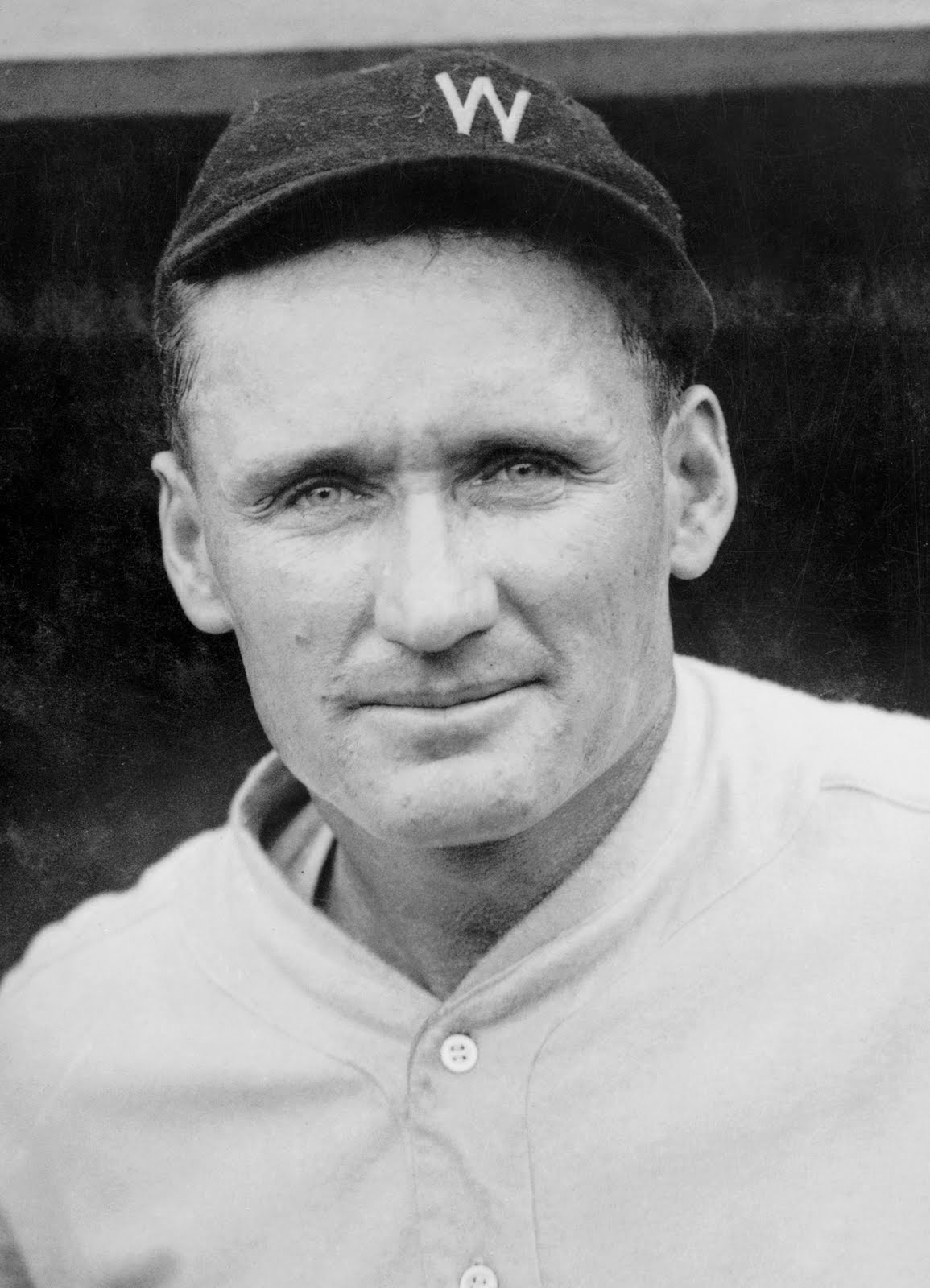
 Walter “Big Train” Johnson played 21 years for the original Washington Senators, 1907-1927. Johnson is second in all time wins with 417 (Cy Young won 511) and is still the all-time career leader in shutouts with 110. Using scientific tests available at the time, Johnson’s fastball was clocked at over 91 miles per hour which was phenomenal for the time. His motion and fastball fooled many hitters, especially right handers. Many of his strikeout records lasted more than 50 years before being broken by future Hall of Famers Bob Gibson, Nolan Ryan, Steve Carlton, and Gaylord Perry.
 Christy Mathewson holds the National League record for wins with 373. In 17 years, he won all but one of those games with the New York Giants. In 1916, Mathewson was traded to the Cincinnati Reds and became their manager. During his career, Mathewson was famous for his duels with Mordecai “Three Finger” Brown, mostly against the Chicago Cubs. Brown got the best of Mathewson 13-11 with one no-decision. Johnson’s career was cut short when he was accidentally gassed during World War I.
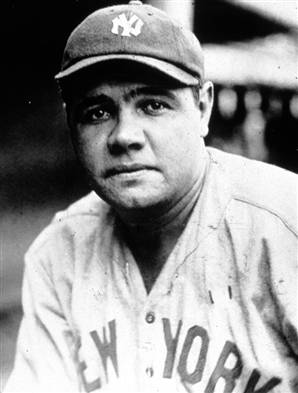
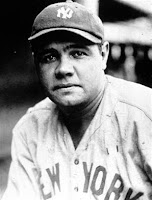 George Herman “Babe” Ruth, “the Bambino,” “the Sultan of Swat,” the former pitcher turned outfielder is largely credited for saving baseball after the Chicago Black Sox Scandal during the 1919 World Series. Baseball needed a new hero and Babe Ruth was there with a mighty bat. The sale of his contract from the Red Sox to the Yankees in December 1919 had been part of Red Sox lore and hung like an albatross until the BoSox won the World Series in 2004—which they beat the Yankees to get into the World Series after being down three games to one in the ALCS!
Babe Ruth was baseball’s first home run king. In 1921, Ruth hit 59 home runs while the Yankees shared the Polo Grounds with the Giants. That record stood until Ruth belted 60 for the “Murderer’s Row” team of 1927. It was a record that stood until Roger Maris hit 61 in 1961. His 714 career home runs served as a record until broken by Hank Aaron in 1974. Ruth’s .690 slugging percentage remains a record.
George Herman “Babe” Ruth, “the Bambino,” “the Sultan of Swat,” the former pitcher turned outfielder is largely credited for saving baseball after the Chicago Black Sox Scandal during the 1919 World Series. Baseball needed a new hero and Babe Ruth was there with a mighty bat. The sale of his contract from the Red Sox to the Yankees in December 1919 had been part of Red Sox lore and hung like an albatross until the BoSox won the World Series in 2004—which they beat the Yankees to get into the World Series after being down three games to one in the ALCS!
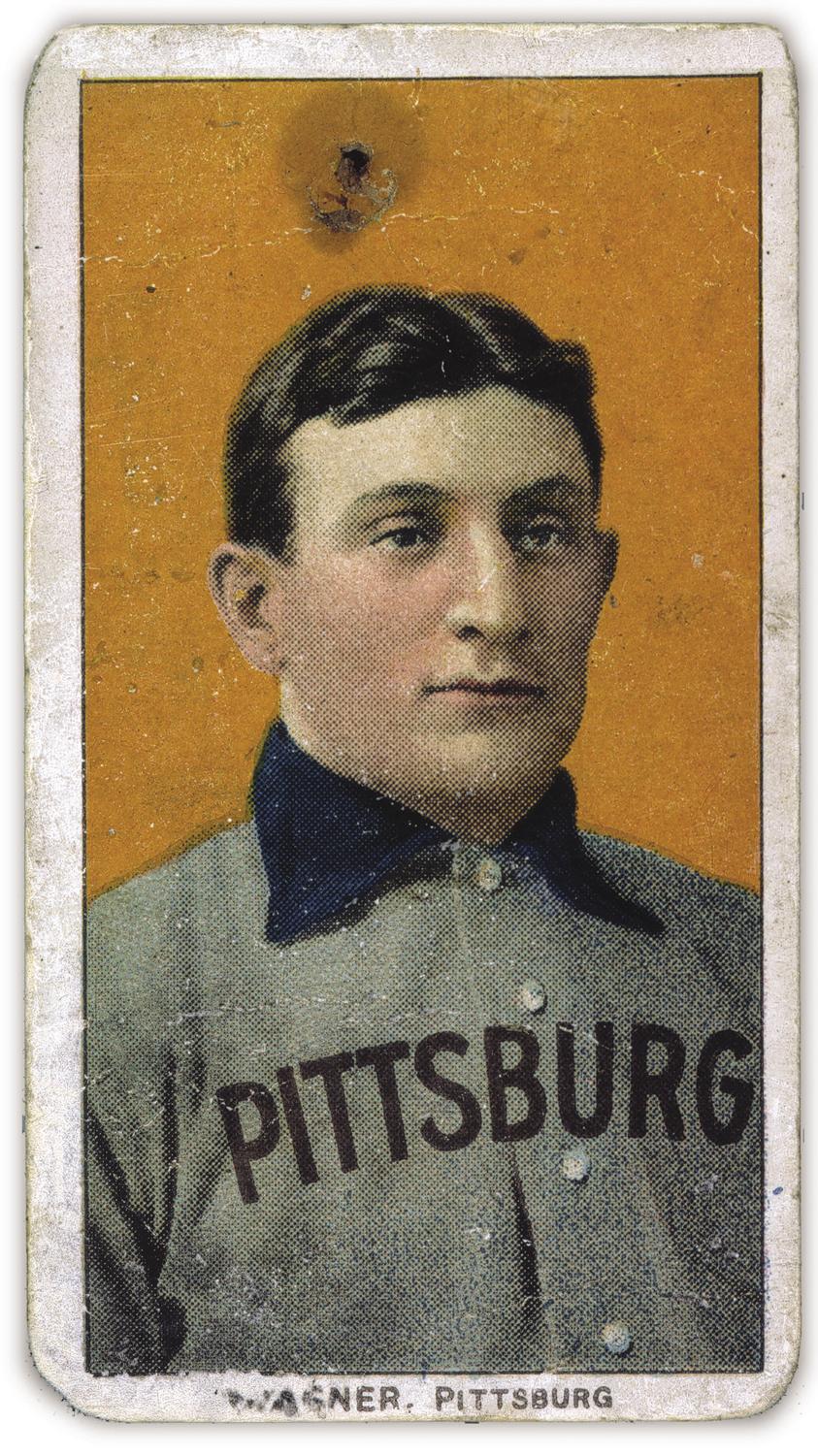
Babe Ruth was baseball’s first home run king. In 1921, Ruth hit 59 home runs while the Yankees shared the Polo Grounds with the Giants. That record stood until Ruth belted 60 for the “Murderer’s Row” team of 1927. It was a record that stood until Roger Maris hit 61 in 1961. His 714 career home runs served as a record until broken by Hank Aaron in 1974. Ruth’s .690 slugging percentage remains a record.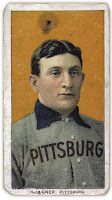 Johannes Peter “Honus” Wagner was probably baseball’s first superstar. Playing most of his career with the Pittsburgh Pirates, Wagner won eight batting titles which is tied for the most in the National League with Tony Gwynn. One of the highlights of Wagner’s career was when the Pirates faced the Detroit Tigers in the 1909 World Series. The Tigers were lead by the 22-year old Ty Cobb. Vowing not to have the same poor showing as he did during the 1903 World Series, Wagner out hit Cobb .333 to .231 and stole six bases, setting a World Series record. At 35 years old, Wagner lead his Pirates to victory over the Tigers, 4-3. Wanger’s T206 Baseball card made by the American Tobacco Company is the most expensive baseball card in the world—only 57 are known to exist.
There have been 205 former major leaguers, 27 executives, 35 Negro League players, 19 managers, and 9 umpires elected to the Hall of Fame. There are currently 63 living members. Exhibits include Women in Baseball, ¡Viva Baseball! celebrating baseball in Latin America and the Caribbean, and The Records Room that shows off the real equipment used to set Major League records.
Should the bill pass, it calls for the minting of 750,000 half-dollar clad coins, 400,000 $1 silver coins, and 50,000 $5 dollar gold coins in 2015. The sale of these coins will include a $35 surcharge for the gold coin, $10 for the silver dollar, and $5 for the clad half-dollar. The potential income of $9.5 million will be paid to the National Baseball Hall of Fame to help finance its operations.
According to the bill, the obverse design of the coin will require an open competition. “The competition shall be judged by an expert jury chaired by the Secretary and consisting of 3 members from the Citizens Coinage Advisory Committee who shall be elected by such Committee and 3 members from the Commission of Fine Arts who shall be elected by such Commission.” The bill said that the “Secretary shall determine compensation for the winning design, which shall be not less than $5,000.” Of course there is a catch. The bill says that the “Secretary may not accept a design for the competition unless a plaster model accompanies the design.”
For the reverse, the bill says the coins “shall depict a baseball similar to those used by Major League Baseball.”
But there is an interesting catch to the design specified in the bill. The bill wants the coin design “fashion[ed] similar to the 2009 International Year of Astronomy coins issued by Monnaie de Paris, the French (sic) Mint, so that the reverse of the coin is convex to more closely resemble a baseball and the obverse concave, providing a more dramatic display of the obverse design chosen.” This should give the U.S. Mint some use for the machinery they used to strike the 2009 Ultra High Relief Double Eagle Gold Coin.
With 293 co-sponsors from both sides of the aisle, there should be no reason for this this bill not to pass—but stranger things have happened with this congress already. The bill has been referred to the House Financial Services Committee where it will likely to be assigned to the Subcommittee on Domestic Monetary Policy and Technology chaired by Rep. Ron Paul (R-TX). In the “what could go wrong” category, Rep. Paul is not considered a friend to the U.S. Mint or its practices.
The bill has also been referred to the House Budget Committee who has its hands full with other matters. Budget Committee Chairman Rep. Paul Ryan (R-WI) is also known not to be a fan of the government.
Neither Paul or Ryan are co-sponsors of this bill. Maybe they can put aside their partisan differences like others who have co-sponsored the bill since baseball is something we can all agree on. As a long time baseball fan, I would buy these commemoratives. I hope congress gives me the chance!
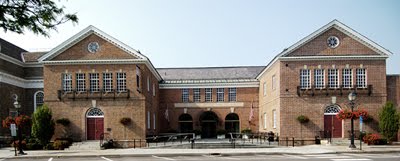
Baseball Hall of Fame image courtesy of the National Baseball Hall of Fame and Museum.
All other pictures courtesy of Wikimedia.
Jul 16, 2011 | coins, fun, US Mint
Looking around for something interesting I was thinking about putting together a type collection. I was looking for an interesting type collection. Rather than a type collection by coin types, how about by a theme. How about a Buffalo Type Collection.
The American Buffalo, or more accurately called the American Bison, was once king of the American Plains. Until the 19th century, it roamed freely until they were almost hunted and slaughtered to extinction. Still, the buffalo represents the United State’s expansion to the west and the growth of the nation. It is just an All-American symbol.
Putting together a Buffalo Type set could be easy, depending on the coins you choose, but it can get expensive. If you choose all proof coins, it could get very expensive. In any case, you can put together a nice collection of coins with buffaloes on them.
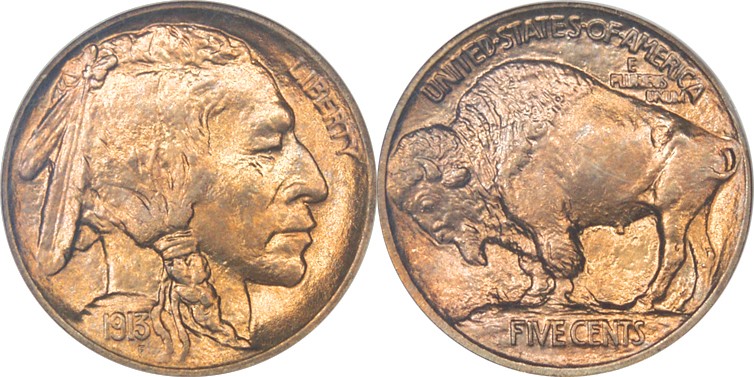
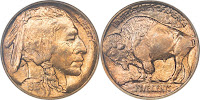 Looking at a buffalo type collection, we have to start with the Buffalo Nickel. Designed by James Earle Fraser, the Buffalo Nickel was struck by the U.S. Mint from 1913 to 1987. The obverse of the coin features a Native American that Fraser said was a composite design of three chiefs and the reverse is a buffalo that Fraser was modeled after Black Diamond, an American bison he found at the Bronx Zoo. Both claims by Fraser has been controversial since several American Indian Chiefs claimed to have been Fraser’s model and Black Diamond was housed at the Central Park Zoo. In either case, it is a wonderful coin and a great start to a collection.
For the type collection, there are two varieties of Buffalo Nickels. Variety 1 is the original where the buffalo is standing on a mound that was only issued in 1913. After finding that the lettering that said “Five Cents” and the mint mark wore off easily, the U.S. Mint hollowed out the mound making it look like a line that the buffalo stood on. The second variety was used until the last Buffalo Nickel was struck in 1938.
To start this set, I can purchase a nice 1913 (P) Type 1 Buffalo Nickel for $35-50 and a 1938-D for $25-40. These would be attractive uncirculated coins but not top of the grading scale.
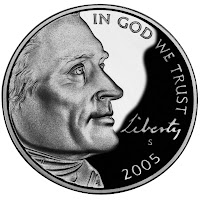
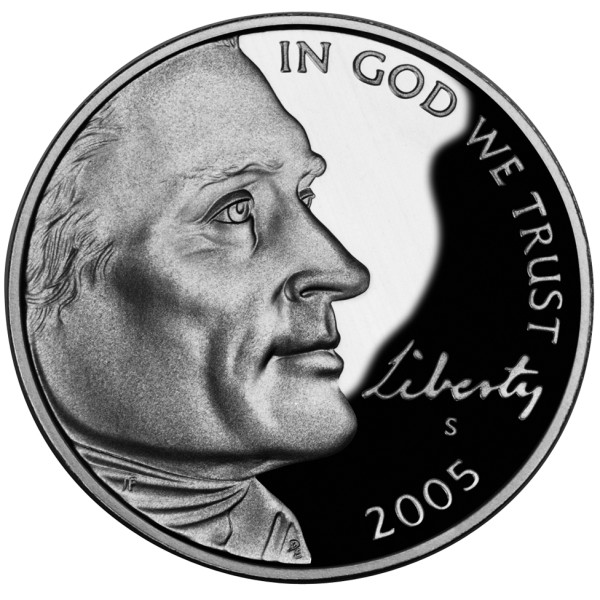
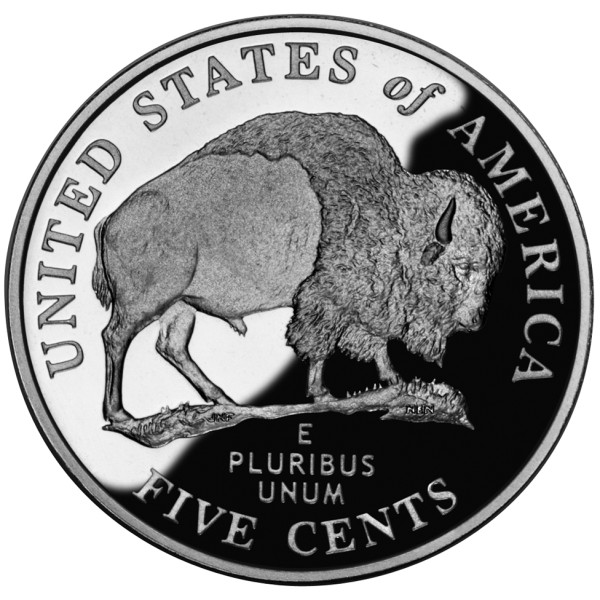
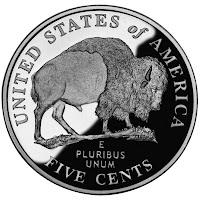 Keeping with nickels, the first issue of the 2005 Westward Journey Nickels had a bison on the reverse. Not only did it have a bison, but it featured an attractive portrait of Thomas Jefferson by artist Joe Fitzgerald. That portrait of Jefferson has the most character of any presidential portrait that has appeared on a coin. Too bad they U.S. Mint issued it only in 2005. Since this is an easy and inexpensive purchase, I think I would add both the P and D business strikes along with an S mint proof coin.
Two more easy coins are the 2005 Kansas State Quarter and the 2006 North Dakota State Quarter. Both quarters are highly available in uncirculated grades making it easy to collect P and D mint coins. The question then is whether to collect one proof or the clad and silver proof. Since both are readily available, I am going to add both to the collection.
<UPDATE>
Originally, I forgot about looking at the National Park Quarters for buffaloes. One of the reasons is that I have yet to see one in pocket change. But the 2010 Yellowstone National Park Quarter does feature a buffalo standing in front of Old Faithful erupting. Like the state quarters, circulating coins were struck in Philadelphia and Denver. There were also clad proof and silver proof. It is probably costs the same to collect these sets as with the State Quarters, so we will add all four coins to this collection.
</UPDATE>
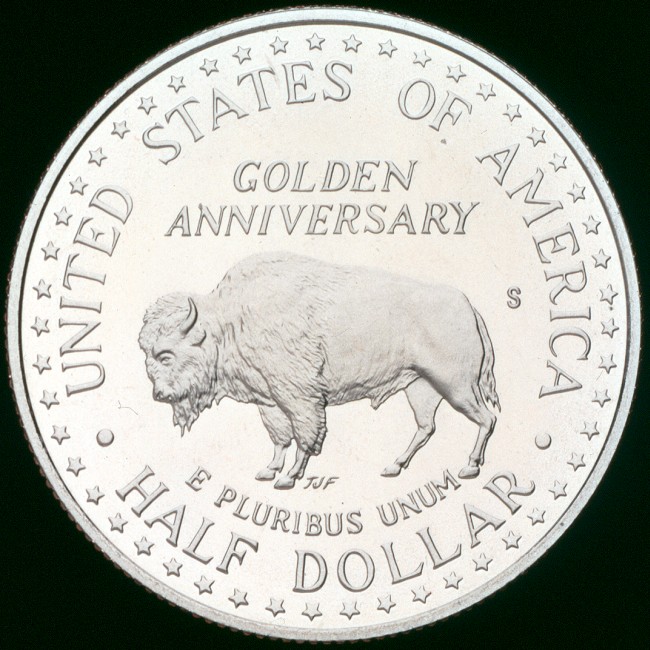
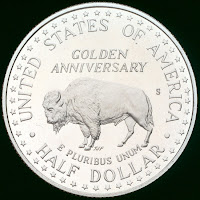 Moving from circulating coins to commemoratives, the first coin is the 1991 Mount Rushmore Golden Anniversary Half Dollar. While the the obverse has a nice image of the Gutzon Borglum masterpiece carved into the Black Hills of North Dakota, the reverse uses a classic design of a buffalo. Since there were so many of these coins struck, both the 1991-D (uncirculated) and 1991-S (proof) are available as inexpensive additions. So let’s get both for our type collection!
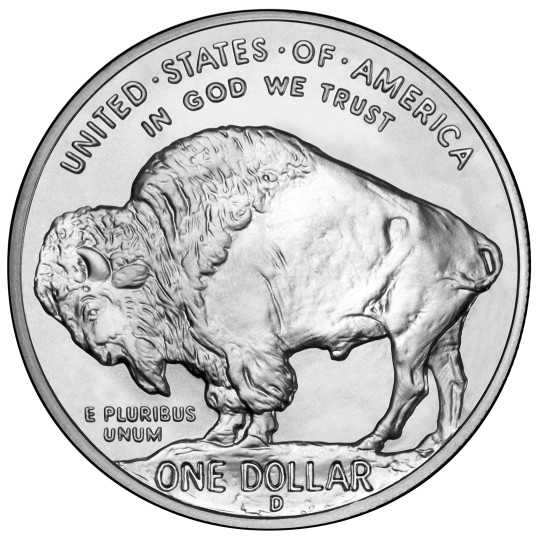
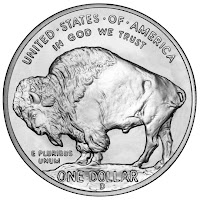 A little more expensive addition is the 2001 American Buffalo Dollar. Struck as uncirculated in Denver and proof in Philadelphia, this coin has been in high demand, which shows in its price. Although the coin was criticized for not being as faithful to James Earle Frasier’s original design, the buffalo on the reverse is well done while being proportionally smaller than it should have been. Even though both the uncirculated and proof coins can cost between $150-200, I think I will stick with the proof. I think proof coins are better looking.
<UPDATE>
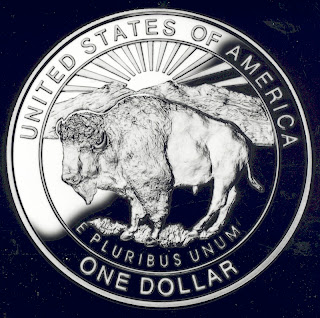 Another commemorative that includes a buffalo is the 1999 Yellowstone National Park Commemorative Silver Dollar. Struck to commemorate the 125th anniversary of the park’s establishment by Ulysses S. Grant in 1872, the proceeds given to the Yellowstone National Park and the National Park Foundation to help maintain the U.S. national park system. The obverse is shows Old Faithful, one of the park’s main attractions, erupting. The reverse is an adaptation of the National Park Service’s official agency logo. Since there is little difference in the price between the uncirculated and the proof, I will add both for somewhere in the $35-40 range, each.
</UPDATE>
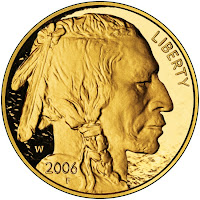
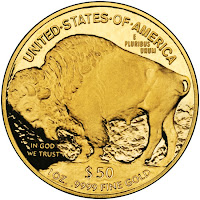 Now for the higher end is the American Buffalo 24-Karat Bullion Gold Coin. Since the program started in 2006, the U.S. Mint has been producing a one-ounce 24-karat gold coin with a very faithful image of James Earle Frasier’s Type 1 design. The textured fields on the obverse of the coin adds character to the large gold disk and makes it a very attractive coin. Fortunately for me, I own a 2006 proof American Buffalo coin from when the spot price of gold is almost half of what it is today. But if I was starting this collection today, I would only purchase the proof coin since it looks much nicer than its uncirculated cousin.
In 2008 and 2009, the U.S. Mint struck fractional gold American Buffalo coins in ½-, ¼-, and 1⁄10-ounce coins. If you can afford the one-ounce coin, I would suggest buying one. But if you cannot, the 1⁄10-ounce proof coin is worth the spot price of its gold content ($159.41 as I type this) plus 10-15 percent. Having the option to purchase the fractional gold coins makes this set more affordable.
For extra credit, how about adding one currency item to the collection? In 1901, the Bureau of Engraving and Printing printed the $10 Legal Tender Note (Fr.#114-122) with an image of a buffalo surrounded by portraits of Meriwether Lewis and William Clark. Aside from being my favorite note, it is ranked sixth in the book 100 Greatest American Currency Notes, by Q.David Bowers and David M. Sundman. It is possible for find a nice specimen in Fine and Very Fine condition for $500-800 depending which issue you purchase and where you buy one. Higher grades can push the price over $2,000! Adding one to this type collection would be wonderful.

This would make an attractive type set consisting of:
- 1913 (P) Buffalo Nickel
- 1938-D Buffalo Nickel
- 2005-P Westward Journey Nickel, Bison Reverse, uncirculated
- 2005-D Westward Journey Nickel, Bison Reverse, uncirculated
- 2005-S Westward Journey Nickel, Bison Reverse, proof
- 2005-P Kansas Quarter, uncirculated
- 2005-D Kansas Quarter, uncirculated
- 2005-S Kansas Quarter, clad proof
- 2005-S Kansas Quarter, silver proof
- 2005-P North Dakota Quarter, uncirculated
- 2005-D North Dakota Quarter, uncirculated
- 2005-S North Dakota Quarter, clad proof
- 2005-S North Dakota Quarter, silver proof
- 2010-P Yellowstone National Park Quarter, uncirculated
- 2010-D Yellowstone National Park Quarter, uncirculated
- 2010-S Yellowstone National Park Quarter, clad proof
- 2010-S Yellowstone National Park Quarter, silver proof
- 1991-D Mount Rushmore Golden Anniversary Half Dollar, uncirculated
- 1991-P Mount Rushmore Golden Anniversary Half Dollar, proof
- 1999 Yellowstone National Park Commemorative Dollar, uncirculated
- 1999 Yellowstone National Park Commemorative Dollar, proof
- American Buffalo Bullion Coin, one-ounce proof
- 1901 $10 Legal Tender Note (Fr.#114-122)
It is such a good idea, I might just put together a set!
Buffalo Nickel, Buffalo Dollar, and Mount Rushmore Commemorative images are courtesy of The Coin Page.
Westward Journey Nickel, Yellowstone National Park Dollar, and American Buffalo Gold images are courtesy of the U.S. Mint.
$10 Legal Tender Note image is courtesy of Wikimedia.
Prices confirmed with NumisMedia.
Jul 11, 2011 | coins, commemorative, foreign
Long before the invention of electricity, before steam powered everything, and even before the perfection in the forging of iron and steel to make manual machines, coins were hammered by strong men in order to impress the image on the coinage metals.
Hammered coins were struck from ancient times until the screw coin press was invented by German silversmith Max Schwab around 1550. Hammered coins were struck by frost placing a coin blank on a stationary die (anvil die) that was attached or sunk into a log or another hard surface. The anvil die produced the reverse image. Then, holding the obverse die (trussel) in one hand, the coiner swung the hammer and forced the dies into the coin blank. The pressure from the hammering pushed the metal into the crevices of the dies including the stationary lower die to create the impression. It would take multiple hammer strikes in order to impress the image into the coin.
Hammered coins were rarely perfectly round. Aside from there being no collar surrounding the blank to keep it in place, Depending on the strength and skill of the coiner, the image may not transfer perfectly, the thickness may vary, the coin could exhibit flat edges, and striking errors. Collectors of these coins, mostly pre-17th century, find beauty in the character of each strike.
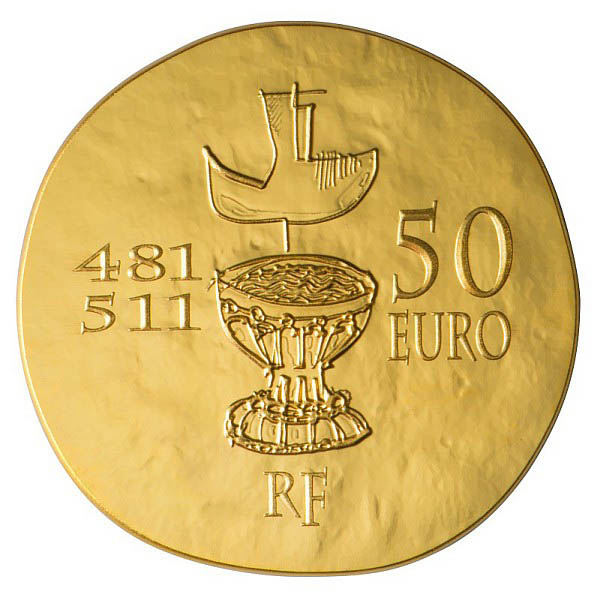
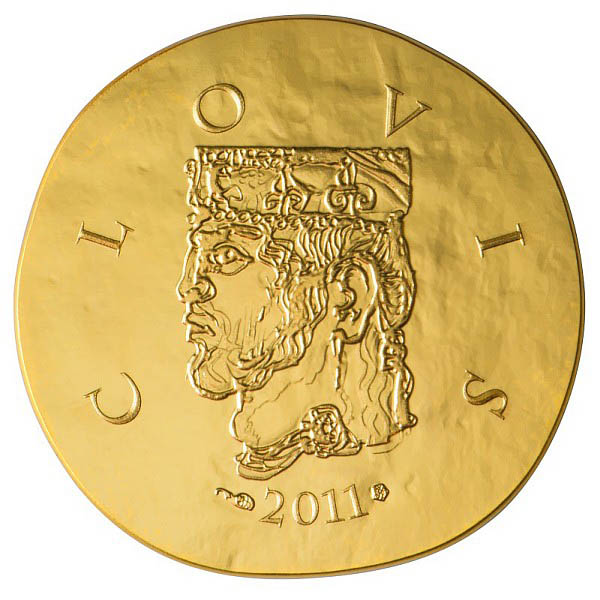
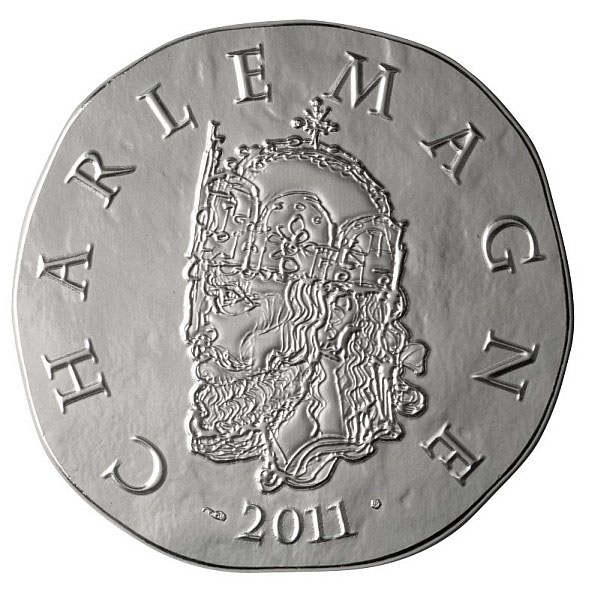
Monnaie de Paris (The Paris Mint) announced that it will create coins with the theme “From Clovis to the Republic” commemorating 1500 years of the history of France. The theme and design concepts were created by famed designer Christian Lacroix, Artistic Advisor of the Monnaie de Paris. The series will celebrate 15 kings, emperors, and presidents over five years that represents French history from Clovis I through Fraçois Metterand.
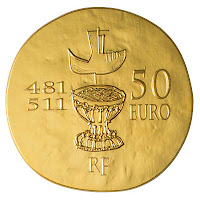
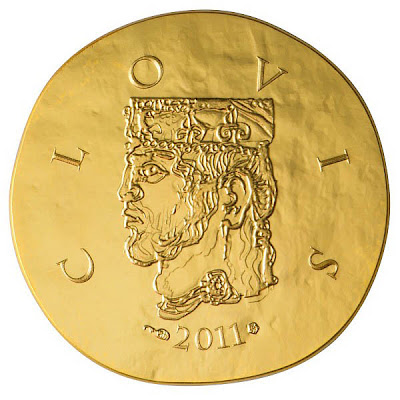 The first coin commemorate Clovis I. Clovis was the first King of the Franks. Clovis was the first Catholic king who united all of the Frankish tribes under one ruler. The second coin in the series features Charlemagne, the first Holy Roman Emperor and King of the Franks who created the first European-based empire. Both France and Germany traces their history back to Charlemagne.
To give the coin a similar character to what might have existed during the time of Clovis and Charlemagne, Monnaie de Paris developed a method to make the coin appear to be hammer struck using modern minting equipment. The obverse of both coins has a portrait as it might have appeared at the time.
The reverse of the Clovis coin has a dove flying over a baptismal font representing his Catholic heritage.
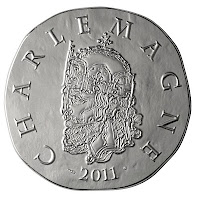
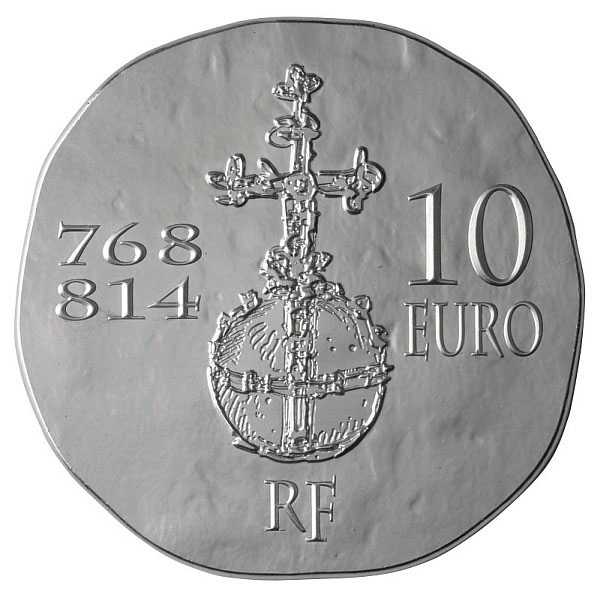
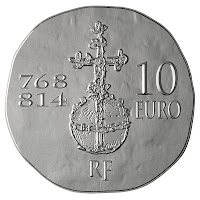 The reverse of the Charlemagne coin features a cross-bearing orb (globus cruciger in Latin), Charlemagne’s symbol of his sovereignty and power as the first emperor of the Holy Roman Empire.
To the left of the reverse image are the years of their reign. To the right is the denomination. Below the image are the letters “RF” for République Français for “The French Republic.”
For each commemorative. Monnaie de Paris will be producing two coins. The 10 Euro coin is made from 22.2 grams of .900 fine silver and has a production limit of 20,000 coins at a cost of 65 € (54.35 € without VAT for outside of Europe). The 50 Euro coin is made from 8.45 grams (quarter-ounce) of .920 fine gold (22-Karat) and has a production limit of 1,500 coins and will cost 427 €. Those of us who live outside of Europe can find regional authorized distributors using a web search.
I like the idea to make commemoratives honoring historic figures designed and struck to look close to period pieces. It will be interesting to see how the people who vote for Coin of the Year reacts to these coins.
Coin images courtesy of Monnaie de Paris.










 Loading ...