It was a hot day in Philadelphia when the First Continental Congress met on July 4, 1776 to finalize a resolution that would permanently separate the American colonies from the British Crown. According to the leaders of the day, it was the only way to rid themselves of the unfairness of British rule. In order to ensure that everyone was heard, the Congress adjourned and met as a Committee of the Whole to debate and adopt the resolution.
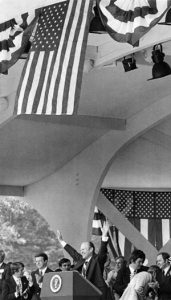
Thirty-three years ago, the United States celebrated its Bicentennial with a big celebration. As part of the celebration, the US Mint issued special circulating commemoratives honoring the occasion. For those of us who were born at the end of the Baby Boom generation, this was the first change in coinage we experienced. It was a great experience, especially when I shook hands with President Gerald Ford during a public appearance in Charlotte in 1975.
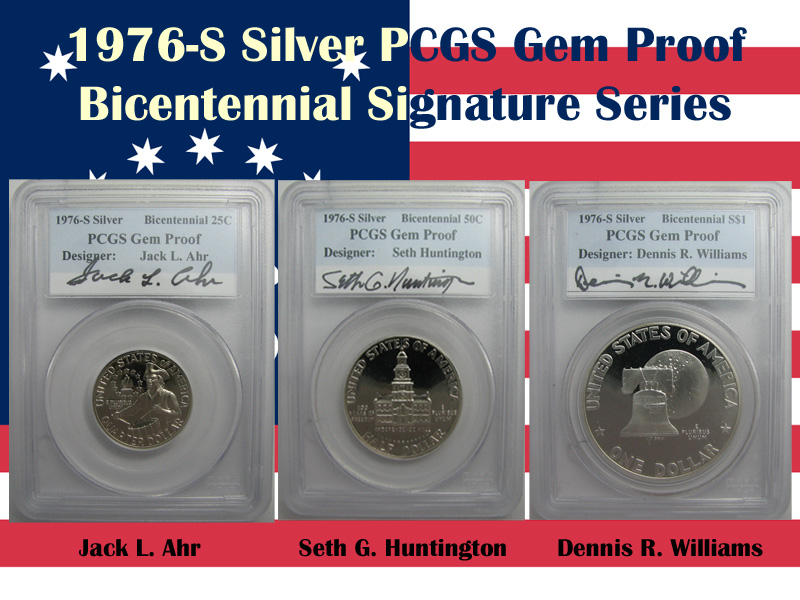
In honor of the United States Independence Day Celebration, here is my collection of Bicentennial Silver Proof Coins autographed by the artists whose designs were used.
Image of President Ford speaking at the Charlotte, N.C., bicentennial celebration on May 20, 1975, courtesy of
Andy Burriss Photography.
Jun 27, 2009 | bullion, coins, foreign, gold, silver
Fans of the Chinese Panda can look forward to a special edition bullion coin to commemorate 30 years of producing bullion coins. Although the Panda began its production in 1982, The People’s Bank of China has been producing bullion coins since 1979.
 The basic design of the coin will be the same as the regular 2009 issue. The obverse of the coin features the Hall of Praying for Good Harvest of the Temple of Heaven in Beijing, the title for the Peoples’ Republic of China in Chinese, and the year. Added to the lower half of the edge will be “30th Anniversary of the Issuance of the Chinese Modern Precious Metal Commemorative Coins” in Chinese.
The reverse will feature the panda design for 2009 with a border that will include “30th Anniversary of the Issuance of the Chinese Modern Precious Metal Commemorative Coins” in English. The weight and fineness of the metal will be placed at the bottom of the design just above the border.
This commemorative series will consist of a one-quarter ounce gold coin and a one-ounce silver coin. The gold coin will be made of one-quarter troy ounces of .999 gold, 22 millimeters in diameter, and have a face value of 100 Yuan. The silver coin will be made of one troy ounce of .999 fine silver, 40 millimeters in diameter, and have a face value of 10 Yuan. Mintage is limited to 10,000 gold and 300,000 silver coins.
Coins will be struck at the Shenzhen Guobao Mint and officially distributed by China Gold Coin, Inc., a corporation of the People’s Bank of China.
It looks like I will have to add the silver coin to my want list in order to keep up with the series.
Image courtesy of China Gold Coin, Inc.
Jun 20, 2009 | coins, commentary, fun
While attending the Whitman Baltimore Coin and Currency Show, I was privileged to have a conversation with American Numismatic Association Vice President and Presidential candidate Patti Finner. Finner was in her usual location, the Kids Korner at the show. While talking about various aspects of numismatics, I asked about keeping people interested during that period after being a Young Numismatist and rediscovering the hobby later on.
I understood the problem when I returned to the hobby in my 40s after aspects of my life settled. I was collecting state quarters out of change and placing them in a colorful folder before diving back in. When I returned to numismatics, I continued the traditional collecting as I did when I was younger. I found old folders and albums, updated them to new materials, and started to buy coins from local dealers, online, and coin shows. I was filling albums, buying lots, and selling off the excess so that the proceeds could be used to support my new habit.
Over the last few years I have filled up many albums, purchased some key coins, and created a nice collection of series by date and mint mark. While there was something satisfying about this, I wanted more.
More came in the form of registry sets, bullion silver with different designs, as well as medals and tokens that have meaning to me. I then discovered that collecting this exonumia was not only fun but it was not expensive. But I was having a difficult time figuring out how to make this interesting to an average collector. Then I spoke with Ms. Finner.
Finner’s idea is to create a personal album of coins. Regardless of how you organize the collection, her idea is to document where you received the coin, how much it is worth or you paid for it, when it was acquired, and any other facts about the coin that is important to you. She told me how some were creating databases or writing it on paper and placing it between pages, and a few other ideas.
When I returned home after the show, I opened a three-ring notebook containing paper currency and saw the two 1912 Russian notes that belonged to my late grandfather when his family arrived in the United States from Lithuania. The notes were given to me after my grandfather passed away. While thinking about what Ms. Finner had said, I typed information regarding their provenance: who they belonged to, how I obtained them, and other information about the notes including estimates of their value. The page I created was inserted into the binder behind the note.
I thought this was a great idea that I started to create pages for the notes and other items in that binder. For example, I have ticket stubs from the 1986 National League Championship Series and World Series. I created pages for those items including box scores that I found online. Documenting a collection like this takes it from a series of coins to a personal collection. It adds history and provenance to the collection.
After telling this to a friend, he created his own album. My friend had taken the coin boards that the US Mint has been producing the first three years of the Presidential Dollars and created pages to hold the boards and a sheet of paper where he could document the history of the coins. He used a one-pocket mylar page creating a pocket using a food sealing machine. He created two binders for each of his children and is considering doing the same for the 50 State Quarters.
For those 20- and 30-somethings who are establishing themselves in their careers and with families, this is an opportunity to create a family collection and tell a story that documents the family history with the coins. For those with children, it is also something you can do together.
This can be done using coins, tokens, currency, medals, or anything collectible. Make it a project. Share the project. But the most important thing to remember is to make it fun!
Jun 15, 2009 | Baltimore, coins, shows
Sunday traffic to Baltimore was not bad. Even though the Orioles were playing the Atlanta Braves at Camden Yards (the O’s crushed the Braves 11-2), there was not a lot of traffic in downtown Baltimore. I was able to park in my usual overpriced location at the Sheraton Inner Harbor Hotel and hobbled my way through the lobby, up the escalator, to the walkway between the hotel and the Baltimore Convention Center.
I know that some dealers wanted Whitman to bring back Sunday hours, but when I was there the floor was empty. It appeared that more than half of the dealers left before the Sunday session but the number of people there appeared less than I saw before closing on Friday. Maybe this is not a good indicator of the potential for Sunday attendance because of the nearby Orioles’ game. Rather than regular parking rates, nearby lots charge “event rates” which may keep people away. The next Whitman Baltimore show will be November 12-15. The Baltimore Ravens, who play in nearby M&T Bank Stadium, will play on Monday night that week. We will see how Sunday hours do in November without competing events in downtown Baltimore.
The great thing about going to these shows are the people you meet. There are some dealers that it is great to talk with. They are wonderful, hard working people who make this a great hobby. These are also the dealers that I continue to buy from because not only do they deserve my business, but they also sell at a fair price, which all that we collectors can ask for.
Every show always has an underlying theme, a type of coin that seems to be more prevalent with the dealers and looked after by the buyers. This time it was interesting because nearly every dealer, regardless of what they were selling, had rolls or singles of the 2009 Lincoln Bicentennial cents. One dealer whose inventory contained a lot of silver coins as well as gold and silver bullion also had rolls and singles of the cents for sale. There were others with the D.C. & U.S. Territories quarters and Presidential Dollars, the 2009 cents were a dominant theme.
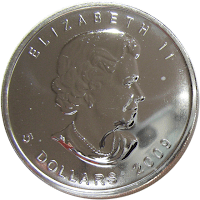
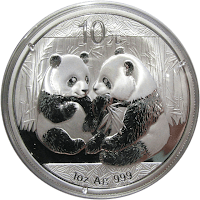 While talking with that bullion dealer I found very nice examples of the 2009 silver Maple Leaf and Panda. While the Maple Leaf was very full of luster and is a solid and consistent design, I continue to be amazed at the artistry and craftsmanship of Chinese Panda. Since they hired a new artist in 2001, the design of the Panda coins have been phenomenal. The artistry and the quality of the strike makes the Panda something really special to own.
As I looked over the shoulder of the buyers searching the cases, I noticed that 20th century United States silver coins were a popular choice. From early Washington quarters to Walking Liberty half dollars, I noticed quite a few people interested in silver. And not just silver coins, quality early issues of these popular series. Even some later series were receiving attention, like the Roosevelt Dime and Franklin Half Dollar. I think this is the first time since I have been attending this show that I observed the dominant coin was not the Morgan Dollar.
Even though the Sunday session was sparsely attended, I still had the opportunity to meet and talk with a lot of good people. I even found a Father’s Day present for my father that I know he will like. I also know he reads this blog so this purchase will remain a secret until he receives it next week!
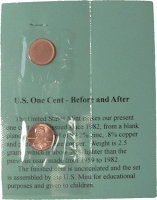 In keeping with my tradition, I had to find that one “oh, neat” item. This time, it was given to me shortly after my arrival on Friday. Following the setup of my exhibit, I spoke with Patti Finner in the Kids Korner. While speaking with her, she gave me a card with a type 2 blank cent planchet and an uncirculated 2008-D Lincoln Cent. A type 2 planchet is one whose rims were upset, the last step before striking. The planchet and the cent are in US Mint-type blister packaging and attached to a card explaining the “Before and After” of the process. The card was produced by the US Mint in conjunction with the h.i.p. program (History In your Pocket) for teaching children about coins and collecting.
I will be talking more about my conversation with Patti Finner in another post, but I would like to publicly thank her for this neat card and our very educational conversation.
If you made it this far, I am sure you can guess that my exhibit did not win at the show or I would have mentioned it at the beginning. The exhibit that one was a person who collected half-cents that were clipped during the minting process in each of the positions of the clock. He presented 12 coins in the layout of a clock that showed each coin and their clip. It was a very interesting and fun exhibit. It was a very fun and educational experience. I learned a little about exhibiting and will be making adjustments in order to do better next time—and there will be a next time. At least I received an uncirculated 2009 Silver Eagle for participating.
I know that sometimes it seems that buying coins online either through auctions or dealers appears easy, but you should really try to visit a coin show. You should meet the people in the hobby. You should see the coins. There is nothing more fascinating than looking at a case full of shiny silver dollars or something you are not collecting. By being on the bourse floor, you can meet dealers and other collectors. You can ask questions. You can get a better appreciation for this hobby beyond just accumulating. It is a hobby of people bound by the this passion for numismatics and that makes for a fun day at a coin show.
Jun 12, 2009 | Baltimore, coins, shows
There are few shows like the thrice yearly Whitman Baltimore Expo. There are other large shows that are very well attended and Whitman is trying to expand their show portfolio to places like Philadelphia, but Baltimore supports this show three times per year. It is an amazing sight that has to be experienced to really appreciate.
I left home a bit late this morning after doing some work. With my backpack and cane, I drove to Baltimore. The drive to Baltimore was uneventful except, meaning the traffic on the Capital Beltway was bad. As I turned off the highway onto I-395 toward downtown Baltimore I had a sinking feeling. At the first traffic light I looked in my bag and realized I left the backing to exhibits at home. After taking the time to cut the backing to size, the feeling of instant panic was almost consuming.
Rather than go to the Baltimore Convention Center, I veered to downtown to find a place to stop and think. I looked at the iPhone and started to look up locations of craft stores. After finding a store not too far away and calling to confirm they had sheets of felt, I brought up a map with directions and drove to the store.
After purchasing four large pieces of felt, I rushed to the Sheraton Inner Harbor, where I usually overpay for parking, and hobbled to the Convention Center. After claiming my Exhibitor badge, I entered the large exhibit hall and found the exhibit area next to the Kids Corner. I was the last to set up, but I made it to my cases.
My exhibit is titled “The Bicentennial In Numismatics.” It is about one-third of my collection of numismatic-related bicentennial memorabilia put on display for all to see. Aside being a great milestone for this country, the bicentennial coinage marked the first time those of us at the tail end of the Baby Boom era experienced a change in design in our coinage. Numismatically, it is a fun topic. There were so many medals and tokens produced, it was difficult to reduce the number of items to fit in four cases.
As I setup my cases I realized that I left a few medals and a two dollar bill at home. I had one two dollar bill that was stamped in Philadelphia on the first day of issue, but I wanted a second one to show the reverse that was an engraving of John Trumbull’s painting “The Declaration of Independence.” Oh well… next time I will be more organized.
After I completed my setup, I looked at the other cases in the exhibit area. There were some differences between their cases and mine. Each had a different theme, but had a strict order to them. I felt that mine was not so much an exhibit but a celebration. In fact, I had a few people view the exhibit just after I set it up and commented as to how they remembered the coins, medals, and the celebration. Even if I do not win, I know that at least one person enjoyed the exhibit!
If there is one thing I do not like about my iPhone is the quality of the built in camera. Even with the glare of the overhead lights, I think I was able to capture images of the cases to give my readers an idea of my exhibit. The following is a slideshow of the cases as stored in a Photobucket album:
I will have more to say about the show in another post. But I wanted to mention that amongst the people I met, I had a nice conversation with American Numismatic Association Vice President Patti Finner. I met Patti at the Kids Corner where she was ready to talk about anything numismatics. I invited her to speak at my coin club the next time the Whitman show will be in Baltimore. She was very gracious, full of energy, and looking to help as best she could in making her talk a success for our club. I really appreciate her taking the time to talk with me.
Exhibits competition results will be announced at 11:00 AM on Sunday morning. Stay tuned!
Jun 3, 2009 | coins, video
A retired psychologist in Truro, Massachusetts on Cape Cod found a 17th century sixpence while digging in his garden.
It was reported that Dr. Peter Burgess retired to Truro and decided to plant a garden. While digging in March 2008, he found the coin. Although it was very worn, Dr. Burgess did some Internet research and contacted Louis Jordan of the Department of Special Collections at University of Notre Dame. Jordan verified that the coin was a William III sixpence.
William III of Orange was King of England, Scotland, and Ireland from 1689-1702. He was King along side his wife, Queen Mary II until her death in 1694. William endowed the College of William and Mary in present day Williamsburg, VA.
I found a video of an interview with Burgess by the Cape Cod Times:
Even though the coin is worn, I think it is worth something. In any case, it is a good find!
Jun 2, 2009 | coins, shows
I had taken some time off from the blog world to get some other work done. Maybe one day I will figure out how to make this a full time job, but until then we will have to endure a written silence. Since I am back after two weeks, here are some random thoughts:
My ballot for the American Numismatic Association 2009-11 Board of Governors elections. Compared to the last few elections, this one is very quiet. The significant race is the one for president that features Patti Finner, the current ANA Vice President, and Cliff Mishler, a current board member and former president of Krause Publications. Both are ANA Life Members with a distinguished career with the ANA. Both have their fans and critics. I have not yet decided who to endorse.
In the mean time, the ANA is still in court fighting former Executive Director Christopher Chipoletti. Now the ANA is alleging that Chipoletti stole money from the organization. If true, Chipoletti’s career is over.
From the perspective of the Federal Reserve, the economy must be wreaking havoc with their distribution operations. In the Washington, DC area, I have not seen any 2009 coins in circulation. Up until recently it was common to find 2008 dated coins in change. Now, I am finding 2008-D coins amongst the coins.
Considering our proximity to Philadelphia, receiving uncirculated, removed from the rolls Denver minted coins in quantity is unusual. In the last week, I almost filled a plastic tube of 2008-D cents! This phenomenon cannot be tied to a “Coinstar effect.” These are new coins that had to be distributed by the Federal Reserve.
The Whitman Baltimore Coin and Currency Show will be held June 11-14 at the Baltimore Convention Center. This show will include the first Maryland State Numismatic Association Distinguished Lecture Series featuring Q. David Bowers. Bowers, who recently publishedWhitman Encyclopedia of Colonial and Early American Coins, will be talking about Colonial and Early American Coins. The talk is being held on Saturday, June 13 at the Convention Center. Times and locations will be posted on site.
MSNA is also sponsoring competitive exhibits at the Baltimore Show. A few people, including your intrepid blog host, will be exhibiting at the show. This will be my first ever exhibit. It will be interesting!
The US Mint announced their Last Opportunity Sale to sell off all 2008 dated items. You have until June 30 to buy these items.
Other than the ANA election, the most interesting story that will be coming this summer is the pending trial for the twenty 1933 Saint-Gaudens $20 Double Eagles found by the relatives of the late Israel Switt. This could be the biggest numismatic soap opera since trial and subsequent sale of the Farouk-Fenton specimen.
I have a few book reviews coming. Stay tuned!
May 4, 2009 | coins, US Mint
After finding out that the US Mint will stop producing certain coins, I went to several banks Friday afternoon and Saturday morning looking for rolls of 2009 coins. Aside from my bank, I went to several banks where I have been able to easily find rolls of dollar coins.
A few banks allowed me to look through their rolls, without opening then of course. Tellers brought boxes of coins from the “back room” they received from their supplier. I searched the rolls, limiting my examination to shotgun rolls, looking at the ends for 2009 coins.
While searching the rolls standing in the banks, I did not find a shotgun roll with identifiable 2009 coins. In fact, I did not find a roll with uncirculated cents. Few had rolls of Presidential Dollars but no 2008 Martin Van Buren dollars, which I continue to have a difficult time finding.
I took a chance with four dime and two nickel rolls that showed the reverse on both ends of the shotgun rolls. After I searched the rolls, I found $44 worth of mostly 2007 and 2008 coins.
I have yet to see circulating 2009 coins. The DC Quarter and William Henry Harrison Dollar I have came from the change machines at the US Mint Headquarter.
As I noted in my last post, 2009 could produce the fewest coins since the early 1950s. I wonder what the premium will be in 5-10 years when (hopefully) the economy improves?
May 1, 2009 | coins, US Mint
It is being reported that the US Mint will cease production of nickels and dimes for six months because of the reduced demand from the Federal Reserve. Production of other coins with changing designs, such as the Bicentennial Lincoln Cent, DC & Territories Quarters, and Presidential Dollars, will continue production pending further review.
Workers at the US Mint will participate in a six-month productivity maintenance program and capital maintenance in order to keep the rank-and-file workers employed. The US Mint has imposed a bureau-wide hiring freeze.
This announcement effects both the Philadelphia and Denver facilities.
As of the end of April, 2009, the US Mint produced 79.2 million nickels and 146 million dimes. In 2008, the US Mint produced 640.56 million nickels and 1050.50 million dimes. If no more coins are produced for the rest of the year, it would mean an average if 87-percent reduction in nickel and dime production. Not including proof and other special production coins, the last time the US Mint produced few nickels all mints in a single year was the 56.7 million nickels in 1951 (28.5 million from Philadelphia, 20.4 million from Denver, 7.76 million from San Francisco).
For dimes, we have to go back to the 44.9 million produced in 1955 (12.45 million from Philadelphia, 13.96 million from Denver, and 18.51 million from San Francisco).
Numismatically, it could make these coins modern rarities. Then again, coins from the 1950s have not significantly increased in prices, with the exception of very high grade and full detail coins. While I may put away a few of these coins, I am not going to hold out hope of buying my dream home with them. We may be long passed before these coins show significant price increases.



 Loading ...