Nov 19, 2008 | Australia, coins, YN
The future of the hobby we love are in our children. There has to be a way to get children interested in collecting coins beyond looking at the sameness of circulating series. We have seen that the 50 State Quarters program has had a postitive impact on the hobby. There has even been intrest in the Presidential Dollar program and the educational aspect with learning about each president.
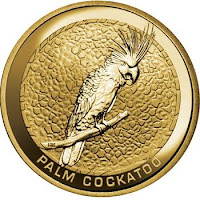 Our friends at The Perth Mint has taken this one step further. They have created a AU$1 series based on animals found in Australia. The 2008 Australian Animal $1 Coins program is being marketed to young collectors to teach them more about Australian animals. The Perth Mint has also been reaching beyond Australia to young collectors all over the world.
The program is a 12 coin series of $1 non-circulating legal tender coins with four coins in each of three categories of animals that live in the air, on land, and in the sea. To appeal to the young collector, The Perth Mint offers the coins on individual cards or together with an album and two different sets. The complete set includes all 12 coins, a complete album with themed games, stickers, and a medal of “Gordy the Gekko,” a mascot of The Perth Mint.
There is even a companion website that also has games for the young, or young at heart. There is a contest, but I am not sure it is something those of us who live outside of Australia can participate with. But I had fun with the word search game.
With the current exchange rate, the cost for the complete set is just under $47.00. It sounds like a good gift for the young numismatist. With the Whitman Baltimore Show coming this weekend, I will see if a dealer has a set I can buy for my niece who really likes animals. She will like it!
Image courtesy of The Perth Mint.
Nov 4, 2008 | BEP, coins, legislative, US Mint
Citizens of the United States wake up this morning to what some has called the most exciting and exhausting election season since Dewy did not beat Truman. It also has to be the longest campaign after having started the day after the 2006 midterm election by our over-active press.
Numismatically, there should be few changes if any. Although there is a lot of passion for the presidential candidates, the only influence the president may have is the appointment of the directors of the US Mint and the Bureau of Engraving and Printing. Otherwise, congress must past the laws to command the US Mint to do its job. The president can veto any law, but is rarely done with numismatic bills.
Although most of the action is in congress, there is not much to watch from a numismatic perspective. Polls show that the Democrats will maintain control of Congress and possibly increase their lead. It is likely that the leadership will probably remain in place for the 111th Congress including Barney Frank (D-MA), Chairman of the House Financial Services Committee, the committee responsible for numismatic laws.
Analysts suggest that Frank will win his 15th election and return to the House as chairman of the House Financial Services Committee. Numismatically, this means that the run the committee adopted that any commemorative coin bill must have 250 co-sponsors before it would be considered.
In other races, Virgil Goode (R-VA) is in a very tight race. Goode was eventually credited with inserting a measure in an omnibus budget act to move the motto “IN G-D WE TRUST” from the edge to the front of both dollar coins.
For those hoping that the new congress will eliminate the paper dollar, the 111th congress may not be your answer. With the exception of the retiring Rep. Tom Davis (R-VA), most of the Washington, DC area representatives in Maryland and Virginia will be returning to their seats the House meaning that there will continue to be local political incentives force the BEP to continue with printing $1 Federal Reserve Note.
Since this election does not matter numismatically, you may want to consider such “minor” issues such as the economy, healthcare, or international policy. But whomever you chose, VOTE!
Vote Early and Often!
Oct 21, 2008 | coins, fun
I was visiting the site for the New York Public Library looking to see what government records they have that would show information about my family when I decided to click the link for the The Library Shop. I wanted to find out what souvenirs could be found in a library gift shop, other than bookmarks.
 It was surprising to find a section for Jewelry. While visiting the site, I clicked on the section for rings and paged through the section to find very interesting coin rings. Rather than the smooth, flat rings, like I wrote about in the past, you can see the design inside and out. It is almost as if the ring was folded over and formed.
Coin rings are custom made and can be made from a Walking Liberty Half Dollar, New York State Quarter, Mercury Dime, and Morgan Dollar. The listing says that the coins require 1-2 weeks and can be made in sizes of up size 12 for the dime and quarter, size 14 for the half and dollar coins.
I may buy myself an early holiday present!
Image courtesy of The Library Shop at the New York Public Library
Oct 5, 2008 | coins, currency
While the United States continues to be one of the few countries to circulate its unit currency in paper, two countries have recently announced that they are going to replace their lowest denomination notes with coin.
The Czech Republic will begin to circulate their 50-koruna banknote with a coin. While both the coin and banknote will circulate simultaneously, the Ceska Narodni Banka (Czech National Bank) expects to discontinue the circulation of banknotes. No decision has been made as to the design of the new coin.
Earlier this year, the Banco Central de Nicaragua (Central Bank of Nicaragua) announced the new issue of a 10 cordobas coin. These coins will co-circulate with their banknote counterparts until the paper money wears out. The bank will soon begin to circulate a 500 cordoba note.
Central banks across the world are beginning to look into replacing lower denomination currency with coins. In Canada, a friend reports that he was involved with a survey that asked about replacing the Canadian 5-dollar note with a coin.
In the mean time, the paper dollar continues to circulate in the United States even though it would be economically beneficial to replace the paper with coin. Politics will remain in the way of the government doing the right thing.
Oct 4, 2008 | coins, commemorative, legislative
The House of Representatives passed the “Stimulus Package” yesterday, and went into their “clean up” mode. As part of that exercise, the house passed H.R. 5714, their version of the United States Army Commemorative Coin Act of 2008. This came one day after the Senate passed S. 2579.
Before the bill was passed, one amendment was offered. Although the text of the amendment was not available at the time I write this, it may have been offered to synchronize this bill with its Senate ounterpart. In these cases, a conference committee will pick one bill and send it back to both chambers for an up or down vote. This will probably be done during the lame duck session that follows the election.
Oct 3, 2008 | coins, commemorative, legislative
After the Senate passed their version of the Emergency Economic Stabilization Act (H.R. 1424, commonly known as the “Wall Street Bailout Bill”), the upper house went into “clean up” mode. Clean up mode is when congress pushes lesser, non-controversial bills through the body. As part of that clean up, the Senate passed S. 2579, United States Army Commemorative Coin Act of 2008.
The bill calls $5 gold coins with a limit of 100,000 minted, 500,000 $1 silver coins, and 750,000 clad half-dollars commemoratives in 2011 to recognize the founding of the United States Army in 1775. “The design of the coins minted under this Act shall be emblematic of the traditions, history, and heritage of the United States Army, and its role in American society from the Colonial period to today.”
Coins will include a $35 surcharge on the gold coin, $10 for the silver dollar, and $5 for the clad half-dollar will be paid “ to the Foundation to help finance the National Museum of the United States Army.”
Before the can become law, it must pass in the House of Representatives and signed by the president. Even though it is the same bill as H.R. 5714 that has 348 cosponsors, there is no guarantee that the lame duck session that will meet after the election will take up this measure.
Sep 28, 2008 | coins, registry sets
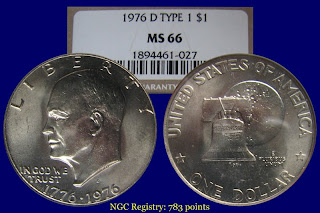 It has been a while since I have showed off a new purchase and I wanted to show off my 1976 Type 1 Eisenhower Dollar graded MS66 by NCG. While some may not think this exciting, it is a very good looking coin that helps boost the score of my registry set collection.
For those new to reading this blog, I wrote about Competitive Collecting which is collecting high grade coins and attempting to complete Registry Sets by the major third party grading services. Those competing in the registry set competitions, try to collect the highest grade coins. Those coins are assigned points and those with the most points wins each year.
I started by dabbling in registry set collecting at the end of 2006. I became more serious in 2007. By the end of 2007, I decided that if I was going to compete, I wanted to win. Since I have an interest in bicentennial numismatics, I decided to clean out the sets I am no longer interested in collecting and just collect 1976 registry coins.
For 2008, I decided to try to find the best coins I can afford in order to have a top registry set. I started with upgrading my Eisenhower Dollars. But these high grade large dollars are not easy to find since they were never struck well. For registry set collectors, higher graded coins can give a registry set a nice point boost. Also, since finding these high grade dollars are difficult, it is satisfying when I find a nice coin.
When I found that this coin was available, I looked up the registry set value and found that removing the previous coin and adding this one would raise my point total by 616 points. Even more important, it would propel me to third place for the 1776-1976 Clad Mint Set competition. I could not resist buying the coin.
After adding the coin to my registry set, I found that the signature banner produced by NGC has added “An NGC Top Ranking Set” to the bottom of the banner for having the third ranked set. This is so cool and such a great ego boost, I downloaded the current banner so I can have a copy.

How cool is that!
Sep 25, 2008 | coins, gold, US Mint
The US Mint sent a letter to authorized dealer announcing sales of the American Buffalo Gold Coins have been suspended.
“Demand has exceeded supply for American Buffalo 24-karat gold one-ounce bullion coins, and our inventories have been depleted. We are, therefore, temporarily suspending sales of these coins,” the Mint said in a memorandum to authorized American Buffalo dealers.
The Mint had resumed sales of American Eagle Gold Coins and said that they had a sufficient supply for dealers.
This announcement does not include collectible coins, which can be purchased via the US Mint’s online catalog.
Sep 21, 2008 | coins, legislative
Representative Frank Lucas, a Republican who represents Oklahoma’s 3rd District and a coin collector, introduced H.R. 6942 “to provide for the return of the half-dime as the new 5-cent circulating coin.”
The text of the bill is very simple, it calls for the removal of “Paragraph (5) of section 5112(a) of title 31, United States Code” (31 U.S.C. §5112(a)) that describes the current nickel as “a 5-cent coin that is 0.835 inch in diameter and weighs 5 grams.” In its place, the bill calls for “a clad half-dime that is based on the size and shape of the half-dime or 5-cent coin produced in the 1870s.”
If the bill is not buried in committee, more exacting standards will have to be added when it goes through mark-up.
The half-dime that Rep. Lucas refers to are the Liberty Seated half-dimes designed by Christian Gobrecht. Liberty Seated half-dimes were in production from 1837-1873. Those coins weighed 1.34 grams and were 15.5 millimeters (0.610 inch) in diameter with reeded edges. Half-dimes of that era were struck in .900 silver and .100 copper.
Shield Nickels, designed by James B. Longacre, were put into circulation in 1866 using the .750 copper and .250 nickel composition still in use today.
The purpose of the bill is aimed at lowering the price to strike 5-cent coins so that their production does not cost more than their face value. In this case, rather than a 5-gram coin that is .750 copper and .250 nickel whose metal values are approximately $0.0477 (based on the market close as of September 19), it would be a smaller coin made with .9167 copper and .0833 nickel—clad coinage is a .750 copper and .250 nickel cover around a pure copper core. The metal value of the new coin would be $0.0146, or approximately 70-percent less than the current coin in the cost of metals.
As with any change to our change, there will be resistance. Aside from the social impact, the most significant resistance could come from the vending machine operators who would have to worry about accepting the new coins. Banks and coin counting services could complain about the increased cost in handling a new coin type.
H.R. 6942 has little chance of passing, regardless of any merits. It was introduced on September 18, 2008, with no co-sponsors and referred to the House Financial Service Committee. The introduction came during a week that congress was asked to approve a $700 billion bailout of the financial industry.
Congress is scheduled to go into recess on September 26 so that members can conduct their campaigns. They will not return to Washington until after the November election. At that time, the lame duck congress will have to resolve any budget issues not passed before the fall recess. I doubt any “non-essential” bill will be considered before the final adjournment of the 110th Congress.
Sep 19, 2008 | coins, other
 Over 3 million nickels were strewn all over the southbound lanes of I-95 in Brevard County, Florida after two trucks collided on Wednesday. The truck that caused the accident was carrying the nickels from the US Mint in Philadelphia to the Federal Reserve in Miami for public distribution. The Miami facility is a branch of the Federal Reserve Bank of Atlanta.
The crashed caused the closing of the southbound lanes for over 5 hours.
Reports say that the truck carrying the nickels struck another truck from behind causing both semis to jack knife. The accident killed William Sherman, 61, the guard who was sleeping in the back of the cab. William Rohrman, 54, was driving and was taken to a local hospital. The driver of the other truck was not hurt.
Florida State Troopers protected the scene until the U.S. Secret Service arrived. They estimated that $185,000 in nickels spilled out onto the roadway.
The report said that the U.S. Mint uses private haulers in regular trucks to transport money so that they blend in with the rest of traffic for security reasons. The private company is responsible for all of the money they haul.
Image courtesy of WFTV-9 of Orlando, Fla.

 Our friends at The Perth Mint has taken this one step further. They have created a AU$1 series based on animals found in Australia. The 2008 Australian Animal $1 Coins program is being marketed to young collectors to teach them more about Australian animals. The Perth Mint has also been reaching beyond Australia to young collectors all over the world.


 Loading ...