Feb 1, 2009 | coins, legislative
Since Rep. Sheila Jackson-Lee (D-TX) introduced H.R. 255, NASA 50th Anniversary Commemorative Coin Act, there has been two more coin-related bills introduced in congress.
Rep. Joe Baca (D-CA) introduced H.R. 406, Alice Paul Women&rsqou;s Suffrage Congressional Gold Medal Act. The bill authorizes “The Speaker of the House of Representatives and the President pro tempore of the Senate shall make appropriate arrangements for the presentation, on behalf of the Congress, of a gold medal of appropriate design in commemoration of Alice Paul, in recognition of her role in the women’s suffrage movement and in advancing equal rights for women.” The US Mint would be authorized to “sell duplicates in bronze of the gold medal.”
The other bill, H.R. 621, Girl Scouts USA Centennial Commemorative Coin Act, was introduced by Rep. Jack Kingston (R-GA). It calls for the minting of $1 silver uncirculated and proof coins “in commemoration of the centennial of the Girl Scouts of the USA” in 2011.
All three bills have been referred to the House Financial Services Committee. With the current fiscal crisis, they may be be on hold in that committee for a while.
Jan 19, 2009 | coins, dollar, US Mint
Last year, I did not see a coin with a 2008 date until April. Even with the Federal Reserve giving priority to circulating 50 State Quarters during their first two weeks of issue, it was a while before I found one in change. I wondered how long it would take to find a 2009 coin in my pocket. This year, the wait lasted until January 13.
On Tuesday, January 13, I attended the meeting of Montgomery County Coin Club, where I was inaugurated as president for my second term. Our treasurer works near the US Mint’s headquarters. He used his lunch break to visit the headquarters to purchase a number of the Hawaii quarters and the new Native American $1 Coin from the change machines in the building’s lobby.
Before the meeting started, I handed our treasurer a $1 Federal Reserve Note and he handed me a $1 coin. With the coin in my pocket, I can proclaim receiving a 2009 in change! Ok… it may be cheating, but it is still a 2009 coin and it did not cost me more than face value to obtain it.
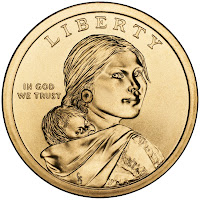 This was the first time I saw the design rather than the line drawing. The obverse of the coin continues to have the Glenna Goodacre designed portrait of Sacagawea, the Shoshone Indian guide for Meriwether Lewis and William Clark, carrying her infant son, Jean Baptist. The only difference between the previous versions and the new obverse is that the date and mint mark were moved to the edge along with E Pluribus Unum and 13 stars.
For 2009, the Native American $1 Coin Act (Public Law 110-82 [text] [pdf]) required the redesign of the reverse to honor Native Americans and the important contributions made by Indian Tribes and individual Native Americans in United States history. This year, the design represents the “Three Sisters Agriculture,”
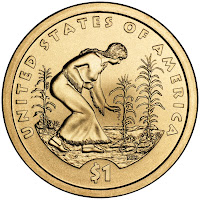 “Three Sisters” agriculture is the practice of growing corn, beans, and squash in the same mound enhanced the productivity of each plant. This simple concept lead to the accepted practice of crop rotation that is used today to maintain the production in modern farms. This helped Native American produce food and sell their knowledge to the early European colonists to ensure their survival.
In hand, it is an excellent design. The details of the image is simple, yet complete that gives the coin a great look. Even the change in the font used for “United States of America” near the edge enhances give the coin the feel of Native American art work. US Mint Sculpture-Engraver Norman E. Nemeth should be commended for his wonderful work.
Images courtesy of the US Mint.
Jan 18, 2009 | coin design, coins, Royal Mint
It is interesting to watch what other mints do with circulating and commemorative coinage. Each mint is governed by its own laws and regulations that are very different than the coin design process required of the US Mint. While the US Mint is very regulated, other mints have the flexibility to create interesting coins and do it in a way that involves the public. One mint that is using its flexibility is Great Britain’s Royal Mint.
The Royal Mint is a crown corporation answerable to the Queen. While the Queen has the final authority of all Royal Mint activities, the Mint is required to consult with the Chancellor of the Exchequer (a position equivalent to the US’s Secretary of the Treasury) and the Prime Minister. Although this gives the Royal Mint a lot of flexibility, the Royal Mint uses their power judiciously—as they showed last year by redesigning British circulating coinage for the first time in 40 years, after decimalization.
With the London 2012 Olympic and Paralympic games a few years away, the Royal Mint is preparing by starting the design process. To commemorate the games, the Royal Mint is planning issue 50 pence coins with 27 different reverse designs representing the different sports that are part of the games. The obverse will continue to use the portrait of Queen Elizabeth II designed by Ian Rank-Broadley. But rather than go through a traditional design competition by having a competition amongst artists, the Royal Mint is opening the design competition up to the entire nation.
The competition is open to residents of the United Kingdom. Those interested should go to the Royal Mint’s special website for entry information. Design winners will receive a gold version of their coin, get to see their coin being produced at the Royal Mint, and receive a £1,000 prize (currently about $1,473). The following video was produced by the Royal Mint and features Chief Engraver Matt Bonaccorsi:
Along with the regular competition, the Royal Mint is holding two other competition for students. There will be a design competition for children aged 6 to 12 years and a design competition for children aged 13 to 19 years old. The younger competition winner will not receive cash and the school where the winner of the older competition attends will receive £10,000.
Deadline for the competition is the end of April. It will be interesting to see how the process progresses. It looks like the Royal Mint has an interesting idea to get the country involved. I will be watching to see how successful they are with this program. Maybe the US coin bureaucracy can learn something from this venture.
Jan 16, 2009 | coins, commemorative, legislative
One day after the convening of the 111th Congress, Rep. Sheila Jackson Lee (D-TX) introduced H. R. 255, NASA 50th Anniversary Commemorative Coin Act even though NASA’s 50th Anniversary was in 2008. The bill was referred to the House Financial Services Committee.
Since a similar bill introduced in the second session of the 110th congress did not pass, Rep. Jackson Lee introduced it for consideration in the new congress. Currently, the bill has two co-sponsors and may not have the support to pass in NASA’s 51st year.
This is the first coin bill of the 111th congress. I am sure that there are more to come!
Jan 14, 2009 | coins, commemorative
Challenge coins are medals that bears an organization’s logo or emblem that are carried by the members and given to outsiders as an honor. In the United States, challenge coins are part of military tradition that started during World War I when Ivy League students went to war and created these coins as an act of camaraderie. Legend has it that one coin saved the life of a pilot.
According to legend, a pilot was shot down behind enemy lines and captured by German soldiers. Sine the pilot kept the coin in a pouch around his neck, the Germans did not confiscate his coin. That evening, the pilot was kept in a French-German town that was bombarded in the evening by allied forces. The pilot escaped during the bombing. During the next day, the pilot came upon a French military unit who was told to watch for German soldiers posing as citizens. To prevent from being arrested and executed by the French soldiers, the pilot showed them his challenge coin. One of the soldiers recognized the insignia and delayed the execution until they were able to verify the pilot’s identity. Once the story spread, a tradition was born!
Challenge coins were named on the tradition of the challenge. When a member draws his or her challenge coin and slaps it on the table, others must produce their challenge coin. If someone does not have their challenge coin, that person must buy a round of drinks for the group. The challenge is used as a morale builder amongst the group.
NBC Nightly News broadcast a story about the production of challenge coins at the Highland Mint in Melborne, Florida. The story noted that commemorative coins are a “half-billion dollar a year business.” At the end of the story, reporter Roger O’Neil challenged Brian Williams with an NBC challenge coin. Williams not only showed his challenge coin, but showed off a collection of challenge coins he received during his career. Watch the story:
I wonder if Brian Williams collects other coins?
Jan 5, 2009 | Canada, coins, RCM
A fascinating aspect of numismatics is to learn how the coins we collect are made. Whenever a television show has a story on the production of coins or currency, I always watch with interest. One show where I have seen an interesting presentation on minting coins is on a show called How It’s Made that is airing on Discovery network’s Science Channel.
For those not familiar with How It’s Made, it shows how various items are manufactured in nicely edited five-minute vignettes. Although the producers find manufacturers all over the world to show how products are made, the show is based in Canada. So rather than try to pierce the veil of the US Mint for the show, they went to the Royal Canadian Mint to show how commemorative coins are made.
Thanks to another How It’s Made fan posting the segment on YouTube, watch how the RCM makes commemorative coins:
On January 9, 2009 at 10:30 PM (EST), the Science Channel will be airing How It’s Made: REMIX, a show where they bring in separate vignettes under one theme. This show features currency. According to their online schedule, the stories planned for this show is change machines, gold, stamps, and collectible coins. Check your local listing to find the Science Channel in your area.
Dec 23, 2008 | ancient, coins, gold
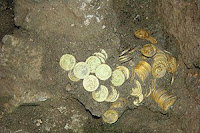 Archaeologists excavating an area at the Jerusalem National Park in Israel uncovered 264 gold coins from the Byzantine period, early in the seventh century.
The Israel Antiquities Authority reported that the coins were found under a large rock in an area where a car park was being excavated. In Israel, it is required that construction sites must undergo an archaeological investigation to ensure antiquities are recovered. This was one such dig.
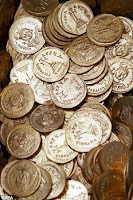 All of the coins bear the likeness of the emperor Heraclius who was emperor of the Byzantine empire 610-641. Archaeologist believe the coins were minted and hidden at the site prior to the Persian capture of Jerusalem in 614. Heraclius is depicted on the obverse wearing his military uniform and holding a cross in his right hand. A cross is shown on the reverse. The coins were found in near mint condition.
Daily Mail (UK) credits the discovery to Nadine Ross, a British volunteer working in the fourth and last week of the excavation.
Dr. Doron Ben-Ami and Yana Tchekhanovets, directors of the excavation, said that the coins had likely been hidden in a niche in one of the building’s walls because the of the lack of other items found in the area. Archaeologists hope that more can be found as they continue to explore.
First image courtesy of the Israel Antiquities Authority
Second image courtesy of the Daily Mail
Dec 20, 2008 | cents, coins, commemorative, dollar, Eagles, gold, quarter, state quarters, US Mint
As we end 2008 and look to 2009, numismatists are going to have a lot of options to add to their collections. There will be quite a number of coins that will excite many. But the shear numbers may be overwhelming to others. However you feel, the US Mint will have a very busy year. Let’s look at what is coming up in the new year.
First, three coins will not see any changes. The “Return to Monticello” Jefferson Nickel introduced in 2006 will not be changed. Neither will the Roosevelt Dime, in circulation since 1946, and the Kennedy Half Dollar, as it has been since 1964 except for the Bicentennial issues.
For 2009, we will celebrate the bicentennial birthday of Abraham Lincoln. In celebration, congress has authorized the 2009 Lincoln Bicentennial One Cent Program as part of Public Law 105-145. As part of this program, the Mint will issue four reverse design representing Lincoln’s birth and early childhood in Kentucky (1809-1816), his formative years in Indiana (1816-1830), his professional Life in Illinois (1830-1861), and an extraordinary presidency in Washington, DC (1861-1865).
As part of the Lincoln Cent program, the US Mint will issue a 2009-S VDB non-circulating coin that will be struck in the .950 copper alloy used when the 1909-S VDB was first struck. Also, Public Law 109-285 was passed earlier this year that created Abraham Lincoln Commemorative Silver Dollar to round out the celebration of our 16th president.
To round out the State Quarter program, 2009 will issue quarters to honor the District of Columbia and five US territories: Puerto Rico, Guam, American Samoa, the US Virgin Islands, and the Commonwealth of the Northern Mariana Islands. The DC and US Territories Quarter Program authorized by congress in an amendment as part of an omnibus budget bill at the end of 2007.
The same omnibus budget bill also removed the motto “IN G-D WE TRUST” from the edge of the dollar coins. The amendment was introduced by Rep. Virgil Goode (R-VA) who was defeated for re-election.
The Presidential $1 Coin Program continues in 2009 to honor presidents William Henry Harrison, John Tyler, James K. Polk, and Zachary Taylor. Harrison had the shortest term when he died one month into office after contracting the flu following his refusal to wear an overcoat during his two-hour inaugural address on a cold day in March, 1841. All of the packaging options with Presidential $1 Coins will not be offered in 2009 after not selling well the last two years.
Along with the presidents, the First Spouse Gold Coins will be issued for Anna Harrison, Letitia Tyler, Julia Tyler, Sarah Polk and Margaret Taylor. Letitia Tyler was the first President’s wife to die in the White House. Julia Tyler became First Lady after marrying John Tyler in 1844.
Native American $1 Coins program will begin in 2009 with a design honoring the “Three Sisters’ agriculture, in which corn, beans and squash growing in the same mound enhanced the productivity of each plant. It was a unique program that lead to the concept of crop rotation we know today. This change was authorized by Public Law 110-82 and add edge lettering to these coins.
That brings the total number of circulating coins to 18! Proof sets will have 18 coins and the uncirculated Mint Sets will have 36 coins. Although the Mint has not announced pricing, it would be fair to guess that the prices will raise with more coins in the set. Clad and Mint sets should see a modest price increase. Silver proof sets will add an additional silver quarter and is likely to see a $10-15 rise in price.
Beyond circulating coinage, the Mint will produce the 2009 Louis Braille Bicentennial Silver Dollar to honor the 200th anniversary of Braille’s birth. It is being touted by the Mint as being the first coin with readable Braille.
Precious metals programs will change in 2009. First, only the bullion issues of the American Eagle coins will be strucl. The Mint has discontinued the collector’s uncirculated coin program, eliminating the W mintmark from their portfolio. American Eagles will be available in proof and bullion coins in one-ounce, half-ounce, quarter-ounce, and tenth-ounce denominations.
American Buffalo 24-Karat Gold Coins will also continue in 2009 but without fractional issues. The Mint will offer only one-ounce proof and investor bullion coins.
Last, but certainly not least, is probably the most intriguing coin that will be issued in 2009: the 2009 Ultra High Relief Double Eagle Gold Coin. The coin’s design will be a high-relief $20 gold piece on a double-thick, 24-karat gold planchet (sometimes called a piefort) 27 millimeters in diameter. The design will feature Augustus Saint-Gaudens’ original 1907 design where the date will be in roman numerals (MMIX). The inspiration for this coin came from 1907 when the Mint tried to strike an experimental double eagle coins using two stacked $10 eagle planchets. When the Mint’s management realized that congress would have to approve the striking of the coin for circulation, the project was abandoned and the test pieces were melted. Aside from the date, the only difference between the 1907 test pieces and the 2009 bullion issue is that the the motto “In G-D We Trust” will be added over the rising sun as it appeared in 1908. It is expected that these coins will be struck in proof-only varieties.
It will be quite a year!
Dec 16, 2008 | coins, legislative, state quarters
In case you missed, I know I did, the Senate passed H.R. 6184, America’s Beautiful National Parks Quarter Dollar Coin Act of 2008 by unanimous consent. The bill calls for circulating quarters “that are emblematic of a national park or other national site in each State, the District of Columbia, and each territory of the United States.” The bill has been sent to the president for his signature, which is likely.
H.R. 6184 was introduced by Rep. Michael Castle [R-DE] who introduced the “The 50 States Commemorative Coin Program Act” [Public Law 105-124]. Rather than honor states, this bill honors national parks or other historical site in each state. And this bill already included the District of Columbia and the insular territories.
I wrote it before: ENOUGH!
While I doubt the president will veto this bill, having another state-related quarter program is just too much. There is real chance for collector fatigue, especially during a stressed economy. I think it is the wrong time for this program.
The program will run from 2010 through 2018, two years longer than the projected duration for the Presidential $1 Coins.
Dec 3, 2008 | coins, dollar, US Mint
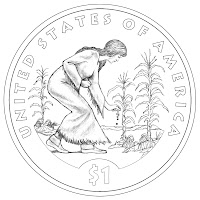 On November 28, Native American Heritage Day, the US Mint announced the design for the reverse of the new 2009 Native American $1 Coin. This design depicts a Native American woman planting seeds in a field of corn, beans and squash, representing the Three Sisters method of planting.
Public Law 110-82 [PDF] was past in September 2007 and signed by the president two weeks later calls for the reverse of the Sacagawea Dollar be redesigned every year to commemorate “of Native Americans and the important contributions made by Indian tribes and individual Native Americans to the development of the United States and the history of the United States.” The obverse will continue to have the Sacagawea design.
The law reduces the percentage of these dollars that have to be struck versus the Presidential $1 coins. This program has no end date.
Image courtesy of the US Mint.



 Loading ...