I’m bored with what is coming out of the U.S. Mint and looking at the interesting collector coins coming out of other mints who are being more innovative with their designs. Where the U.S. Mint has produced one ultra-high relief coin, the Royal Canadian Mint has three high-relief coin designs for 2011.
I’m bored with the themes of the coins coming out of the U.S. Mint. While the Medal of Honor Commemorative is a worthy coin and one of the few good designs to come out of the U.S. Mint, but I am fascinated by what some of the other mints are doing. The Mongolia 2011 500 Tugrog Endangered Wildlife silver commemorative features the Ural Owl struck in high relief with an antique finish and Swarovski Crystal Eyes. This is part of the same series that produced the 2007 Wolverine coin that was named the 2009 Coin of the Year. It also was a high relief coin with an antique finish and Swarovski Crystal eyes. We have great artists in the United States, why can’t the U.S. Mint create coins like this?
Why can’t the U.S. Mint celebrate the history of auto making in the United States the way Tuvalu celebrates Classic Sports Cars or great American motorcycles the same way Somalia did in 2007?
My late mother was a fan of impressionism. She could tell you anything about the artists and the art of that era. One day, I showed here the 2007 Niue Island Van Gogh rectangular silver dollars and thought the design was one of the neatest things she saw. Every time I see on online I am reminded of her interest in a coin when she was not a coin collector. Could we interest others artists if the U.S. Mint created coins honoring American artists? Can you imagine what could be done with Georgia O’Keeffe’s flowers, Andy Warhol’s pop art, or even Louis Comfort Tiffany’s glass designs? These could become popular collectibles and generate significant seignorage for the U.S. Mint.
The reason why the U.S. Mint is behind the rest of the world is because of congress. Congress has taken its power to coin money and has clutched it in such a pedantic manner that it has turned the U.S. Mint into a tired looking organization that is falling behind the rest of the world. Although as a factory for circulating coin, the U.S. Mint produces more coins than any other world mint, they are losing the potential seignorage and artistic prestige to other mints that are producing interesting coins that people want to collect.
There is nothing in the constitution that says the U.S. Mint has to be structured the way it is. All we have is 219 years of “this is the way we wrote the law” that binds the United States to a system that is questioned every few years.
One idea is the model an independent U.S. Mint after the operating model of other world mints. One example that could be adopted is to model a new public corporation after the Royal Canadian Mint. While the RCM is required to produce circulating coinage for the Bank of Canada, they have a little more freedom to produce a portfolio of non-circulating legal tender coins that appears to have a broad appeal. Since many of these NCLT coins are made of precious metals, collectors and investors have been purchasing the RCM’s coins as investments.
As a public corporation, the U.S. Mint would continue to be required to supply circulating coins to the Federal Reserve, maintain the American Eagle Bullion program, and the current commemorative program. As a public corporation, they could add support for additional NCLT coins coins that could compete with other world mints to sell coins with great designs.
I realize that this is a very high-level idea of a new future for the U.S. Mint that requires additional details but it would be a waste of time to pursue this further. Given the personalities in congress who would have to approve such a measure, the chance of this happening is the same as the chance of ending the printing of the one-dollar note.
If congress cannot settle on a budget to keep the federal government operating past midnight on Friday, April 8, the U.S. Mint and the Bureau of Engraving and Printing will continue to operate. Even though both agencies are bureaus under the Department of the Treasury, both are funded through their respective Public Enterprise Funds. The Public Enterprise Funds contains the seignorage (profits) made from the manufacture of the money.
Although Treasury Department has not made any official announcements, the U.S. Mint did send a note to their employees in February. U.S. Mint employees were told that “unless specifically instructed otherwise, United States Mint employees are required to report to work as usual even if there is a government-wide shutdown.”
Regardless of what the non-federal political leaders say, the Washington, D.C. area is a essentially a company town. In addition to the agencies based in the District, there is a significant federal presence in Maryand and Virginia that will impact the communities where they are located. A shutdown will affect the area as far north as Baltimore, Fredericksburg to the south, and many border towns in West Virginia that host “remote” federal facilities. This does not include the commercial contractors that provide support and services to many federal agencies. I saw one estimate that said 80-percent of the DC Metro Area would be affected by a government shutdown.
I know I am not objective on this subject because it is personal. Not only will a government shutdown hurt the economy of everyone in the region, but it can affect me personally. Since my current project is essential in the long term it is not essential for the short term operations of the government. This means I could be furloughed with my colleagues a lot of other people in a similar situation.
Television news shows us stories about the small towns that lost its mill, plant, or factory and its economy crashes. The stories are all the same, the facility closes and the small town of a few thousand is devastated—almost to the point of turning it into a ghost town. If that happened to an area with over 5.5 million people, what will be the economic impact to the entire nation?
While I agree that we need to fix the budget, get rid of government waste, and figure out how to get out of debt for the overall economic health of the nation, drastic measures are not the way to do it. Very few people can kick any habit “cold turkey” and neither can the government. It will just bring pain and suffering to the people who will not have the money manufactured by the U.S. Mint and BEP to circulate in the economy necessary to promote growth.
Bert Lance believes he can save Uncle Sam billions if he can get the government to adopt a simple motto: “If it ain’t broke, don’t fix it.” He explains: “That’s the trouble with government: Fixing things that aren’t broken and not fixing things that are broken.”
Someone forgot to remind the U.S. Mint of Lance’s axiom.
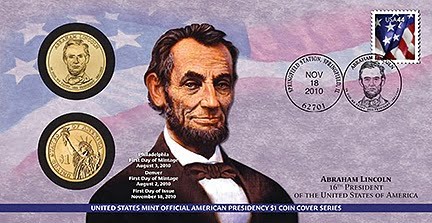
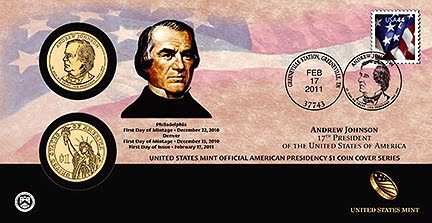
Last month, the U.S. Mint announced the availability of the availability of 2011 Andrew Johnson $1. I am a fan of the coin covers. I have the covers from the 50 State Quarters, D.C. & Territories, Westward Journey Nickels, and the 2000 Sacagawea Dollar covers. I also own the four covers produced by the U.S. Mint produced in the years leading to the American Revolution Bicentennial. However, I was reminded of Bert Lance when I saw the new cover.
Starting in 2007, the covers had a large image of the president being honored with the president’s name, term, and a postmarked current stamp. On the reverse is a short blurb about the president. Embedded in the cover are two uncirculated coins, one from Philadelphia and the other from Denver, from the first day the coins were struck. It is the only way to know on which date the coins were struck. The entire cover was beautiful in its simplicity.
In trying to deal with its new branding, the U.S. Mint altered the cover that reduced the cover and added a black bar across the bottom of the cover. The black bar is empty except for a small version of the official U.S. Mint logo on the left and the new branding logo on the right. As a result, the portrait of the president is made smaller. The space taken up by that garish black bar causes the rest of the cover to look cluttered.
Rather than trying to find a more subtle way to add their branding to the cover, like on the reverse without the tacky black bar, the U.S. Mint broke one of their better presentations.
After this debacle, maybe the CCAC Blueprint Report should have added packaging design to the list of functions that should be reviewed!
With the VCU versus Butler Final Four game (Go Rams!) at halftime, I was poking around YouTube watching a video friend sent then clicking around to the related videos. I stumbled across two videos a group called WalletPop, a personal finance site, created about coin making at the U.S. Mint.
The first video opens with looking at the plaster models of coin designs on display at the U.S. Mint in Philadelphia. This is followed by an interview with Joseph Menna showing how coins are designed using using the same 3D modeling software that is used in Hollywood to create special effects. The design process concentrates on the America the Beautiful Quarters.
Part 1
In the second video, the tour continues to the manufacturing floor where they show how the manufacturing process goes from the 2-ton roll of metal, creating blanks, making of the dies from the master die, and striking over 750 coins per minute to the finished product.
Part 2
No matter how many videos I find about the manufacturing of coins at the U.S. Mint, I am always fascinated by the process.
Although I have been a critic of the CCAC, it is because I see their input into the design process as essential. It is my attempt to provide another perspective to be considered when making the decisions. Each member brings their own unique experience to the process. However, sometimes when you are in the proverbial bubble of the action for multiple years, there is a tendency to adapt to the environment without considering how to adapt and change. At work, we call this “going native.”
I urge members of the numismatic community who may qualify “by virtue of education, training or experience” and would like to see the CCAC have a real positive impact on coinage design to apply for the position. I hope you can work with the committee but provide a strong perspective to promote good designs. If you are willing to find ways of opening up the CCAC to make it more accessible to the public including pushing the U.S. Mint to make materials more available to the public, then you will get my support.
When was the last time I placed a mail order for a U.S. Mint product? In fact, when was the last time I called the U.S. Mint’s toll-free number to place an order? If you check your record, I have never placed a mail or telephone order. All of my orders have been made over the Internet with your online catalog. Then why do you persist in sending advertisements via the Postal Service?
How much does it cost for the U.S. Mint to send postal advertisements to me and others who have only placed orders online? Aside from the postage, which I am sure you are paying bulk rates, how much are you paying to print these materials, process the mailing list, and transport these pieces to the bulk mail center?
Today, I received the latest mail advertising the America the Beautiful Quarters Proof Set. Forgetting the fact that I never order partial sets, I have never ordered products from the U.S. Mint based on mailed advertisements. If the U.S. Mint Marketing Department had performed basic business intelligence, not only you would know that sending postal advertisement has not influenced a my purchases but I am on every email list that the U.S. Mint offers. It seems obvious that the U.S. Mint does not use business intelligence to help with their sales.
While producing a top-notch product is very important to you and the collecting public, being able to run the bureau with efficiency is also important. Part of that is to know that sending postal advertisements to people like me is a waste of money at a time when every cent counts. I hope that you can fix this issue so that you can improve the fiscal performance of the U.S. Mint.
Before commenting on the CCAC Blueprint Report, I would like to note that the report has not been formally published by the U.S. Mint. It appears that the report was sent via email to a number of people who requested a copy. When I received a copy, I posted it here for the public to see. It appears as if the U.S. Mint takes an arms-length approach to the CCAC with regard to its support which shows in the lack of public information disseminated about the CCAC. While I appreciate the U.S. Mint Public Affairs Office sending a copy of this report, they should be more proactive in providing information about the CCAC to the public.
Also, it is not known whether the CCAC is accepting comments about the report. Page iii indicates that this is a final report and was transmitted to the Secretary of the Treasury. This is a shame since the document should clearly have been reviewed by others before its transmittal. While they could reject comments, accepting reviews from another perspective may have been helpful to tighten their sound recommendations.
Since they have not indicated whether they are accepting public comment, I am providing my commentary in this blog post. I will be contacting those CCAC members whose email address I know and point them to this commentary. I ask that they share this with the other CCAC members. They are invited to provide commentary to this blog post or contact me privately for further clarification. I am willing to help in anyway I can.
As with all my blog posts, comments from my readers are always appreciated!
Introduction In 2007, speaking before the delegates at the International Art Medal Federation (Fédération Internationale de la Médaille d’Art or FIDEM) in Colorado Springs, then U.S. Mint Director Edmund Moy announced his vision “to spark a neo-renaissance for coin design and achieve a new level of design excellence.” But during design reviews by the United States Commission of Fine Arts and Citizens Coinage Advisory Committee during 2010, it was noted that the U.S. Mint was falling short of Director Moy’s goals.
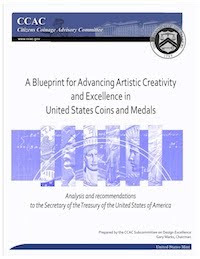
The subcommittee’s work is document in the report, A Blueprint for Advancing Artistic Creativity and Excellence in United States Coins and Medals that was approved by the CCAC as their official position on January 19, 2011. This 62-page report, of which the first 22-pages is the report with the balanced supporting Appendices, describes the reason the CCAC felt it needed to write this report, their findings investigating the issues, and recommendations for improvement.
While reading the documented investigation into the process’s of the U.S. Mint, it reads like the U.S. Mint is a typical federal government agency whose entrenched processes created many years ago are continued today because “that’s the way we’ve always done it.” The biggest flaw is that the Sales and Marketing Department is in charge of the coin design process. While this might have made sense many years ago, as the report points out, there is a conflict between the goals of the Sales and Marketing Department and the artistic nature of the coins produced by the U.S. Mint. Further complicating the situation is that the Sales and Marketing Department does not include someone with an artistic background overseeing the decisions.
Another part of the U.S. Mint bureaucracy is the Design Working Group (DWG) whose function was to coordinate manufacturing time tables and interface with stakeholder groups. Since the creation of the Artistic Infusion Program (AIP), the DWG has managed those artists and coordinating with the U.S. Mint Sculptor-Engravers. However, the report notes that the DWG does not include anyone with an artistic background.
CCAC’s Recommendation #1 The CCAC’s first recommendation is to remove the Sales and Marketing Department from the design process and abolish the DWG. Rather than these groups controlling the artistic design process, the report recommends that the U.S. Mint forms an Coin and Medal Design Department (CMDD) whose Division Chief has an artistic and management background. The CMDD would include all artists and include the management of AIP artists, management of stakeholder relations, and management of the die creating functions (Dies, Tools and Digital Control). While some may see this as the proverbial “shuffling of deck chairs,” it makes sense for the U.S. Mint to combine these functions under one manager and eliminate potential interdepartmental issues that occur within government agencies.
Although this is a sound recommendation, it appears that the recommendation continues to promote a bureaucratic approach for this new organization by creating three Associate Division Chiefs (ADC) to manage each of the major functions. While the ADC of Designing and Engraving should be the “Chief Engraver of the United States Mint” and the ADC of Dies, Tools and Digital Control should be a technical oriented person, it is questionable that the ADC for Stakeholder Relations is necessary. All the report says about the current stakeholder relations is that it is part of the Sales and Marketing Department without describing the basic job function and the level of effort to perform that job. Unless the CCAC and U.S. Mint can justify that the level of effort would require a full-time ADC, it would seem that the external contact and the person best suited to for this function would be the CMDD Division Chief. In fact, it should be recommended that this function be taken on by the CMDD Division Chief until such time as the level of effort is too great for this person to handle.
The report recommends that the DWC be replace by an interdisciplinary group to coordinate artistic and manufacturing schedules, a group referred to as the Timetable Task Force (TTF). According to the report, the TTP would be made up of representatives of Office of Chief Counsel, Sales and Marketing Department, and the Manufacturing Department and “should perform the scheduling function and advise the Art Director on historical, legal and technical matters.” This is absolutely the wrong approach to “fixing” what is wrong with the design issues. The design process already has too many inputs into the process. In order to provide more artistic freedom for the artists to create good designs, it is highly advisable to remove as many obstacles as possible. All design decisions including consulting with outside stakeholders (including the Office of Chief Counsel) should remain within the CMDD and managed by the Division Chief and Chief Engraver. The TTF should only concern itself with the timetable necessary to that will take the law passed by congress and have it manufactured, marketed, and sold to the public. The TTF should be limited to one representative of each department with the authority to speak for that department. Having worked in a federal government environment, having a large group of stakeholders meet is unwieldily and leads to a bad decision making process.
CCAC’s Recommendation #2 The CCAC’s recommendation to provide more artistic freedom for the U.S. Mint Sculpture-Engravers and improve the requests for proposals (RFP, the “call for artists”) for the Artistic Infusion Program is a necessary change the U.S. Mint needs to implement. The report rightly calls for the end of the practice U.S. Mint artists call “trace and bake” where artists are given materials to reproduce rather than rely on the artists talents.
It was surprising to learn that the U.S. Mint artists are not offered addition professional training, the opportunity to attend seminars or workshops, and are not allowed to attend artistic exhibits of coin and medallic art. The CCAC recommends that this change to allow U.S. Mint artists to advance themselves and promote their fine work. Funding must be set aside to support continuing education and promotion of the U.S. Mint’s talented artists. However, the recommendation does not include members of the AIP. Although the AIP artists are technically contract workers to the U.S. Mint, they should be afforded some opportunities to attend seminars and workshops that would benefit their work as part of the Artistic Infusion Program. While these opportunities would be offered on a lower scale than those offered to the full-time Sculpture-Engravers, it would benefit the U.S. Mint for these artists to be able to participate.
Although left out of the Summary section (Section 5), the recommendation for changes in working conditions in Section 4.3 is a key issue for artistic creativity. While the U.S. Mint should provide better working conditions by removing the cubicle farm and creating a studio-like design, the CCAC should have recommended that artists be given the opportunity to participate in a telework program. Missing from the report’s recommendation is how the U.S. Mint would implement “Telework Enhancement Act of 2010” (Public Law 111-292; 124 STAT. 3165) the could help improve the working environment of the U.S. Mint’s artists. Signed by President Obama on December 9, 2010—prior to the publishing of this report—the law calls for agency to “establish a policy under which eligible employees of the agency may be authorized to telework” within 180 days of enactment. The CCAC’s report should recommend that the U.S. Mint Sculptor-Engravers be allowed to telework in their own studios away from their current office at the Philadelphia Mint with a requirement to work at the Philadelphia facility for a certain amount of time to ensure appropriate collaboration. Not only would this provide the artists an opportunity to work comfortably, but it would help the U.S. Mint comply with the new law and begin compliance with the Presidential Memorandum “Accountable Government Initiative” of September 14, 2010.
CCAC’s Recommendation #3 The CCAC recommends that they and the CFA be more integral in the design and review process. After commenting on reducing the bureaucracy in Recommendation #1 (above), this recommendation by the CCAC will only increase it in the name of alleged oversight. First, the CCAC does not say how it will change its process in order to work within the schedule the U.S. Mint might require. Instead, the CCAC recommends that “[production] timelines should be designed to recognize the role of these groups.” Unfortunately, the CCAC does not recognize the will of congress that could force a change in normal scheduling practices by passing a coin-related bill the same year as the coin is produced. While this situation does not effect current production, it has happened in the past and is not recognized by the CCAC.
Routinely, the CCAC decries the U.S. Mint’s scheduling and how designs are thrusted upon them for their approval in order to meet production requirements. What the CCAC has not considered is that their own schedule of monthly meetings that may not fit an active manufacturing process. While all the employees are working daily to manufacture the coins and medals, the CCAC meets once per month in a scheduled three-hour morning session to conduct its business. Waiting for the CCAC to meet in order to gain their concurrence has to wreak havoc with production scheduling. It places the CCAC on the schedule’s critical path of the U.S. Mint’s design and manufacturing process. The CCAC should not be on the critical path. If the report is to hold the U.S. Mint accountable for improving its process, the CCAC must consider their own process improvement to support the changes. As part of these reforms, the CCAC should support Telework Enhancement Act of 2010 and consider holding virtual meetings as necessary to aid the U.S. Mint in its production process. In fact, as a public committee, the CCAC should extend their use of this technology to make the meetings and discussions more accessible to the public rather than requiring interested parties to travel the the U.S. Mint’s headquarters in Washington, D.C.
Further, the CCAC does not include verification from the CFA that they would be willing to participate in this process or has the flexibility to work within the U.S. Mint’s schedule for manufacturing the coin or medal. It should not the CCAC’s place to volunteer the CFA’s time and effort without their concurrence.
Second, the CCAC recommendation asserts itself too far into the design process. For most of the commemorative and bullion designs, the narrative is provided in the law passed by congress. Thus, there is no reason for the CCAC or CFA to be involved in those discussion. Where a narrative is necessary, it should be held with the stakeholders are previously recommended. Inserting the CCAC and CFA will add to bureaucratic process. Once the narrative is created, having the designs reviewed by the CCAC and CFA should remain part of the process. Reviews should be in the form of recommendations and not mandates. Artists should have the ability to reject recommendations for artistic (fitting the narrative) or technical reasons (ability to strike the coin properly) remembering that the law says the final decision rests with the Secretary of the Treasury—and by extension the Director of the U.S. Mint. However, as it was stated above, the CCAC and CFA must become more flexible in their scheduling so as to support the timeline requirements of the U.S. Mint.
The goal of this recommendation is to reduce the bureaucracy giving the artists freedom to be creative and not change the bureaucratic structure.
Additional Recommendation It is unfortunate the the CCAC report does not properly address the bureaucratic nature of the design process and seek to reduce it or its impact on coin designs. While the above commentary attempts to reduce the bureaucracy there is one aspect of the coin design process that the CCAC does not discuss: why does it require two external committees to review coin and metal designs?
The CFA was established in 1910 to give expert advice to the “Federal and District of Columbia governments on matters of design and aesthetics, as they affect the Federal interest and preserve the dignity of the nation’s capital.” Their work consists of monitoring architectural development to historic buildings, statues, monuments, memorials, and other artwork in the public spaces in and around Washington, D.C. They also provide “advice to the U.S. Mint on the design of coins and medals.” In fact, their review of the coin and medal design is their only review that does not include physical development in Washington, D.C.
The CCAC was established in 2003 to provide a dedicated committee review all coin and medal designs replacing the Citizens Commemorative Coinage Advisory Committee, which only reviewed commemorative coins.
It seems that if both committees are doing the same work, it makes sense to consolidate the work into one committee. Since the CCAC is dedicated to advising the Secretary of the Treasury on coin and medal design and is only a part of what the CFA does, it makes sense to eliminate the review of coin and medal design from the CFA’s jurisdiction. This consolidation would also comply with the president’s Accountable Government Initiative.
Eliminating the CFA’s role in coin and medal design should not require an act of congress. The law that governs the CFA (40 U.S.C. §§ 9101–9104) does not mention coin and medal design as part of its jurisdiction. However, the Code of Federal Regulations (CFR) does include coin and medal design under the section for Statutory and Executive Order Authority (45 C.F.R. § 2101.1(d)). Since coin and medal design review is not a statutory requirement for the CFA, it should be recommended that the Secretary of the Treasury request that the President issue an Executive Order to remove this requirement from the CFR as part of the Accountable Government Initiative and reduce the bureaucracy.
A Final Thought I have never hidden the fact that my professional experiences involve working with the federal government. Although I have never worked with the U.S. Mint, I am familiar with the bureaucracy of other bureaus within the Department of the Treasury. Using my understanding of the bureaucratic nature of these agencies and my background in public policy, I hope the CCAC will consider my recommendations to help improve the subcommittee’s report so that they reach their goal of improving coin and medal design at the U.S. Mint.
Following my post asking if the U.S. Mint was hiding the CCAC subcommittee report, I contacted their Public Affairs Office. After two days, a representative sent a copy of the report to me via email. I thank the U.S. Mint for their assistance.
The document has been uploaded on Scribd, an electronic document delivery service. Scribd allows you to read the report online, download it to your computer, allow you to directly print it to your printer (remember, it is 62 pages long), and share with others. In fact, you should share it with as many people as you think would be interested! Just click here to read the document on Scribd or use the reader, below.
I have not read the report as I write this. I will read it and report on my impressions shortly.
In a subtle way, the U.S. Mint announced the retirement of Chief Engraver John M. Mercanti after 36 years with the U.S. Mint.
The announcement was made in a tribute video to Mercanti as the U.S. Mint’s first post to their YouTube Channel. The video includes former U.S. Mint Director Ed Moy, and Sculpture and Engravers Don Everhart, Joe Menna, the back and side of Charles Vickers.
When asked what he will do in retirement, Mercanti said he will write a book, represent or consult with other mints and similar organizations, and he wants to be involved with educating young numismatists. “I think there’s a history in coins,” Mercanti said, “and I want to put that out there and I want to work with a lot of young people to get that history out there and inspire them to collect. I think that’s important.”
Note to the American Numismatic Association: it would be in the organization’s best interest to contact Mercanti to get him involved with his educational desires. Mercanti wool be an asset to the ANA in areas like the Summer Seminar or at the conventions. In fact, with the new fall National Money Show that will be held in Pittsburgh, why not invite Mercanti to cross the state to be a featured instructor during the show. It would be a real incentive for me to make the 5 hour drive from the D.C. area to attend the show!
While watching the live coverage of the situation in Cairo, Egypt, I was marveling how we can see history being made while it was happening. Earlier this year we watched a populist uprising in Tunisia that forced a change in the government broadcast around the world. A few weeks ago when a gunman shot Rep. Gabrielle Giffords, the news was so fluid that watching the news on Twitter became the best way to keep up with the developments. Technology has brought a new world of instant communication to anyone who wants the content. News junkies, like myself, are thrilled!
Unfortunately, this type of communication has been lost on the U.S. Mint. On Wednesday, February 2, it will be two weeks since the Citizens Coinage Advisory Committee introduced and adopted as its recommendation the report “A Blueprint for Advancing Artistic Creativity and Excellence in United States Coins and Medals.” As of the time of this writing, the report has not been made available on either the CCAC’s website or the website for the U.S. Mint.
It must be emphasized that this is the fault of the U.S. Mint. According to CCAC member Donald Scarinci on Twitter, they were “told that it will be posted on the ccac website.” It was confirmed that after the meeting, CCAC Chairman Gary Marks urged the U.S. Mint to have the report posted online immediately.
According to Presidential memo, “Transparency and Open Government,” government should be transparent, participatory, and collaborative. Keeping it off line is not transparent, does not allow participation by the citizens, and does not allow for the collaboration between a government mandated committee (the CCAC) and the “citizens” it is to represent. In short, the U.S. Mint is not doing its job.
I know the weather around the Washington-area has not been the best, but we are not talking about snowmageddon-like conditions we had last year. But according the Office of Personnel Management the government is open. This means that the business of the government must go on including observing the President’s Memo regarding transparency and open government.
I urge the U.S. Mint to post the CCAC subcommittee report immediately!


 Loading ...