Dec 1, 2010 | BEP, US Mint
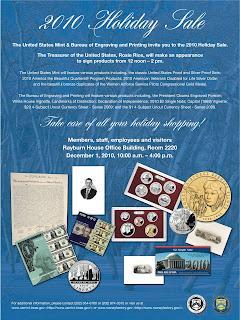 If you happen to be in the area of Capital Hill in Washington, D.C., the U.S. Mint and Bureau of Engraving and Printing are holding a sale at the Rayburn House Office Building today (December 1) in Room 2200 from 10:00 AM until 4:00 PM. The building is open to the public (your representative to congress may have an office in the building) and requires airport-style screening, sans the pat down!
Both agencies will have their 2010 offerings for purchase at regular prices. The difference between purchasing it from a clerk instead of mail order is you do not have to pay postage or worry about your order being cancelled. Besides, you never know who you will meet in the hallway, especially since congress is in session.
Also, Treasurer of the United States Rosie Rios will be there to autograph products from Noon until 2:00 PM.
The Rayburn Building is located at 45 Independence Ave SW, Washington, D.C. between First Street, SW, and South Capital Street, SW. The closest Metro stop is the Federal Center SW or Capital South stations. Both are on the Orange and Blue lines.
Click image to enlarge.
Nov 6, 2010 | commentary, policy, US Mint
Now that the dust has settled from the November 2 mid-term elections, there is a consequence for collectors of United States coins: Rep. Ron Paul (R-TX) will be the chairman of the Subcommittee on Domestic Monetary Policy and Technology, the subcommittee with oversight authority over the U.S. Mint.
Prior to the election, Rep. Melvin Watt (D-NC) was chairman of the subcommittee and Rep. Mike Castle (R-DE) was the ranking member. With the 60-seat gain by the Republican party, they will change the makeup of committees. Since Castle lost his primary race, the Republican leadership in the 112th congress will likely elevate Rep. Paul to be the chairman of the committee. It is likely Rep. Watt will become the Ranking Member.
While there will be other changes in the governing structure in the various committees that provide oversight to the U.S. Mint, this subcommittee provides the direct oversight where bills on coins, commemoratives, and medals are first assigned. Considering the legislative history of its new potential chairman, it is likely that it will be an interesting session.
To say that Ron Paul has an economic agenda that differs from current policies and similar policies that have existed since 1964 would be an understatement. Paul wants to go back to a precious metals-based standard specifically using gold and silver. While it is recognized that a precious metals standard would make it difficult to manipulate currency markets, it has its limitations to be able to supply a demand for money.
Although Paul’s policy preferences are something to be debated, policies dealing with the operation and production of the U.S. Mint is not the place for that discussion. During the hearing of “The State of U.S. Coins and Currency” held on July 20, 2010, Paul’s opening statement was more about not about his view of monetary policy. In his opening statement, Paul commented on the prosecution of Bernard von NotHaus by saying, “the federal government insists on printing trillions of dollars out of thin air, and prosecuting individuals who attempt to create precious metal currencies to compete with the devalued US dollar.”
Later during the same hearing there was a discussion regarding the U.S. Mint not issuing the 2009 American Silver Eagle Proof coins. Paul asked U.S. Mint Director Ed Moy why the U.S. Mint could not just strike 2009 Proof American Silver Eagles. Moy rightfully pointed out that doing so was not legal (see 31 U.S.C. § 5112(d)(1)).
In fact, during the questioning of Director Moy, it was as if Paul did not understand that the “Mint Does What It’s Told by Law to Do.” Although Paul said, “It is a shame that Congress has already unconstitutionally delegated its coinage authority to the Treasury Department,” he underestimates congress’s role as outlined in Title 31 of the United States Code.
I am not encouraged by Ron Paul’s potential elevation as chair of this subcommittee. Rather than provide oversight to an already over-regulated agency, Paul will use his position as a platform for his policy preferences. Oversight of the U.S. Mint is not the place to promote these policies. If Rep. Paul wants to promote his policy preference, I suggest he chooses another committee for which to serve or learn what the U.S. Mint actually does before accepting the role as chairman of its oversight committee.
Oct 7, 2010 | Eagles, gold, US Mint
Ready… Set… BUY!
If you forgot, the 2010 American Eagle Gold Proof coins are now onsale at the U.S. Mint’s online catalog. The one ounce proof coin in display case will open at $1,585. The half-ounce coin opens at $806, quarter-ounce is $415, and the one-tenth ounce coin is $180.50. Opening price for the four coin set is $2,938.
As with other bullion coins, the U.S. Mint will reprice their products on Thursdays depending on market conditions. Gold spot price is currently $1333.90 as I type this—about an 18.8 percent premium.
Oct 4, 2010 | Eagles, silver, US Mint
November 19, 2010!
Circle the date. Add a reminder on your electronic calendar. Program your toaster to remind you. November 19 is the date that the U.S. Mint will begin to sell American Silver Eagle PROOF coins!
Reported by Dave Harper of Numismatic News on his blog, the coins will cost $45.95 per coin with a limit of 100 coins per household. That is a significant increase in the price because of the price of silver ($22.03 per troy ounce as I type this). Delivery is planned for December 1.
UPDATE: You can read the U.S. Mint’s press release here.
For fans of the American Silver Eagle proof who mourned the lack of 2009 coins, this is great news. It has been a while since I was happy about the announcement of a coin release.
I commend the U.S. Mint for this move to make collectors happy.
Oct 3, 2010 | Eagles, gold, palladium, platinum, silver, US Mint
In a rare swift move by the House of Representatives, H.R. 6166, American Eagle Palladium Bullion Coin Act of 2010, was introduced, discharged from the House Committee on Financial Services, considered on the floor, and passed without objection. With its passage in the House, the bill was Engrossed and sent to the Senate for consideration.
In the Senate, the bill was read twice and referred to the Committee on Banking, Housing, and Urban Affairs. Congress has adjourned for the election season.
H.R. 6166 was introduced by Rep. Denny Rehberg (R-MT), the representative at-large from Montana. Montana is home of the Stillwater Mining Company, (NYSE: SWC) the only producer of palladium in the United States. Stillwater also owns platinum mines that supplies the U.S. Mint with platinum for American Eagle Bullion coins. With this bill, Rehberg adds his name to a long line of congressmen who have introduced bills to protect their state’s mining interests by using the U.S. Mint as a primary purchaser.
In the world of metal investing, palladium is behind gold, silver, and platinum in demand. Palladium is not as popular in the United States as it is in other countries. Palladium sells better than silver in Canada and Europe. It is rarer than gold, but a little more abundant than platinum but has the silky look of platinum while being almost as ductile as silver. Artists in Europe and Asia are beginning to use palladium instead of platinum for their higher-end designs.
Since the price of palladium is less than the price of gold and platinum, it is possible that investors could consider palladium as part of a diverse portfolio. Those who believe in “end of the world” scenarios will not be interested because the secondary market is not as strong as it is for gold.

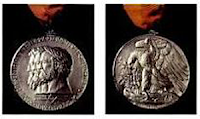 The bill requires that “the obverse shall bear a high-relief likeness of the ‘Winged Liberty’ design used on the obverse of the so-called ‘Mercury dime’” making it yet another bullion coins using a design from the early 20th century. For the reverse, the law says that it “shall bear a high-relief version of the reverse design of the 1907 American Institute of Architects medal.” Both the Mercury Dime and 1907 AIA medal were design by Adolph A. Weinman, whose Walking Liberty design is used on the American Silver Eagle coin.
In other words, congress saying that it does not trust the U.S. Mint to create a design suitable for this coin. While some might have an issue with the design of recent coins, it would be nice to unleash the creativity of the U.S. Mint’s artists and allow them to make a design to represent Liberty. Maybe if the artists were less constrained, they can use their talents.
Another provision of the bill is that aside from using palladium from U.S. sources, it allows the U.S. Mint to purchase palladium from other sources. The bill also makes a distinction between proof and bullion coins allowing the U.S. Mint consider minting proofs to meet collector demand… or not depending on whether there is a demand and a supply to meet the demand. In other words, it will be up to the government lawyers to figure out what is meant by the wording in the bill!
If the bill passes the Senate and signed by the President, palladium bullion coins will not be issued until 2012 because it is too late in the year for the U.S. Mint to plan to issue this coin.
1938 Mercury Dime image is owned by the author.
Image of the 1907 AIA Medal copied from Architecture: celebrating the past, designing the future by Nancy B. Solomon.
Sep 23, 2010 | national park quarters, US Mint, video
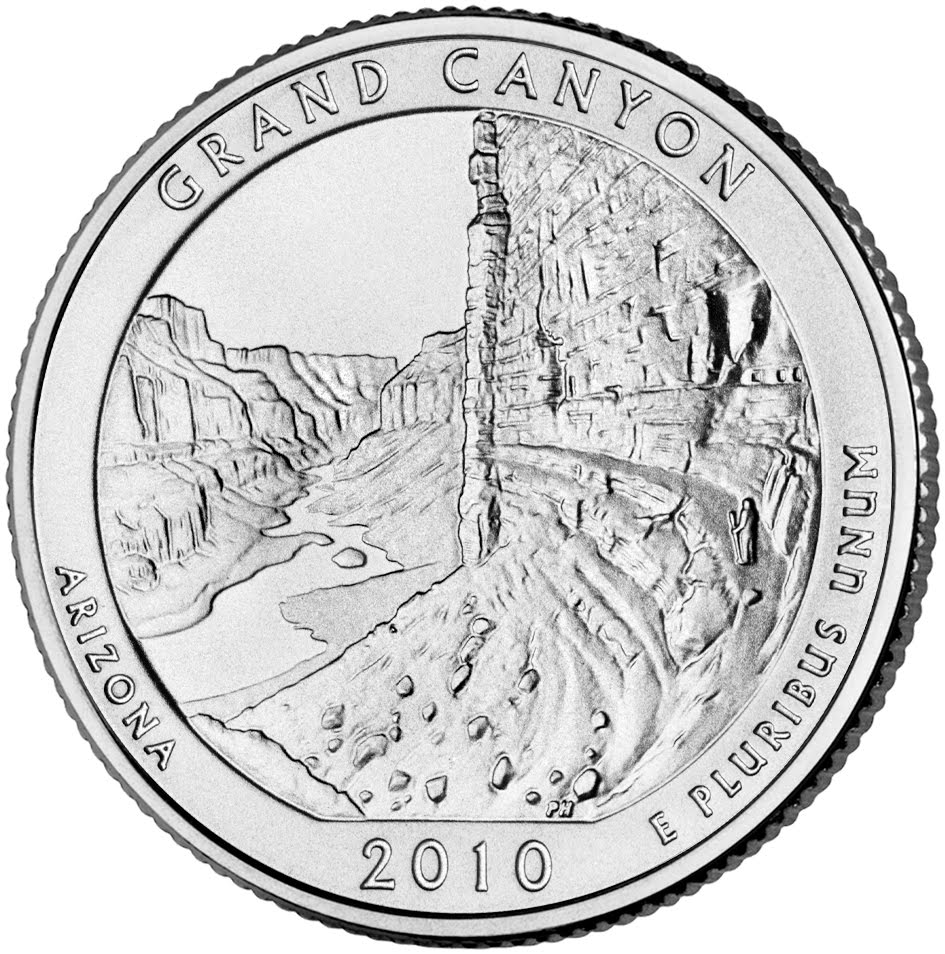
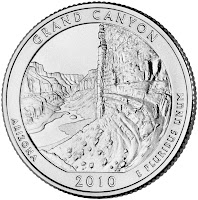 On September 21, the U.S. Mint had its launch of the Grand Canyon National Park quarter. The event was held near the Verkamp’s Visitor Center at the Grand Canyon National Park. The reverse image features a view of the granaries above the Nankoweap Delta in Marble Canyon near the Colorado River. Marble Canyon is the northernmost section of the Grand Canyon. Granaries were used for storing food and seeds. It was designed and sculpted by United States Mint Sculptor-Engraver Phebe Hemphill.
As with previous releases, the U.S. Mint released an edited B-roll video of the launch with highlights, scenery, production footage.
The Grand Canyon is the first of the quarters that represents a national park I have visited. Looking at the background over his shoulder, I understand why U.S. Mint Director Ed Moy looks happy. Although I have only been to the South Rim, the Grand Canyon is still one of the most awesome sites in the United States and worth visiting.
Quarter image and video complements of the U.S. Mint.
Sep 20, 2010 | national park quarters, US Mint
The U.S. Mint will hold its launch event for the Grand Canyon National Park on Tuesday, September 21, at 1:30 p.m. (MST). You can watch the event live starting at 1:25 p.m. (MST)—4:25 p.m (EDT) at americathebeautifulquarters.gov. I will have the highlights and B-roll video posted here when it becomes available.
Sep 11, 2010 | BEP, cents, commentary, Federal Reserve, legal, US Mint
It looks like the pundits have run wild with the malarky that gins up crowds for an issue that should not be an issue. This one was started by John Green, someone with the credibility of a camera who posts videos for something he and his partner calls Vlog Brothers. Apparently, the vlog (video blog) is about whatever comes to their minds whether it is right or not.
In Green’s latest screed posted on YouTube he ruminates about how the “penny” is worthless and the U.S. Mint should not be producing them. In the comments to the video, he claims that he read two articles, one from The Washington Post and another from Consumer Affairs, about the alleged opportunity costs of the coin. In fact, The Washington Post article is an opinion piece and has limited value in the argument. What Green did not say is that both articles are over four years old. Apparently, he could not find anything more recent or factual.
I found the video on the The New York Times block of Stephen J. Dubner, a co-author of the Freakonomics books and journalist who like some of his other The New York Times brethren has issues with facts (e.g., Duke lacrosse case).
Starting with the grossly obvious: The United States Mint does not strike “pennies.” The coin is one cent and not a penny. The penny is the lowest denomination of the current British monetary system. Back when Alexander Hamilton devised the U.S. monetary system, the lowest British denomination was the Farthing, ¼ penny. Rather, Hamilton called the coins “cents” to distinguish the United States coins from the British coins.
But the name of the coin is a basic issue. The real measure of the alleged journalist’s muster is if he could look beyond the salacious drivel to discover the truth that may actually cause real thought and consideration from the public. If Green and Dubner would do their homework they will know that:
NO TAX DOLLARS ARE USED IN THE MANUFACTURE OF COINS AND FEDERAL RESERVE NOTES IN THE UNITED STATES!
“Wait,” you might interrupt. “Aren’t these government agencies that are funded by congress?”
Yes, both the U.S. Mint and the Bureau of Engraving and Printing are bureaus under the Department of the Treasury whose budgets are approved by congress. However, the money that congress allocates to these bureaus are NOT taken from the general fund.
Both the U.S. Mint and the BEP are profit making bureaus. After manufacturing the money, it is sold at face value to the Federal Reserve for distribution to member banks and then to the public. The difference between the face value of the money and the cost to manufacture the money is the profit—called seigniorage. Even though the one cent and five cent coins cost more to manufacture than their face value, the U.S. Mint continues to generate profit from the sale of all coins sold to the Federal Reserve in addition to the sales of bullion and collectible coins.
According to the 2009 U.S. Mint Annual Report (covering Fiscal Year 2009: October 2008–September 2009), they earned $98.1 million in seigniorage. That is a profit of $98.1 million in a down economy!
When the U.S. Mint is paid by the Federal Reserve for the coins, a collector purchases collectibles directly from the U.S. Mint, or a bullion dealer buys bullion coins, the seigniorage is deposited into a special account called the United States Mint Public Enterprise Fund (PEF) as required by law (see 31 U.S.C. §5136). As sales are deposited in the PEF, the law requires that the U.S. Mint use the money in the PEF for budgetary reasons like to manufacture coins, maintain facilities, pay employees, etc. No tax money is deposited in the Public Enterprise Fund and the PEF is managed like all general accounts by the Treasury Department. In fact, excess profit is required to be deposited in the Treasury general fund.
There is a similar fund for the Bureau of Engraving and Printing (see 31 U.S.C. §5142).
If the money that the U.S. Mint uses for all its operations is withdrawn from the PEF and if the PEF does not contain any tax receipts, then how does it hurt taxpayers if the U.S. Mint continues to manufacture one and five cent coins?
More philosophically, it is “[the] primary mission of the United States Mint is to produce an adequate volume of circulating coinage for the nation to conduct its trade and commerce.” This is done by striking coins that are ordered by the Federal Reserve System for placing into commerce. If the Federal Reserve only orders coins they need to sell to member banks, then why is does Federal Reserve Currency and Coin Services order so many one cent coins? If they are useless and cannot buy much, why do they keep ordering more cents?
It is unfortunate that a journalist chose to support his fact deprived argument using an editorially questionable YouTube video.
Aug 29, 2010 | BEP, cash, commentary, economy, US Mint
“Cash is expensive, we need to be using it less.”
This self-serving quote was made by Steve Perry, executive vice president of Visa Europe, in an article that appeared in the Telegraph in the United Kingdom. To justify this statement Perry says that supermarkets in the UK are introducing cashback, a program to promote the use of credit and debit cards over cash because cash is more expensive to handle.
It may be the case in the UK that cash is more expensive to handle, but in the United States, we are seeing consumers and some small businesses moving in the opposite direction. This past week, credit reporting agencies and the credit card companies reported that the average credit card debt has fallen to its lowest point since 2002. Delinquency rates fell by 17-percent to the lowest point since the start of the current recession. Americans are buying fewer items on credit and using what income they have to pay off credit card debt.
With the economy in a stall, the U.S. Mint exceeded its 2009 output in July 2010. And even before the August Federal Open Market Committee meeting, it was speculated that the Federal Reserve would order more paper notes from the Bureau of Engraving and Printing. Since the FMOC meeting, Federal Reserve Chairman Ben Bernanke said that the Fed will do whatever it takes to stimulate the economy.
Aside from the economy another factor turning people away from credit cards is the environment created by the banks prior to the implementation of the Credit Card Accountability Responsibility and Disclosure Act of 2009 (Public Law No. 111-24 [TXT] [PDF]), also know and the Card Act. Between the bill’s passage and recent enactment, the banks have been raising fees on consumers and businesses in order to make up for what they saw as a potential loss of income. Rather than make it better for the consumers in the spirit of the Card Act, the banks showed their bald-faced greed making the using of credit cards more expensive than cash.
Even though Canada is debating on eliminating its 1-cent coin and others are pushing credit card technology onto the smart phone, small businesses are looking to save the cost of credit card handling by offering a discount for paying with cash. Credit card processing costs from three to five percent per transaction plus account fees. Some small businesses are offering their customers a discount of their credit card processing fee if they pay in cash.
Receiving a discount for paying using cash is not a new idea. There was a time, before the Card Act, when gas stations used to offer one price for cash purchases and another for credit card purchases. However, the convenience of using credit cards at the gas pump made this option unattractive. Even though the costs for using credit cards have been added to the price of gas, the elimination of this dual pricing was welcome. Recently, some independently owned stations have been offering a discount for using cash or for using the company’s credit card. The psychology of receiving a discount may make dual pricing more palatable in this environment.
As people are pulling away from credit cards, small businesses are looking to cut costs by offering discounts for paying with cash, and even with the rise in savings rates, it appears that the report of cash’s eventual demise appears to be greatly exaggerated. For numismatists, this means that our hobby will continue to grow with new, fresh material for years to come. And considering the bad economic news, this is good news. Happy collecting!
Aug 21, 2010 | US Mint, web
Back when I wrote about the U.S. Mint joining the electronic communities of Facebook and Twitter. I also noted that the U.S. Mint was showing off a new logo. Almost a week later, the branding consulting firm Siegel+Gale issued a press release announcing new branding for the U.S. Mint they are calling Connecting America Through Coins.
The logo features a golden colored flipping coin that will be used as part of product marketing throughout the U.S. Mint product line. As previously noted, the new logo appears on the U.S. Mint’s new Facebook and Twitter pages as well as the “microsite” for the America the Beautiful Quarters Program. No other U.S. Mint asset uses the new logo. Images of the new products in the U.S. Mint&rsuqo;s online catalog show either the use of the old logo or the official U.S. Mint seal.
According to Siegel+Gale, the U.S. Mint felt there was a “general lack of understanding of its breadth of additional offerings” and “aspired to increase sales of collectable coins, increase the uptake and use of dollar coins, and develop increased public awareness of the United States Mint as the only legal manufacturer of all American coins.”
If the U.S. Mint’s issues were about branding and understanding who they are, then this is a good move. But those of us who watch the U.S. Mint knows that their problems run deeper than their branding and logo. From lackluster designs, questionable customer service, to questionable management, U.S. Mint needs more than branding to help their image. Unfortunately, if we look at the how the U.S. Mint has performed, the axiom “a fish rots from the head&rdquo becomes very profound in describing the state of the U.S. Mint.

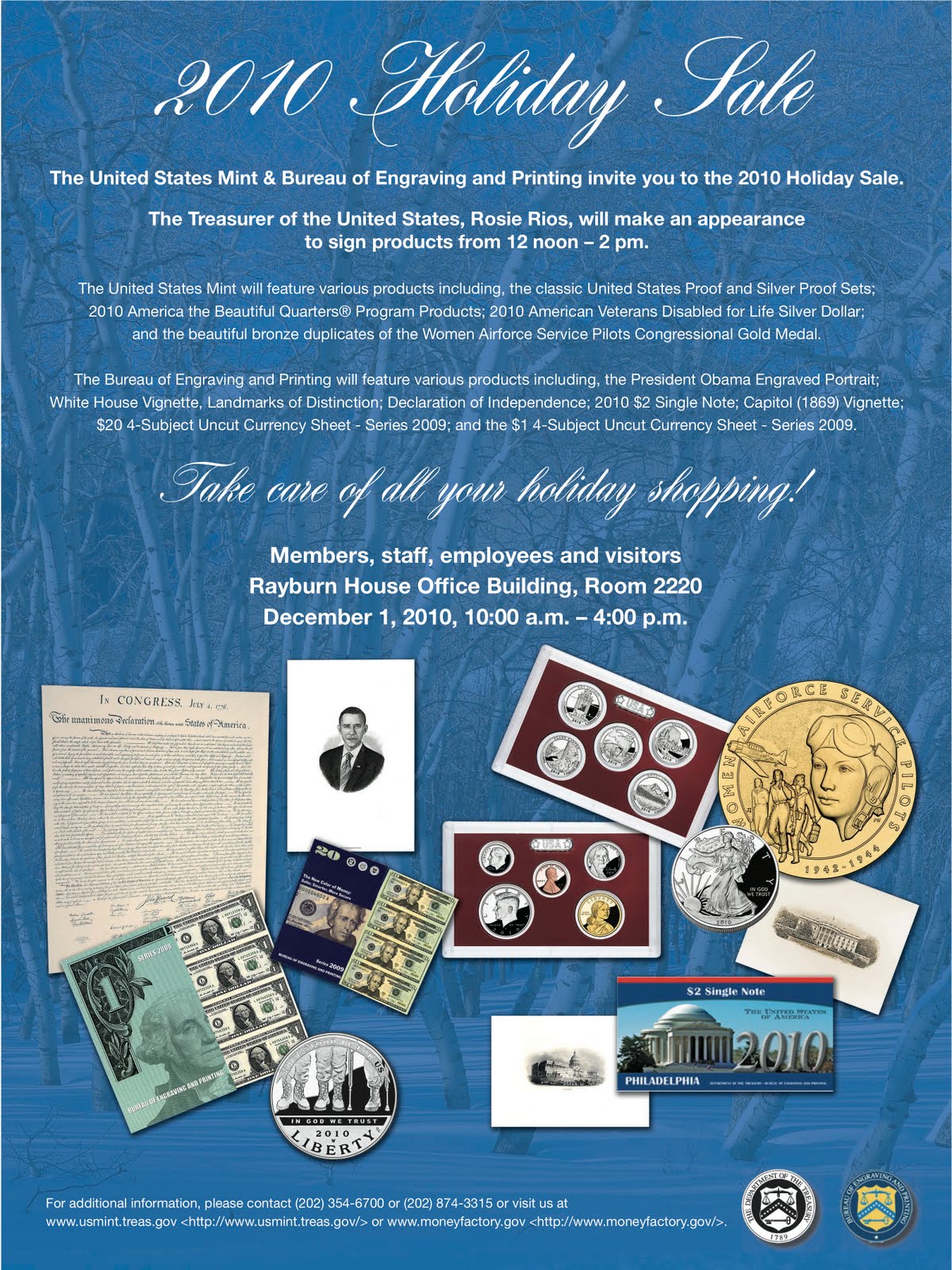 If you happen to be in the area of Capital Hill in Washington, D.C., the U.S. Mint and Bureau of Engraving and Printing are holding a sale at the Rayburn House Office Building today (December 1) in Room 2200 from 10:00 AM until 4:00 PM. The building is open to the public (your representative to congress may have an office in the building) and requires airport-style screening, sans the pat down!
![[Most Recent Quotes from www.kitco.com]](http://www.kitconet.com/images/sp_en_6.gif)



 Loading ...