Sep 28, 2009 | BEP, coins, currency, US Mint
Over the last ten years, US coinage has seen many changes. Starting in 1999, the 50 State Quarters® Program and the DC and US Territories Coin Program has taught us about our country and entertained us with “interesting” designs. The Westward Journey Nickels, Presidential Dollars, and this year’s Lincoln Bicentennial One Cent Redesign have kept us examining our pocket change looking for something new.
US paper currency has also changed. But the changes are not what could be considered earth shattering. Rather than undergo a good design change, I had previously commented that the “[new] currency designs look like the Bureau of Engraving and Printing is dabbling in currency design after being mired using the same basic designs for over sixty years.” With little to no restriction on currency design, the BEP designs have gone from old to bland with no redesign planned for the one dollar bill that was designed in the 1920s!
An article that appeared in The Atlantic found a “image design consultant” who also thinks that the design of the dollar and its paper equivalents need to be upgraded.
Richard Smith, founder of the Dollar ReDe$ign Project thinks that as part of improving the US image, redesign its currency. Noting that a redesign may be looking backwards, Smith noted in an interview that “you need to go backwards to go forward.” (see video below) Without explaining this statement, Smith had to have been referring to the currency of the late 18th and early 19th century that produced phenomenal design.
Smith is approaching this issue from an image perspective. As a numismatist and a collector of Israeli paper currency, I am looking at the issue from a design perspective for making interesting collectibles.
Other countries seem to be able to handle change to their currency. In fact, the emergence of the Euro forced changes throughout Europe. Euro banknotes are printed in a variety of colors and representative designs that are accepted through out the European Union.
Also, the European Union and most other industrial countries does not issue their unit currency in paper. The United States continues to print the one-dollar note which I have written costs the government more to maintain.
Maybe if the numismatic angle is not working with the BEP, maybe the we could try the angle from the image consultant. Anything that could update the US staid currency design.
Sep 23, 2009 | bullion, history, US Mint
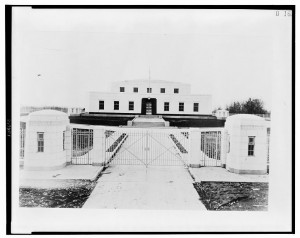
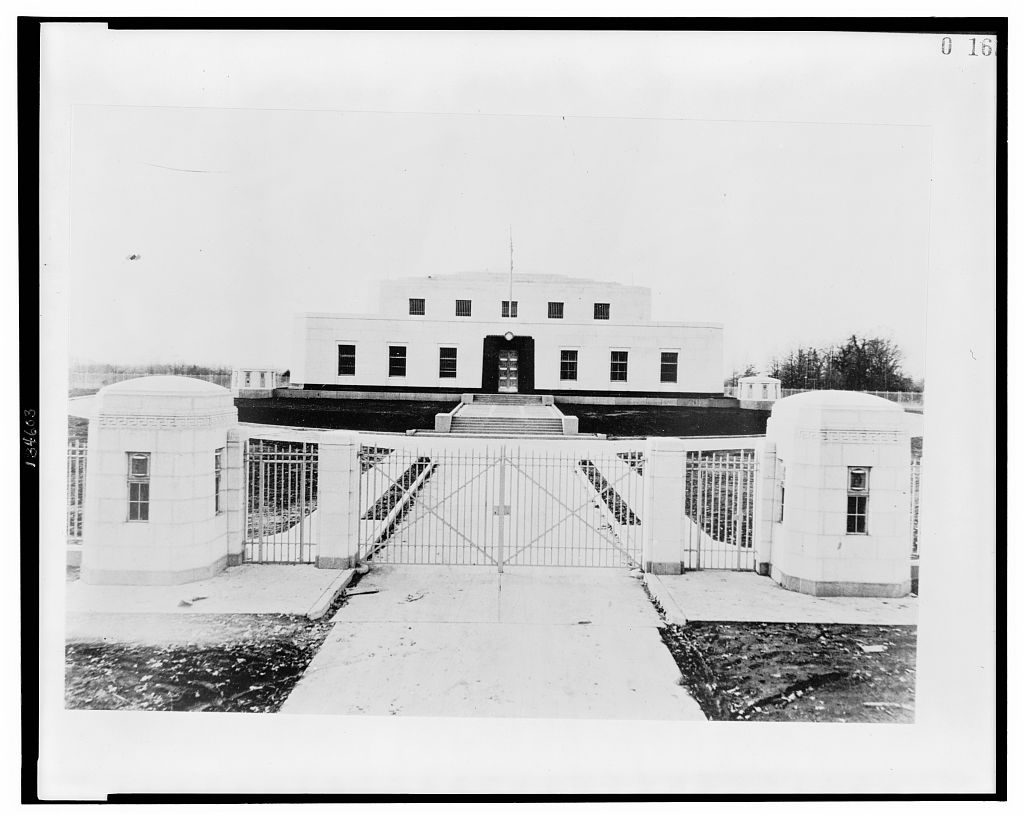
Treasury Department, Procurement Division, Public Buildings Branch, Fort Knox – United States Bullion Depository (1939)
Outside visitors are rare. Following President Franklin D. Roosevelt’s inspection trip in 1943, no outsiders have been allowed to visit the facility. Following an audit that was completed in 1953, the vaults were sealed and nobody was allowed to visit.
In 1974, noted conspiracy theorist Dr. Peter Beter wrote a book titled The Conspiracy Against the Dollar that alleged “powerful Americans have secretly permitted $20 billion worth of gold to be removed from Ft. Knox.” The claim caught on and the public clamored to prove that the nation’s gold was still in Fort Knox.
After clamoring from the public, congressed impressed on the Secretary of the Treasury William Simon and Director of the US Mint Mary Brooks to open the doors of the vault to public inspection. It was finally agreed that a select group of congress members and press would visit Fort Knox on September 23, 1974.
On September 20, 1974, the US Mint release the following press release:
FOR IMMEDIATE RELEASE
September 20, 1974
INSPECTION OF GOLD AT FORT KNOX
The inspection by Members of Congress on September 23, 1974, of U.S. gold stocks stored at the Fort Knox (Ky.) Bullion Depository marks a unique departure from the long standing and rigidly enforced policy of absolutely no visitors, Mrs. Mary Brooks, Director of the Mint, announced today.
“On April 28, 1943, President Franklin D. Roosevelt inspected the Bullion Depository,” Mrs. Brooks said. “His visit was the one and only time a gold vault was opened for inspection for anyone other than authorized personnel.
“The Congressional inspection adheres to the new open door policy of the government announced by President Ford. Treasury Secretary William E. Simon issued the invitation to Congressmen to inspect the gold at Fort Knox. By also inviting the press to witness the Congressional inspection, the Mint is clearing away cobwebs and re-assuring the public that their gold is intact and safe. For the first time photographing is being permitted inside the Depository.”
After the Congressional inspection, the Bullion Depository will once again be closed to visitors.
On September 24, 1974, a special settlement (audit) is scheduled to begin and at its conclusion a report on the audit will be issued.
The audit will be performed by a committee of auditors from the U.S. General Accounting Office (GAO) and the Department of the Treasury. The auditors from the Treasury will be drawn from the Office of the Secretary, the Bureau of Government Financial Operations, the U.S. Customs Service, and the Bureau of the Mint. In addition, the committee will include technicians from the Bureau of the Mint who are trained in assaying and weighing gold bullion.
The monetary gold stock of the United States totals 276.0 million fine troy ounces valued at $11.7 billion at the official rate of $42.2222 per fine troy ounce, and is stored in various federal depositories (table attached), the largest of which is at Fort Knox, Kentucky. 147.4 million fine troy ounces, valued at $6.2 billion, is stored in 13 vault compartments at Fort Knox Bullion Depository.
MONETARY GOLD STOCK OF THE UNITED STATES
(in millions of ounces)
| Account of the U.S. Treasury |
|
|
| Fort Knox |
147.4 |
|
| Denver Mint |
54.9 |
|
| New York Assay Office |
54.1 |
|
| San Francisco Assay Office |
10.6 |
|
| FRB New York – Special Custody Acct. |
4.2 |
|
| Bank of England |
1.3 |
|
| Bank of Canada |
1.4 |
|
| Other |
.1 |
|
| |
|
274.0 |
| Exchange Stabilization Fund |
|
2.0 |
| Total |
|
276.0 |
For more on the Fort Knox visit, you should read the article by David Ganz, who attended as a freelance writer after skipping a day at law school.
Recently, the History Channel aired a show, Fort Knox – Secrets Revealed that was produced in 2007. “Hidden deep inside the vault is an estimated $73 billion dollars in gold. Almost all information about it is classified. Through interviews with eyewitnesses, rare photos and rarely seen films, we will construct a picture of what the building might look like. Hear testimony of those journalists and congressmen who were among the select few invited inside in 1974.”
If you cannot wait for the History Channel to air the show, you can purchase a DVD copy for yourself from Amazon.com. The link to the right will bring you right to the page to purchase the DVD.
Sep 23, 2009 | legal, legislative, US Mint
One of the more interesting aspects of writing this blog is to be able to look into various aspects of numismatics and being able to explain what I discover to my readers. Sometimes, this research allows me to use what I write as a teachable moment to others. While I certainly subscribe to Aaron R. Feldman’s recommendation to “buy the book before you buy the coin,” but sometimes it may pay to read the blog.
Not long ago, I read an article printed in Numismatic News that had the valid point that the US Mint needs new and innovative direction. However, the writer placed the blame on the Mint itself without considering the law that govern everything the Mint does.
Long time readers may have remembered my post Sausage Making And Coin Production that described the process of how a coin or medal goes from being an idea to becoming a coin in detail. It is a sausage making process that would even scare Otto von Bismarck!
I felt that the writer of the opinion piece did not take into consideration that nearly everything the US Mint does is prescribed by law, as i described in my posting. So I took that posting, reworked it a bit to be more suitable for printed media, and sent it to Dave Harper, editor of Numismatic News. I learned from a colleague that the article has appeared on their website.
Long time readers will recognize the topic. Newer readers can use it to catch up. In either case, we might want to alter Feldman’s advice to “read the blog before buying the coin or writing the editor.”
Thank you to all of my readers for being my inspiration.
Sep 20, 2009 | coins, gold, legal, US Mint
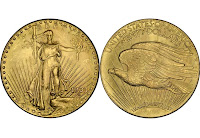 Thanks to an article that appeared in The New York Times, the case of Langbord v. U.S. Mint was back in the news. Apparently, the order [PDF] for the government to turn over the ten 1933 Saint-Gaudens Double Eagle coins to the Langbord family was posted to the website for the US District Court for Eastern Pennsylvania.
In the order, Judge Legrome D. Davis, Jr. agreed with the plaintiff (Langbord family) that the coins were illegally seized and order the government to turn over the coins or initiate a judicial forfeiture procedure by September 28, 2009. There has been no comment issued by the US Mint or the Department of the Treasury. It is expected that the government would file a forfeiture procedure that would have to prove the coins were stolen from the US Mint. Since the alleged crime occurred 75 years ago and none of the principals are still alive, the government has a very high standard to meet.
The 1933 Saint-Gaudens Double Eagle coins has been the source of legends. After the sale of the Farouk-Fenton Coin for $7.59 million in 2002, its story became the inspiration for two books, Illegal Tender and Double Eagle, and inspired legislation to protect older coins and patterns that left the Mint under allegedly nefarious conditions.
But would the addition of ten coins reduce the value of the Farouk-Fenton specimen?
Along with condition and rarity, any special story or provenance of a coin will affect its price. The story and provenance of the Farouk-Fenton specimen is extraordinary. It was the subject of international intrigue including the overthrow of King Farouk of Egypt and the chase by the US Secret Service for the coin that lead to the sting at the Waldorf Astoria Hotel where British coin dealer Stephen Fenton was arrested trying to buy the coin.
Two books, a court case, and a sale by Southeby’s for $6.6 million (plus the 15-percent buyer’s fee making the total $7.59 million) makes it a one-of-a-kind coin.
Even if the Switt-Langbord coins enter the market they may never reach the status of the Farouk-Fenton example. The only factor that could bring down the price of the Farouk-Fenton coin would the be effect of the economy. Otherwise, it will stand alone as the first 1933 Saint-Gaudens Double Eagle that comes with a very unique story.
Image courtesy of the US Mint and NY Times.
Sep 12, 2009 | quarter, US Mint
On Wednesday, the US Mint announced the America the Beautiful Quarter Series, a 56 quarter series to “honor” national parks in the 50 states, District of Columbia, and territories. As part of the announcement, the US Mint announced the schedule of the national parks and historic areas that will be depicted.
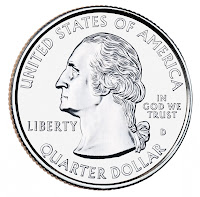 According to the US Mint, a “restored” version of the 1932 portrait of George Washington designed by John Flanagan. Either this could mean that the Mint engravers will either fix the “spaghetti hair” portrait of the 50 State Quarters or change it to resemble linguini.
Pardon me if I fail to show excitement.
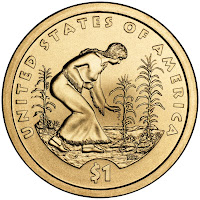 We just finished the State Quarters program and had the DC and Territories Quarters added to the end. This year we celebrate the bicentennial of Abraham Lincoln’s birth and the century anniversary of the Lincoln Cent. The Presidential $1 Coin series is in the middle of some of the dullest presidents in US history. And we cannot forget the Native American $1 Coin that probably has the best reverse design of all 2009 coins. Including the circulating coins without rotating reverses the total is 18 different coins being struck this year.
I agree with Mike Zielinski when he wrote on the Coin Update blog:
Although I did enjoy the 50 State Quarters series, I think reusing the same concept over and over again becomes dull. With no disrespect to the sites selected for the impending quarter series, I would rather see a single design that could become an iconic and lasting symbol of our generation [rather] than another collection of 56 designs representing 56 different things.
Let’s think of these quarters as a stimulus package for the collecting suppliers who will sell new folder and albums to house the coins in this series.
Below is the B-roll provided by the US Mint. Starting around 2:23 of the clip are scenes from within one of the branch mints showing the production of quarters.
Aug 14, 2009 | coin design, US Mint
Yesterday was the first day that the new Professional Life Lincoln Cents were released. Aside from the ceremony in Springfield, Illinois, the US Mint sold rolls at Union Station in Washington, DC. The event passed without much notice.
When the Formative Years, or Rail Splitter cents were released, there was a rush of people to Union Station that caught the notice of the media. Local and national news outlets descended on Union Station to take capture the scene. It was such a happening that it broke through the political games that were going on within yards of Union Station.
Other than an article from the State Register-Journal of Springfield, there was little notice elsewhere. Even the Mint’s hometown Philadelphia Inquirer buried a paragraph about the coin’s release at the bottom of the “Business news in brief” page.
It is the bicentennial birthday of Abraham Lincoln, the president that is credited with holding the country together during its most tumultuous times. We should be celebrating Lincoln. But there seems to be less excitement for these coins than there were for the Westward Journey nickle program.
Discounting the fact that I work “inside the Beltway” and hear more about politics than any other news, there seems to be a focus on other issues and not numismatics. Even the numismatic press has been covering issues of the market and issues of metals values.
This year, the proof sets have 18 coins. When the Mint Sets are released, there will be 36 coins. With coins from the Lincoln Bicentennial Cents, DC and Terrotories Quarters, Presidential Dollars, and the Native American $1 Coin it is the most coins in these sets in the Mint’s history.
Has all of these coin programs jumped the shark?
Originally, I thought this would be an exciting year. But the near monthly release of new coins seems to have faded into the background like rain on a tin roof.
And we have yet to see the 2009 24-karat Gold Buffalo.
Unfortunately, next year will begin the National Parks quarters. Modeled after the successful State Quarters program, congress did not think we needed a break and passed this law anyway.
It’s not like the Mint has been creating “awe inspiring designs.” Now we have to contend with another 11 year state series from the designers that gave us such winners as the Ohio hanging astronaut and the Montana’s dead animal skull.
Numismatic history has not looked too kindly on the early commemorative era. There were too many coins with only marginally interesting commemorations that wore out collectors. We seem to be doing the same with these circulating commemoratives. History is going to show that we overdid the circulating commemorative concept these last ten years. I hope that when these programs end we are granted a break.
Aug 8, 2009 | ANA, awards, shows, US Mint
It is no surprise that there have been a few announcements at the American Numismatic Association’s World’s Fair of Money.® Of the announcements, I found three very interesting stories.
I think the biggest announcement is that the US Mint and the Smithsonian Institution’ National Museum of American History jointly announced that they have partnered to create traveling exhibits from the National Numismatic Collection. The Mint and Smithsonian Institution wants to create exhibits that will highlight U.S. history through its coinage.
The National Numismatic Collection is the largest collection in the world with over 1.6 million coins, notes, tokens, and medals. The collection spans from ancient times to modern days with the bulk of the materials being donated from the Mint’s transfer of its core holdings in 1923. The display of the National Numismatic Collection closed in August 2004 in preparation for the renovation of the American History Museum building. Although selected pieces were incorporated into other exhibits, the collection remains out of public view. Bringing the collection out to the public is a wonderful idea and I look forward to seeing how the curators at the Smithsonian and US Mint display the collection.
In another interesting announcement, the Numismatic Guarantee Corporation will begin to provide detailed grading to problem coins. In the past, NGC would “body bag” coins that were scratched, cleaned, or had other problems. If you wanted these coins encapsulated, the coins would have to be sent to their sister company, the Numismatic Conservation Service. NCS would be able to either conserve the coin and cross it to NGC or would encapsulate the coin with detailed grading. With this announcement, NGC will provide the grading services while NCS will continue to perform conservation.
This new service will simplify the grading and encapsulation of problem coins. Rather than have to wait for the submission to NCS to be processed and possibly NGC, NGC will do it all in one submission. It is also a good idea to include why the coin could not be graded in plain English on a different color label. I think this is a better idea to embedding cryptic code on a label that is not as easily identifiable, especially on the bourse floor of a busy show. More information that is easily understood is always better.
Finally, I want to congratulate Julian Leidman for being awarded the inaugural Harry J. Forman Dealer of the Year Award. Julian is a wonderful person, knowledgeable dealer, and an annual speaker at my local coin club where he talks to our membership about the state of the industry. Julian is one of the few dealers who always has people around his table talking coins or just kibitzing. Congratulations Julian on a well deserved honor.
Jun 17, 2009 | other, US Mint
In a sign of the times, the US Mint announced that they have sublet a part of their headquarters at 801 9th Street, NW, Washington, DC for retail space. The least is for ten years with two five-year options.
The southwest corner of the building is the corner of 9th Street and H Street, NW. It is the near Washington’s Chinatown section and two blocks from the Verizon Center, home of the Washington Wizards professional basketball team and Washington Capitals professional hockey club. The area around the Verizon Center is a popular, revitalized section of Washington.
This space is being leased to Cuba Libre, a Cuban restaurant and rum bar based in Philadelphia that has restaurants in Atlantic City and Orlando. Cuba Libre’s great reputation will only add to the overall neighborhood that includes restaurants representing the cuisines from many areas of the world. As a fan of Cuban food, I am looking forward to their opening.
Jun 4, 2009 | CCAC, cents, CFA, coin design, US Mint
For the last few months, the Commission of Fine Arts and the Citizens Coinage Advisory Committee have been volleying between each other and the sculptor-engravers at the US Mint over the design of the reverse for the 2010 Lincoln Cent. Based on what is being reported one thing is clear, the designs are somewhat less than stellar.
Ok… they stink!
According to Public Law 145-109 Section 303 states, “[the] design on the reverse of the 1-cent coins issued after December 31, 2009, shall bear an image emblematic of President Lincoln’s preservation of the United States of America as a single and united country.”
While the mandate sounds simple, there is a catch: Lincoln only caught a glimpse of a united country. Prior to Gen. Robert E. Lee’s surrender on April 9, 1865, Lincoln visited Richmond after it was taken by Union troops. Lincoln was greeted as a conquering hero by newly freed slaves on his way to visit the Confederate capital. When Lincoln arrived at Jefferson Davis’s office, he sat behind Davis’s desk to symbolize that there was only one president who had the authority to rule over the land. Lincoln was assassinated on April 14, 1865 and died on April 15.
 Lincoln was re-elected in 1864 with 55-percent of the vote and a 212-21 electoral vote margin. On March 3, 1865, Lincoln gave his second inaugural address as the war was winding down. Lincoln’s theme turned to healing as he ended his address:
With malice toward none; with charity for all; with firmness in the right, as God gives us to see the right, let us strive on to finish the work we are in; to bind up the nation’s wounds; to care for him who shall have borne the battle, and for his widow, and his orphan—to do all which may achieve and cherish a just and lasting peace, among ourselves, and with all nations.
With that rich and well documented history, someone could not come up with a good theme to represent the preservation of a united country?
Even though the Confederate states did not participate in the 1864 election, Lincoln’s re-election and inaugural speech laid claim to his desire to end this bloody chapter in our history and pursue a policy of peace. What would be a better iconic image than Lincoln delivering his Second Inaugural Address.
 Although there is only one known photograph of the inauguration (see above), there are artists renderings that could be used to base a design. For example, the color image to the right of this paragraph was found on the Internet. I do not know who created the image but it shows Lincoln standing at a lectern with Vice President Andrew Johnson (a southern Democrat) sitting behind Lincoln, and Chief Justice Salmon P. Chase standing to Lincoln’s left. It is a better image to use than what appeared on the cover of Harper’s Weekly because it shows a more dignified proceedings’plus I think it would look better on a small coin, like the cent.
I think that this is a better idea than sheaths of wheat, shields, and images of the Capital building because it is clearly about Lincoln and how he lead the nation out of its bloodiest war into one United States.
If you agree with me, I encourage you to contact the US Mint, CFA, and CCAC to let them know if this idea. After all, it is our money, we should have more of a say in how it looks!!
May 19, 2009 | dollar, US Mint
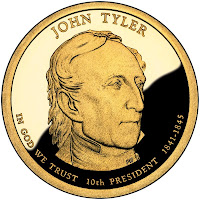 In a ceremony at the Sherwood Forest Plantation home of John Tyler the US Mint released the Presidential Dollar honoring our tenth president. President Tyler was the first to ascend to the presidency from Vice President after the death of William Henry Harrison.
Since Sherwood Forest Plantation is the private home of Tyler descendants, there was no dollar exchange as there was in the past. Only those invited who are under 18 years old were given a single dollar coin.
Nicknamed “His Accidentcy” by his enemies, President Tyler found himself in office during a contentious time. Aside from his accidental presidency, Harrison was selected to run for president by the Whig Party over Henry Clay and Harrison chose Tyler, a former member of the Democrat-Republican party, as his running mate. Clay originally thought that he would be the ”power behind the throne” of the elderly Harrison, but that was thwarted with the younger Tyler becoming president.
Clay was never friendly with Tyler who adapted Democrat-Republican policies from congress. After wrestling with the Whig-controlled congress over banking issues that included the veto of banking measures, the cabinet Tyler inherited from Harrison quit and Tyler was expelled from the Whig Party. Amongst the policies Tyler adopted from the Democrat-Republicans was to oppose the formation of a central bank. This made the Whigs angry and had them suggest that the lack of a central bank lead to the Panic of 1873.
Tyler and the Whigs sparred for most of his presidency. But there were areas where the Tyler and Whigs agreed on policy. Tyler applied the Monroe Doctrine to the Kingdom of Hawaii and used it to begin what became the annexation of the island nation. Tyler normalized relationships with China by sending diplomatic missions and opening a consulate to maintain the relationship. And in 1842, Secretary of State Daniel Webster negotiated the Webster-Ashburton Treaty with Great Britain that set the borders between the United States and Canada.
Tyler risked war with Mexico by annexing the Republic of Texas into the United States. Texas declared its independence from Mexico in 1836. Tyler, who was looking to show his strength in order to be re-elected, sent newly appointed Secretary of State John C. Calhoun to negotiate the annexation. Tyler was convinced that if the United States was able to annex Texas that he would win the support of the Democrat-Republican Party. Texas was annexed but the Democrats became upset and went on to nominate James K. Polk as their presidential candidate.
To run for reelection, Tyler formed his own party from core officeholders in his administration. As an independent and incumbent, Tyler was not as popular as he thought. When the Whigs chose Henry Clay as their candidate, the race became a fierce contest between Tyler and Clay with Polk being ignored. When it looked like he would not win the election, Tyler withdrew and threw his support to Polk. Three days before the end of his term, Tyler singed the bill annexing Texas.
On March 3, 1845, Tyler’s last full day in office, congress overrode a revenue veto, making it the first time that any president’s veto was overridden.
John Tyler was the first president to have two First Ladies while in office. His first wife, Letita Tyler was the first First Lady to die while her husband was in office. Letita Tyler, already confined to a wheel chair by the time her husband became president, died in 1842.
Tyler met his second wife, Julia Gardiner in 1842. Gardiner’s father, David Gardiner, was killed when the steam frigate, U.S.S. Princeton died when a naval gun exploded on the ship while sailing on the Potomac River. Tyler comforted Julia, 30 years his junior, whose subsequent courtship ending with a wedding on June 26, 1844. It was the first time a president was married while in office.
The release of the Tyler Presidential Dollar also marks the first of the Presidential Dollar series where the honored president has a second generation descendant alive to witness the event. Harrison Tyler, who is 81 years old, is the grandson of President John Tyler. Harrison Tyler resides at the family’s Sherwood Forest Plantation in Charles City, Virginia.
Harrison Tyler was born in 1928 as the sixth child of Lyon Gardiner Tyler and the third child of Lyon’s second wife, Sue. Lyon Tyler, who lived 81 years, was 75 when Harrison was born. Lyon Tyler was the thirteenth child of President John Tyler and the fifth child of Julia Gardiner Tyler. John Tyler, who would father 16 children, was 63 years old when Lyon was born. Harrison Tyler was born 66 years after the death of his grandfather.
Harrison Tyler is an alumnus of the College of William & Mary, as was his grandfather. Harrison also holds a graduate degree from Virginia Tech University. Harrison is one of the founders of ChemTreat, Inc. a company that claims to be “the nation’s largest independent firm dedicated solely to industrial water treatment.”
Coin image courtesy of the US Mint.



 Loading ...