Mar 5, 2009 | US Mint
I received a few notes from readers asking why I have not commented on the US Mint’s recent failures. I have a feeling that they were prompted to ask after reading this post at the Mint News Blog and Susan Headley’s story about the Mint’s computer issues. The short answer is that I have said all I can say about the Mint.
After writing about the Mint’s pricing policy with the Ultra High Relief Double Eagles, a commenter criticized me for not having respect for the Mint employees. It prompted me to write about who I thought was the blame at the Mint.
Almost two weeks later, the Mint changes its return policy giving bogus reasons for not managing this situation correctly.
If Andy Brunhardt was hired to “fix” the operations of the US Mint, his performance has been much less than stellar and seems to be getting worse. I am just tired of harping on it.
Rather than comment here, I have written to my members of congress, Office of the Inspector General for the Department of the Treasury, and staff of the President of the United States. Hopefully, between those five people I hope to see progress.
Mar 3, 2009 | cents, coins, dollar, US Mint
I went to the US Mint’s online catalog to see when the Puerto Rico quarters and District of Columbia Quarter first day covers would be released. While scanning down the list of Scheduled Product releases I noticed that the Mint will be releasing a roll set for the Lincoln Cent Birthplace coins. These rolls are scheduled to be released on March 13.
Also in the list are roll sets for the Formative Years, Life in Illinois, and Presidency coins.
With the backlog of cents in the Federal Reserve System preventing these coins from circulating, this is a good idea. It will allow collectors easier access to the coins.
But what of the costs? Rolls of other coins wrapped in US Mint paper are sold with a premium. Rolls of dollar coins in the Mint wrapper with a $25 face value are sold for $35.95. Kennedy Half dollar and State Quarter rolls contain $20 worth of coins (2 rolls) sells for $32.95. How much of a premium will the Mint add to rolls worth 50-cents each?
Would it be possible that the Mint will also sell these coin as part of their Direct Ship program? Under the direct shipment program, the Mint sells 10 rolls of Presidential Dollar coins at face value ($250) in commercially wrapped paper with free shipping. It may not be cost effective for the Mint to do with with $5 worth of Lincoln Cents, but it is an option for them to think about even if they do charge for the shipping.
I may order these rolls, depending on the pricing. It may be easier than waiting for the banks to get these coins.
Feb 28, 2009 | coin design, US Mint
Buried within the hype of the Ultra High Relief Saint Gaudens Double Eagle and all of the other news of the day was that during the ceremony for the opening of the UHR exhibit at the Philadelphia Mint was the announcement that John Mercanti would be the 12th Chief Engraver of the US Mint.
Mercanti, who was previously the “Supervisory Design and Master Tooling Development Specialist,” has been working for the US Mint since 1974 and has been responsible for the design of some of the Mint’s most spectacular coins of the last 35 years. Mercanti worked under Chief Engravers Frank Gasparro and Elizabeth Jones.
After Jones retired in 1990, the US Mint abolished the position of Chief Engraver. After 19 years, Director Edmund C. Moy has decided to bring back the position and offer the job to the Mint’s most experienced and accomplished engraver. Mercanti deserves the honor to join this elite group:
| Robert Scot |
1793-1823 |
| William Kneass |
1824-1840 |
| Christian Gobrecht |
1835-1844 |
| James Barton Longacre |
1844-1869 |
| William Barber |
1869-1879 |
| Charles Edward Barber |
1879-1917 |
| George T. Morgan |
1917-1925 |
| John R. (Ray) Sinnock |
1925-1947 |
| Gilroy Roberts |
1948-1964 |
| Frank Gasparro |
1965-1981 |
| Elizabeth Jones |
1981-1990 |
| John M. Mercanti |
2009-present |
Congratulation to John Mercanti!
Feb 19, 2009 | policy, US Mint
Last November, I wrote an open letter to then President-elect Barack Obama about his choice to be Director of the US Mint. In that letter, I asked for someone more qualified than the current director.
Earlier this month, David Ganz wrote an article describing his experiences with Mint directors and his suggestion as to the qualifications for the next Mint director. According to Ganz, the successful Mint directors in recent history has had the following qualifications (quoting from his article):
- Are political, most typically on a national level (consistent with the President’s policies)
- Have a working relationship with either the Treasury secretary, the President or both
- Are good listeners
- Hear their own bureaucracy but reach out to other sectors
- Don’t necessarily have technical knowledge but are quick studies
- Have an entrepreneur’s spirit
- Aren’t lemmings
- Speak enthusiastically to the various segments of the Mint’s constituency
- Come from various segments of society
- Work well with members of Congress (both sides of the aisle)
- Understands what staff’s role actually is.
- Know were the buck stops
Ganz concludes that, “[none] of this definitely says who should be the next Mint director. But this list surely defines who is unlikely to be successful by type and experience.”
I hope the president and his staff has read these comments and finds a proper director for the US Mint.
Feb 12, 2009 | cents, coin design, coins, Federal Reserve, US Mint
The US Mint will introduce the first in a series of redesigned Lincoln Cents honoring our 16th President’s 200th birthday at the Abraham Lincoln Brithplace in Hodgenville, Kentucky. Unveiling will occur at 10:00 AM during The Kentucky Abraham Lincoln Bicentennial Celebration to be held at LaRue County High School in Hodgenville, Kentucky.
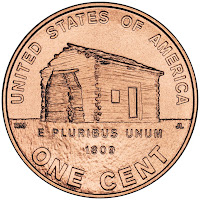 Billed as the first redesign of the Lincoln Cent in over 50 years, the first coin issued will honor his birth and early childhood in what is now known as Hodgenville, Kentucky. Lincoln was born on February 12, 1809, in a log cabin to Thomas and Nancy Hank Lincoln. While the log cabin where Lincoln lived has been lost to history, a replica of common design for the era was used as a model for the coin. The reverse was design by Artistic Infusion Program (AIP) Master Designer Richard Masters and sculpted by Sculptor-Engraver Jim Licaretz
However, it may be a while before the new coin will be seen in change. Susan Headley points out that the way coins are distributed through the Federal Reserve system, there may be a backlog of coins in stock that will prevent the new cents from reaching the public. Susan explains that the bad economy has caused more coins being returned to the Fed than being distributed. Since the Fed buys only what it needs from the US Mint, it may be a while before the inventory is depleted enough for the Fed to order coins.
Susan reported that when she visited the Philadelphia Mint last week, she found that three of the lines striking cents were not running. When I visited the Philadelphia Mint in the summer of 2007, we were told that the machines that strike cents run 24 hours a day, seven days a week. To hear that the Mint has reduced production of cents is very worrisome for the economy and those who work at the Mint. I hope their superintendent has the chutzpa that Mae Biester showed in the 1950s.
Image courtesy of the US Mint.
Feb 12, 2009 | coins, commemorative, dollar, US Mint
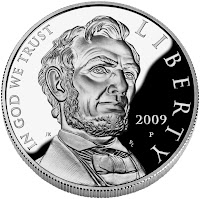 Starting at 12:00 Noon Eastern Time, the US Mint will begin to sell the 2009 Abraham Lincoln Commemorative Silver Dollar. The commemorative is limited to a production of 500,000 coins by law and will be available in proof and uncirculated versions. Coins will be struck in 90-percent silver and will have a face value of one dollar.
The obverse of the coin was created by United States Mint Artistic Infusion Program Master Designer Justin Kunz and sculpted by Sculptor-Engraver Don Everhart. The image was inspired by Daniel Chester French’s famous sculpture of the President that sits inside the Lincoln Memorial in Washington, DC.
 The reverse was designed and sculpted by Sculptor-Engraver Phebe Hemphill. The design features the an inscription of the last 43 words of the Gettysburg Address:
WE HERE HIGHLY RESOLVE THAT THESE DEAD SHALL NOT HAVE DIED IN VAIN–THAT THIS NATION, UNDER GOD, SHALL HAVE A NEW BIRTH OF FREEDOM—AND THAT GOVERNMENT OF THE PEOPLE, BY THE PEOPLE, FOR THE PEOPLE, SHALL NOT PERISH FROM THE EARTH.
These words are encircled by a laurel wreath with Lincoln’s signature incuse into a banner at the bottom of the design.
From the first availability until 5:00 PM on March 16, 2009, the Mint will sell these coins at a reduced price. According to the Mint’s press release pricing has been set as follows:
| Product Code |
Description |
Introductory Price |
Regular Price |
| LN7 |
Proof Silver Dollar |
$37.95 |
$41.95 |
| LN8 |
Uncirculated Silver Dollar |
$31.95 |
$33.95 |
| LN6 |
Special Set |
— |
— |
The special set will contain a proof silver dollar and proof versions of the four 2009 Lincoln Cents. The set will be available in the spring and will be limited to 50,000 units. The special set sounds interesting and worth waiting to see how the Mint will price this option.
Images courtesy of the US Mint.
Feb 11, 2009 | policy, US Mint
Apparently, the management at the US Mint has blog posts like mine that talks about the cost of precious metal products and the their liberal return policy. Today, following a week where the prices were adjusted upward, the Mint announced a new return policy. The return policy has been reduced from 30-days to seven days.
Considering that the Mint’s pricing policy for precious metals changes weekly, it makes business sense to change the return policy to match. The seven day period starts from the day your package is delivered, which can be obtained from the package tracking information from the carrier used. Returned items must be postmarked within seven days of delivery.
So how can the Mint get a policy right and wrong at the same time? When the bureaucrats change the policy for all collectibles and not just bullion. According to the press release:
Rather than have two separate return policies – seven days for numismatic products containing gold and platinum coins and 30 days for other numismatic products – the United States Mint elected to implement a uniform seven-day policy for all numismatic products. This gives customers consistency and clarity when purchasing its products.
BULL FEATHERS! (I have to keep it clean!)
We live in a world where merchants have different return policies. Go into any big-box electronics store and look at their return policy—14 days for computers, 21 days for other electronics, and don’t open that software or music if you want to return it. Other stores have special sales that are not returnable and then there others who will take anything back.
Coin and metals dealers also have separate return policies for bullion and numismatic products. In fact, some dealers have different policies for graded and non-graded numismatic products.
By saying that the new policy “gives customers consistency and clarity” the US Mint is either patronizing, covering up for their own deficiencies, or showing disrespect for their fine employees telling them that they cannot handle a variable policy. If the Mint believes that the public cannot understand a variable return policy, then they are underestimating their buying public. And considering that Deputy Director Andrew Brunhart has a history of employee discontent from when he was General Manager of the Washington Suburban Sanitary Commission (WSSC), it is possible he does not trust the Mint workers.
A more plausible explanation is that the US Mint may not be able to implement a variable return policy because of technology and contractual issues. Since the US Mint entered into a contract with a new fulfillment provider, the order management system may not be able to handle the new requirement. After all, the contract was negotiated with the requirement of the one 30-day return policy. It is possible that the contract and the technology used by the contractor cannot implement the requirement. Rather than issuing a change request so that the tools meet the requirement, the US Mint is allowing the tool to dictate the requirement.
While I do not expect the US Mint to tell the truth, even though the administration it serves has declared a policy of transparency, I did not expect the US Mint to issue a press release with a shallow and patronizing statement as part of its policy driver.
I know that President Obama has serious issues to deal with, but the US Mint is a profitable enterprise that may be on the brink of imploding and needs attention. The president’s team must consider leadership change very soon before the implosion.
Feb 3, 2009 | history, US Mint, video
On July 20, 1958, Mrs. Rae V. Biester, Superintendent of the US Mint in Philadelphia was a contestant on the the CBS game show, What’s My Line. Watch as Mrs. Biester stumps the pannel:
While looking for biographical information about Rae Biester, I was surprised to learn that she was instrumental in the promotion of proof coin sets in the 1950s.
According to Tom DeLorey in The Three Major Eras of Modern Proof Sets, following the passage of legislation that allowed the US Mint to produce proof sets in 1950, sales started slowly as the public was getting used to the program and paying a small premium over face value for the “special handling.” The newly appointed Biester did what she could to help increase sales of proof sets, especially during a recession, in order to prevent layoffs. DeLorey writes:
Sales increased slowly over the first few years, and finally began to climb in 1954 under the personal care and promotion of the new Philadelphia Mint Superintendent Rae Biester, who sought to avoid a threatened round of layoffs by increasing Mint output via Proofs. Biester went so far as to write personal notes thanking buyers of the 1953 Proof sets, and inviting them and their friends to buy the 1954 and subsequent sets.
Under Biester’s administration the packaging was improved by placing the coins between two sheets of plastic divided into pockets via a simple pressure bonding, which allowed the coins to be viewed and displayed without removing them from their original holders. These &ldlquo;flat packs” appeared in mid-1955, and this is the only year which is collected by holder variations (other than by product variations).
By the time Mrs. Biester appeared on What’s My Line, she had saved the proof program and protected the employment of many US Mint employees.
Jan 31, 2009 | policy, US Mint
After I posted the article Ultra High Price Gouging With No Relief, an anonymous commenter accused me of having a “a low opinion the of the people there and don’t give them any credit.” It was an article that was critical of the US Mint and its policies, I was not directing criticism to the people who work for the Mint but those who run the bureau.
First, let me say that unequivocally, I have tremendous respect for all government workers. I live in the Washington, DC metropolitan area and work with the government on various levels, I know how hard the career government employees work and the pressure of working with what seems like undue regulations in their job. I have seen those with commercial experience not do well in this tightly controlled atmosphere of a government job. But when I explain this to friends and relatives who do not have my insights, I am laughed at for being too close to the situation. I fully understand the environment working for the federal government and I have a lot of respect the work they do and their service to this nation.
My low opinion of the US Mint, and other areas of the federal government, is reserved for the appointees and some high-level special pay executives who set the policies the rest of the bureau has to implement. With the problems of the Mint in the last year, I have questioned Director Edmund Moy’s ethics and his policies. I have also been critical of the hiring of Andy Brunhart as Associate Director after his less than stellar job at the Washington Suburban Sanitary Commission. With the Mint failures of the past year, both men deserve a tremendous amount of criticism for the work it appears they have not done.
Until Moy is replaced by someone more competent, I will continue to criticize him and the policies of the US Mint. Remember, this criticism is being levied against Moy, Brunhart, and the other bureaucrats. I am not criticizing the hard working employees of the bureau.
To my anonymous commenter, I apologize for making it sound like I was indicting the entire bureau for the problems caused by the bureaucrats who deserve the criticism. If you would like to talk further, you can send me a private email note and I would be happy to discuss this further.
Jan 29, 2009 | state quarters, US Mint
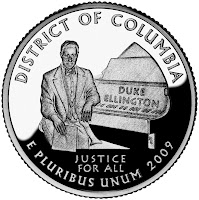 This week, the US Mint released the quarter for the District of Columbia that honors Edward Kennedy “Duke” Ellington. The Washington-born Ellington was one of the most influential musicians of the 20th century with a career that spanned 60 years until his death in 1974. Ellington was awarded the Presidential Medal of Freedom by President Richard Nixon in 1969.
Ellington was a great musician and musical ambassador. His music was very popular amongst the Washington society crowd in the early part of the 20th century. When his career picked up, Ellington moved to New York City to take advantages of opportunities. Ellington reinvented his career twice and was working on new projects when he died on May 24, 1975.
Although Duke Ellington was a great musician and worthy of an honor, those who were involved with the District of Columbia quarter selection process missed an opportunity to properly honor the District and make a statement.
Following the passage of the budget bill that contained the provisions for the DC and Territories Quarters program, then Mayor Anthony Williams appointed a committee to determine the design of the DC Quarter. When the design descriptions were submitted to the US Mint for approval, they included the phrase “Taxation Without Representation.” The phrase, which is on District license plates, is a protest noting that US citizens who live and vote in Washington does not have a representative in congress, who levies taxes and has veto authority over the city’s mayor. The Mint rejected the design as being too political.
When the design was rejected, newly elected Mayor Adrian Fenty reconvened the committee to come up with a new design. Several designs were considered and put to a vote by District residents. The design honoring Duke Ellington won decisively.
Unfortunately, the best option for the quarter design was considered. If the District government was serious about getting their message out about the lack of congressional representation for Washingtonians, they could have sparked the conversation by selecting a design that honored Walter E. Washington, the first elected home-rule mayor of Washington, DC.
Washington, DC is the only world capital that is not represented in the government which it hosts. For nearly 200 years, congress has taken a pedantic view of Article 1, Section 8 of the US Constitution stating:
To exercise exclusive Legislation in all Cases whatsoever, over such District (not exceeding ten Miles square) as may, by Cession of particular States, and the acceptance of Congress, become the Seat of the Government of the United States
By doing this, congress has been giving the residents of the District of Columbia less rights and representation that any of the other states. Congress controls the District, its revenues, and its laws. Legislation passed by the city council and signed by the mayor has to be approved by a congressional committee before it becomes law.
 The Georgia-born Walter Washington was appointed as Commissioner of the District of Columbia by President Lyndon B. Johnson in 1967. His early years were marred with race riots and other issues that he had problems dealing with because of the restrictions placed on the appointed commissioner. After much lobbying, congress passed the District of Columbia Self-Rule and Governmental Reorganization Act of 1973 that allowed the city to elect its own government. Washington was elected as the first mayor of Washington, DC.
If the District honored Walter Washington on its quarter, not only would it have been more appropriate from a historical perspective, it would have given the home-rule activists an opening to talk about their lack of representation in congress. People who have asked about this person on the quarter and they could have filled in the blanks. While it would not have been an overt message, it would have been subtle and shown intelligence with integrity.
I like Duke Ellington but Walter Washington would have been a better subject.
DC Quarter image courtesy of the US Mint.
Image of Walter E. Washington from Wikipedia.



 Loading ...