Jan 28, 2009 | gold, US Mint
Following up on my post about the pricing policy at the US Mint for Ultra High Relief Saint Gaudens Double Eagle gold coins, Susan Headly is reporting that the Mint guarantees that the purchaser will pay the price of the coin as of when it was ordered. This means that if the price of gold rises before your order is fulfilled, your price will stay the same as when you ordered.
It also means that if the price of gold falls, your price will stay the same as when you ordered.
The Mint has a very liberal, 30-day return policy for all of its product. Purchasers can return any item in its original packaging within 30-days of purchase. If the prices go down after your coin is shipped, you can return the coin and re-order it at the lower price. Also, if the price drops before your order is shipped, you can cancel your order and re-order the coin at the lower price.
Although there is a potential for abuse, it is comforting for collectors that the US Mint follows market practices on price rises. However, it is up to you to lock in a lower price when the price falls.
While the US Mint has gone out of its way to explain its precious metals pricing policy, the Mint should make it clear what its policy is when purchasing backordered products.
Jan 26, 2009 | gold, policy, US Mint
Throughout the second half of 2008, the US Mint has had problems with the supply of gold coins for the collector and investor market. Gold American Eagle and Buffalo coins were is short supply causing the US Mint to suspend and limit gold sales before changing the pricing policy of all precious metal products. Could the US Mint be trying to discourage gold ownership?
Michael Zielinski, author of Coin Update and Mint News Blog, writes about this on the Seeking Alpha blog. Zielinski tracks the actions taken by the US Mint and their explanation for the actions noting that “the consequence of each action has been to limit or discourage gold ownership.”
Zielinski notes that the US Mint will be lowering the number of gold options by eliminating fractional issues and suspending the American Buffalo issue altogether.
“Whether or not it was the US Mint’s intention, every significant action they have taken since August has either limited gold availability, eliminated gold product options, or increased the cost of acquiring gold,” Zielinski writes. “Has it all just been a consequence of surging global demand for gold, supply chain mismanagement, and bad timing for policy decisions? Or is there something else going on here?”
Please read Zielinski’s full article at Seeking Alpha.
Jan 25, 2009 | gold, policy, US Mint
If you have been watching the US Mint this week, you may have noticed that the 2009 Ultra High Relief Saint Gaudens Double Eagle started to sell on January 22, 2009.
With a limit of one coin per household, the catalog page advises “Orders will be processed on a first-in, first-out basis, and could potentially take up to six to nine months to complete based on gold blank availability.” (emphasis added) They further explain that the Mint will not charge your credit card until your order ships. This means that the coin could cost more than the current $1,189.00 price. With the changing price of gold and that the first coins will not be available until February 6, 2009.
According to the new precious metals pricing policy, the price of gold products will be adjusted based on the Thursday AM London Fix price. Since the price of gold on Thursday, January 22 was $847.75 per ounce, the current price of the coins will not change on Monday. However, the Friday AM Fix was $873.00 per ounce and the PM close was $875.75. If the price does not come down, the coin’s price could rise to $1,239.00 before one coin is delivered.
As a consumer, when I purchase a product, even if it is backordered, I am locked into the price at the time of the order. Even if the backordered item takes three months to fulfill, my price is guaranteed. In fact, if the price goes down many vendors will adjust the price to the new lower price. This is the definition of customer service.
The US Mint, being run by a bureaucrat, opens sales at one price that has the potential (based on current market conditions) to rise before the first coin is delivered two week later.
An opposing argument will be the fluctuating price of gold and market conditions. However, the Ultra High Relief coin is being sold as a collectible item, not as bullion. It is understandable if bullion changes based on market conditions, not for collectibles. Further, as the price of silver fluctuates, the Mint does not adjust the price of American Silver Eagle Proof or the annual silver sets when the spot price of silver changes. Did the Mint lower the price of silver products after the price plummeted from $20 per ounce?
Another reason that the Mint should not be adjusting the prices of collectible coins once ordered by the consumer is that the Mint has variability built in to the price. At the bottom of the new pricing tables is a note that says “cost of metal 71%-74%, cost to manufacture (including overhead) 11% – 14%, and margin 15%.” How does the cost of manufacture change so variably as the price changes?
After writing computer programs for many types of business, I had taken business courses to understand how business works. In the basic business courses I learned that when analyzing the overhead, most of the costs are fixed. Variable costs do not vary greatly with maybe the exception of the costs of energy. However, most of the variable costs are not based on a percentage of the costs. Overhead usually comes from fixed costs, such as facilities, machinery, labor, etc. Variable costs are based on the cost to produce a unit of the item. These variable costs include energy and material costs. However, the Mint is already saying that 71-74 percent of the price is based on the cost of the metal. So what are the variable costs in coin manufacture?
Let’s look at the numbers. Assuming an 11-percent cost of overhead at the low-end of the the Mint’s price range, the Mint is saying that when the price of gold is $800 per ounce, the cost to manufacture is $122. But when the price of gold rises to $900 per ounce, the cost to manufacture is $133. Considering that the variable cost of the metal is calculated separately, why does it cost the Mint $11 more to make this coins when the price of gold rises by $100?
Does it make sense that the US Mint can fix the cost of the manufacture of billions of Lincoln cents and complain that it they cost more than face value to manufacture but they cannot nail down the cost of a coin that will have significantly less population?
The formal notice of the price change was published in the Federal Register Volume 74, Number 3, pages 493-496 (GPO Access: [text] [PDF]). The notice does not explain the rationale for the percentages used nor does it fully explain the cost of manufacture.
I will be asking my representatives in congress to ask the Mint to justify their pricing. I may also submit a Freedom Of Information Act (FOIA) request as well. I will report what information I gather. In the mean time, maybe President Obama’s administration should review my suggestion as to how to pick a new Mint director.
Jan 20, 2009 | history, legal, US Mint
A few moments ago, on the west side of the Capitol, Barack Obama was sworn in as the 44th President of the United States. On a specially built platform, President Obama put his hand on the same bible that Abraham Lincoln used at is inauguration in 1861 and was sworn in by John Roberts, Chief Justice of the Supreme Court. Millions millions of people watching on the National Mall and around the world heard President Obama take the oath of office:
I Barack Hussein Obama do solemnly swear that I will faithfully execute the Office of President of the United States, and will to the best of my Ability, preserve, protect and defend the Constitution of the United States. So help me G-D.
Whether you voted for President Obama or not, this is a historical moment that everyone should savor. We wish the new president well and hope he will pursue the right policies to better this country.
Numismatically, President Obama’s election has caused opportunists to come out of the woodwork with numismatic collectibles that potential collectors should think twice about before purchasing. We have seen the advertisements on television, in magazines, and as fliers in other mail. They are advertised as “exclusive” and “limited editions” with prices set at one price, but if act today, you can receive the coins at a lower price.
If you buy these coins, please remember that these vendors are colorizing business strikes made by the US Mint and are worth their face value. Coins are colorized or thinly plated with less with less than a few cents of gold. Although the work is made with real coins, they are numismatically worthless. Similar collectibles for other events have not increased in value. In some cases they worth less than their issue price.
The US Mint warns that the coins are not official US Mint products and not endorsed by the Mint.
Please enjoy the view of history from where ever you are. But please consider another collectible to honor this history. Pins, buttons, clothing, hats, copies of The Washington Post from the day of the inauguration are wonderful alternatives that you can appreciate for years to come.
Jan 19, 2009 | coins, dollar, US Mint
Last year, I did not see a coin with a 2008 date until April. Even with the Federal Reserve giving priority to circulating 50 State Quarters during their first two weeks of issue, it was a while before I found one in change. I wondered how long it would take to find a 2009 coin in my pocket. This year, the wait lasted until January 13.
On Tuesday, January 13, I attended the meeting of Montgomery County Coin Club, where I was inaugurated as president for my second term. Our treasurer works near the US Mint’s headquarters. He used his lunch break to visit the headquarters to purchase a number of the Hawaii quarters and the new Native American $1 Coin from the change machines in the building’s lobby.
Before the meeting started, I handed our treasurer a $1 Federal Reserve Note and he handed me a $1 coin. With the coin in my pocket, I can proclaim receiving a 2009 in change! Ok… it may be cheating, but it is still a 2009 coin and it did not cost me more than face value to obtain it.
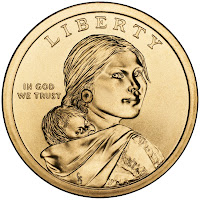 This was the first time I saw the design rather than the line drawing. The obverse of the coin continues to have the Glenna Goodacre designed portrait of Sacagawea, the Shoshone Indian guide for Meriwether Lewis and William Clark, carrying her infant son, Jean Baptist. The only difference between the previous versions and the new obverse is that the date and mint mark were moved to the edge along with E Pluribus Unum and 13 stars.
For 2009, the Native American $1 Coin Act (Public Law 110-82 [text] [pdf]) required the redesign of the reverse to honor Native Americans and the important contributions made by Indian Tribes and individual Native Americans in United States history. This year, the design represents the “Three Sisters Agriculture,”
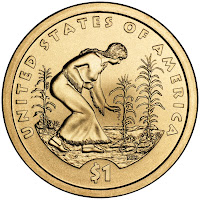 “Three Sisters” agriculture is the practice of growing corn, beans, and squash in the same mound enhanced the productivity of each plant. This simple concept lead to the accepted practice of crop rotation that is used today to maintain the production in modern farms. This helped Native American produce food and sell their knowledge to the early European colonists to ensure their survival.
In hand, it is an excellent design. The details of the image is simple, yet complete that gives the coin a great look. Even the change in the font used for “United States of America” near the edge enhances give the coin the feel of Native American art work. US Mint Sculpture-Engraver Norman E. Nemeth should be commended for his wonderful work.
Images courtesy of the US Mint.
Jan 4, 2009 | state quarters, US Mint
After fifty different State Quarter designs, there has to be a few turkeys in the bunch. In this case, I call a design a “turkey” when it just turns me off. A bland design, disturbing images, and trying to do too much on a coin all qualifies as a turkey of a design.
As I follow-up on my Best Quarters Designs, here is the count down to the ten worst 50 State Quarters designs from the 41st “best” designs.
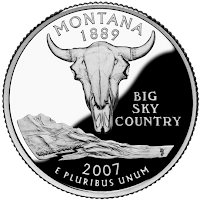 #41 Montana
Engraver: Don Everhart
It is very disturbing to have the image of a dead animal on a coin. I do not care what it is supposed to mean to the people of Montana, putting the decomposed skull of a bison is just disturbing.
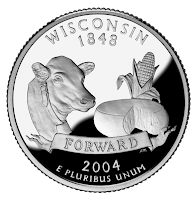 #42 Wisconsin
Engraver: Alfred Maletsky
Wisconsin deserves a better quarter design. This milquetoast design looks like someone was thinking about breakfast than Wisconsin. While the dairy from Wisconsin is necessary for a good breakfast, those who produce the dairy just deserve better.
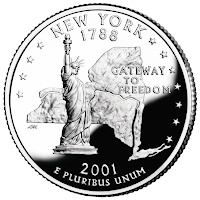 #43 New York
Engraver: Alfred Maletsky
I love New York. I was born in New York. I still consider New York home. As a transplanted New Yorker, I hate the quarter’s design. I am not a fan of state outlines on the quarter because it really says nothing about the state other than “we’re here.” Then, the decision to put the Statue of Liberty on the quarter was made during a time that New York was arguing with New Jersey over ownership of the island making the decision for the design just dumb.
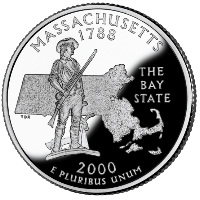 #44 Massachusetts
Engraver: Thomas D. Rogers
Another state map trying to masquerade as a design. While the image of the Minuteman does depict Massachusetts’ place in the founding of this country, it would have been more fitting to find a design more fitting of this great accomplishment.
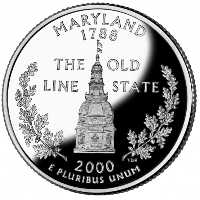 #45 Maryland
Engraver: John Mercanti
When the Maryland quarter committee met, I was working on my Masters and taking care of a sick wife. But considering what could have been Maryland’s quarter design, the top of the capital is very lame. From the beauty of the Chesapeake Bay to the history of Fort McHenry, there is not a lack of good subjects. But the lame design was decided on by then Governor Paris Glendenning, who was Maryland’s worst governor since Spiro Agnew. Bad governor and a bad design.
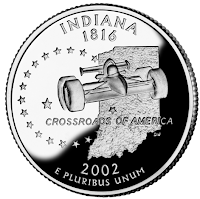 #46 Indiana
Engraver: Donna Weaver
Another state outline and a trite reference to the one well known auto race in the state. There has to be something more to Indiana than fast cars. This would have been Indiana’s opportunity to teach us about their home. Instead, we get another state outline.
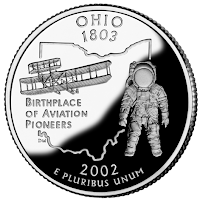 #47 Ohio
Engraver: Donna Weaver
This is another state outline with a twist: the hanging astronaut! With all due respect to Ohio, celebrating the “Birthplace of Aviation” with people whose accomplishment in Ohio is where they were born would be like calling Kentucky the Land of Lincoln. Further, poor John Glenn looks like he is hanging from Cleveland! He deserves better. Bad concept. Bad design.
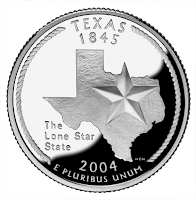 #48 Texas
Engraver: Norman E. Nemeth
I will admit, I am not a fan of Texas. And I am not a fan of a former governor who‘se been living in public housing in Washington, DC for the past eight years. Maybe that is shading my view on the state and the obnoxious look of the star on yet another state outline. Did someone forget the Alamo?
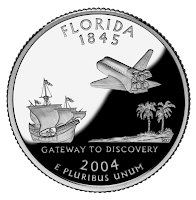 #49 Florida
Engraver: T. James Ferrell
A jumbled mess of three untied images that had to have been decided by a committee because a fifth grader could have done better. I understand the concept to bring in the history of discovery that occurred in Florida. But even rough sketches with clouds and other elements did not work. They were better off sticking with oranges and alligators.
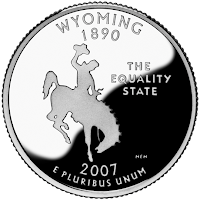 #50 Wyoming
Engraver: Norman E. Nemeth
My first impression of this design was “is this it or is this a cud?” Sure, the symbol is on the license plate, but maybe that is where this image should have stayed. Wyoming is the home of Yellowstone National Park and the Grand Tetons and a cud is the best they can do?
I looked at the ten best and the ten worst. Next, I want to look at the ten quarters that either taught us something or reinforced something historic about the state.
Dec 31, 2008 | state quarters, US Mint
The end of 2008 is upon us which means that the 50 State Quarters program comes to the end. With the end of this program comes time for a review. It was a unique program, never tried in this scale by any mint. Regardless of any measure, the program was a success. After the release of the Hawaii quarter, the US Mint issued at press release noted that the netted nearly $3 billion in extra seignorage from the increased demand for the quarters.
Another side effect of the State Quarters has been the increased interest in coin collecting. Although the mintage of the quarters dropped as time went on, many of the State Quarter collectibles saw sellouts at the Mint’s online catalog.
States used the program to get their citizens involved in the design of their quarter. Some states held design competitions while others appointed special commissions to find a representative design. After 50 different designs, there were some good designs, there were some bad designs, and then there were the designs that helped teach history. For the rest of this article, I will focus on what I felt were the ten best designs.
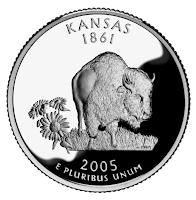 #10 Kansas
Engraver: Norman Nemeth
I have to admit I love the concept of buffaloes on coins. I am a fan of the Buffalo Nickel and I think it is a uniquely American animal that is more representative of this country than any other animal. I like the design used on this coin.
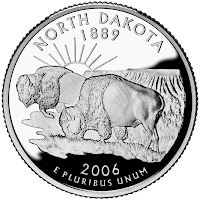 #9 North Dakota
Engraver: Donna Weaver
What’s better than one buffalo than a herd of buffaloes! Yes, two buffaloes make a heard. Donna Weaver treated us with a wonderful design that should be used somewhere else.
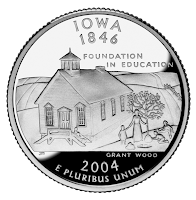 #8 Iowa
Engraver: John Mercanti
The adaptation of Grant Wood’s “Arbor Day’ to honor Iowa’s place in promoting education is an example of how states should have treated their quarter designs. Mercanti executed an excellent design that Iowans should be proud to carry.
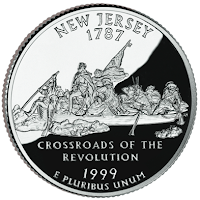 #7 New Jersey
Engraver: Alfred Maletsky
George Washington crossing the Delaware River to attack the British is a powerful story and makes for a powerful image on the New Jersey quarter. The details of the engraving show well on such a small coin. It would be interesting to see how Maletsky would execute this on a larger surface.
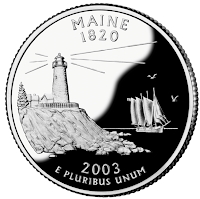 #6 Maine
Engraver: Donna Weaver
If you have ever been to Maine, you would understand how the depiction of the Pemaquid Point Lighthouse with the schooner screams that it represents Maine. Weaver’s work reminds me of oil paintings of the area. There is a serene feeling of this image that is very appealing.
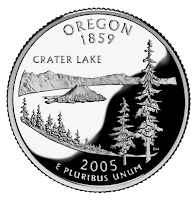 #5 Oregon
Engraver: Donna Weaver
Donna Weaver has to be one of the best landscape engraver at the Mint. Her take on Crater Lake, viewed from the south-southwest rim to include Wizard Island and Watchman and Hillman Peaks on the lake’s rim almost puts the us right at the lake on a calm sunny day.
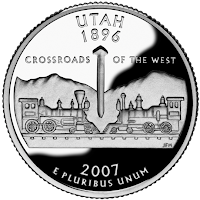 #4 Utah
Engraver: Joseph Menna
When the program started, there were a few states whose themes could be easily guessed. Utah was one of those states. Utah chose a design based on the meeting of the Central Pacific and Union Pacific railroads at Promontory to open the first transcontinental railroad. Even with the design’s predictability, the execution is very impressive. Maybe my bias towards history shows in this pick, but I really like the design of this coin.
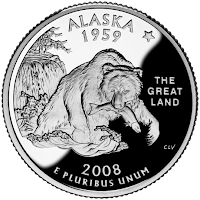 #3 Alaska
Engraver: Charles Vickers
Animals are tough to ignore. Animals depicted in their natural habitat showing how the balance in nature works is also tough to ignore. Combine this with the skills of a master engraver and you have a wonderful work of art on a quarter. Vickers depiction of the grizzly bear catching the salmon is a phenomenal work of art and deserving of a Top-5 pick.
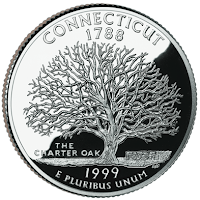 #2 Connecticut
Engraver: T. James Farrell
There are some coin designs that look better in hand than its picture. Then there are those designs that look great in hand and phenomenal under magnification. Farrell’s engraving of the Charter Oak, the hiding place of Connecticut’s first constitution, is an amazing work of art, both in hand under under magnification.
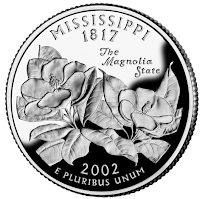 #1 Mississippi
Engraver: Donna Weaver
While it might be trite to use a magnolia for the Magnolia State, Donna Weaver produces yet another winner with her beautiful engraving of magnolia blossoms. Magnolias are beautiful flowers and this design does them justice. It is difficult not to smile and have pleasant thoughts when looking at this design.
As you scan my list, you will notice that four of the designs were engraved by Donna Weaver. Weaver was a Master Engraver at the Mint who in 2006 to pursue other ventures (see her website at www.waxportraits.com). She continues to be involved with coin design as a member of the Artistic Infusion Program. Keeping her involved with coin design will benefit future Mint issues.
Next, we will look at the the ten worst designs.
Dec 20, 2008 | cents, coins, commemorative, dollar, Eagles, gold, quarter, state quarters, US Mint
As we end 2008 and look to 2009, numismatists are going to have a lot of options to add to their collections. There will be quite a number of coins that will excite many. But the shear numbers may be overwhelming to others. However you feel, the US Mint will have a very busy year. Let’s look at what is coming up in the new year.
First, three coins will not see any changes. The “Return to Monticello” Jefferson Nickel introduced in 2006 will not be changed. Neither will the Roosevelt Dime, in circulation since 1946, and the Kennedy Half Dollar, as it has been since 1964 except for the Bicentennial issues.
For 2009, we will celebrate the bicentennial birthday of Abraham Lincoln. In celebration, congress has authorized the 2009 Lincoln Bicentennial One Cent Program as part of Public Law 105-145. As part of this program, the Mint will issue four reverse design representing Lincoln’s birth and early childhood in Kentucky (1809-1816), his formative years in Indiana (1816-1830), his professional Life in Illinois (1830-1861), and an extraordinary presidency in Washington, DC (1861-1865).
As part of the Lincoln Cent program, the US Mint will issue a 2009-S VDB non-circulating coin that will be struck in the .950 copper alloy used when the 1909-S VDB was first struck. Also, Public Law 109-285 was passed earlier this year that created Abraham Lincoln Commemorative Silver Dollar to round out the celebration of our 16th president.
To round out the State Quarter program, 2009 will issue quarters to honor the District of Columbia and five US territories: Puerto Rico, Guam, American Samoa, the US Virgin Islands, and the Commonwealth of the Northern Mariana Islands. The DC and US Territories Quarter Program authorized by congress in an amendment as part of an omnibus budget bill at the end of 2007.
The same omnibus budget bill also removed the motto “IN G-D WE TRUST” from the edge of the dollar coins. The amendment was introduced by Rep. Virgil Goode (R-VA) who was defeated for re-election.
The Presidential $1 Coin Program continues in 2009 to honor presidents William Henry Harrison, John Tyler, James K. Polk, and Zachary Taylor. Harrison had the shortest term when he died one month into office after contracting the flu following his refusal to wear an overcoat during his two-hour inaugural address on a cold day in March, 1841. All of the packaging options with Presidential $1 Coins will not be offered in 2009 after not selling well the last two years.
Along with the presidents, the First Spouse Gold Coins will be issued for Anna Harrison, Letitia Tyler, Julia Tyler, Sarah Polk and Margaret Taylor. Letitia Tyler was the first President’s wife to die in the White House. Julia Tyler became First Lady after marrying John Tyler in 1844.
Native American $1 Coins program will begin in 2009 with a design honoring the “Three Sisters’ agriculture, in which corn, beans and squash growing in the same mound enhanced the productivity of each plant. It was a unique program that lead to the concept of crop rotation we know today. This change was authorized by Public Law 110-82 and add edge lettering to these coins.
That brings the total number of circulating coins to 18! Proof sets will have 18 coins and the uncirculated Mint Sets will have 36 coins. Although the Mint has not announced pricing, it would be fair to guess that the prices will raise with more coins in the set. Clad and Mint sets should see a modest price increase. Silver proof sets will add an additional silver quarter and is likely to see a $10-15 rise in price.
Beyond circulating coinage, the Mint will produce the 2009 Louis Braille Bicentennial Silver Dollar to honor the 200th anniversary of Braille’s birth. It is being touted by the Mint as being the first coin with readable Braille.
Precious metals programs will change in 2009. First, only the bullion issues of the American Eagle coins will be strucl. The Mint has discontinued the collector’s uncirculated coin program, eliminating the W mintmark from their portfolio. American Eagles will be available in proof and bullion coins in one-ounce, half-ounce, quarter-ounce, and tenth-ounce denominations.
American Buffalo 24-Karat Gold Coins will also continue in 2009 but without fractional issues. The Mint will offer only one-ounce proof and investor bullion coins.
Last, but certainly not least, is probably the most intriguing coin that will be issued in 2009: the 2009 Ultra High Relief Double Eagle Gold Coin. The coin’s design will be a high-relief $20 gold piece on a double-thick, 24-karat gold planchet (sometimes called a piefort) 27 millimeters in diameter. The design will feature Augustus Saint-Gaudens’ original 1907 design where the date will be in roman numerals (MMIX). The inspiration for this coin came from 1907 when the Mint tried to strike an experimental double eagle coins using two stacked $10 eagle planchets. When the Mint’s management realized that congress would have to approve the striking of the coin for circulation, the project was abandoned and the test pieces were melted. Aside from the date, the only difference between the 1907 test pieces and the 2009 bullion issue is that the the motto “In G-D We Trust” will be added over the rising sun as it appeared in 1908. It is expected that these coins will be struck in proof-only varieties.
It will be quite a year!
Dec 3, 2008 | coins, dollar, US Mint
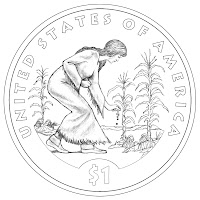 On November 28, Native American Heritage Day, the US Mint announced the design for the reverse of the new 2009 Native American $1 Coin. This design depicts a Native American woman planting seeds in a field of corn, beans and squash, representing the Three Sisters method of planting.
Public Law 110-82 [PDF] was past in September 2007 and signed by the president two weeks later calls for the reverse of the Sacagawea Dollar be redesigned every year to commemorate “of Native Americans and the important contributions made by Indian tribes and individual Native Americans to the development of the United States and the history of the United States.” The obverse will continue to have the Sacagawea design.
The law reduces the percentage of these dollars that have to be struck versus the Presidential $1 coins. This program has no end date.
Image courtesy of the US Mint.
Nov 24, 2008 | US Mint
Dear President-Elect Obama:
I know you are busy and have a lot of other issues to deal with, but as a numismatist and blogger on numismatic topics, I am concerned with who you may ask to run the US Mint.
In the recent past, the Director of the US Mint has been a political appointment whose experience was not in areas necessary to make the Mint a success. For example, this past year, the Mint has not been able to keep up with the demand of bullion coins. Followers of the Mint are dumbfounded over these circumstances since the Mint is reporting striking fewer coins in 2008 than they did ten years ago when the demand was higher.
In addition to failing to meet the demand for its product, the Mint has mismanaged the costs necessary to manufacture their products and tried to extend their product lines in ways that even their most ardent customers found excessive. Recently, the Mint had to hold a “Clearance Sale” to rid themselves of an oversupply of collector products that never sold. Items that were available in sale, such as 1999-dated collectibles, shows that the current bureaucracy has been ineffectual in managing the Mint’s resources and misjudged the demand to the collector community.
Although collectors would like for your Mint Director to be a collector, the situation calls for a leader who has experience in manufacturing, supply chain management, and customer service. This leader should be able to manage four active factories whose well known products are as important to the public as it is to the collector. The importance and scale of this manufacturer belies the ability of a bureaucrat to manage.
News reports announcing the selection of your new leadership team indicate that you are looking for the most qualified people. When you consider who should be the next Director of the US Mint, would you please consider appointing someone with a manufacturing background whose product serves a commodity community as well as a specific market? It would help if this person was familiar with managing a company in a regulated market. Such a person would be able to understand the markets the US Mint serves while being able to successfully manage a profitable government organization.
Congratulations on your victory and I wish you much luck in dealing with the problems the nation is currently experiencing.
Scott



 Loading ...